

Industry: Landfill | Process: Final_Effluent_Polishing
A tough waste stream is becoming a strategic water source as landfill operators bolt on polishing steps—ultrafiltration, advanced oxidation, and multi‑stage RO—to hit reuse targets and cut costs.
With roughly 2.1 billion people—about 25% globally—still lacking safely managed drinking water, according to WHO/UNICEF (2025) (who.int), and an estimated 80% of the world’s wastewater discharged untreated (blogs.worldbank.org), every cubic meter reused matters. Landfill operators—long stuck with costly leachate disposal—are responding by recycling treated effluent for dust control, irrigation, and even high‑spec industrial supply.
The economic signals are hard to ignore: water‑reuse markets are expanding, projected at USD 18.45 billion by 2025 (mordorintelligence.com). Case studies now show full‑scale plants producing drinking‑quality water from leachate (wwdmag.com).
In water‑stressed regions (for example, Indonesia), reusing treated landfill effluent—rather than disposing it—can cut freshwater demand and environmental impact. Reapplication in a closed loop via cover irrigation has been shown to uptake nutrients and prevent contamination escape (researchgate.net).
Water scarcity and reuse drivers
Landfills generate polluted leachate and runoff but also consume potable water for spraying and wash‑down. Recycling treated flows cuts this draw. In one study, pretreated leachate applied to vegetated cover at about 400 m³/month/ha did not harm soil or plant growth, and plants on irrigated areas grew better than controls (researchgate.net).
Behind the shift: rising scarcity and compliance pressure. Reuse can reduce freshwater purchases and lower disposal liabilities while aligning with the global push to curb untreated discharges (blogs.worldbank.org).
Reuse applications and quality targets
Different reuse scenarios require different water qualities. For landfill cover or landscape irrigation, the soil–plant system provides additional polishing. Still, heavy metals and pathogens must be controlled. WHO guidelines for irrigation target ≤10^3 CFU/100 mL total coliforms (colony‑forming units per 100 milliliters) and ≤1 helminth egg/L (pmc.ncbi.nlm.nih.gov).
Agricultural irrigation off‑site is stricter—especially for crops eaten raw. In the absence of local reuse standards, designs may target Indonesian drinking‑water or irrigation limits, and polishing steps may need to approach potable‑grade quality (Permenkes 492/2010 is cited in the design context). For industrial uses such as cooling, wash‑down, or processing, total dissolved solids (TDS) and scaling ions dominate; basic solids removal and disinfection often suffice, although high‑purity needs (e.g., boiler feedwater) drive full RO (reverse osmosis). For on‑site non‑potable services like toilet flushing or firefighting, pathogen elimination is critical; Indonesian PDAM guidelines (Permen LHK 5/2014 for domestic wastewater) or WHO potable‑reuse targets typically guide a UV+chlorine multi‑barrier approach. Groundwater recharge generally demands advanced polishing (RO and advanced oxidation processes, AOPs) and rigorous monitoring.
Pre‑treatment and biological removal
Leachate is tough—high salinity, ammonia, and refractory organics. Plants typically begin with pH adjustment and sedimentation to remove gross solids. That might include headworks screening with an automatic screen and controlled chemical feed using a dosing pump. For primary solids removal ahead of biological steps, a compact clarifier can provide detention for settling.
Biological processes then do the heavy lifting on BOD (biochemical oxygen demand) and ammonia. Sequencing Batch Reactors (SBRs) provide flexible nitrification/denitrification; packaged options like a sequence batch reactor (SBR) are common in variable‑load settings. Where tighter solids control is needed, an MBR (membrane bioreactor) combines a biological reactor with membrane separation to produce a clarified effluent suitable for downstream polishing. Constructed wetlands or polishing ponds can further reduce organics, nutrients, and metals passively, with studies showing significant nitrogen reduction and peak retention (researchgate.net).
Membrane and adsorption polishing
Filtration tightens clarity and pathogen control. Microfiltration/ultrafiltration (MF/UF) can remove >99% of particulates and many microbes (to roughly 0.01 µm pore size). In one full‑scale landfill project, UF was used as pretreatment to RO and produced drinking‑quality water when combined with multi‑stage RO (wwdmag.com). For this duty, utilities often standardize on an ultrafiltration rack before high‑pressure membranes.
To protect membranes from trace organics and specific ions, adsorptive steps are common. Granular activated carbon (GAC) is deployed for refractory organics; in engineered trains this is often a GAC filter. For ammonium or hardness control, resins can be applied—operators frequently specify an ion‑exchange resin stage. Where fine particulate insurance is needed upstream of RO, a final cartridge filter helps stabilize SDI (silt density index).
Reverse osmosis and advanced barriers
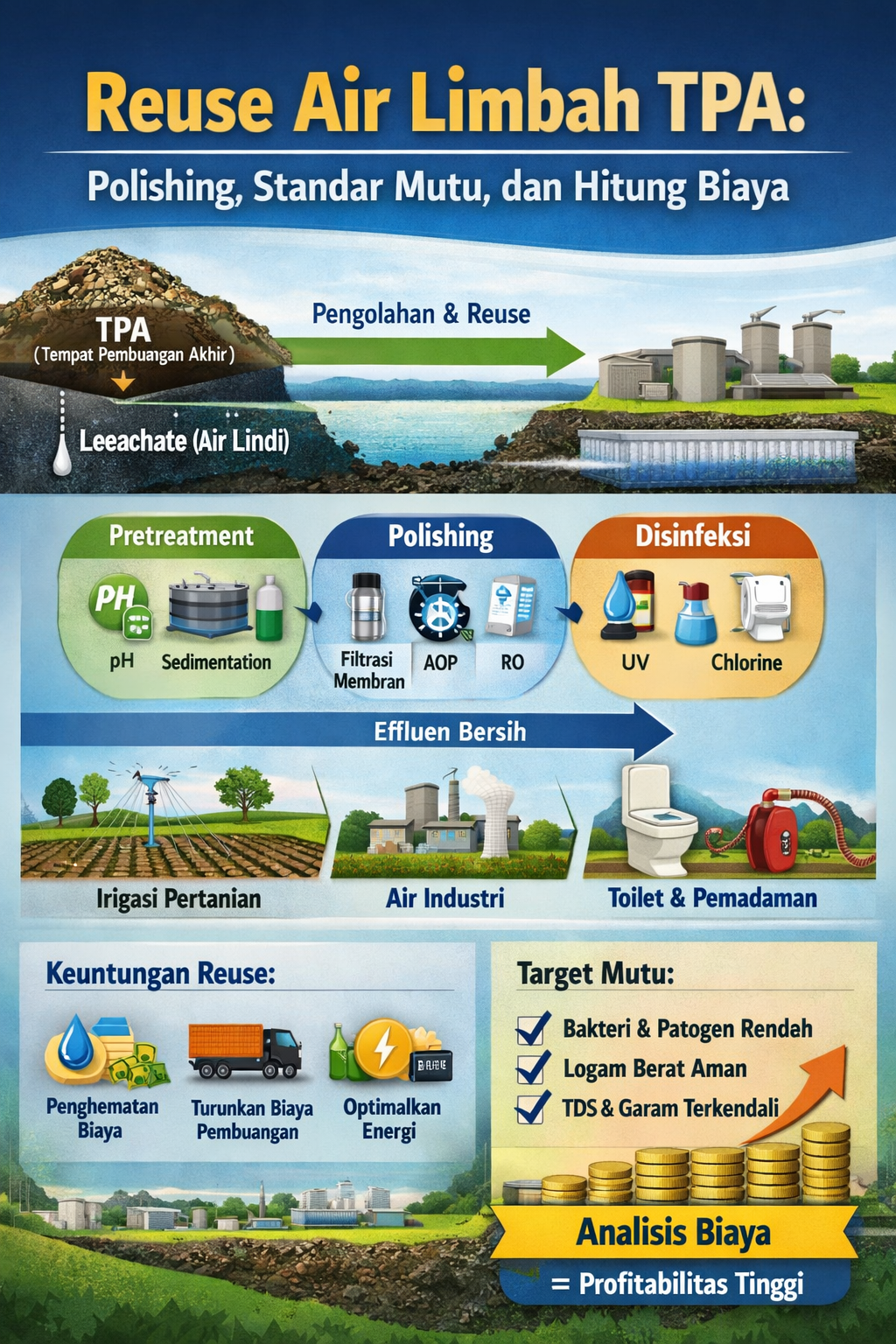
RO is the capstone for high‑quality reuse. Multi‑stage RO can strip ions and micropollutants to near‑distilled levels. A three‑stage, high‑pressure RO train following UF has been implemented at full scale, with permeate meeting drinking standards; reported outcomes included >99% ammonia removal (from about 5.5 g/L to <2 mg/L) and near‑total salt rejection (wwdmag.com). For landfill salinities up to typical brackish ranges, operators match duty to a brackish‑water RO system, often within a broader membrane systems platform. Where hardness removal at lower pressure is advantageous, nanofiltration (NF) can be slotted as a selective barrier.
Advanced Oxidation Processes (AOPs) such as ozone or UV/H₂O₂ tackle refractory organics and provide additional disinfection. Reports cite COD (chemical oxygen demand) reductions from 20,000–40,000 mg/L down to single digits in RO‑based landfill schemes, with ozonation also aiding membrane defouling (wwdmag.com). Final disinfection remains mandatory in most reuse contexts; plants pair UV disinfection with a chlorine residual, and some sites generate hypochlorite on demand via electrochlorination.
Application‑specific quality considerations
For irrigation—whether landfill cover or off‑site—designers use WHO microbial criteria (≤10^3 coliform/100 mL; ≤1 helminth egg/L) and ensure low heavy metals; the WHO guidance is detailed here (pmc.ncbi.nlm.nih.gov). For industrial cooling, focus shifts to TDS, hardness, and silica; treatment may omit RO but incorporate chemical control such as scale inhibitors. For dust control or wash‑down, turbidity and odor are key; modest chlorination/UV is usually sufficient. Where very pure industrial water is required, plants standardize on RO trains and frequently specify elements like FilmTec membranes to meet near‑potable specs.
Indonesian regulatory benchmarks
Indonesia’s framework emphasizes discharge control. For landfill leachate, Permen LHK 59/2016 (“Baku Mutu Lindi TPA”) sets maximum pollutant concentrations for BOD, COD, NH₃, and heavy metals in leachate released to the environment; “Baku Mutu Lindi” defines permissible pollutant concentration in leachate discharged into water from a landfill (adikatirtadaya.co.id). Any reuse system with overflow or residuals must meet these limits, alongside ambient water standards (PP 82/2001 water quality classes).
For the reuse water itself, quality aligns with the end use. Irrigation follows WHO criteria (≤10^3 coliform/100 mL; ≤1 nematode egg/L) (pmc.ncbi.nlm.nih.gov). If reuse approaches drinking water (e.g., indirect potable or groundwater recharge), Indonesian drinking water standards (Permenkes 492/2010) apply—pH 6.5–8.5, turbidity <1 NTU, no E. coli, BOD <5 mg/L, and strict organics/metals limits—achievable with RO‑based trains (wwdmag.com and wwdmag.com). Industrial users specify makeup quality individually (e.g., hardness, conductivity, silica). Non‑potable building uses reference domestic wastewater criteria (often “Class 3”) with tight coliform and BOD/COD limits.
Indonesia does not yet have a dedicated reuse standard; engineers typically reference international guidance (WHO) or adapt PDAM/discharge rules. Local environmental authorities (DLH) may require permits; in many cases, demonstrating that effluent meets or exceeds Permen 59/2016 discharge limits and is pathogen‑free (lab‑verified) is sufficient for non‑potable reuse approval.
Economic impacts and cost offsets
Every cubic meter reused offsets freshwater purchases. Indonesian municipal tariffs run around Rp2,410–4,730 per m³ (≈$0.16–$0.32) (mrfixitbali.com), so reusing 10,000 m³ annually saves roughly Rp24–47 million (US$1.6–3.1K). Disposal costs can also tumble: at one Sicilian landfill, an onsite UF+RO plant eliminated trucking; processing initially cost about €100/m³ but was reduced to <€10/m³ (a 90% reduction) at about 300 m³/day (wwdmag.com).
Energy savings add up: high‑pressure RO pumps designed for landfill duty have lower friction losses, reducing power draw (wwdmag.com). Some sites run treatment on landfill power. Beyond cost, reuse can deliver branding benefits and potential incentives.
Costs are context‑specific, but trends favor reuse: IFC estimates suggest recycled non‑potable water can cost as little as ~$0.32/m³—often below desalination or long‑distance transfer (blogs.worldbank.org). Water demand is rising toward about 55% higher by 2050 (blogs.worldbank.org). The reuse equipment market is expanding (projected RMB 18.45B by 2025) (mordorintelligence.com), suggesting declining technology costs and rising adoption.
Treatment trains matched to reuse
At the low end (cover irrigation, equipment wash‑down), moderate polishing—biological treatment, UF, and disinfection—can suffice. A simple train might run SBR to UF with UV finishing. For higher‑quality irrigated agriculture or sensitive industrial uses, designers layer in adsorptive polishing and RO—e.g., GAC followed by a brackish RO stage—often with robust housings and ancillaries from a water‑treatment ancillaries suite. For the most stringent targets (indirect potable or groundwater recharge), plants combine UF + AOP + multi‑stage RO + final disinfection; some specify element families such as Toray membranes within integrated RO/NF/UF systems.
The takeaway is practical: match barriers to the end use, meet Indonesian discharge rules (Permen LHK 59/2016) alongside international reuse criteria, and capture both resource and cost advantages. The evidence base spans peer‑reviewed work on safe cover irrigation (researchgate.net) and full‑scale UF+RO producing drinking‑quality permeate (wwdmag.com).
References and sources
WHO/UNICEF (2025) on global access (who.int); World Bank blogs on untreated wastewater, reuse economics, and demand outlook (blogs.worldbank.org); Mordor Intelligence market sizing (mordorintelligence.com); constructed wetland/irrigation study (researchgate.net); UF and multi‑stage RO performance and costs (wwdmag.com and wwdmag.com); Indonesian leachate standards (Permen LHK 59/2016) and definitions (adikatirtadaya.co.id); WHO reuse microbial criteria (pmc.ncbi.nlm.nih.gov); Indonesian water tariffs (mrfixitbali.com).