

Industry: Landfill | Process: Leachate_Treatment_(Aerobic
Landfill leachate is a brutal wastewater: biochemical oxygen demand (BOD, a measure of biodegradable organics) routinely runs 4–10 g/L, chemical oxygen demand (COD, total oxidizable organics) hits 6–70 g/L, and ammonia–N sits in the hundreds of mg/L, according to Indonesian landfill data (researchgate.net). Those numbers routinely blow past discharge limits — Indonesia caps BOD at ≤150 mg/L and total nitrogen at ≤60 mg/L (id.scribd.com).
Old‑school pond systems need 30–50+ days of hydraulic retention time (HRT, how long water stays in a reactor) and still frequently fail those standards (researchgate.net). A staged biological approach is outperforming them by a wide margin.
Two‑stage biological sequence
The playbook is straightforward: a high‑rate anaerobic digester first strips most organics and converts them to biogas; then an aerobic reactor “polishes” the effluent — oxidizing residual BOD/COD and nitrifying ammonia to nitrate. In practice, an up‑flow anaerobic sludge blanket (UASB, a compact granular‑sludge digester) or similar unit leads, followed by activated sludge, trickling filter, or MBBR (moving bed biofilm reactor) in aeration. The sequence slashes organic load, generates methane energy, and the aerobic step eliminates ammonia.
Vendors support this flow with modular platforms, from anaerobic front ends such as wastewater biological digestion systems to aerobic trains like activated sludge. Alternatives include biofilm carriers in MBBR and flexible batch operation via a sequencing batch reactor (SBR).
Anaerobic stage: COD removal and biogas
Inside the anaerobic digester, hydrolysis–acidogenesis–methanogenesis (successive microbial processes that break down and convert organics) degrade soluble organics to methane (CH₄) and CO₂. Under mesophilic conditions with HRT around 1–3 days at high organic loading rate (OLR), studies report ~70–80% COD removal in practice (researchgate.net).
Archaea‑driven UASB trials summarized by Wang et al. (2018) show wastewater with 3–48 g/L COD achieving 76–80% COD removal (researchgate.net). Fresh leachate at 53 g/L COD hit 86.3% reduction in one‑ or two‑stage UASBs (Moujanni et al., 2022; eeer.org). Even higher removals — up to 90+% — are reported for high‑rate reactors such as anaerobic membrane bioreactors (MBR) and EGSB (expanded granular sludge bed) (researchgate.net).
Crucially, a large share of removed BOD/COD becomes biogas. Reported yields for leachate digestion are 0.27–0.35 L biogas per g COD removed (eeer.org). With typical landfill leachate biogas at 50–70% methane, that’s roughly 0.16–0.24 L CH₄/g COD — on the order of ~6–8 kJ/g COD. Moujanni et al. directly measured ~0.123 L CH₄ per g COD removed (eeer.org). For context, 1 m³ of CH₄ carries ~35–36 MJ (~10 kWh) (patents.google.com), so digesting 1 kg COD could yield about 10–12 MJ (roughly 3–3.5 kWh). This renewable energy can offset plant power use. A side benefit: some metals precipitate as sulfides in the anaerobic step, slightly easing downstream bio‑treatment.
Bottom line at this stage: typically 60–90% of the organic load is removed (researchgate.net), dropping effluent COD/BOD to the low‑thousands mg/L and lowering the load on aeration. Many studies observe ~0.3 L biogas/g COD (∼9–10 kJ/g) from mesophilic UASB leachate treatment (eeer.org), so a well‑run anaerobic pre‑treatment can cut influent BOD/COD by roughly three‑quarters while generating usable biogas energy (researchgate.net).
Membrane bioreactor configurations are also part of the design toolkit; plants deploy options like a membrane bioreactor where appropriate for combined biological treatment.
Aerobic stage: polishing and ammonia control
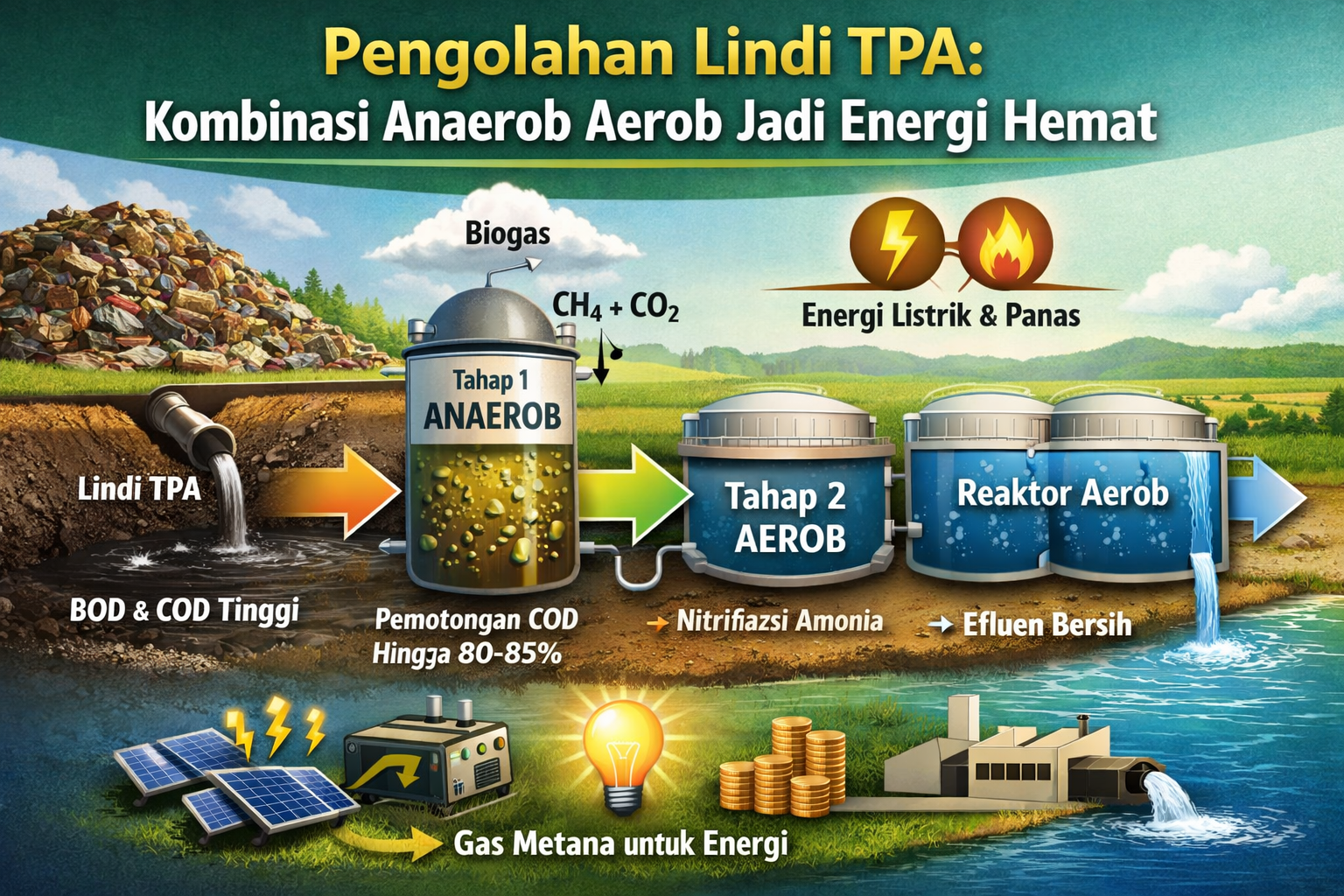
Post‑digestion effluent still contains refractory COD and typically very high ammonia–N (hundreds to thousands of mg/L depending on leachate age). In the aerobic step, heterotrophic bacteria oxidize the residual COD/BOD, and specialized nitrifiers convert ammonium (NH₄⁺) to nitrite (NO₂⁻) and then nitrate (NO₃⁻) via nitrification. In practice, aeration further reduces COD and accomplishes most of the nitrate formation.
Observed aerobic‑stage removals are roughly 35–70% of COD (on top of the anaerobic 60–80%) and ~50–90% of NH₄‑N. In one UASB + aerated lagoon sequence, the anaerobic step gave 71% COD removal and the aerobic lagoon removed an additional 35–70%, yielding up to 84% total COD removal; that pilot also reported ~54% NH₄‑N removal in the aerobic lagoon (link.springer.com).
With optimized design, nitrification/denitrification can push nitrogen far lower. Kalyuzhnyi & Gladchenko (2004) found a two‑stage UASB + aerobic/anoxic (anoxic = no dissolved oxygen, enabling denitrification) system could remove ~75% total N when the anaerobic effluent was very low in COD, but up to ~92–95% total N when residual organics remained to drive denitrification (iwaponline.com). Plants targeting this pathway often add an anoxic polishing stage, supported by packages such as nutrient removal systems.
In an Indonesian trial of an anaerobic–aerobic–denitrification sequence (8 days anaerobic, 3 days aerobic, 1 day anoxic; total HRT 12 days), the system achieved 97% COD and 97.6% NH₄‑N removal (researchgate.net). With appropriate design, nearly complete nitrogen removal is feasible. Even without an anoxic stage, typical full‑scale post‑aeration (nitrification only) can drive ammonia low enough to meet nitrate discharge limits, given sufficient solids retention time (SRT, the age of biomass in the reactor) and moderate salt (researchgate.net).
Key outcomes at this stage: the aerobic reactor polishes the water to standard, consuming remaining organics (driving effluent BOD/COD down to the tens of mg/L) and biologically oxidizing NH₄⁺. Literature reports NADV (NH₄‑N removal) ranging from ~50% up to >90% in aeration (link.springer.com; iwaponline.com). Busser (2012) notes ~54% nitrification of NH₄ in one UASB + lagoon setup (link.springer.com), while more advanced aerobic/anoxic sequences can reach ~95–99% total N removal (iwaponline.com; researchgate.net). A small fraction of nitrogen remains as nitrate after nitrification — with Indonesia allowing up to 60 mg/L total‑N (id.scribd.com).
Case data and compliance context
Shiraz landfill leachate with initial COD 45–90 g/L and NH₄‑N 1–2.5 g/L treated via UASB (2 d HRT) + aerated lagoon (4 d HRT) achieved 66–94% overall COD removal, with ~54% NH₄‑N removed in the aerobic stage (link.springer.com). In practical two‑stage plants, combined COD removal (anaerobic + aerobic) often reaches 80–90% (link.springer.com; eeer.org). With more intensive aeration or longer SRT, ammonia can be driven even lower — the Indonesian biofilter sequence noted above reached 97.6% NH₄‑N removal (researchgate.net). These outcomes align with Indonesia’s final discharge limits of ≤150 mg/L BOD and ≤60 mg/L total‑N (id.scribd.com).
By contrast, simple pond systems rarely approach these results and generally fail stricter standards. At the Cipayung landfill, the existing pond train produced effluent still exceeding national limits (researchgate.net).
Energy recovery and operating economics
Integrating anaerobic digestion generates on‑site energy and reduces aeration demand. Analyses note that adding digestion “reduces aeration and oxygen requirements,” lowering operating costs while producing methane for heat or power (patents.google.com). A facility treating 1000 m³/day of leachate at 5000 mg/L COD could produce on the order of 100–200 m³ CH₄ per day — enough for ~600–1200 kWh of thermal/electric energy in the digester’s energy balance. The result: less grid power for blowers and a smaller sludge bill, since much of the organic matter leaves as gas rather than biosolids.
Where plants standardize equipment, ancillary packages help stabilize operations; facilities commonly pair aeration basins with wastewater ancillaries to maintain consistent nitrification/denitrification performance.
Footprint, timelines, and adoption
Economically and spatially, the staged approach shrinks landtake and time‑to‑treat. Ponds need ~30–50 days retention and large land area, whereas a two‑stage digester + reactor can operate in ~12–24 days total (Said & Hartaja, 2018; researchgate.net; link.springer.com). The setup is also less sensitive to seasonality and load swings than ponds, bolstering reliability. In practice, many modern leachate plants in Indonesia and worldwide are moving to UASB or anaerobic filters followed by activated sludge/SBR/MBBR to secure compliance and energy recovery.
For facilities planning the aerobic “polish,” equipment choices often reflect loading variability and nitrogen goals; operators mix classic aeration with biofilm carriers or batch operation and, where needed, add targeted denitrification capacity, as with nutrient removal modules.
Performance summary and sources
Across studies, staged systems report anaerobic COD removal ~76–85% and aerobic polishing COD removal ~30–60%, for total COD removal ~80–95% (link.springer.com; researchgate.net). Ammonia is tougher, but nitrification in aeration removes the bulk — ~50–90% NH₄‑N — and adding an anoxic step can push total N removal above 95% (link.springer.com; iwaponline.com; researchgate.net). These results align with reported UASB performance (~80% COD removal; Wang et al. 2018, researchgate.net), high biogas yields alongside 86% COD removal (Moujanni et al., eeer.org), and the Indonesian biofilter sequence’s ~97% removals for both COD and NH₄‑N at 12 days HRT (researchgate.net).
Regulatory and case‑study details are sourced from official and academic documents — including Permen LHK 59/2016, multiple landfill assessments (researchgate.net), high‑rate biological treatment studies (link.springer.com; iwaponline.com; eeer.org), and energy analyses (patents.google.com). All citations above are journal articles or government documents as noted in the source paper.