

Industry: Landfill | Process: Leachate_Treatment_(Aerobic
Landfill leachate typically arrives loaded with very high NH4+-N (ammonium as nitrogen) — often in the hundreds to thousands of mg/L — and short on readily biodegradable carbon, with potential inhibitors like heavy metals that suppress nitrifiers (autotrophic bacteria that oxidize ammonia) (mdpi.com). In one Polish study on mature leachate diluted 1:1, researchers measured ~304 mg/L NH4–N (TKN, total Kjeldahl nitrogen, ~440 mg/L) and only 20 meq/L alkalinity (pmc.ncbi.nlm.nih.gov).
Compliance pressure is real: Indonesian regulations (Permen LHK 59/2016) set strict effluent limits for landfill leachate, including N‑NH3 (as NH3/NH4+). Biological nitrification (NH4+→NO2−→NO3−) consumes about 7.14 mg CaCO3 per mg NH4–N oxidized and requires roughly 4.6–4.7 mg O2 per mg NH4–N (cwea.org; climate-policy-watcher.org). In practice, keep pH near neutral (pH ≥ 7) and dissolved oxygen (DO) > 2 mg/L — poor buffering or low DO (< 1–2 mg/L) can quickly collapse the process.
Biofilm reactors and carrier advantages
Moving Bed Biofilm Reactors (MBBR) retain a large nitrifying biofilm on suspended carriers, decoupling biomass age from flow and stabilizing performance. Typical carriers offer 500–1000 m²/m³ specific surface area (e.g., ring or honeycomb elements), enabling high solids retention time (SRT) at modest hydraulic retention time (HRT). In moving‑bed systems, ~90–93% of the active biomass sits in the biofilm, minimizing washout and creating microenvironments: an aerobic outer layer for nitrification and, where partial flocs or anoxic pockets exist, some simultaneous denitrification (SND) (intechopen.com).
Bench and pilot data point to resilience and high removal. One study reports “Removals of up to 97% were reached for NH4–N by using an MBBR process” (mdpi.com); hybrid biofilm reactors routinely exceed 90% nitrification efficiency even at high loading rates (intechopen.com). Plants looking to implement this platform often turn to moving‑bed bioreactors with robust carrier retention and aeration.
Areal rates and organic load limits
Measured nitrification rates on biofilm media are strong even in cool water: ~0.8–1.0 g N/m²·day at 10–15°C (intechopen.com). At tropical temperatures (≈25–30°C), rates climb; in lab granules treating leachate, researchers reported 44.2 mg N/L·h at 29°C, dropping to ~30 mg/L·h at 20–25°C (pmc.ncbi.nlm.nih.gov).
But organics can throttle nitrification: classic tests showed collapse when organic loading exceeded ~5 g BOD7/m²·day, and low DO becomes a first‑order rate limiter (Water Research (1994), sciencedirect.com). The playbook is to reduce COD (chemical oxygen demand) before nitrification. Where feasible, anaerobic steps upstream — for example via anaerobic digestion systems — lighten the carbon load ahead of bio‑oxidation.
Oxygen supply, alkalinity, and pH targets
Design aeration to deliver ~4.6–4.7 g O2 per g NH4–N oxidized and hold DO ≥ 2 mg/L; if DO dips, ammonia oxidation slows sharply, with observed first‑order dependence at low DO (climate-policy-watcher.org; Water Research (1994), sciencedirect.com). Intermittent aeration is used in SND processes, but for pure nitrification continuous aeration is preferred.
Nitrification consumes alkalinity at ~7.14 mg CaCO3 per mg NH4–N; for a feed at 303 mg/L NH4–N, expect ~2,100 mg/L CaCO3 equivalent to disappear (cwea.org). Operators commonly dose NaHCO3/Na2CO3: in one study on 1:1‑diluted leachate, ~0.14 g/L was used to keep pH stable, with effluent pH maintained above ~6.5–7 (pmc.ncbi.nlm.nih.gov). Simple controls — metering via a dosing pump and DO probes — pay off quickly in stability.
Temperature effects and heating trade‑offs
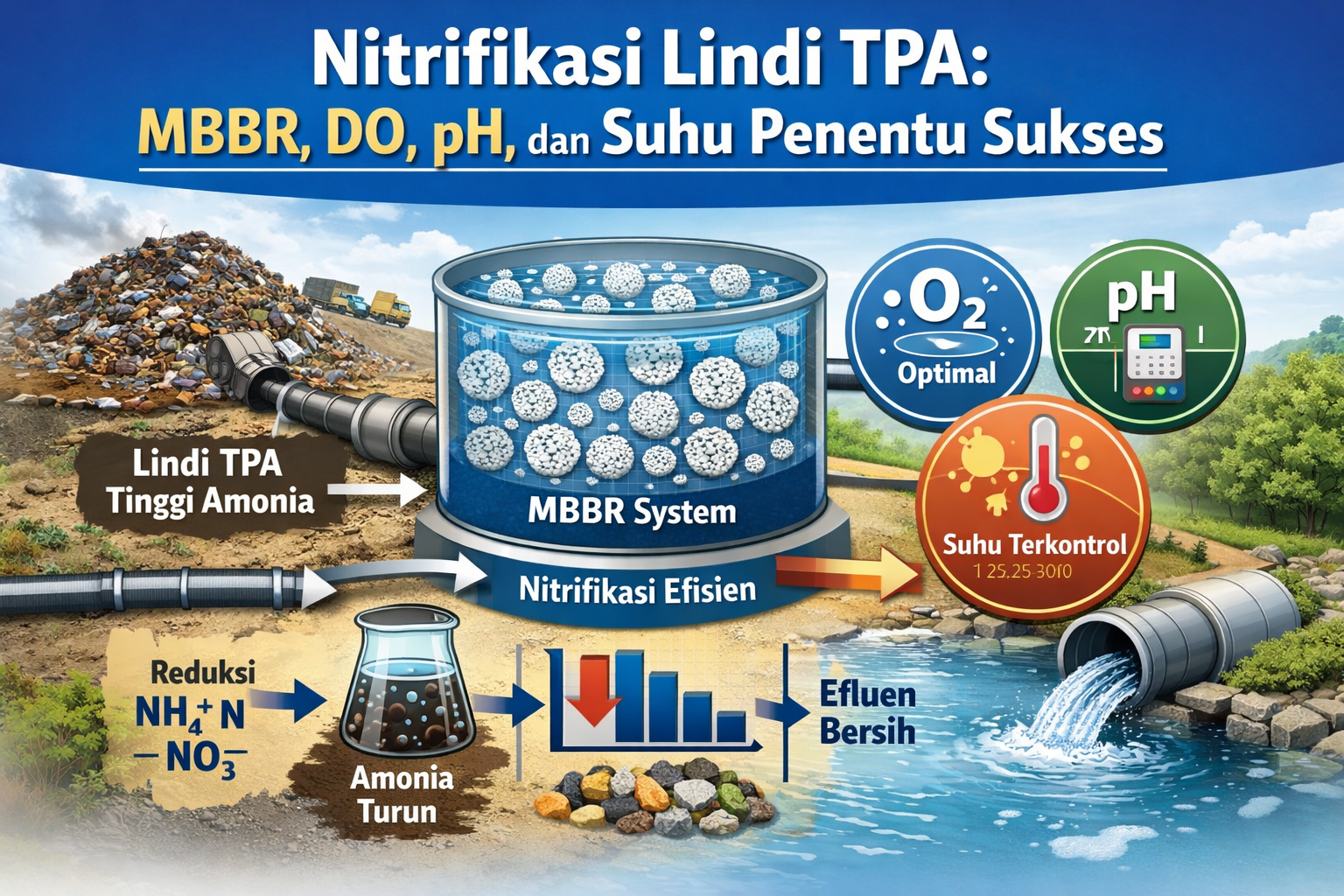
Nitrifiers favor warmth. From ~8–30°C, each +1°C lifts growth about 10% (climate-policy-watcher.org). At ~16°C, rates are ~50% of those at 30°C; below ~10°C they fall sharply, and nitrification essentially stops under ~5°C (water.mecc.edu). In Indonesia’s climate, raw leachate typically sits ~25–30°C year‑round, so heating is seldom needed. If tanks cool (e.g., groundwater inflow or nighttime loss) below ~20°C, expect proportional slowdowns — steady‑state removal at 1°C was only ~23% of that at 20°C in a lab MBBR study (pubmed.ncbi.nlm.nih.gov). Energy costs for heating are non‑trivial; insulation and covering tanks are low‑cost ways to retain heat, while some plants consider waste‑heat via CHP loops if available.
Performance snapshots and outcomes
Full‑ and pilot‑scale results are consistent: integrated anaerobic–aerobic MBBR cut influent NH4–N ~123 mg/L to ~17 mg/L in one program (mdpi.commdpi.com; mdpi.com). In lab tests at 29°C, complete NH4 removal was achieved in ~3–4 hours at rates ~30–44 mg/L·h; at 20°C, ~4+ hours were needed (pmc.ncbi.nlm.nih.gov).
MBBR also tends to produce minimal excess sludge (biofilm sloughing only) and eliminates the need for secondary clarifiers, trimming tank volume. Carrier choice matters: high‑surface‑area elements such as honeycomb bio media (high m²/m³) help achieve target SRT without oversized basins.
Design and operations checklist
The following parameters, equipment, and setpoints recur in the strongest programs (all values and sources preserved as cited):
- Pre‑treatment to lower COD: Reduce organics to protect nitrifiers; high organics inhibit nitrification at ~5 g BOD7/m²·day and low DO becomes a rate limiter (Water Research (1994), sciencedirect.com). Where feasible, use upstream steps like anaerobic digestion.
- Carrier fill and mixing: Target ≥ 40–60% fill of high‑surface carriers; ensure vigorous mixing so carriers move freely. Keep carriers inside the tank with screens and maintain high fill fraction. Carrier retention hardware is part of standard wastewater ancillaries.
- Dissolved oxygen provisioning: Maintain DO ≥ 2 mg/L and size aeration for ~4.6–5 g O2 per g NH4–N oxidized (climate-policy-watcher.org). Redundant fine‑bubble grids or pure O2 can be used; intermittent aeration is for SND, while continuous aeration is preferred for pure nitrification.
- Temperature control: In tropical Indonesia, ambient 25–30°C usually suffices. If nighttime or inflows cool reactors below ~20°C, nitrification slows; at ~16°C, rates are ~50% of 30°C; below ~10°C rates fall sharply; under ~5°C, nitrification essentially stops (water.mecc.edu). A lab MBBR at 1°C achieved ~23% of the 20°C removal rate (pubmed.ncbi.nlm.nih.gov). Insulation/covering and optional heat recovery are the common tactics.
- Alkalinity and pH management: Dose to offset ~7.14 mg CaCO3 per mg NH4–N consumed; for each 100 mg/L NH4–N, add ~714 mg/L CaCO3 equivalent. Keep alkalinity > 100–150 mg/L as CaCO3 and pH ≥ ~6.5–7; NaHCO3/Na2CO3 additions around ~0.14 g/L were used in 1:1‑diluted leachate in one study (cwea.org; pmc.ncbi.nlm.nih.gov). Controlled dosing via a chemical dosing pump is standard practice.
- Monitoring and control: Track NH4–N, NO2–N, and NO3–N in real time; NO2–N buildup signals imbalance. Maintain low nitrite if denitrification is off‑line. Measure pH, DO, and biomass activity (e.g., oxygen uptake rate, OUR) periodically.
- Biomass and media handling: Plan occasional drains/cleaning for carrier recovery. Over 5–10 years, carriers can biofoul and require replacement; losses are typically minimal due to biofilm retention.
Throughput targets and feasibility
An optimized MBBR in warm conditions can nitrify > 50 g N/m³·day. As a reference point, a 20‑hour HRT treating 300 mg/L NH4–N down to 30 mg/L equates to 13.5 g/m³·day; higher rates and lower HRTs are achievable with optimization. Set a baseline expectation of > 80% NH4–N removal; > 90–95% is achievable with tight control (mdpi.com; intechopen.com). Reaching < 5 mg/L effluent NH4–N typically requires partial denitrification; nitrification alone seldom drives below ~10–20 mg/L without very long HRT.
Sources and further reading: data and kinetics from Sustainability (mdpi.com), temperature and rate findings from World J. Microbiol. Biotechnol. (pmc.ncbi.nlm.nih.gov), hybrid reactor performance from IntechOpen, and foundational biofilm‑nitrification behavior from Water Research (1994), sciencedirect.com. Oxygen and alkalinity stoichiometry and temperature response are detailed in climate-policy-watcher.org, cwea.org, water.mecc.edu, and low‑temperature MBBR performance at pubmed.ncbi.nlm.nih.gov.