

Industry: Landfill | Process: Stormwater_Management
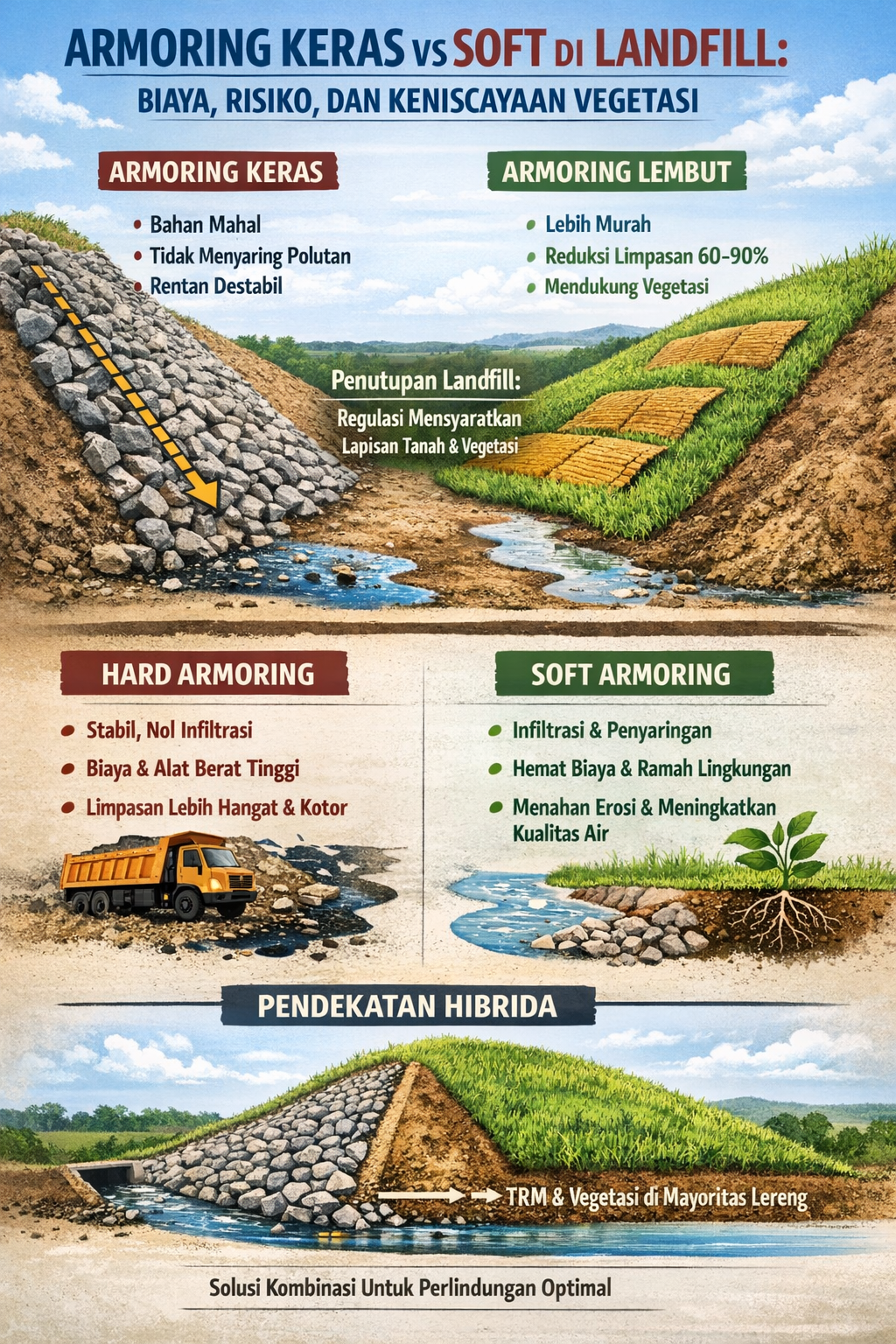
In the long-running fight to keep landfill caps from washing away, the rock‑versus‑roots debate is tilting green. State manuals still call riprap one of the most effective erosion preventers, but they also flag the price tag and the physics: on steep slopes and broad faces, vegetated “soft armor” is cheaper, lighter to install, and — once established — stubbornly effective at throttling runoff and trapping sediment.
Minnesota’s stormwater design manual describes riprap as “one of the most effective methods of erosion prevention,” yet “more expensive to install compared to vegetation (i.e., due to equipment and handling costs)” (stormwater.pca.state.mn.us). Industry guidance echoes that riprap “can be expensive, not locally available, and placement requires heavy equipment” (www.prestogeo.com).
Beyond cost, rock surfaces are impermeable and heat‑absorbent; runoff skims over them unfiltered and often warmer and more polluted, with maintenance headaches like undermining at boundaries. The same Minnesota manual cautions that riprap should be used “only where flows exceed vegetative capacity” — think high‑velocity outlets — and that it “may be unstable on slopes steeper than 2H:1V,” recommending turf reinforcement mats or articulated mats instead (stormwater.pca.state.mn.us; stormwater.pca.state.mn.us). In practice, many cap designs reserve rock for channel linings or outlet protection, not the entire slope face.
Soft‑armor systems and installation costs
Soft armoring — erosion‑control blankets and mats, hydroseeding, geotextiles, and mulch/coir logs — stabilizes soil with minimal disturbance and accelerates vegetation establishment. Turf‑reinforcement mats (TRMs, synthetic or natural meshes that boost shear resistance) and rolled erosion control products (RECPs, pre‑made blankets/mats) ship light and install fast, often “much less expensive than installed riprap or hard armor” (geosyntheticsmagazine.com). Instead of dumping tons of stone, crews tie the soil immediately with a blanket, then let it biodegrade into a living cover.
The hydrologic lift is measured. A 2.5 cm compost blanket on a 3:1 slope reduced total runoff by about 65% relative to bare soil (www.researchgate.net). In another study, 2″ compost blankets retained roughly 80% of rainfall and cut cumulative runoff by about 60%, while a straw mulch cover only cut runoff around 27% (www.researchgate.net).
Stormwater quality and filtration benefits
Vegetated covers slow and filter water; swales and blankets naturally trap sediment and nutrients, whereas hard surfaces convey dirty, heated runoff. Kelsey (2023) reports that vegetated covers (e.g., TRMs or erosion blankets with seed) provide stormwater‑quality benefits via filtration and infiltration, sequester carbon, and support wildlife habitat (geosyntheticsmagazine.com). Those filtering actions parallel the aims of media filtration in water treatment; for example, dual‑media beds like sand and silica filters are designed to remove 5–10 micron particles, while the landfill cap achieves similar outcomes biologically through soil and roots.
Soft armors also hold water on‑site — reducing peak flows — while roots reinforce the soil over time. As a process analogue in broader water programs, pressure‑driven membranes such as ultrafiltration target fine particulates in surface waters; on landfills, vegetation and blankets accomplish filtration and infiltration without hard infrastructure.
Performance limits and hybrid designs
Soft armoring has limits. Until vegetation is well established, it generally cannot match the extreme shear resistance of large rock under severe flows. That’s why blankets or geotextiles often augment seeding on moderate slopes during early stabilization. Engineered systems can stretch the envelope: one vegetated geogrid (GEOWEB/TRM) has been shown to withstand about 9 ft/s flows (versus roughly 4 ft/s for unreinforced grass) and up to around 30 ft/s when fully vegetated (www.prestogeo.com).
Design manuals still warn against relying solely on vegetation where flows are extreme, and real‑world projects often go hybrid: rock riprap at the toe or at concentrated flow inlets, with erosion blankets or turf mats across the bulk of the slope.
Cost, maintenance, and adaptability
Effectiveness: riprap is highly stable but offers zero infiltration or pollutant removal. Vegetated soft covers typically achieve ≥ 50% reductions in runoff/erosion — often far more with compost‑based mats (www.researchgate.net; www.researchgate.net).
Cost and install: rock requires heavy equipment and high material volumes, driving costs and fuel use (www.prestogeo.com). TRMs and rolled mats are “much less expensive than installed riprap or hard armor,” and blankets or mulch can often be sprayed or fluffed by blower trucks (geosyntheticsmagazine.com).
Longevity and maintenance: hard armor can last decades but may undercut or settle if soils shift. Soft armor transitions to a permanent vegetated cover; once established, maintenance is largely mowing and re‑seeding, not heavy equipment work.
Adaptability: soft mats conform to irregular surfaces and contours; rock placement may be limited by access and footprint. Successful vegetation naturally fills small cracks or eroded spots.
Regulatory context and closure layers
U.S. closure rules presuppose a vegetated cap. EPA guidance requires a final cover that supports vegetation (www.stormwater.com): an earthen cap of at least 18″ infiltration soil topped by at least 6″ of an “erosion layer…capable of sustaining native plant growth” (www.stormwater.com). That is not a bare rock prescription.
Regulatory trends echo globally. Indonesian standards specify a thick planting layer on final covers: “di atas tanah penutup akhir harus dilapisi dengan tanah media tanam (top soil) … min. 60 cm,” and mandate slopes ≤1:3 “to avoid erosion” (world.moleg.go.kr; world.moleg.go.kr). They recommend immediate grass planting — “Penanaman rumput dianjurkan untuk … mengurangi efek retakan tanah melalui jaringan akar” — with ultimate goals to “menjamin tumbuhnya tanaman… dan menjamin stabilitas kemiringan (slope)” (world.moleg.go.kr; world.moleg.go.kr).
Vegetation mechanics and measured outcomes
A healthy vegetative cover is the long‑term control. Root networks bind soil, increase shear strength, and create macropores that boost infiltration. EPA notes that surface cover (grass or mulch) “has considerable influence on infiltration by attenuating rainfall kinetic energy and reducing crusting” (nepis.epa.gov). In erosion modeling, a compost‑based cover achieved a USLE cover factor (C, the Universal Soil Loss Equation’s vegetation/cover term) of 0.065 versus roughly 0.189 for a straw mulch cover (www.researchgate.net).
Field results are stark: compost/vegetative covers on slopes often cut erosion by more than 80% compared to bare earth. One study logged roughly an 86% decrease in soil loss with compost‑amended blankets versus bare soil, and mixed compost/mulch blankets markedly outperformed straw alone (www.researchgate.net; www.researchgate.net). Another found vegetated blankets kept about 80% of rainfall on‑site (www.researchgate.net). By contrast, bare or inadequately seeded slopes can crack and gully; Hüttl et al. (2014) reported massive gully erosion on unvegetated mine spoil within a few years (www.researchgate.net).
Bottom line and source notes
Hard armor like riprap remains indispensable in chutes, channels, and at high‑velocity outlets — but it is costly, equipment‑intensive, and provides no infiltration or pollutant removal. Soft armors (biodegradable blankets, geotextiles, turf systems) combined with seeding are preferred for most cap slopes: they cut erosion dramatically (often 60–90% reduction in runoff), are cheaper to deploy, and enable ecological cover. Crucially, a well‑established vegetative cap tends to be the most durable, maintenance‑light protection: roots hold soil, infiltration lowers runoff, and the site behaves like a self‑repairing green surface. Guidance consistently emphasizes a vegetated topsoil cover on a gentle slope as the key to long‑term erosion control (www.stormwater.com; world.moleg.go.kr).
Sources: Authoritative guidelines and studies. For example, EPA landfill cap guidance specifies thick soil layers to support vegetation (www.stormwater.com); Minnesota’s engineering manual notes riprap “more expensive to install compared to vegetation” (stormwater.pca.state.mn.us); industry reviews report up to roughly 60–86% erosion/runoff reductions from compost‑ or mulch‑based blankets (www.researchgate.net; www.researchgate.net); and Indonesian closure regulations explicitly mandate sloped, vegetated covers (soil media ≥60 cm, slope ≤1:3) (world.moleg.go.kr; world.moleg.go.kr). Detailed references are cited inline.