

Industry: Landfill | Process: Stormwater_Management
Stormwater leaving a landfill can look like chocolate milk — and test like it too. Untreated sedimentation basins at earthwork sites have discharged 100–1650 NTU (Nephelometric Turbidity Units, a measure of water cloudiness) even after heavier particles settled, according to Jones et al. (1998) (ui.adsabs.harvard.edu).
Regulators are tightening clarity. In Indonesia, Permen LHK 5/2021 caps Total Suspended Solids (TSS) at 100 mg/L for industrial discharges (id.linkedin.com), while the US EPA’s 2010 Construction Effluent Limitation Guidelines set a 280 NTU daily average limit (www.smithcurrie.com). Modern design often aims for effluent clarity an order of magnitude lower — for example, below 50 NTU — to protect receiving waters.
That level of polishing typically demands both gravity and chemistry: a properly sized sedimentation pond for coarse solids and coagulant–flocculant treatment to grab fine clays. Optimized systems routinely remove 80–95% of influent solids to meet ≤100 mg/L TSS and land well under 50 NTU (ui.adsabs.harvard.edu; id.linkedin.com).
Regulatory benchmarks and turbidity targets
Indonesian norms do not specify turbidity directly, but TSS limits can be converted for typical mineral solids: 50–100 mg/L TSS corresponds roughly to 20–40 NTU of turbidity (higher with organics or colloids). To comply with emerging Indonesian standards (≤100 mg/L TSS; id.linkedin.com) and international best practice (often <20–50 NTU), a landfill stormwater system must remove 80–95% of influent solids, including fine clays. For comparison, the US construction rule is 280 NTU daily average (www.smithcurrie.com). Jones et al. (1998) show why: untreated basins discharged 100–1650 NTU (ui.adsabs.harvard.edu).
Sedimentation basin sizing and hydraulics
A sedimentation pond (detention basin) works by slowing inflow so suspended solids settle by gravity. Key parameters: storage volume for detention time, surface area for overflow rate, and hydraulic controls (weirs, baffles, skimmers). Many guidelines (e.g., ten-state standards) point to an overflow rate around 500–600 gallons/ft²·day (~20–25 m³/m²·day) for high TSS removal (nepis.epa.gov; nepis.epa.gov).
In practice, that translates to 24–48 hours of detention under typical runoff. If a design storm yields 10,000 m³ of runoff, a 24-hour residence basin needs ≈10,000 m³ storage. Lower overflow rates (larger area or slower drawdown) improve capture of small particles (nepis.epa.gov; nepis.epa.gov).
Under quiescent conditions, a properly sized basin can remove 60–90% of TSS by settling alone, but colloidal clays (<20 μm) settle very slowly or not at all in practical detention times (nepis.epa.gov; ui.adsabs.harvard.edu). In one field trial, even after ~2–3 days, untreated basins were still discharging 100–1650 NTU, mainly from fine clays (ui.adsabs.harvard.edu).
Design must also address resuspension: inlet energy-dissipation and perimeter baffles prevent short-circuiting, while floating skimmers draw water from just below the surface (as in the study: ui.adsabs.harvard.edu) to avoid sludge. Sludge accumulation must be monitored; with typical loading, sediments may build up at a few mm per year, requiring periodic dredging.
Chemical coagulation for fine clays
Because passive settling underperforms for sub‑10 μm particles, chemical enhancement is common. Coagulants (e.g., aluminum sulfate, ferric chloride, polyaluminum chloride) carry positive charges that neutralize the negative surface charge of clays, initiating aggregation, while flocculant polymers bind micro‑flocs into larger, denser agglomerates that settle faster (nepis.epa.gov; nepis.epa.gov). In effect, flocculation can double or more the settling velocity of colloids (nepis.epa.gov).
The practice is growing: a 2021 survey of U.S. DOT agencies found 39% now use flocculants on construction stormwater sites; most rely on manufacturer dosage guidelines (54%), though only 23% require monitoring of residual flocculant downstream (www.researchgate.net). Properly applied, flocculant treatment typically yields “promising results” in removing fine particles (www.researchgate.net).
In stormwater application, jar tests on site water guide selection and dose. Common choices include alum and ferric salts, and polyaluminum chloride (PAC). Where PAC is selected, operators often source it as polyaluminum chloride (PAC). In cold or very dilute runoff, higher doses or polymer aids help; industrial experience (e.g., in concrete washwater) suggests starting trials with low‑cost alum or ferric salts, then optimizing polymer addition as needed (nepis.epa.gov).
Where procurement is formalized, utilities often group chemical supply under coagulants and flocculants programs so the materials and application support align with the treatment train described here.
Field dosages and performance evidence
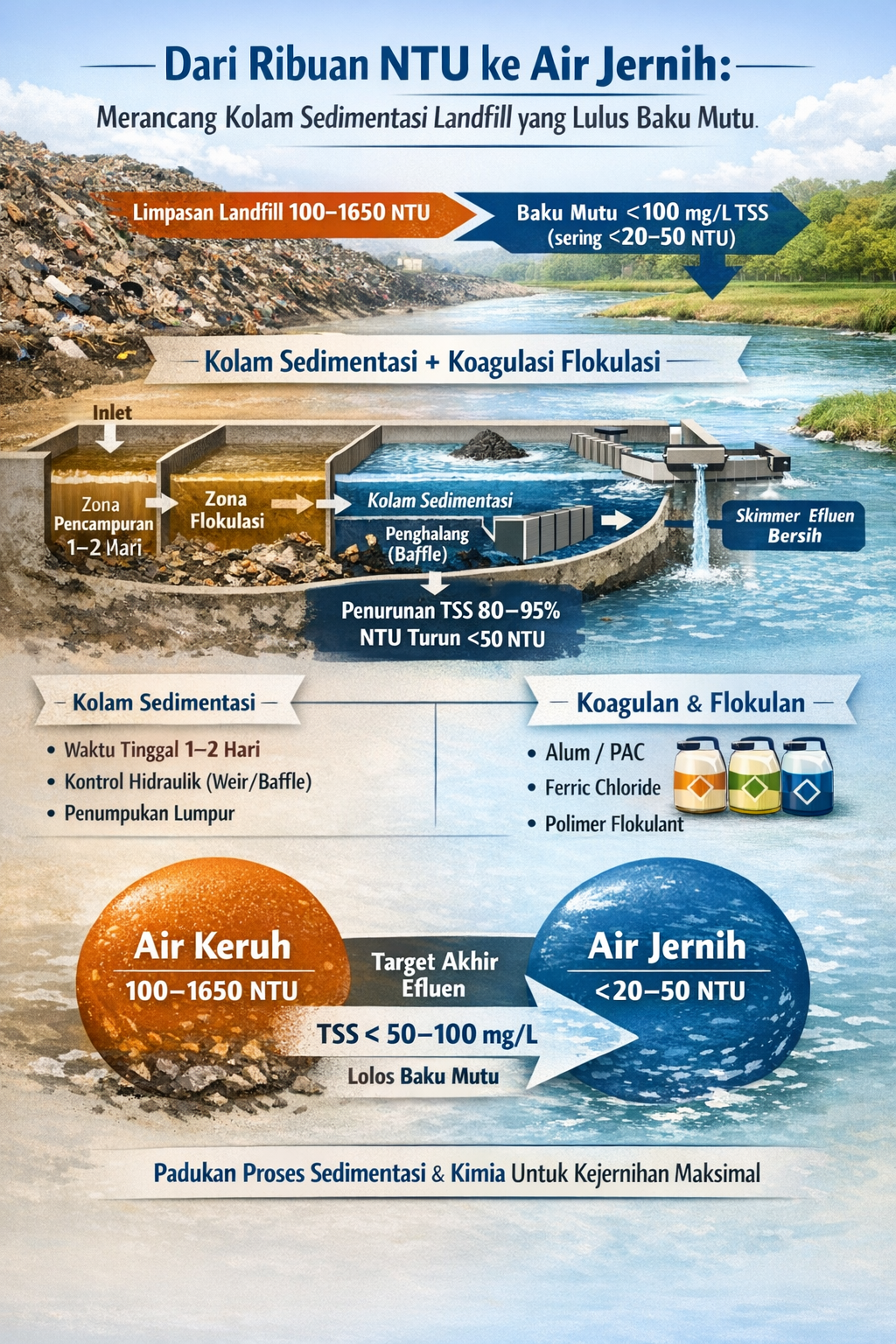
In field‑scale practice, dosages are much lower than in bench jars, often 50–300 mg/L of coagulant or polymer. Jones et al. (1998) applied 450–520 mg/L of molded gypsum (CaSO₄·0.5H₂O) as a flocculant in an urban sediment basin, trimming turbidity from up to 1650 NTU down to <50 NTU in outflow; discharge reached 100 NTU after 2–20 hours and 50 NTU after 5–52 hours, depending on plaster concentration (ui.adsabs.harvard.edu).
Jar testing remains essential for tuning chemistry. One Indonesian landfill‑leachate study (a tougher matrix than stormwater) tested alum+FeCl₃ blends, finding that 16 g/L Al₂(SO₄)₃ + 7 g/L FeCl₃ (per jar) gave 87.99% BOD and 81.48% TSS removal, dropping TSS from 108 to 20 mg/L (www.researchgate.net). Stormwater typically contains fewer dissolved organics, but this illustrates coagulants can reduce solids to well below 50 mg/L.
System layout and operations
Design for detention plus mixing: include a rapid‑mix zone or upstream injection point to disperse coagulant, followed by a gentle flocculation zone (e.g., a baffled channel with slow mixers), then the sedimentation basin. Total contact time (mix+detention) of 2–6 hours is common, but fine tails may need up to 24–48 hours (ui.adsabs.harvard.edu).
Chemical injection is typically metered via a dosing pump to hit target mg/L feed rates established by jar tests and site pilots. For site hardware — weirs, baffles, mixers, and skimmers — operators often rely on supporting equipment packages that match the basin hydraulics detailed above.
Sludge handling is part of the plan. Coagulation greatly increases settled sludge volume. The sediment pond should have easy access for silt removal every few months (or sooner if solids production is heavy). Spent floc sludge will contain bound pollutants (metals, BOD) so should be managed as hazardous if landfill criteria demand it; otherwise, dry and dispose in landfill.
Monitoring and compliance margin
Monitoring focuses on turbidity/NTU of effluent and residual chemistry such as pH and metal ions. Avoid excessive dosing: studies note the risk of flocculant overapplication causing downstream toxicity (www.researchgate.net). If turbidity remains high, incremental coagulant addition or multiple settling passes (series ponds) can be used.
The compliance margin can be steep. If a storm yields 1000 NTU influent, reducing below 50 NTU means >95% solids removal. The Leeds* et al.* results show this is feasible with flocculation (ui.adsabs.harvard.edu; www.researchgate.net). In practice, designers should specify a combination of detention time and coagulant dose to demonstrably meet the strictest anticipated limit (e.g., TSS ≤50–100 mg/L).
Data‑backed outcomes and key takeaways
Combining settling and chemical treatment yields high overall removal. Floc‑assisted ponds achieve effluent turbidities often <50 NTU; in the cited study, treated discharge never exceeded 50 NTU after flocculant addition (ui.adsabs.harvard.edu). Many practitioners target <20–30 NTU (roughly equivalent to 20–50 mg/L of TSS) to ensure ecosystem protection, far below the US construction rule’s 280 NTU numeric limit (www.smithcurrie.com).
TSS reduction follows: ponds alone may remove ~60–70% of TSS by simple settling (nepis.epa.gov), and adding chemicals can push this into the 80–95% range. The leachate study cited above saw 81.5% TSS removal (108→20 mg/L) with alum+FeCl₃ (www.researchgate.net), while surface‑applied gypsum in a field basin drove turbidity down to <50 NTU (ui.adsabs.harvard.edu).
Performance targets can be stated plainly: aiming for TSS <50 mg/L (≈<20 NTU) outflow would satisfy most Indonesian and international limits (www.researchgate.net; id.linkedin.com). Use jar tests and pilot trials to confirm the chosen dose consistently hits target removal under worst‑case storm turbidity.
Bottom line: a properly sized sedimentation basin removes the bulk of coarse solids, but for fine‑clay particles a chemical polishing step is essential to meet clear‑water standards. Field data show floc‑aided basins can exceed 80–90% TSS removal and yield effluent turbidity an order of magnitude below typical regulatory caps (ui.adsabs.harvard.edu; www.researchgate.net). The combined detention–chemistry approach aligns with Indonesia’s tightening turbidity/TSS expectations (e.g., ≤100 mg/L) and protects downstream water quality (id.linkedin.com).
Sources: Peer‑reviewed studies and technical manuals were used in this analysis (ui.adsabs.harvard.edu; nepis.epa.gov; nepis.epa.gov; www.researchgate.net; www.researchgate.net; id.linkedin.com; www.smithcurrie.com). Each provides quantitative data on sedimentation design or coagulation performance relevant to landfill stormwater treatment.