

Industry: Landfill | Process: Final_Effluent_Polishing
Landfill leachate is a stubborn mix of refractory organics — humic/fulvic matter, aromatic hydrocarbons, surfactants, dyes — plus ammonia and salts. After biological or chemical treatment, those dissolved organics often exceed discharge limits; Indonesia’s standard (Permen LHK 59/2016) allows ≤300 mg/L COD (chemical oxygen demand) and ≤150 mg/L BOD (biological oxygen demand) (slideshare.net).
That’s where granular activated carbon (GAC) comes in. The US EPA calls GAC a proven advanced (tertiary) treatment that removes the small residual organics — and some inorganics — left after secondary processes (nepis.epa.gov).
Residual organics and regulatory targets
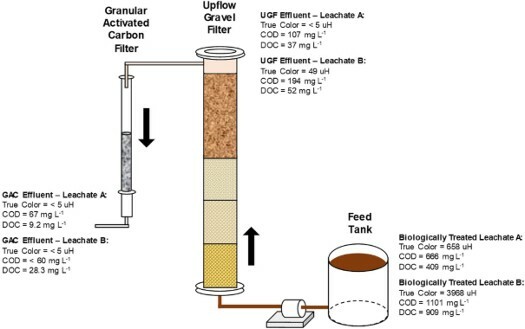
GAC works by physical adsorption into a pore structure that captures a broad spectrum of organics. EPA’s list spans aromatic solvents (benzene, toluene, xylenes), polynuclear aromatics (naphthalene, biphenyl), chlorinated aromatics (chlorobenzene, PCBs, dioxins), phenolics (phenol, cresols, chlorophenol), anilines/amines, surfactants and large dyes (alkylbenzenesulfonates, textile dyes), fuels/oils, chlorinated solvents, organic acids (humics), and pesticides/herbicides (nepis.epa.gov).
In practice, GAC sits at the end of a treatment train. Placing it downstream of primary biological treatment can follow systems such as anaerobic and aerobic digestion without making new claims about performance. To protect the carbon from particulates, operators commonly add upstream clarification; a compact unit clarifier can serve this role (clarifier), with sand media polishing out 5–10 micron solids before carbon contact (sand/silica filtration). Fine protection is often handled by cartridge filters to minimize headloss at the GAC bed.
Measured removal performance
Full‑scale and pilot data are striking. At Niagara Falls WTP, GAC polishing cut roughly 800 lb/day of organic pollutants down to about 12 lb/day in the effluent (≈98.5% removal) (nepis.epa.gov).
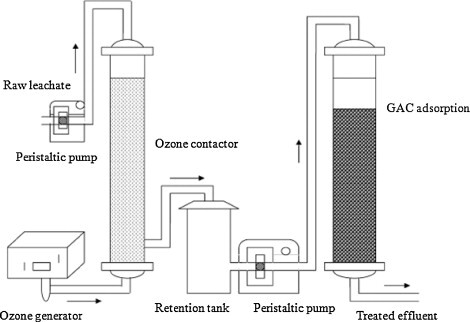
Laboratory studies show >99% removal of residual leachate COD after an upstream oxidation step; one pilot using Fenton‑pretreated leachate reported 99.3% COD removal and 99.9% color removal through a GAC adsorber (mdpi.com) (mdpi.com). Kurniawan et al. (Hong Kong) found that with raw leachate (COD ~8000 mg/L), GAC alone removed 58% COD in batch tests, while H₂O₂ oxidation plus GAC removed 82% — but final COD remained above discharge limits, underscoring the need for multiple stages (pubmed.ncbi.nlm.nih.gov).
Bench tests back this up: in a 72‑hour batch, 8 g/L of GAC removed ~60% of COD (researchgate.net). Overall, GAC excels on larger, hydrophobic organics. In the Fenton/GAC pilot, a macroporous granular GAC removed COD more effectively than fine powdered activated carbon (PAC), while PAC removed color (humic dyes) more efficiently — a pore‑size story where larger pores favor high‑molecular‑weight compounds (mdpi.com) (mdpi.com).
Where chemical oxidation is part of pretreatment, stable feed control helps; accurate addition can be handled by a dosing pump without asserting new performance claims.
Packed‑bed contacting system design
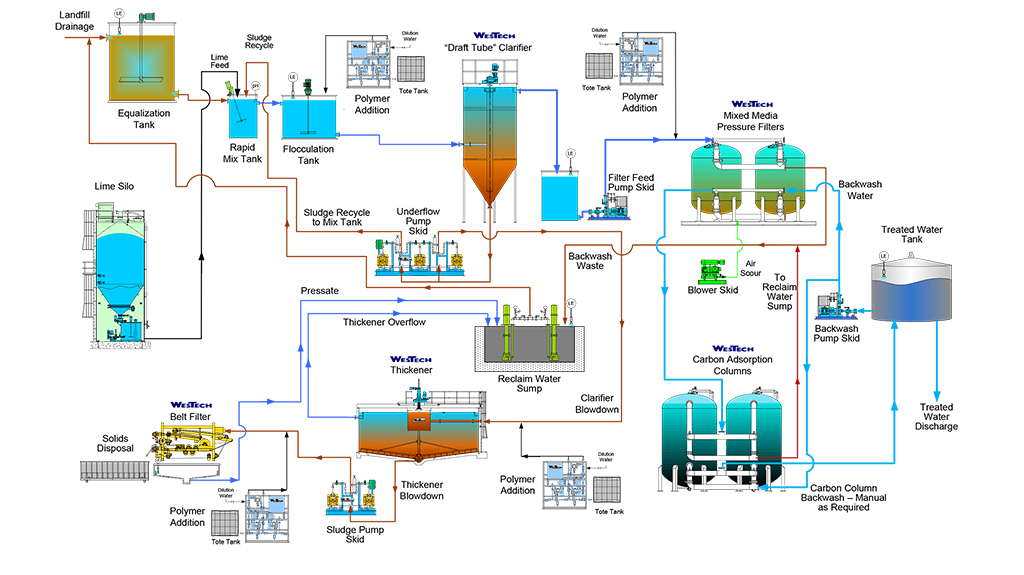
Most GAC systems are packed‑bed columns — downflow or upflow — in lined steel or concrete vessels with an underdrain to support the media (nepis.epa.gov). In gravity downflow, leachate enters at the top and percolates down. Periodic backwashing and air scouring remove settled solids and limit headloss (nepis.epa.gov).
Alternatives include expanded‑bed or moving‑bed contactors where fresh carbon continually replaces spent, reducing clogging risk (nepis.epa.gov). Multiple contact vessels are common so one can go offline for regeneration. EPA guidance notes most plants run two or more beds in series or parallel; as one bed nears breakthrough (when effluent concentration rises as the mass‑transfer zone reaches the outlet), another takes over polishing duty (nepis.epa.gov).
Design parameters are well established. EPA recommends downflow hydraulic loading of 3–5 gpm/ft² and upflow 4–10 gpm/ft² (gpm/ft² = gallons per minute per square foot), with bed depths of 10–40 ft (3–12 m) to achieve 10–60+ minutes of EBCT (empty‑bed contact time) (nepis.epa.gov). At Niagara Falls, beds were 8.5 ft (2.6 m) deep at ~2.2–3.0 gpm/ft² (500–700 m³/m²·d) (nepis.epa.gov) (nepis.epa.gov).
A rule of thumb is two or three beds in series so the final column maintains effluent quality even as upstream beds saturate (purewaterblog.com). Carbon mass is sized to organic load; for filtered secondary effluent, typical demand runs 400–600 lb per million gallons, while raw high‑strength leachate can require 600–1800 lb/MG (nepis.epa.gov).
Case configuration: Niagara Falls WTP
The Niagara Falls GAC system comprises 28 parallel beds, each 17.3 × 42 ft and 8.5 ft deep, with ~180,000 lb of carbon per bed (nepis.epa.gov). Primary effluent flows downward by gravity, producing effluent organics of ~12 lb/day after polishing (nepis.epa.gov).
Backwashing is triggered by headloss, and spent carbon (~5.5% lost per cycle) is withdrawn for regeneration. The on‑site multi‑hearth regenerator processes about 2,000 lb/hr of spent GAC and consumes about 5.5% of carbon per year; backwashing is performed once per year, and regenerated carbon is stored on site until the next reload (nepis.epa.gov).
Activated carbon selection factors
Carbon choice hinges on raw material and pore architecture. Coconut‑shell grades are highly microporous, with high iodine numbers and strong abrasion resistance; they excel at small, polar organics and micropollutants (e.g., trace solvents, PFAS). Coal‑ and lignite‑based GAC offer more meso‑ and macropores, favoring high‑molecular‑weight humics common in late‑stage leachate. In one study, a macroporous lignitic GAC (8×30 mesh, ~349 m²/g) outperformed a fine mesoporous PAC for COD removal, while the PAC captured color more efficiently (mdpi.com) (mdpi.com) (mdpi.com).
Particle size (e.g., 4×8 or 8×30 mesh) trades kinetics against headloss; typical water‑works carbons are 4×10 to 8×30 mesh. Iodine number indicates micropore capacity (small molecule uptake), while methylene blue number tracks mesopore content (larger molecule uptake). Mechanical strength matters to resist backwash abrasion, and cost/availability drive the choice between coconut, coal, lignite, wood, or peat. Many plants pilot candidate grades before selecting activated carbon tailored to the leachate’s organic profile.
Regeneration and end‑of‑life management
Thermal regeneration is the standard: spent GAC is steam‑purged and heated to ~800–900 °C in a kiln or multiple‑hearth furnace, oxidizing adsorbed organics to CO₂, H₂O, and trace byproducts and restoring capacity. Expect 5–10% carbon mass loss per cycle (nepis.epa.gov). Large systems (≫1 million lbs inventory or >10^6 lb) often regenerate on‑site; smaller installations typically ship spent GAC off‑site for commercial reactivation and bring back fresh carbon (nepis.epa.gov).
Chemical regeneration (acid/base, solvents, advanced oxidation) exists but is used less for landfill leachate; thermal is preferred for full restoration. If regeneration is infeasible — e.g., hazardous contamination or heavy fouling — spent carbon goes to high‑temperature incineration or secure landfill. Unreactivated GAC can also be burned in cement kilns or coal furnaces for energy (co‑management). Disposal or reuse must follow environmental controls on ash and off‑gases.
Operating outcomes and cost drivers
With proper design and operation, GAC polishing can reduce leachate COD/NOM by 90–99% to very low levels (often <10–20 mg/L COD) (mdpi.com) (mdpi.com). One study achieved 62.4 L of leachate per kg GAC before breakthrough (≈0.11 kg COD removed per g carbon) (mdpi.com).
Design trends favor multi‑column beds (3–6 m depth, 10–30 min EBCT each) with periodic regeneration. Lifecycle cost hinges on carbon loss and reactivation logistics: about 5–10% replenishment per cycle plus regeneration energy, with economics improved by on‑site reactivation or co‑treatment of spent carbon. For influent control, debris removal upstream can be automated without overstating benefits by specifying an automatic screen that continuously removes solids before the GAC stage.