

Industry: Landfill | Process: Final_Effluent_Polishing
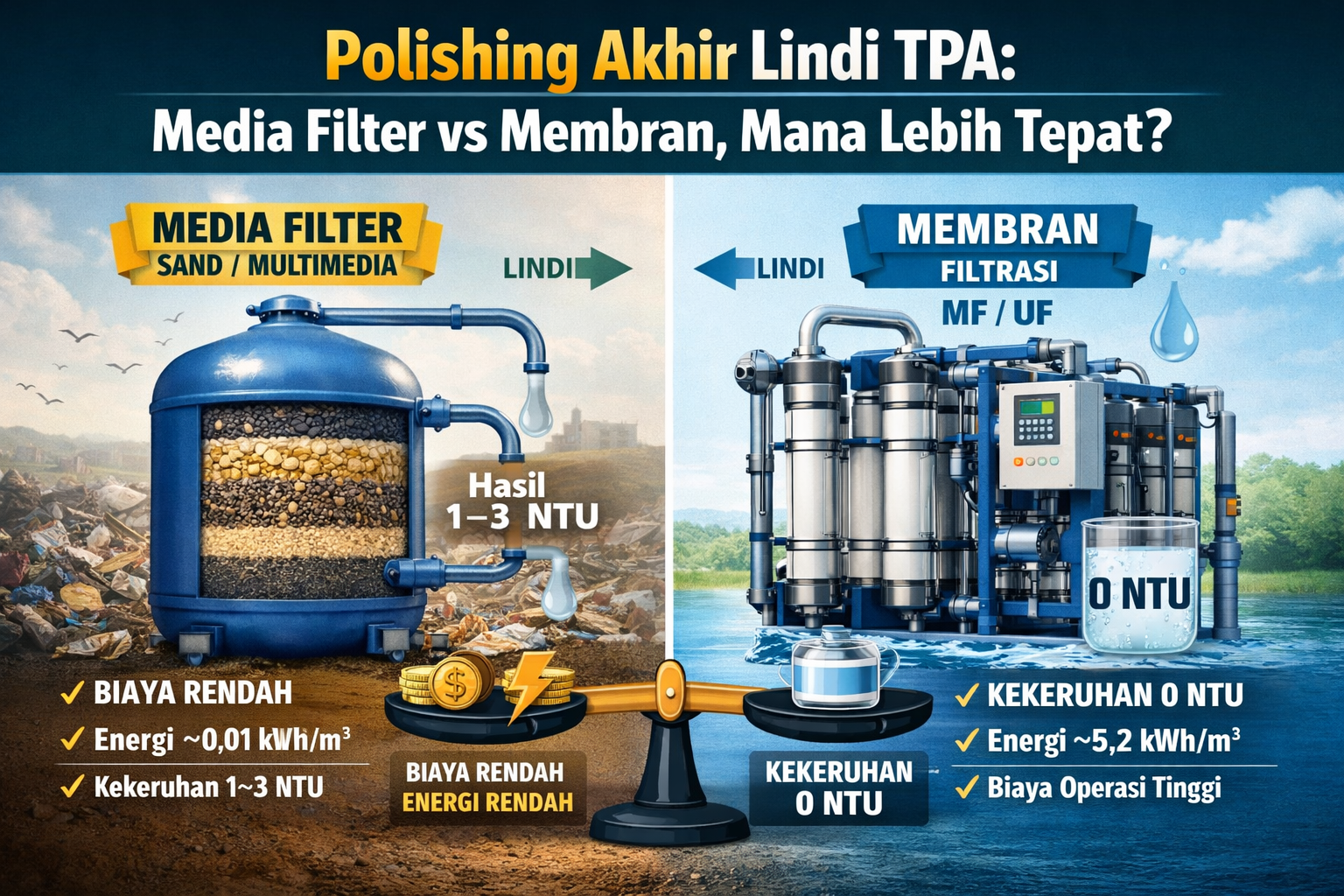
Landfill leachate treatment has a clear fork in the road at the polishing step: gravity‑driven beds of sand and anthracite, or pressurized micro‑ and ultrafiltration membranes. The performance gap is real — so is the energy bill. A sand filter can sip ≈0.01 kWh/m³, while a leachate MBR (membrane bioreactor) logged ~5.2 kWh/m³ for filtration, scouring and aeration (huber.es; mdpi.com).
Both routes target the same finishing line — stripping out residual suspended solids and colloids — but by different mechanics. Media filters trap solids through depth filtration, typically as rapid gravity filters. Membranes (MF/UF) physically sieve at pore scales of ~0.01–0.1 µm (micrometers; one‑millionth of a meter), yielding essentially particle‑free effluent (mdpi.com).
Hydraulic loading and solids capture
Rapid sand or multimedia filters run at 5–20 m³/m²·h (hydraulic loading rate — flow per filter area), equivalent to 2–5 US gpm/ft², according to US EPA guidance (nepis.epa.gov). Dual‑ or multi‑media beds can push higher flows of 4–8 gal/ft²·min (≈10–20 m³/m²·h) (nepis.epa.gov). Specifying the media matters: operators commonly pair sand media with anthracite media to create a multigrade depth profile.
With proper coagulation pretreatment, media filters can be very effective. A multigrade sand/anthracite column removed about 98% of TSS (total suspended solids) from secondary effluent (agribiop.com). One high‑efficiency media filter produced filtrate near 0.1 NTU (Nephelometric Turbidity Units, a measure of water clarity) (filtsep.com).
Absent coagulant, results can slide. One study showed turbidity removal around ~28% without coagulant versus ~70% with a coagulant/flocculant dose (mdpi.com). Under optimal flocculation, sand filters typically achieve >90% total particle removal, with feed turbidity into the filter kept ≲15 NTU (mdpi.com).
Physics sets a hard limit: EPA notes colloids smaller than ~1 µm may pass a deep bed unless they are coagulated and flocculated; truly dissolved organics and heavy metals also pass media filtration unless precipitated upstream (nepis.epa.gov). In short, media filters excel as the last stop after precipitation/settling.
Energy and O&M footprints
Media filters are frugal. Reported energy is on the order of 1–10 Wh per m³ of filtrate; a multi‑layer sand filter was ≈10 Wh/m³ (≈0.01 kWh/m³), and a continuous moving‑bed sand filter consumed ≈1.5–2.0 kWh per person per year (huber.es). Backwash water is typically 5–10% of filtered volume, with media replaced on ~1–2‑decade intervals (nepis.epa.gov). After coagulant pretreatment, one case estimated ~0.41 € per m³ O&M for conventional depth filtration (mdpi.com). Those coagulants are routinely delivered by dosing pumps and sourced as coagulants and flocculants.
Membranes come with higher energy and maintenance. The Italian leachate MBR’s ~5.2 kWh/m³ specific energy dwarfs gravity filtration; vendor data for municipal effluent show sand filters near ~10 Wh/m³ and disc screens ~4 Wh/m³, versus the MBR’s ≈5200 Wh/m³ (huber.es; mdpi.com). One study found that adding UF raised O&M from 0.41 €/m³ (sand) to 0.46 €/m³ (UF), and the leachate MBR logged ~0.79 € per m³ of permeate in energy plus chemicals (mdpi.com; mdpi.com). By contrast, sand/media filters typically run at a few cents per m³ (e.g., 1–5 ¢/m³).
Flux limits and fouling risk
MF/UF operates at low flux — 2–11 L/(m²·h) (LMH), about 0.05–0.26 m³/m²·day — which is orders of magnitude lower than media beds at 5–12 m³/m²·h. Systems are kept at ~0.5–1.5 bar and require regular cleaning to manage fouling (mdpi.com). As pretreatment or final polishing, ultrafiltration (UF) produces essentially particle‑free effluent: full‑scale/bench data show ~99% TSS removal and turbidity <0.1 NTU, and in a leachate MBR case ultrafiltration delivered 99% TSS and 98% BOD (biochemical oxygen demand) removal (mdpi.com).
Microfiltration has also shown disinfection‑grade performance. A 0.05 µm drinking‑water pilot achieved 100% E. coli removal and 93% turbidity reduction, versus ~53% turbidity removal by sand filtering in the same comparison (researchgate.net). Membrane systems remove the fine colloids, protozoa and pathogens that media filters leave behind; many facilities bundle MF/UF within broader membrane systems when ultra‑low turbidity is non‑negotiable.
Coagulant and flocculant polishing dose
EPA underscores that colloids “may not be removed effectively” by media filtration unless precipitated or flocculated (nepis.epa.gov). Plants often inject a small upstream dose of coagulant/flocculant right before the filter to enlarge fines; the approach increases framboid size (aggregate size/shape) and shear resistance, so filters capture them more readily (nepis.epa.gov). Filter aids like diatomaceous earth can precoat cloth or sand filters to trap the remaining fines (nepis.epa.gov).
Adding alum or polyaluminum chloride (PAC) ahead of sand filtration has been shown to push removal higher — >70% turbidity reduction and >95% pathogen/colloid removal in the cited work (mdpi.com). Plants frequently procure PAC via PAC coagulants and pair it with a small polymeric flocculant. In membrane systems, a final polishing dose also reduces fouling by aggregating colloids (mdpi.com).
Dose magnitude is modest. A typical polishing addition of 1–10 mg/L (as Fe/Al‑based coagulant) plus a small flocculant can extend media or membrane run times; dosing on the order of 1–5 mg/L has been reported to cut filtrate turbidity from ~10–50 NTU down to <1 NTU (untreated vs treated), depending on feed and setup (nepis.epa.gov; mdpi.com). Metering is typically handled by a chemical dosing pump.
Choosing a final polishing step
For modest targets — think final turbidity on the order of ~0–3 NTU (often <1 NTU) and >90% TSS removal — media filtration with coagulant pretreatment is frequently sufficient and economical (agribiop.com; filtsep.com). When ultra‑low turbidity or pathogen removal is required, membranes can deliver ≈0 NTU effluent and essentially remove all particulates (mdpi.com), albeit at higher energy and capital cost; membranes also offer a smaller physical footprint and may achieve discharge goals without chemical polishing beyond pretreatment.
US EPA guidance frames filtration as a polishing step after precipitation/settling, with feed solids kept relatively low (<~1000 mg/L) (nepis.epa.gov). For landfill sites designing to local rules — including Indonesian Permen LHK standards for TSS/COD — equipment sizing (bed depth/area, membrane area) and the coagulant strategy should be matched to the effluent specification and the operating cost profile.
Key figures and comparisons
Media filters: 5–20 m³/m²·h (≈2–8 gal/ft²·min) hydraulic loading; >90% TSS removal, often >98% reported, with filtrate turbidity down to ~0.1 NTU (nepis.epa.gov; agribiop.com; filtsep.com). Energy ~0.01–0.02 kWh/m³; backwash 5–10% (huber.es; nepis.epa.gov).
Membranes (MF/UF): 0.05–0.26 m³/m²·day (2–11 L/m²·h) flux; provide ~99.9% removal of TSS and turbidity (effluent ≈0 mg/L SS, <0.1 NTU); energy around ~5.2 kWh/m³ in a leachate MBR case, with O&M on the order of €0.4–0.8/m³ for membrane polishing in reported cases (mdpi.com; mdpi.com; mdpi.com). Coagulant dosing at ~1–5 mg/L (Fe/Al) can drop filtrate turbidity from ~10–50 NTU to <1 NTU (mdpi.com; nepis.epa.gov).