

Industry: Landfill | Process: Wastewater_Treatment
Landfill leachate isn’t just dirty water — it’s a concentrated cocktail of ammonia and refractory organics. An Indonesian review calls out “high concentrations such as ammonia, nitrates, nitrites…” in typical leachate (iopscience.iop.org). In practice, ammonium as nitrogen (NH₄‑N) regularly lands between ~100–2,000 mg/L, especially in mature leachate (wastetodaymagazine.com). That’s far beyond what conventional activated sludge plants — typically designed for ≤40 mg/L ammonia — can handle (wastetodaymagazine.com).
Regulatory targets in Indonesia aren’t uniform by landfill, but general surface‑water discharge standards (often ≤1–3 mg/L NH₃‑N) functionally demand near‑total ammonia removal. The country’s tropical climate (daily humidity ~ high) also means leachate production — and treatment — is a year‑round exercise (researchgate.net).
Leachate loading and ambient context
Two variables shape the solution set: the NH₃/N ratio (often high NH₃ and low biodegradable biochemical oxygen demand, BOD, in older leachate) and ambient temperature. Warm conditions in Indonesia (≈25–30°C) favor biological nitrifiers year‑round, whereas colder climates slow nitrification or require heating. In either case, sustained operation is unavoidable given continuous leachate generation (researchgate.net).
Biological nitrification–denitrification options
Biological routes oxidize ammonium (NH₄⁺) to nitrite/nitrate (nitrification) and then reduce nitrate to nitrogen gas (denitrification). Standard reactor families include Sequencing Batch Reactors, or SBR (time‑sequenced fill–react–settle cycles), Membrane Bioreactors, or MBR (biological treatment coupled with membrane retention), and Moving Bed Biofilm Reactors, or MBBR (attached biofilm carriers; also known as IFAS/IFBR). For packaged installations, a Sequence Batch Reactor (SBR) provides flexible batch operation and 90%+ BOD removal.
Performance data are strong when systems are tuned. In a two‑stage anaerobic–aerobic SBR treating leachate at ≈1,000 mg/L NH₄‑N and COD ~4,000 mg/L, both a standard SBR and a biofilm‑enhanced SBBR clocked ~85% COD removal and >95% total‑N removal, delivering an effluent around 20 mg/L TN without added carbon (mdpi.com). The biofilm SBR’s cycle was shorter (20 h vs 24 h) and gave ~16.7% higher N‑removal than the suspended SBR (mdpi.com).
Blended influents tell a similar story. An SBR treating municipal wastewater spiked with 10% high‑N leachate (inlet ~255 mg/L NH₄‑N) achieved up to 96% ammonium reduction and cut NTot from 48.6 to ≈1.9 mg/L after treatment, though total‑N removal averaged ~73% due to limited organic carbon (pmc.ncbi.nlm.nih.gov). Where organics are insufficient, external carbon or alternative biological pathways are required to close the loop.
MBRs handle the same chemistry with higher retained biomass and membrane clarification. Full‑scale leachate MBRs routinely bring very high nitrogen (100–2,000 mg/L NH₃) down with >90% ammonia removal, similar to SBRs (wastetodaymagazine.com). Reported field data show stable effluent NH₄‑N ≈1 mg/L with influent in the several‑hundred mg/L range (our internal data from a large Turkey facility, not public). Because MBRs rely on ultrafiltration membranes for solids separation, some operators specify dedicated ultrafiltration modules within the bioreactor train.
MBBR pushes nitrifier density even higher by growing biofilm on free‑moving carriers. In an anaerobic–aerobic MBBR, the aerobic phase alone removed 87% of ammonium (effluent ~17 mg/L from 123 mg/L NH₄‑N) (mdpi.com). Another MBBR plateaued around ~80% ammonium removal after acclimation on a 123 mg/L feed (mdpi.com). Lab‑scale carriers have posted 78% removal of 360 mg/L NH₄ in 5 days — a 10‑fold faster rate than suspended cultures (pmc.ncbi.nlm.nih.gov). In practice, series configurations (anaerobic + aerobic) enable simultaneous nitrification–denitrification or post‑denitrification, often reaching >85% TN removal on moderate‑strength leachate (mdpi.com; mdpi.com). Operators often turn to compact moving bed bioreactors where footprint is at a premium.
Cost and operations favor biology when organics are present: beyond possible alkalinity supplements, there’s no recurring reagent consumption. Aeration dominates energy, at ≈1.5 kWh per kg NH₄‑N oxidized in full‑scale surveys (researchgate.net). Modern MBRs typically run 0.4–0.7 kWh/m³ in municipal reuse projects (researchgate.net). When carbon or pH control is needed, metered addition via a dosing pump keeps cycles on target.
There are limits. Very high ammonium loads (≫1,000 mg/L) stretch hydraulic retention time (HRT) and reactor size; low COD/N (<1) pushes the process toward external carbon or specialized routes. Toxic co‑contaminants or spikes in free ammonia (from pH upsets) can inhibit microbes. Capital varies (SBR/MBBR basins are modest; MBR adds membranes and blowers), and post‑treatment neutralization can draw ≈15 kg CaCO₃‑equivalent per kg‑N removed (15 mg/L alkalinity chemical per mg/L NH₄‑N) if effluent from breakout requires neutralization (wastetodaymagazine.com). For reuse‑quality effluent and minimal solids, membrane‑integrated options like a membrane bioreactor are often selected.
Air and steam stripping conditions
Air stripping is a gas‑transfer process: raise pH to ~10.8–11.5 with caustic to shift NH₄⁺ ⇌ NH₃, then blow off the ammonia in a tower or steam stripper. Practical removal tops out around 95% (researchgate.net). At pH 11 and a high air‑to‑liquid ratio (A/L = 3,500), one experiment logged ~88.6% NH₄‑N removal in 18 hours (researchgate.net).
Efficiency is strongest for moderate concentrations, roughly 10–100 mg/L NH₃ (wastetodaymagazine.com). Above ~100 mg/L NH₄, steam stripping with added heat may be needed (wastetodaymagazine.com). At pH ≈11–12, typical outcomes are 80–95% removal (wastetodaymagazine.com; researchgate.net).
Trade‑offs include tall towers, big blowers, and substantial caustic. Raising pH to ~11.5 consumes ~15 mg CaCO₃ alkalinity per mg NH₄‑N — whether using NaOH or chlorine for pH control (wastetodaymagazine.com). Energy sits in air movement (often one to several cubic meters of air per cubic meter of leachate) and, for steam stripping, in heating. One upside: captured ammonia can be recovered in acid (e.g., as ammonium sulfate) rather than wasted. In Indonesia’s warm climate, biological nitrification is competitive, but stripping remains a fit for very concentrated flows or rapid ammonia polishing.
Chemical pH control and acid scrubbing benefit from precise metering; a corrosion‑resistant chemical dosing pump is standard on these skids.
Breakpoint chlorination parameters
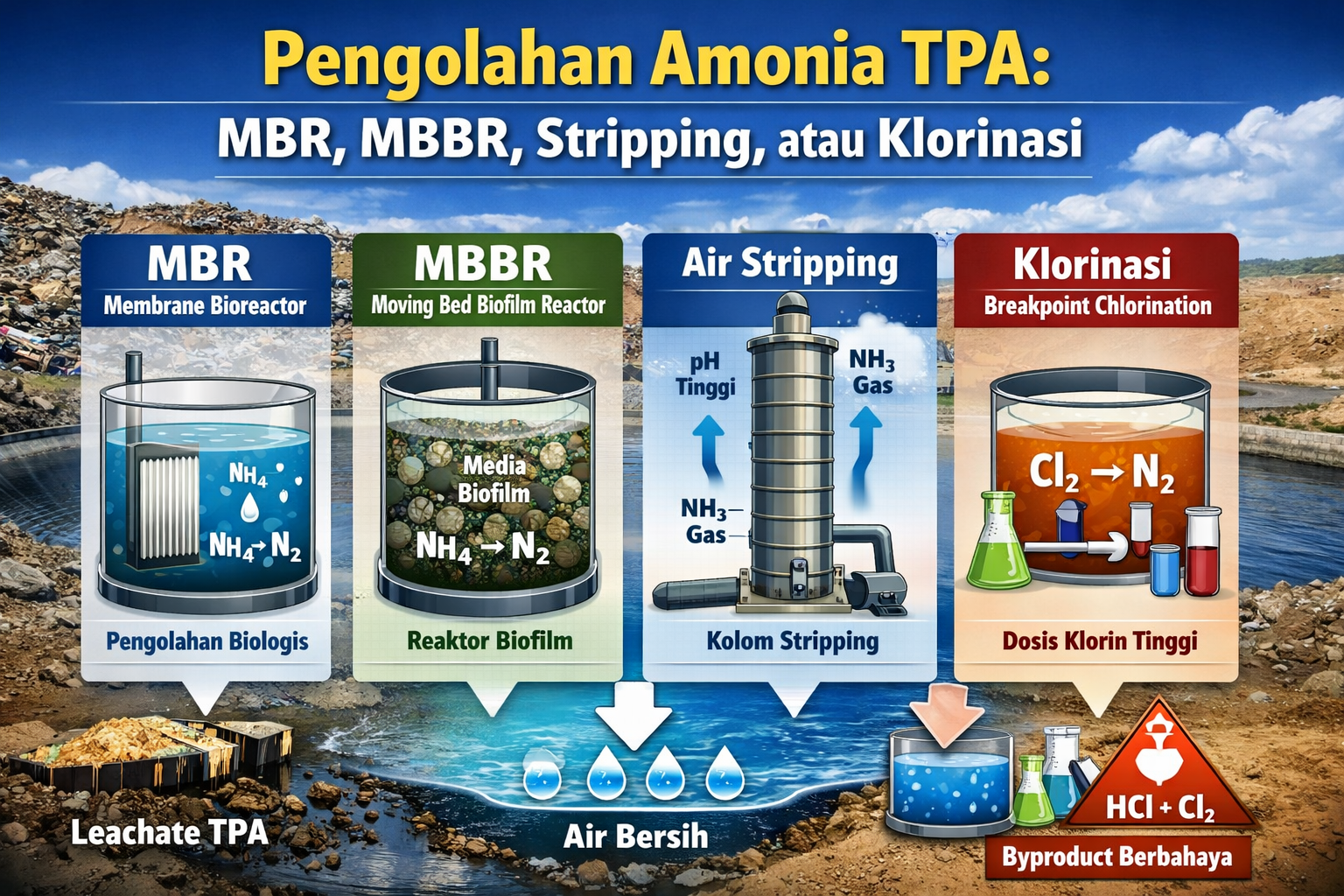
Breakpoint chlorination chemically oxidizes ammonia to nitrogen gas. With sufficient dose to the “breakpoint,” effluent NH₃ can be pushed below 0.1 mg/L under ideal conditions (nepis.epa.gov). The theoretical reagent ratio is steep — ~7.6:1 Cl₂ per NH₄ by weight — and real‑world doses rise if COD or other oxidizables are present (wastetodaymagazine.com).
Byproducts and alkalinity are concerns. Chloramines and even potentially explosive nitrogen trichloride (NCl₃) can form, and total dissolved solids (TDS) increase. Maintaining reaction pH typically draws ~15 mg CaCO₃ alkalinity per mg‑N (wastetodaymagazine.com). One waste‑industry review concludes: “This method is generally only used to ‘polish’ effluent wastewater with lower concentrations of ammonia” (wastetodaymagazine.com).
Downstream control of chlorinated byproducts often leans on granular media; many operators specify activated carbon for polishing. To meet discharge limits for residual chlorine, dedicated dechlorination agents are routinely applied.
Other physical–chemical routes (brief)
Ion exchange (e.g., ammonium‑selective zeolites) can remove NH₄ but is prone to fouling and requires pretreatment. Precipitation as struvite (magnesium ammonium phosphate, MAP) is constrained by phosphate availability and competing cations. Advanced oxidation (chlorine dioxide, ozone, Fenton) can oxidize NH₃/NH₄ to N₂, but tends to be chemical/energy intensive and may produce nitrite/nitrate. Where resin‑based capture is warranted, an ion exchange resin provides the required selectivity.
Quantitative comparison and trade‑offs
Removal efficiency: Well‑operated biological SBR/MBR/MBBR systems commonly achieve >85–95% ammonium or total‑N removal (mdpi.com; pmc.ncbi.nlm.nih.gov; mdpi.com). Air/steam stripping typically reaches ~90–95% removal at high pH, with a practical ceiling near 95% (researchgate.net; researchgate.net). Breakpoint chlorination can drive residual NH₃ to effectively zero under ideal control (nepis.epa.gov).
Required conditions: Biology needs retention time and, for denitrification, sufficient organic carbon; nitrifiers prefer near‑neutral pH and warm temperatures. Stripping demands pH ≥10.8–11.5 and high air flow; steam stripping adds heat. Breakpoint chlorination hinges on high chlorine dose, tight pH control (pH 6–8), and robust mixing (nepis.epa.gov; wastetodaymagazine.com).
Operational complexity: SBR/MBR/MBBR are mainstream; operators manage sludge, aeration, and occasional alkalinity or carbon feeds. MBRs add membrane cleaning. Stripping towers require caustic handling and off‑gas scrubbing (often to acid). Chlorination demands precise dosing and subsequent dechlorination for residual control.
Byproducts: Biological routes produce biomass (sludge), often at low yields, especially in biofilm systems. Stripping concentrates ammonia into off‑gas or acid, with treated water gaining salinity from neutralization. Chlorination adds chlorinated organics/inorganics and TDS, typically addressed via post‑polishing.
Cost and energy: Biological nitrification typically consumes ~1.5 kWh/kg‑N oxidized (researchgate.net), with modern MBRs around 0.4–0.7 kWh/m³ in municipal reuse settings (researchgate.net). Stripping carries significant reagent costs (e.g., ~$0.25–0.5/kg‑NaOH equivalent per kg‑N) plus blower energy (order of 0.5–1.5 kWh/m³ of air, translating to a few kWh/kg‑N depending on loading). Breakpoint chlorination is chemically intensive: ~7.6 kg Cl₂ per kg‑N, and at $500–700/tonne Cl₂, that’s >$3.8/kg‑N before pH control. A full‑scale German survey found retrofitting to deammonification (partial nitritation/anammox) versus conventional nitrification–denitrification saved ~€25,850/year (~29% O&M reduction), largely by cutting external carbon (researchgate.net), underscoring the efficiency of specialized biological schemes for very high‑N leachate.
Decision framework for technology selection
-
Leachate composition: With BOD:N >0.5, conventional SBR/MBR/MBBR nitrification–denitrification is feasible because organics fuel denitrification. With low BOD:N (mature leachate), nitrification alone leaves nitrate; consider anammox (if feasible) or a physical process like air stripping. For ~100–300 mg/L NH₄ and ample COD, biology is typically best; for ≫500 mg/L NH₄ and little COD, an initial chemical removal step can right‑size reactors.
-
Effluent requirements: For near‑zero NH₃ targets (e.g., <1–3 mg/L), biology alone can deliver effluent in the low mg/L range (mdpi.com), with polishing (e.g., air stripping or adsorption) as insurance. For discharge to a POTW, partial removal (to <100 mg/L) may suffice. For reuse, an MBR with potential stripping polish offers highest quality.
-
Climate: Tropical temperatures favor biology year‑round. In cold settings, nitrification slows below ~10°C, and heating costs can tilt designs toward chemical stripping.
-
Cost and resources: When land is scarce or effluent TSS must be minimal, MBR’s higher capex can be justified. Where space allows, SBR/MBBR offer lower capex. Stripping towers (higher capex/opex) pencil out mainly for >500–1000 mg/L NH₄ or when ammonia recovery is desired. Breakpoint chlorination is rarely used at scale, reserved for polishing due to cost and disinfection byproducts.
-
Operational expertise: Biology requires skilled operators for acclimation and sludge control. Stripping requires caustic/acid handling and continuous pH control. Chlorination mandates precise dosing, safety protocols, and reliable residual quenching.
For most Indonesian landfills with moderate‑to‑high leachate production and high nitrogen loading, a biological treatment train is the default — often anchored by an SBR, MBR, or MBBR — with optional tertiary polishing. For extreme ammonia or low‑carbon leachates, pair nitrification with air/steam stripping, or pursue advanced biological routes such as single‑stage nitritation–anammox. Piloting to benchmark removal percentages and kWh/kg‑N for shortlisted designs on actual leachate is recommended to finalize the choice.
Sources: Peer‑reviewed studies and technical reports provide the removal figures and case data cited here (mdpi.com; pmc.ncbi.nlm.nih.gov; mdpi.com; mdpi.com; researchgate.net; wastetodaymagazine.com; wastetodaymagazine.com). All URLs are cited inline above.