

Industry: Landfill | Process: Leachate_Pre
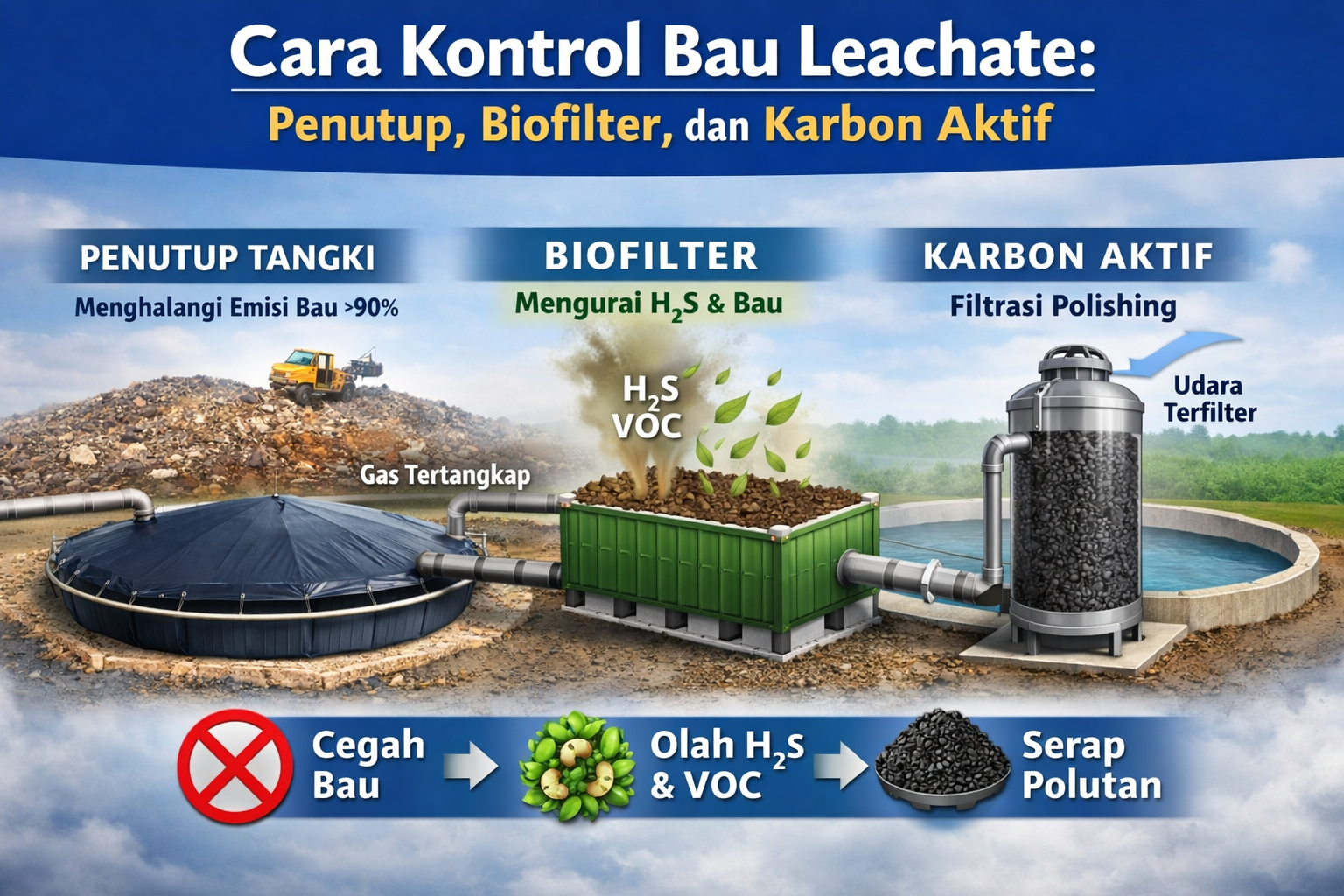
At landfill leachate treatment plants, odor control is less about air freshener and more about engineering. The fastest wins come from putting a physical lid on the problem and routing gases to proven destruction steps. Industry sources call it out plainly: “covering tanks, basins, and/or lagoons with high-quality covers is often the best solution for reliable odor control” (lemna.com).
After capture, biological filters oxidize hydrogen sulfide (H2S) and volatile organic compounds (VOCs); granular activated carbon (GAC) adsorbs residual odorants; and chemical agents knock down spikes. Regulatory guidance has even emphasized “Install an impermeable cover” to control odor and vent or treat the trapped gas (nepis.epa.gov).
Tank and pond covers (physical containment)
Open basins and tanks are odor point sources. Floating geomembrane or fabric covers (often 10–50 m diameter) are custom-built to seal the liquid surface, forcing any gas buildup to rise to a collection vent. In practice, “open basins and tanks are… covered with a floating cover, ensuring that the released odour vapours are collected and evacuated for further treatment” (task.be). Self‑supporting dome covers can be fitted over tanks (up to ~20 m span) or over ponds (up to ~50 m) and include ports for piping off‑gas.
By preventing diffusion into ambient air, covers can suppress >90% of odor emissions (effectively hiding the odor source) (lemna.com). They “prevent the bad odours from spreading” and give operators a single vented stream to treat (task.be). After covering, the captured vapor stream can be treated via chemical or biological scrubbers, biofilters, or activated carbon beds (“Depending on the nature of the off‑gases… [they can be sent] to a chemical gas scrubber, a biological gas scrubber, [a] biofilter or active carbon filter. Often… such an installation is already present and can easily be connected” — task.be).
Covers do impose costs and maintenance (tensioning, cleaning, vent gas handling), but they deliver an immediate reduction and lower community nuisance and worker exposure. EPA guidance has long pointed to an “impermeable cover” with appropriate venting (nepis.epa.gov).
Biofiltration of captured off‑gases
Biofilters are packed beds of moist media (compost, wood chips, peat, or engineered media) where microorganisms oxidize H2S and other odorants. In one sanitary landfill application, Li et al. (2012) reported >90% H2S removal in summer and >80% in winter over sustained operation (agris.fao.org). Peak elimination capacity reached 9.1 g H2S/m3·h at a loading rate of 10.5 g/m3·h (agris.fao.org).
Omri et al. (2013) found ~99% H2S removal from a 200–600 mg/m3 inlet at a 60 s empty‑bed retention time (EBRT, the gas residence time through media) (pmc.ncbi.nlm.nih.gov). Literature consistently shows biofilters can achieve 80–99% H2S removal when properly designed and maintained. Performance hinges on gas load, humidity, and temperature: at ≤6 g/m3·h H2S loading, 99% removal was sustained; at ~10 g/m3·h, removal dropped to ~64% (pmc.ncbi.nlm.nih.gov).
The biological process oxidizes H2S primarily to sulfate (with some elemental sulfur in the bed) (agris.fao.org). Media typically must stay moist (40–60% water content) and near neutral pH. Operating costs are low and no chemicals are needed, but systems require footprint and periodic irrigation or media replacement.
Biofilter example metrics:
- Inlet H2S: 26–213 mg/m3; Removal: >90% (summer) (agris.fao.org)
- Inlet H2S: 200–600 mg/m3; Removal: ~99% (60 s EBRT) (pmc.ncbi.nlm.nih.gov)
- Elimination capacity: 9.1 g/m3·h at load 10.5 g/m3·h (agris.fao.org)
- Outlet H2S: <5 mg/m3 (for 200–600 mg/m3 in) (pmc.ncbi.nlm.nih.gov)
Activated carbon adsorption for off‑gas polishing
Granular activated carbon filters remove odorous compounds by adsorption. The key advantage is immediate efficacy: no biological acclimation is required, and a fresh bed starts working instantly (anuainternational.com). Activated carbon can remove a broad spectrum of odorants with efficiencies often quoted as 90–99% for low‑concentration streams (anuainternational.com), and installation is relatively simple with modest capital compared to larger biological or chemical systems (anuainternational.com). For carbon media selection, operators typically source activated carbon suited to H2S, mercaptans, and VOCs.
Limits are well known. Adsorption capacity for H2S is ~0.4–0.5 mg H2S per g carbon (mdpi.com), so beds saturate quickly at higher loads. Sources note carbon filters are “not well suited for higher H2S concentrations (>20 ppm)” (anuainternational.com). Media changeouts are expensive and “involve confined‑space entry,” with a risk of odor breakthrough as beds become spent (anuainternational.com).
Example from literature: a compost/GAC biofilter removed 75–99% of 35–450 ppm H2S at 20–60 s EBRT (pmc.ncbi.nlm.nih.gov). In summary, carbon offers strong odor/VOC removal (often >95% in the effective range — anuainternational.com) and is typically deployed as a polishing step after biofiltration or chemical scrubbing.
Chemical odor‑neutralizing agents and in‑tank dosing
Chemical treatments convert odor molecules to non‑odorous forms. Strong oxidants like hydrogen peroxide (H2O2) react rapidly with H2S; at pH <8.5 the reaction is H2O2 + H2S → S + 2H2O (nepis.epa.gov). Ozone (O3) and chlorine (Cl2) are even stronger oxidants often used in lagoon odor control. Such chemicals can instantly inactivate H2S, and “a narrow dose of H2O2 (or peracetic acid) can often reduce H2S by >90%,” though costs rise with higher load. Facilities that adopt these supplemental steps generally rely on standard water and wastewater chemicals for oxidants and additives.
Inorganic additives bind or biologically oxidize sulfide. Ferric chloride (FeCl3) dosing (~300 mg/L to raw sewage) cut dissolved H2S by ~100% (essentially all H2S removed), though the water became acidic (researchgate.net). Small doses of nitrate (e.g., 4–6 mg/L as NO3–N) can biologically oxidize H2S in situ: adding 4–6 mg/L NaNO3 dropped a carbon‑column effluent’s H2S from ~9.5 mg/L to <1 mg/L (nepis.epa.gov). Bases such as NaOH or Ca(OH)2 raise pH above the H2S dissociation point, converting H2S to HS– and reducing odor; carbonate salts (NaHCO3/MgHCO3) also buffer pH and can mask odor.
Masking agents (often proprietary surfactants or fragrances) are sprayed on working faces or tanks — typical examples include bleach, baking soda, ammonium bicarbonate, caustic soda, or organic amines (nepis.epa.gov). Regulatory guidance cautions these are only temporary: “odor neutralizers are considered temporary measures as the products typically do not prevent the production of odorous compounds” (nepis.epa.gov).
Overall, in‑line chemical dosing (H2O2, NaOCl, NaNO3, Fe3+, etc.) can oxidize or bind 90–100% of detectable H2S under controlled conditions (nepis.epa.gov; researchgate.net). These methods are useful for shock treatment or polishing but incur ongoing chemical costs and safety considerations, and may create secondary streams (e.g., sulfate‑rich effluent, low pH). They are generally used to supplement covers/biofiltration.
Implementation considerations and layered approach
The data support a layered approach: cover odorous leachate units and actively treat the collected air stream. Floating or engineered tank covers can suppress >90% of odor dispersion (lemna.com; task.be), while biofilters routinely deliver ~90–99% H2S removal with minimal waste (agris.fao.org; pmc.ncbi.nlm.nih.gov). Activated carbon beds remove a wide range of odorants but require replacement at ~0.4–0.5 mg H2S/g capacity (mdpi.com) and incur media costs (anuainternational.com). Chemical oxidants/additives can achieve near‑total H2S destruction (e.g., FeCl3 or H2O2) but should not be the sole long‑term solution (researchgate.net; nepis.epa.gov), and sprays merely “mask” emissions without preventing H2S generation (nepis.epa.gov).
Operators must weigh capital and operating costs — media, energy, chemical cost — against abatement needs. In practice, covers plus biofiltration, optionally polished by carbon and backed by targeted chemical dosing, provide the strongest, data‑backed control of leachate odors. For consumables and oxidants used in supplemental dosing, utilities typically source standard water/wastewater chemicals alongside the adsorbents already noted.