
Mature landfill leachate often runs alkaline and hard — a perfect storm for calcium carbonate scale. Industrial inhibitors can suppress it at milligrams‑per‑liter, if selected and dosed against real‑world leachate data.
In landfill leachate systems, the villain is usually hiding in plain sight: carbonate hardness. As leachate ages, its pH tends to climb to ≈8–8.5, driven by biodegradation and carbonate buffering (younger leachate can be acidic) (frontiersin.org). At the same time, alkalinity commonly sits in the hundreds to thousands of mg/L as CaCO₃ (bowser-morner.com).
That chemistry sets up carbonate precipitation anywhere the water loses CO₂, concentrates, or warms — from storage to heat exchangers to membrane RO. Operators running integrated membrane systems see this quickest on high-shear surfaces.
Leachate chemistry and carbonate supersaturation
Measured field data underscore the risk. Construction/demolition leachate has shown calcium in the hundreds of mg/L, magnesium in the low hundreds, and total alkalinity often 260–3600 mg/L (average ≈2100 mg/L as CaCO₃) (bowser-morner.com) (bowser-morner.com). In Lebanon, aged leachate (pH 8.26) contained ~59 mg/L Ca and ~32 mg/L Mg (mdpi.com). These ions often derive from dissolution of carbonate minerals like concrete and gypsum, and from organic breakdown that produces bicarbonate (HCO₃⁻) (bowser-morner.com).
The result: leachate is frequently supersaturated with respect to calcite. On indices like LSI (Langelier Saturation Index, a common supersaturation indicator), values >0 are routine, and any rise in pH or temperature triggers carbonate fouling (ascelibrary.org) (bowser-morner.com). An ASCE study puts a finer point on it: the primary cause of clogging in landfill leachate collection pipes is CaCO₃ precipitation (ascelibrary.org), with deposits that can quickly choke pipes, pumps, and heat exchangers — even causing “catastrophic failures” (ascelibrary.org).
Other scales do appear — calcium sulfate where gypsum‑derived sulfate is high, iron hydroxides as pH rises, and struvite (MgNH₄PO₄·6H₂O, a magnesium ammonium phosphate mineral) when ammonium and phosphate align — but CaCO₃ dominates in many landfills (ascelibrary.org).
Scale inhibitor classes and mechanisms
Chemical scale inhibitors work by “threshold” effects (disrupting crystal nucleation/growth) or by complexing hardness ions into soluble forms. The major classes are phosphonates (e.g., HEDP, ATMP, PBTC), polycarboxylate polymers (e.g., polyacrylates, polymaleates, polyaspartates), and polyphosphates (researchgate.net) (researchgate.net).
Potency varies by chemistry. Phosphonates are extremely effective — 0.02–10 mg/L can reduce CaCO₃ fouling by >90% (researchgate.net) and 10–20 mg/L has delivered ~94–96% reduction (researchgate.net). Even inorganic phosphate at 2 mg/L shows notable inhibition in tests (researchgate.net).
Polyacrylates typically require a few mg/L: 5–10 mg/L often yields ~60–90% reductions in calcite fouling, with effects plateauing or varying around 25 mg/L depending on water chemistry (researchgate.net) (researchgate.net). Polycarboxylic acids such as polyaspartate‑type polymers have posted ~80% fouling reduction at ~1 mg/L in specific tests (researchgate.net).
Trade‑offs matter. Phosphonates tolerate hot, high‑ionic waters but add phosphorus and resist biodegradation. Polyacrylates are phosphorus‑free and generally cheaper but less potent and vulnerable to oxidative breakdown (e.g., by chlorine) (researchgate.net). Blends — a phosphonate plus a dispersant polymer — are common in high‑calcium leachates to combine threshold inhibition with dispersion.
Environmental profiles are in focus. Reviews note widely used chemistries (aminophosphonates, polyphosphates, polyacrylates) show low biodegradability and can contribute to eutrophication (researchgate.net). As a result, R&D is pivoting to “green” inhibitors — polyaspartates, polyglutamates, or phosphonate copolymers with biodegradable fragments — and industry reviews highlight environmentally friendly, biodegradable polymers as a focus area (researchgate.net). Many suppliers promote “biodegradable scale inhibitor” blends based on polyacrylate‑succinate copolymers.
It’s a big market: scale inhibitors totaled about $4.7 billion in 2019, with North America, Europe, and Southeast Asia leading consumption (researchgate.net) (researchgate.net).
Selecting chemistry for landfill leachate
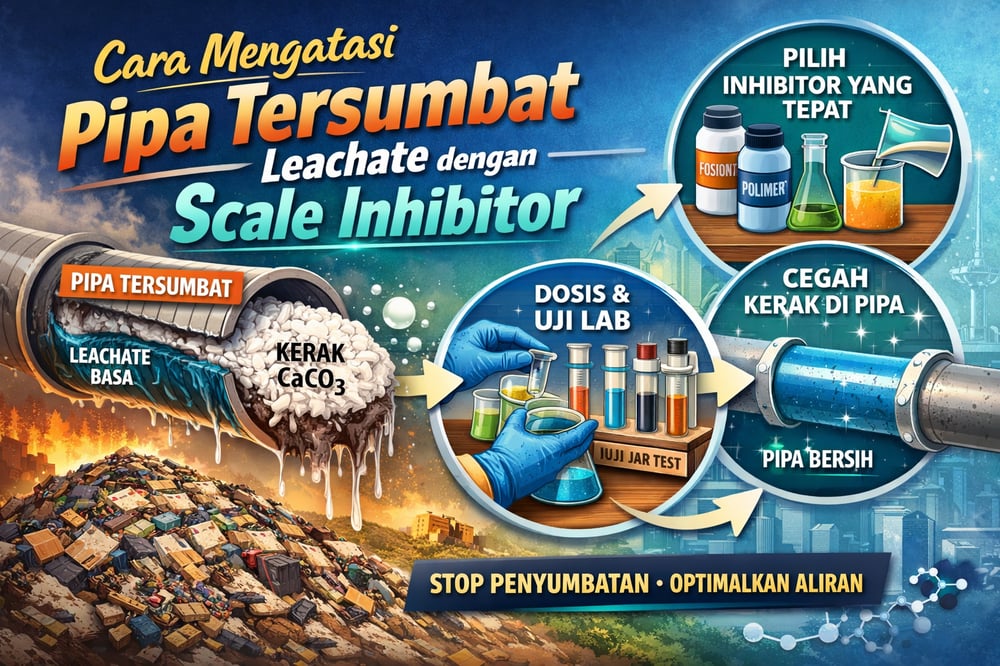
Start with characterization: pH, alkalinity, Ca/Mg hardness, sulfate, silica, temperature, turbidity/solids, and flow regime. If pH is near neutral but carbonate alkalinity is high, CaCO₃ scalability is high. Temperature or concentration steps — for example, membrane RO or evaporation — increase risk further (ascelibrary.org). For facilities using reverse osmosis, placing the inhibitor feed upstream of units such as a brackish-water RO can reduce downstream fouling pressure without changing the core process assumptions.
Compute scaling indices such as LSI from lab analyses. As a rule‑of‑thumb example, pH ~8.3 with Ca ~60 mg/L is borderline, while Ca ~300–500 mg/L at pH 8–9 is strongly supersaturated (as seen in some C&D leachates) (bowser-morner.com).
For CaCO₃, leading options are polyacrylates or phosphonates. If gypsum (calcium sulfate) is a risk, phosphonates can also help. Where chlorination or biological systems are present, phosphonates’ stability is an advantage. If phosphorus discharge is constrained (e.g., under Indonesian effluent programs that generally require treated leachate pH ~6–9), phosphorus‑free polymers or lower‑P variants (e.g., ATMP vs. HEDP) are used (check local permit specifics) (scribd.com). Compatibility with biological pretreatment and biodegradability should be weighed.
Bench validation is practical: split raw leachate into parallel vessels; simulate destabilization via heat or CO₂ stripping; dose candidate inhibitors across ranges; measure residual Ca²⁺ or mass of precipitate; and, if needed, analyze inhibitor residuals. Thermodynamic or cooling‑tower style models can guide predictions, but must be validated against the site’s water (researchgate.net).
Dosing and monitoring in the field
For moderate scaling, a starting point is ~5–10 mg/L of a polymeric inhibitor; for severe cases, ~1–5 mg/L of a strong phosphonate. In lab studies, polyacrylates at 5–10 mg/L cut CaCO₃ fouling by ~60–90%, with performance varying at 25 mg/L depending on chemistry (researchgate.net) (researchgate.net). Phosphonates have demonstrated near‑complete inhibition at ~0.02 mg/L in specific tests, and ~94–96% reduction at ~10–20 mg/L (researchgate.net) (researchgate.net).
Field optimization typically chases the minimum effective dose: incrementally adjust feed until conductivity, turbidity, or a probe fouling rate stabilizes at clean‑system baselines; then trim down until small scaling reappears, and step back up (frenchcreeksoftware.com). Parallel treated vs. untreated loops can verify performance. Accurate chemical feed equipment, such as a dedicated dosing pump, helps maintain tight control at the low mg/L regime.
After dosing, monitor scale on heat exchangers, pumps, and membranes, and re‑optimize if upstream conditions (e.g., pH adjustment) change. Environmental considerations persist: any discharge has to meet permits on nutrients or toxicity; low‑P or biodegradable chemistries mitigate this risk. In practice, one case found ~10 mg/L of a polymeric inhibitor cut carbonate deposits by ~90%, while combining a low‑dose phosphonate (e.g., 1–5 mg/L) with a dispersant polymer can practically eliminate formation in severe cases (researchgate.net) (researchgate.net).
Commercially, operators source blended chemistries as a packaged scale inhibitor for raw leachate lines or upstream of RO trains, including where the RO is part of a membrane system for high‑TDS waters.
Practical recommendations
- Analyze leachate for pH, alkalinity, Ca, Mg, and solids; compute scaling indices (LSI, RSI) to confirm carbonate tendency.
- Identify scaling scenarios: look for pH or temperature changes in storage ponds, heaters, and RO/NF systems (these are injection points) (ascelibrary.org).
- Pilot test inhibitors: bench jar tests with polyacrylate, phosphonate, etc., at incremental doses; target ≥90% fouling reduction with minimal dose, using the literature as benchmarks (researchgate.net) (researchgate.net).
- Optimize dose in‑situ: start around 2–5 mg/L polyacrylate or 0.5–2 mg/L phosphonate, then adjust based on monitored performance; employ minimum‑effective‑dose tactics (frenchcreeksoftware.com).
- Consider environment/regulation: avoid violating effluent limits; if phosphorus is constrained, select phosphorus‑free or biodegradable formulas; Indonesian programs generally require pH ~6–9 for treated leachate (scribd.com).
- Review trending practices: industry is moving toward “green” inhibitors (polyaspartate/maleate blends, etc.) because they ultimately biodegrade (researchgate.net).
Source notes and citations
Leachate composition surveys show pH 7–9 with Ca/Mg in the tens–hundreds mg/L (frontiersin.org) (mdpi.com) (bowser-morner.com) (bowser-morner.com). Field studies confirm CaCO₃ as the main clog in leachate pipes and highlight the risk of “catastrophic failures” (ascelibrary.org).
Scale‑inhibitor performance and market/trend data are drawn from industry reviews: e.g., 5–10 mg/L polyacrylate delivers ~60–90% CaCO₃ inhibition; 0.02 mg/L of specific phosphonate chemistries can fully inhibit under lab conditions; 10–20 mg/L phosphonate achieves ~94–96%; 2 mg/L inorganic phosphate shows inhibition; 1 mg/L polycarboxylic acid can give ~80% reduction; global spend ~US$4.7 billion in 2019, with North America, Europe, and Southeast Asia leading consumption; R&D is focused on biodegradable polymers (researchgate.net) (researchgate.net) (researchgate.net) (researchgate.net) (researchgate.net) (researchgate.net) (researchgate.net) (researchgate.net).
Dose‑modeling and optimization methodologies referenced are consistent with oilfield/cooling‑water practice and emphasize validation and minimum effective dosing (frenchcreeksoftware.com).
In short, aligning inhibitor chemistry to the leachate’s supersaturation profile — and feeding it precisely through the raw leachate line or ahead of RO — can suppress scale even in high‑pH, high‑alkalinity streams. Where membrane trains are central to the flowsheet, pairing upstream chemical control with the design basis of a brackish-water RO helps protect recovery without redesign.
