

Industry: Brewery | Process: Boiling
Beerstone chemistry and consequences
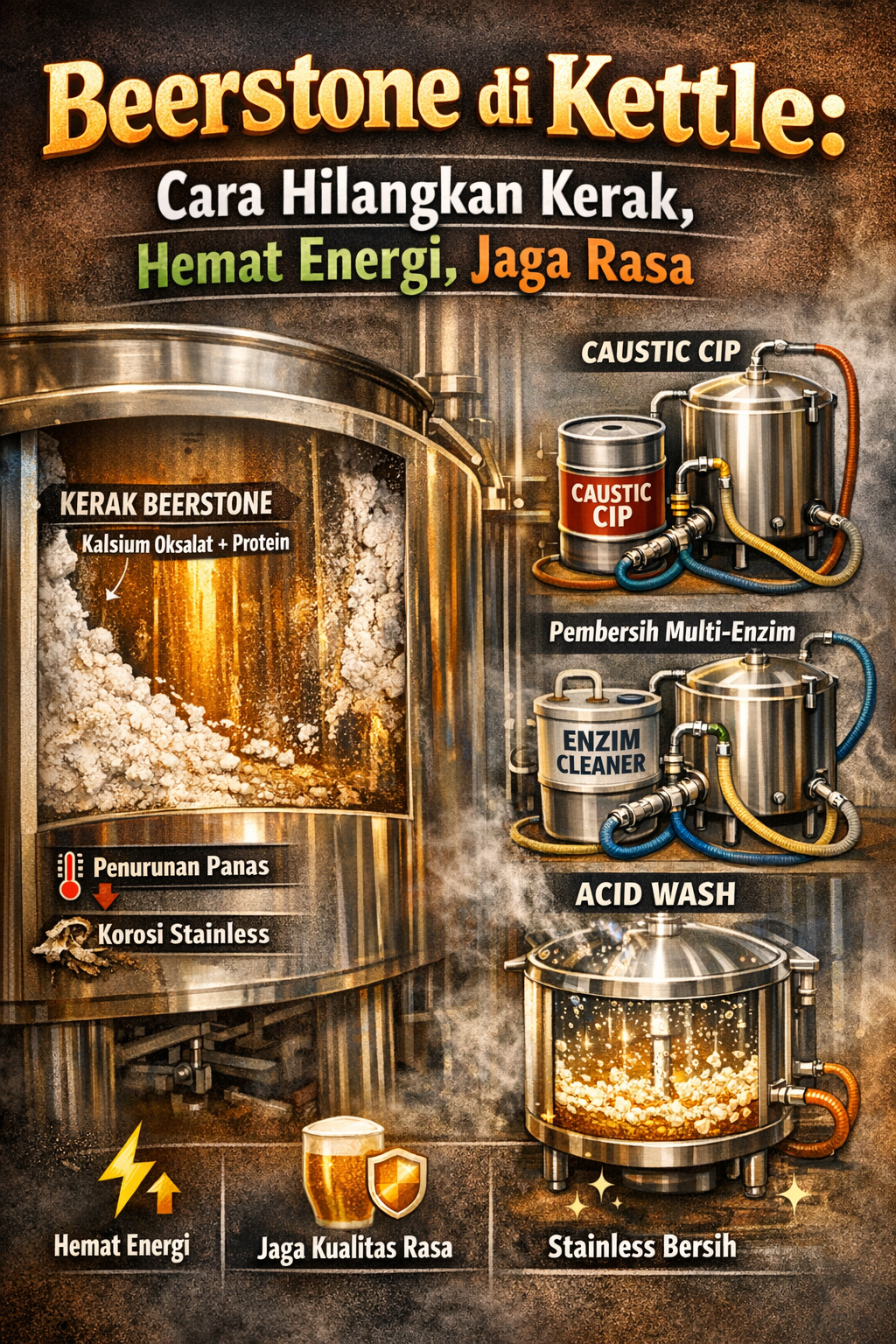
Beerstone is a tenacious composite of calcium–magnesium oxalates and entrained proteins/polypeptides that precipitate from wort and beer (www.morebeer.com) (www.beerlab.co.za). It commonly appears as a chalky gray‑white film on stainless surfaces (kettle shells, coils, heat exchangers, valves, etc.). Because it embeds proteinaceous matter, beerstone cannot be sanitized – it harbors spoilage microbes and fouling organisms, thwarting surface sanitation (www.morebeer.com) (www.beerlab.co.za).
In heat exchangers and kettle jackets these deposits act as insulation, degrading thermal transfer; on stainless steel they can break the passive oxide layer and permit pitting corrosion (www.morebeer.com). In short, any beerstone left untreated can cause off‑flavors (from microbial growth) or equipment failure (scale, corrosion), so breakage of the organic matrix is essential. Most brewers therefore adopt preventive CIP (cleaning‑in‑place): soften cleaning water and use trials to avoid build‑up. Parkes notes “the easiest way to deal with beerstone is to prevent it by using proper cleaning techniques regularly,” such as soft rinse water and chelated cleaners (www.morebeer.com). Once beerstone is visible, removing it chemically is extremely laborious – even at high caustic/acid concentrations brewers report needing hours or days of scrubbing (www.morebeer.com).
Caustic alkaline regimes (dose and additives)
Traditional brew‑house CIP relies on alkaline detergents (typically NaOH) to hydrolyze proteins and organic soils. Strong caustic (>pH 12) at elevated temperature (60–80 °C) will melt hop resins, destroy oils and break peptide bonds (www.morebeer.com). However, pure NaOH also reacts with Ca/Mg hardness, so brewery caustic cleaners are “built” with additives. Modern caustic CIP formulations include chelating agents (EDTA, gluconates, polyphosphates) and low‑foaming surfactants (www.morebeer.com) (www.craftbrewingbusiness.com).
The chelators bind hardness ions to prevent new scale precipitation, while surfactants improve soil wetting and rinsability. For instance, EDTA is “a recommended component of many brewery caustic (and noncaustic) cleaners” (www.morebeer.com). Brewers have found that these additive‑rich caustics can greatly reduce chemical usage and even negate the need for an acid step in light soils (www.craftbrewingbusiness.com). In practical terms, typical CIP concentrations are on the order of 1–4% w/v (weight/volume) NaOH at ~65–75 °C for 20–40 minutes (www.morebeer.com).
If tanks hold CO₂, it must be vented before adding caustic: otherwise CO₂ reacts with NaOH to form Na₂CO₃, which “can reduce the effective concentration of the caustic by about 50%” or even collapse the tank via vacuum (www.morebeer.com) (www.morebeer.com). Brewers often spike caustic washes with oxidizers (e.g. hydrogen peroxide or percarbonate) to tackle stubborn protein/calcium soils (www.craftbrewingbusiness.com). Note that chlorinated alkalis (sodium hypochlorite) were once used for extra protein removal, but exposure to high caustic followed by acid can evolve chlorine gas – a dangerous practice (www.morebeer.com). In sum, caustic cleaning is highly effective on organic soils when properly formulated, but on its own will precipitate hardness unless countered by sequestrants (www.morebeer.com) (www.craftbrewingbusiness.com).
Multi‑enzyme cleaners (scope and limits)
Breweries have begun trialing enzymatic (multi‑enzyme) cleaners as substitutes for caustic. These contain cocktails of proteases, amylases and other hydrolases tailored to digest the organic matrix at moderate pH (typically pH 9–11) and warm temperatures (~45–60 °C) (www.the-home-brew-shop.co.uk). Such formulas are marketed to “break down the organic residues… left behind when brewing beer” (e.g. carbohydrates from starch, proteins, hop/caramelized solids) (www.the-home-brew-shop.co.uk).
In practice, enzymes can dissolve protein films and biofilm more selectively than caustic, often in one cycle. One proteolytic cleaner recommends 5–10 g/L (0.5–1%) at 50–60 °C for 10–30 min (www.the-home-brew-shop.co.uk), claiming “time and water savings” and full biodegradability (>98% in 28 days) (www.the-home-brew-shop.co.uk). In controlled comparisons (in dairy and brewing contexts), enzyme washes have removed organic soils at similar or faster rates than caustic at lower chemical strength (www.brewops.com). However, enzymes alone do not dissolve mineral scale. Breweries using enzyme cleaners still find that residual oxalate salts must be treated with acid. Parkes summarizes that any effective program must include an acid attack on the oxalate: “alkaline detergent to ‘digest’ the protein, followed by an acid detergent to dissolve the minerals” (www.morebeer.com). Thus, enzyme cleaners can reduce caustic usage and improve worker safety, but they are complementary rather than complete solutions for beerstone.
Acid detergents for mineral oxalates
The acid wash is crucial for dissolving the Ca/Mg oxalate crust of beerstone. Brewers typically use a formulated acid detergent (e.g. a blend of phosphoric and nitric acids with surfactants) at about ~0.5–1% v/v, recirculated hot (60–75 °C) for 20–40 min (www.morebeer.com). This step dissolves calcium carbonate/hard‑water scale and oxalates, and the nitric‑phosphoric synergy preserves steel. Nitric acid boosts protein hydrolysis and provides stainless passivation, while phosphoric allows high temperatures without rapid vaporization (www.morebeer.com).
A well‑formulated acid CIP will rapidly dissolve visible beerstone. On kettle jackets, Parkes notes that “acid is the best way to remove the white calcium deposit on the jacket” (www.craftbrewingbusiness.com). In practice, some brewers do an acid‑first or single‑stage acid CIP to avoid a CO₂ purge (since strong acid will not react explosively with CO₂). Others alternate as in the traditional regimen (www.morebeer.com). After acid, a thorough cold‑water rinse is essential to remove residual low‑pH liquid. Care: phosphoric–nitric acid cleans are powerful; OSHA‑like precautions are needed, and effluent neutralization may be required before disposal.
Kettle CIP sequence (validated parameters)
An effective brewery CIP program combines the above chemistries into a repeatable sequence. A typical kettle‑fermenter CIP might run as follows: pre‑rinse with warm water (often softened or RO water) using a spray ball, pulsed to flush solids and purge CO₂ (www.morebeer.com). Many brewhouses meet the “softened” brief via an in‑line softener (see </products/softener>), while reverse osmosis (RO) systems supply low‑TDS rinse water where needed (</products/brackish-water-ro>).
Alkaline wash: recirculate 1–4% hot caustic (or noncaustic oxygenated alkali) for 20–40 min at ~65–75 °C; purge all headspace beforehand to avoid CO₂‑neutralization of caustic (www.morebeer.com) (www.morebeer.com). Monitoring tools (flow, pump pressure, pH/conductivity) ensure full circulation; where enzymes are used, substitute the alkaline step with the enzyme make‑up per the supplier dose and contact time.
Intermediate rinse: thorough warm rinse (typically 1× tank volume) to remove alkali. Conductivity or pH sensors on the return line can verify when rinsewater is free of caustic. Automated systems can cut rinse volumes by ~50% by signalling completion (www.brewops.com) (www.brewops.com).
Acid wash: recirculate ~0.5–1% phosphoric/nitric acid at ~65–75 °C for 20–40 min to dissolve oxalate scale and hard‑water salts on the kettle wall and heat‑exchanger (www.morebeer.com). Spray devices must reach all soiled areas; spray balls or self‑rotating jets at ≥5–7 bar supply are ideal (www.foodengineeringmag.com).
Final rinse: cold water rinse (1–2× tank volume) to remove acid. Sanitization: many breweries include a cold peracetic‑acid (PAA) or iodophor step (e.g., 0.5–1% PAA at ambient for 5–10 min) (academicjournals.org). PAA is common as a no‑rinse sterilant because its breakdown is safe for food equipment (www.asianbeernetwork.com) (www.morebeer.com). After CIP the tank is drained and filled with sterile water or inert gas until next use.
Instrumentation, water quality, and verification
Key operational tips include using softened/lowered‑hardness water or adding sequestrant to caustic to prevent new scale (www.morebeer.com). Where higher purity rinse is required, plants often extend pretreatment with membrane‑based RO as part of their water train (</products/membrane-systems>). Clean‑in‑place piping and spray balls must function correctly; velocity around ~1.5 m/s in lines promotes turbulence for cleaning (www.alfalaval.com.au). Recording and validation of each cycle, plus regular calibration of sensors and pumps, are recommended (www.brewersjournal.info) (www.brewersjournal.info).
For chemical control, breweries standardize make‑up and addition for repeatability; accurate chemical dosing supports consistent concentration control (</products/dosing-pump>). For each vessel (kettle, mash tun, bright tank, etc.) the cycle and mix may be tuned (e.g. longer duration on steam‑jacketed kettle versus fermenter). Verification after CIP using ATP swabs or protein tests is recommended; accepted final rinse ATP is typically <10–30 relative light units (RLU) (academicjournals.org).
Costs, automation, and compliance
One microbrewery study found that using 2% vs. 3% caustic in 100 L fermenter cycles (6/week, 312/year) cut caustic consumption from 39 to 26 drums/year – saving ~£344 annually (with greater savings if chemicals are expensive) (academicjournals.org). Saving just 500 L of rinse water per cycle (across 312 cycles) saved ~£287/year in combined water/sewer charges (academicjournals.org). Thus, monitoring and optimization of CIP (chems %, temperature, rinse volume and time) can have real financial impact (academicjournals.org) (www.researchgate.net).
Management practices matter: document standard operating procedures and train staff on CIP; use sensors/automation for consistency (flow meters, temperature probes, conductivity, or dedicated CIP controllers) so each run is “same as last” (www.brewersjournal.info) (www.brewops.com). Schedule periodic acid‑passivation (e.g. citric or weak nitric flush) to maintain stainless. Track CIP KPIs (chemical use, water/energy use, and cleanliness tests) as part of continuous improvement. Newer breweries increasingly adopt intelligent CIP: real‑time conductivity probes can cut wasted rinse in half by indicating exactly when the tank is clean (www.brewops.com) (www.brewops.com). In all cases, CIP must align with food‑safety standards (e.g. HACCP, GMP).
Source notes and citations
Sources: Authoritative brewing and engineering sources (BrewingTechniques/MoreBeer, Journal of Brewing & Distilling, J. Inst. Brew., Brewing trade magazines, industry white papers) were used. Key data include cleaning cycle recipes and effects (www.morebeer.com) (www.morebeer.com), CIP optimization results (academicjournals.org) (academicjournals.org) (academicjournals.org), and technology trends in CIP automation (www.brewops.com) (www.brewersjournal.info). All claims are backed by inline citations as above.