

From cooling towers to pump rooms, audits are surfacing big wins: higher cooling cycles, smarter drives, and reuse loops that slash bills. Case studies show months‑long paybacks and double‑digit ROI, with regulations nudging the shift.
Industry: Automotive | Process: Assembly_Line_Utilities
An automotive assembly plant’s thirst often sits out of sight, in the utility block. Cooling towers, boilers, chillers, pumps, and fans quietly dominate water and electricity use — and they’re where the fastest savings hide.
In one auto assembly audit, roughly 60% of water went to equipment cooling, 15% was lost to leaks, and only about 20% of wastewater was being reused (elion.co.in) (elion.co.in). Globally, industrial cooling water systems can consume 70–95% of a plant’s total water input (prochemtech.com) (sciencedirect.com).
The fix starts with a rigorous audit: map all water and energy sources and sinks, install flow meters and sub‑meters with logging, review bills and consumption histories, and interview operators to surface wasteful practices (elion.co.in). In Indonesia, policy is a tailwind: the PROPER environmental rating program (Permen LHK 1/2021) explicitly targets “konservasi air” and energy management, and Gov’t Reg. 33/2023 mandates industrial energy conservation (enthalphy.com) (enthalphy.com).
Water and energy audit scope
Typical audit findings cluster around excessive cooling (overdesigned systems or low cycles of concentration), unchecked piping/drain leaks, inefficient cleaning or process rinse water, and underused reuse loops (elion.co.in) (elion.co.in). The same discipline applies to energy: identify major consumers (fans, pumps, compressors, heating), measure motor loads and operating profiles, then pinpoint wastes such as partial‑load operation, heat losses, and outdated insulation.
Once quantified — and benchmarked against similar facilities — the biggest opportunities emerge. Many are in the utility block where constant‑speed motors and once‑through water practices persist.
Cooling tower blowdown reuse
Rather than discharging cooling tower blowdown, plants can route it to other utility uses. Treated blowdown can become boiler make‑up water or feed a closed‑loop heat exchanger — with filtration or softening often required — which “frees up potable water for other high‑value uses” (prochemtech.com). Where hardness is the constraint, a softener can be a low‑lift pretreatment.
Reuse of treated effluent in cooling towers can eliminate municipal make‑up water costs and sewer fees (prochemtech.com). One design that collected all plant drains to cooling tower sumps — then treated that circuit to near zero‑discharge — reused nearly 1 billion gallons per year of reclaimed water (a power plant example, illustrating potential) (powermag.com). Automotive plants can similarly collect and re‑use process effluent as “high‑value” cooling tower make‑up (prochemtech.com).
Process wastewater recirculation
Where washers or coating lines generate wastewater, plants can treat it via filters, settling, and chemical dosing, then loop it into utility uses such as cooling tower make‑up (prochemtech.com). A solids capture step such as a clarifier is a common front end, with metered chemical addition via a dosing pump.
Because treated wastewater is often chemically cleaner than raw make‑up, it may allow higher cycles of concentration in towers with less added chemistry (prochemtech.com). Reviews note that reuse with subsequent zero‑discharge can “totally eliminate” cooling tower effluent (prochemtech.com).
Condensate and rainwater capture
Air‑handling unit/fan‑coil unit (AHU/FCU) condensate — essentially distilled water — can offset a meaningful fraction of cooling make‑up. Collected AHU condensate can supply on the order of 10–15% of a cooling tower’s make‑up water (uce.com.vn). Captured via drain pans and holding tanks, it typically needs filtration/disinfection; a low‑cost option is ultraviolet disinfection.
Boiler steam condensate is another high‑quality source; returning it reduces both make‑up water and fuel needed for feedwater heating. Rainwater harvesting also fits: roof runoff, with filtering and pH adjustment, can supply non‑potable loads (uce.com.vn) (uce.com.vn). For particulate polishing, a cartridge filter is a straightforward add‑on.
Integrated reuse and zero‑discharge
At design or retrofit, plants can capture all process and utility wastewater into a central loop: treat it via reverse osmosis (RO), evaporators, and biological treatment, and reuse nearly 100%. While full Zero Liquid Discharge (ZLD) may be extreme for many plants, hybrid recycling yields sizable returns. RO make‑up systems such as brackish‑water RO and biological trains like membrane bioreactors (MBR) are typical building blocks.
One mid‑sized industrial plant in South Africa eliminated its municipal water bill (R15 million/yr saved) by switching to a borehole+closed‑loop system — “effectively eliminated the company’s dependence on municipal water” and cut sewer fees — delivering a 16× return on investment (bt-industrial.co.za). The lesson from that case: high upfront project cost can pay off many times in recurring water/fee savings.
Reuse implementation checklist
- Route all blowdown and drains to a treatment/recycle loop (e.g., cooling‑tower sumps) (powermag.com).
- Install condensate collection for AC and boiler systems; pump it into make‑up tanks (uce.com.vn).
- Use treated effluent (e.g., from scrubbers or RO reject) as cooling tower or firewater make‑up (prochemtech.com).
- Divert rainwater to surge tanks for make‑up or irrigation (uce.com.vn).
- Consider treating and recycling sterilizer, cleaning, or plating baths on‑site.
Meter reclaimed streams to ensure quality meets spec. Industry benchmarks show reuse programs in refineries and power plants routinely save tens of thousands of cubic meters annually once fully implemented.
Variable‑frequency drives (VFD) on fans and pumps
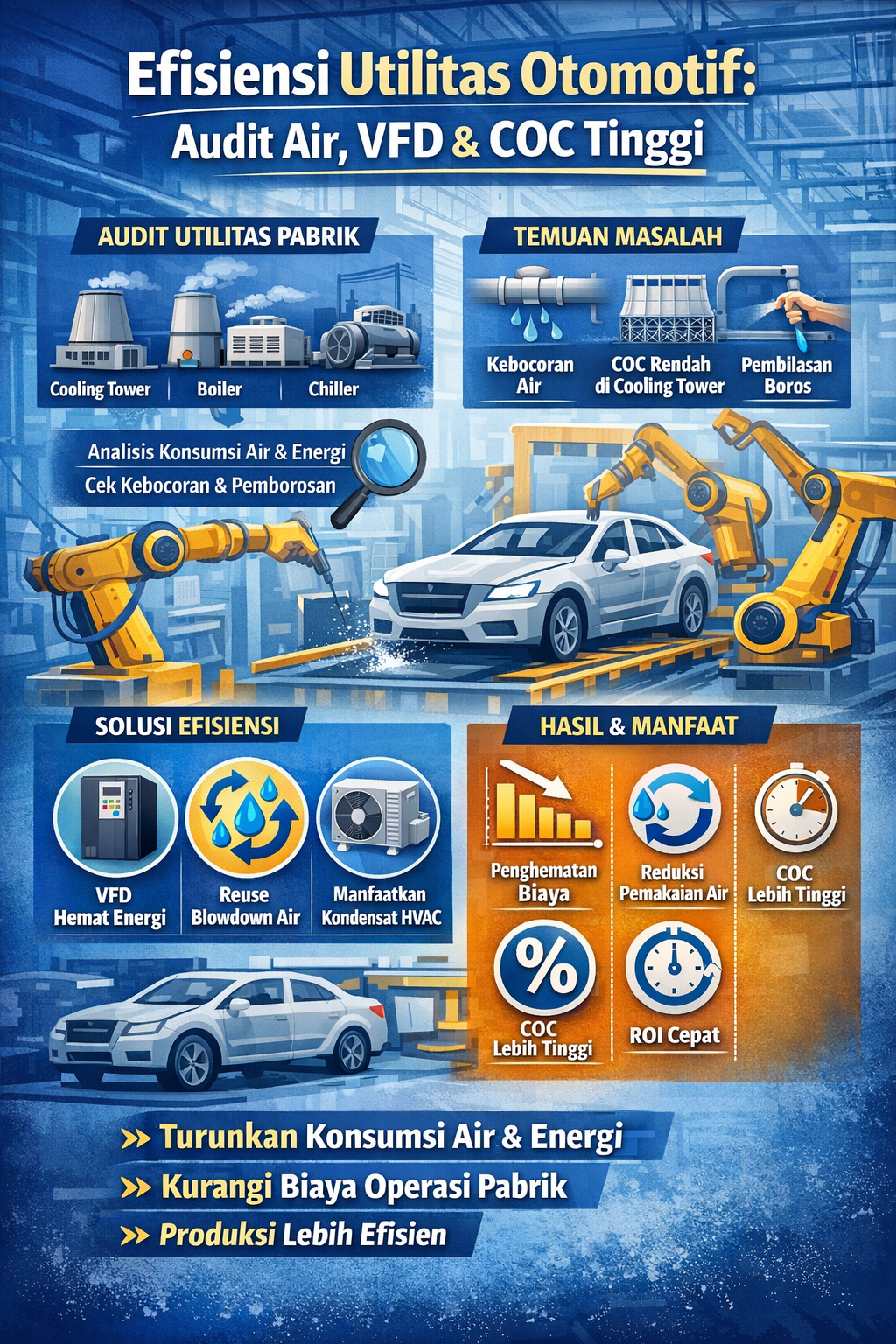
On the energy side, variable‑frequency drives (VFDs; speed controllers for AC motors) often deliver the fastest payback. Because motor power follows the cube of speed (affinity law), dropping fan speed from 100% to 80% can cut power by roughly 50% (processindustryinformer.com).
In practice, a 7.5 kW cooling tower fan with a VFD ran at an average 3.7 kW instead of 7.5 kW over a Johannesburg climate year — saving ~51% energy, or 31,800 kWh/yr (≈US$3,123 at $0.0981/kWh). With the VFD costing about $1,500, simple payback was about six months (processindustryinformer.com) (processindustryinformer.com). In Durban, a similar 7.5 kW fan VFD cut average power to 3.49 kW, saving 53.5% (33,371 kWh/yr, ~$3,274/yr) (processindustryinformer.com) (processindustryinformer.com). Reduced energy bills alone yielded sub‑1‑year ROI; even modest water treatment cost reductions from lower evaporation/blowdown would shorten payback further (processindustryinformer.com) (processindustryinformer.com).
Scale it up and the math still works. Replacing an 18.1 MW boiler‑feed pump’s hydraulic clutch with a VFD cut electricity draw by 11,706 MWh/yr (≈13%); at €0.06/kWh that saved €702,000 annually, paying back the upgrade in under two years. Side benefits included softer starts (no inrush currents), longer equipment life, and reduced maintenance (mb-drive-services.com) (mb-drive-services.com) (mb-drive-services.com).
Bottom line: VFDs on fans and pumps usually pay back in under 1–2 years if equipment runs many hours; even 10–50 HP motors can yield 1–3 year paybacks. Complementary measures include premium‑efficiency (IE3/IE4) motors, high‑efficiency fans and pump impellers, improved insulation on steam/hot water lines, and tighter controls to avoid deadheading or bypass throttling — replacing constant‑speed motors plus throttling valves with VFDs wherever flow varies. Affinity‑law savings are typically 50% at 80% speed (processindustryinformer.com).
Cooling chemistry and cycles of concentration
Cycles of Concentration (COC; the ratio of dissolved solids in recirculating water to that in make‑up) determine how much blowdown a tower needs. Most towers without treatment run at 3–5× (removing 20–33% of flow as blowdown) to avoid scale. Advanced water treatment can elevate COC to 6–10× or more, roughly halving or quartering blowdown.
EVAPCO reports that halving make‑up conductivity (i.e., removing 50% of ions before the tower) allows doubling the COC. Raising COC from 2.5 to 5.0 saved 1.5 million gallons (5.7×10^6 L) annually on a single system (coolingbestpractices.com) (coolingbestpractices.com).
In a 1,000‑ton tower economic analysis, increasing COC from ~2.2 (hard water, polymer treatment) to 10.0 (softened make‑up plus advanced inhibitors) reduced annual make‑up from 17,766,375 to 10,767,500 gallons — a 39% reduction. Blowdown fell from 8,075,625 to 1,076,750 gallons — an 87% cut (prochemtech.com). Operating cost dropped to $167,634/yr in the high‑COC case versus $246,464/yr baseline — saving $78,830/yr — with ~$13,909/yr in salt disposal fees also avoided (prochemtech.com) (prochemtech.com).
This example yielded roughly a 3×5‑year payback (i.e., ~5‑year payback given the figures), counting only operating cost change. Even plants currently at COC 3–5 can, with a partial softener or a new inhibitor package, target 8–10× to cut water by 40–60% and likely pay back in 2–4 years given water and sewer charges. Treatment levers include softening (removing Ca/Mg hardness) and specialized chemistry — for instance, programs delivered via cooling tower chemical feeds such as scale inhibitors, corrosion inhibitors, and biocides (specialized biocides/scale inhibitors were cited). The study referenced a polysilicate/polyphosphate inhibitor blend (Aqua Ionic™) to control corrosion at 10× COC (prochemtech.com).
Other strategies include pH control (acid adjustment has safety issues) or reverse osmosis on make‑up water (prochemtech.com). Where RO is warranted, plants commonly turn to industrial RO make‑up systems. In any case, raising COC reduces both fresh water and chemical demand.
Impact sizing and investment screens
Empirical results show water and energy measures are highly cost‑effective. Closing water loops and eliminating one‑pass flows often yields double‑ or triple‑digit ROI (bt-industrial.co.za), while VFD upgrades typically repay in months.
In quantifiable terms: upgrading cooling tower fans to VFDs can save on the order of 30–80 MWh/year per fan per 10 kW, roughly halving fan energy (processindustryinformer.com). Increasing cooling tower cycles by even a factor of two can cut make‑up water tens of percent — multi‑million gallons per year for large towers (prochemtech.com) (coolingbestpractices.com).
For decisions, compile audit data into dashboards (water flow diagrams, energy use charts), then evaluate candidates by simple payback or ROI using up‑to‑date electricity, water, sewer, and chemical prices. As a yardstick: if municipal water costs $1/m^3, saving 10,000 m^3 yields $10k/yr; if electricity is $0.10/kWh, saving 100 MWh yields $10k/yr. Low‑cost measures like leak repair, meter installation, and control upgrades often pay back in 1–3 years; larger retrofits (new chillers, RO systems) merit life‑cycle cost analysis.
Key data points for automotive plants
- Cooling typically accounts for ~50–60% of plant water; leaks ~15%; reuse ~20% in a cited assembly plant audit (elion.co.in) (sciencedirect.com).
- Reuse can close 20–100% of blowdown when loops are integrated (elion.co.in) (prochemtech.com).
- Condensate reuse can offset ~10–15% of cooling make‑up (uce.com.vn).
- VFD fan savings: ~50% power — 31.8–33.4 MWh/yr on a 7.5 kW fan in the cited climates, with ~$3,123–$3,274/yr savings and ~6‑month payback at ~$1,500 capex (processindustryinformer.com) (processindustryinformer.com).
- VFD pump savings: ~13% on an 18.1 MW unit, 11,706 MWh/yr and €702,000/yr saved; payback under two years (mb-drive-services.com) (mb-drive-services.com).
- Cooling COC gains: ~40% make‑up water reduction and ~$80k/yr OPEX saved in the 1,000‑ton example; blowdown cut 87% (prochemtech.com) (prochemtech.com).
For Indonesian automotive plants, these magnitudes can be tailored using local rates and equipment sizes to forecast ROI.
The through‑line is clear: by auditing and then acting on the biggest opportunities — repairs, reuse, and efficiency upgrades — car plants can deliver double‑digit percentage savings on water and energy, with paybacks typically under 3–5 years for moderate upgrades. With both resources increasingly scarce and costly (especially under PROPER/ESDM regulations), data‑backed investments in efficient equipment and advanced treatment are sound business decisions that also enhance environmental compliance and sustainability (elion.co.in) (prochemtech.com).