
Regulators now expect aquaculture intakes to protect tiny life stages, not just adult fish. The design choice between traveling screens and wedge‑wire panels hinges on exclusion efficiency, reliability, and the hydraulics that minimize impingement and entrainment.
For water‑hungry farms, the wrong intake can be lethal for the very fish they aim to nurture. Regulations such as US Clean Water Act §316(b) require “best technology” to minimize impingement (organisms pinned against a screen) and entrainment (organisms drawn through a screen into the intake). The US EPA has bluntly noted that “a traditional traveling screen [alone] cannot meet the impingement mortality standard” for small fish (nepis.epa.gov).
The stakes are not academic. Australian studies and irrigation‑legislation worldwide set strict criteria on approach velocities and mesh sizes; without screening, diversions can remove millions of fish annually. One estimate puts the toll at tens of millions of native fish lost each year to unscreened pumps (www.publish.csiro.au).
Regulatory drivers and ecological risk
Compliance is built on a simple premise: exclude targeted aquatic life stages and safely return any that contact the screen. That premise determines the hardware—traveling water screens or wedge‑wire panels—and the design parameters that govern performance, including mesh (or slot) size and approach velocity (the flow speed perpendicular to the screen face).
In practice, these choices also shape the pretreatment train feeding aquaculture facilities’ water systems. Many plants place screen equipment within broader physical separation packages to remove debris before finer filtration, for example via packaged systems for screens in physical separation, or by selecting continuous debris‑removal units comparable to an automatic screen.
Traveling water screens: mechanics and performance
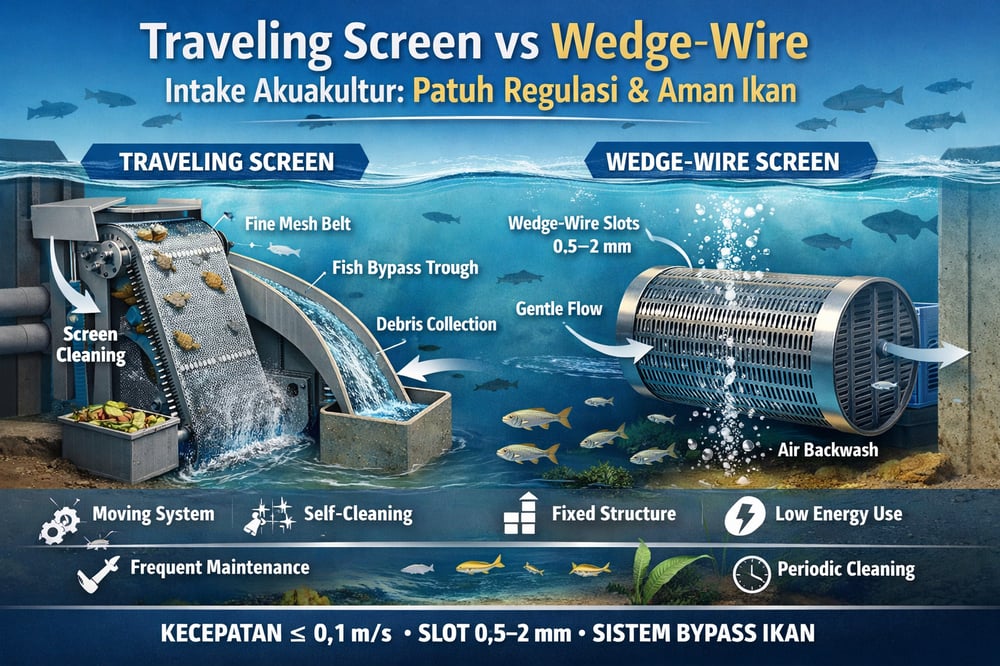
Traveling screens are mechanical “bucket belt” systems: screen panels on a continuous belt or drum rotate through the intake, capturing fish and debris and conveying them to the surface, where sprays rinse them into a bypass trough to return fish to the source. They are widely used in older industrial intakes and can be installed vertically or on an incline.
Exclusion efficiency depends on mesh. Coarse panels stop large fish but pass most juveniles and larvae. With fine mesh—often ~0.5–1.0 mm—facilities have achieved high exclusion of fish eggs and larvae (nepis.epa.gov). In controlled tests on juvenile salmon (~26 mm long), a 2.5 mm mesh retained ~100% at approach velocities up to 0.3 m/s (nepis.epa.gov). Operationally, even with fine mesh some small fish can be impinged and may slip through under strong currents. With fine mesh, traveling screens can achieve >90% retention for sturdier species, though capture of the smallest larvae drops unless mesh is extremely fine.
Reliability is proven but mechanical. These systems offer continuous self‑cleaning via brushes and sprays. Brush‑cleaning intervals on large screens are often ≈5 minutes or triggered by a small pressure drop (fwafishforum.com). Modern bucket designs have delivered very high survival of impinged fish—one study reported survival “among the highest for any traveling screen system” after bucket improvements (nepis.epa.gov). The trade‑off is moving parts: motors, sprockets, and brushes require power and routine maintenance, with failures causing downtime if upkeep lapses.
Maintenance centers on lubricating chains, replacing worn mesh panels, and servicing spray/brush components. Manual debris removal is minimal during operation, but the bucket conveyor and wash system need regular inspection. Fine mesh can foul with algae if not flushed; clean‑water sprays help, while spray nozzles and bearings require periodic replacement. Overall, traveling screens impose higher maintenance for mechanical care, even as self‑cleaning reduces manual labor.
Wedge‑wire screens: passive, fine‑slot exclusion
Wedge‑wire screens are rigid stainless panels—flat or cylindrical—built from wedge‑profile wires welded onto supports. The wedge geometry creates a high open area (often 30–40%) and a continuous slot; installations can be perpendicular or angled into flow, with deflectors or weirs to distribute flow and reduce approach velocity.
They are widely recognized as highly effective for protecting small fish and larvae: with sufficiently small slots, they physically exclude larval‑sized organisms. Laboratory and field studies report that ~0.5–2.0 mm slots block 98–100% of small fishes and eggs (nepis.epa.gov; www.publish.csiro.au). Stocks et al. (2024) found a 2 mm wedge‑wire screen cut Murray cod larval entrainment by ≤84%, and with a 2 mm slot and ≤0.1 m/s design velocity, essentially none got through (www.publish.csiro.au; www.publish.csiro.au).
There are trade‑offs. Narrower slots raise headloss and clog risk from fine debris (www.mdpi.com), although large installations designed “specifically to prevent entrainment of [organisms]” have not caused unusual maintenance problems (nepis.epa.gov). In practice, many industrial wedge‑wire screens use ~4–10 mm slots and accept bypass of larvae; when used as small mesh panels (SMP) or paired with finer attachments, they can meet the strictest exclusion goals. With low design velocities and appropriately small slots, wedge‑wire systems can achieve near‑total exclusion of a target size class (nepis.epa.gov; www.publish.csiro.au).
Reliability favors the passive approach: no motors or chains means high mechanical uptime and low energy use. Flow must be sufficient to carry debris away, but maintenance is typically occasional cleaning rather than constant operation. Modern systems trigger air‑pulse or rotating‑brush cleaning on a sensed pressure drop (www.mdpi.com), keeping operating costs low (www.mdpi.com). Power‑plant intakes with 6–10 mm slots have been “biologically effective in preventing impingement of larger fish,” with no unusual maintenance problems (nepis.epa.gov). Clogging remains a concern if slots are too fine without upstream debris control; where manual clean options are considered, some facilities evaluate manual screen units in low‑load locations.
Maintenance is straightforward: remove environmental fouling (barnacles, algae) and monitor pressure or flow drop to cue self‑cleaning. Seasonal use of fine screens often involves backflushing or air‑scouring. When clean, wedge‑wire faces do not impede flow and help keep approach velocities low. The trade is some headloss sensitivity for dramatic reductions in routine mechanical maintenance and power consumption (www.mdpi.com; www.mdpi.com).
Hydraulic criteria that drive survival
Approach velocity is the dominant variable. Empirical studies show sustained approach velocities ≤0.1–0.12 m/s (≈0.3–0.4 ft/s) allow fish to escape; small fish were “significantly more susceptible” to entrainment at 0.5 m/s than at 0.1 m/s, leading Boys et al. (2013) to recommend ≤0.1 m/s (pmc.ncbi.nlm.nih.gov). Stocks et al. (2024) similarly recommend ≤0.1 m/s for juvenile cod with a 2 mm screen (www.publish.csiro.au).
Sizing follows from the velocity cap. As a rule of thumb, 1 cfs at 0.33 ft/s requires ~3 ft² of open screen area (fwafishforum.com). High open‑area faces (≥30–40%) reduce slot velocity; where structure limits open area, designers add screen panels. One study showed deflectors reduced peak inlet velocity from >2.0 m/s to ~0.06–0.08 m/s by equalizing distribution (www.mdpi.com). Adequate sweeping current is also critical: guidance recommends cross‑current at least 2× the approach speed so fish pass by rather than hold against the face (fwafishforum.com).
Slot size, mesh, and what gets through
Screen opening (slot) size must be smaller than the smallest protected organism. Guidelines suggest ~0.5–1 mm for salmonid fry, and up to ~2–3 mm for larger juveniles (nepis.epa.gov; www.publish.csiro.au). Collected data show 0.5 mm openings retained ≈98–100% of larval fish in tests (nepis.epa.gov), whereas even 1.8–2.5 mm openings allowed escapes. In practice, many aquaculture intakes use medium slots (~3–5 mm) plus active fish‑return systems for larger fish.
Upstream debris management aligns with these choices. Where debris loads are variable, some operators consider continuous debris‑removal screen equipment similar to an automatic screen to stabilize differential head, while low‑flow canals may rely on simpler solutions akin to a manual screen in maintenance windows. These selections sit within broader physical pretreatment blocks, such as screens and primary separation.
Fish return, cleaning triggers, and uptime
Providing escape routes or returns is non‑negotiable. Traveling screens depend on improved bucket shapes (Envirex design) and well‑monitored bypass troughs; reported survival of adult and juvenile fish has reached 90–100% in evaluations of these improvements (nepis.epa.gov). On wedge‑wire panels, airflow or water jets coupled with post‑screen return flows free impinged fish.
Operations keep velocities in check by cleaning on small head differentials: a common trigger is 0.03 m water column (≈0.1 ft), ensuring approach speeds never exceed criteria (fwafishforum.com). Automated cleaning systems that respond to pressure drop are standard on passive designs (www.mdpi.com).
Materials, edges, and verification
Construction must avoid injurious surfaces. Specifications call for smooth stainless steel, with sharp edges disallowed (fwafishforum.com). Rigid frames should be flush with adjacent walls to prevent eddies. Corrosion‑resistant materials and anti‑fouling coatings reduce buildup that would otherwise force higher velocities. Post‑construction biological monitoring verifies that impingement is negligible.
Bottom line: hardware plus hydraulics
Effective fish protection pairs the right screen with disciplined hydraulics. Traveling screens—with fine mesh and fish‑return—are time‑tested and retrofit‑friendly, but demand more power and maintenance. Wedge‑wire screens generally deliver higher exclusion (especially for larvae) and lower operating cost, at the expense of clogging risk if slots are too fine without upstream control. Across both, the critical requirement is sustaining low approach velocities of ≈0.1 m/s and providing return or bypass pathways (pmc.ncbi.nlm.nih.gov; nepis.epa.gov).
Adhering to these criteria—qualified by local regulations—lets aquaculture intakes draw the water they need while minimizing harm to fish and meeting sustainability goals. Where facilities want packaged or modular options, vendors offer screen‑centric physical separation systems alongside continuous and manual screen formats that map to the designs described here (physical separation; automatic screen; manual screen).
Sources used to quantify performance, velocities, and survival include peer‑reviewed research, agency proceedings, and guidelines: www.mdpi.com; nepis.epa.gov (multiple sections including improved screening, cylindrical wedge wire, and impingement mortality); pmc.ncbi.nlm.nih.gov; and www.publish.csiro.au (with velocity guidance). Design calculations and criteria are also reflected in fisheries screening guidance (screen area; cleaning frequency; sweeping current; head differential triggers; materials).
