

Industry: Fertilizer_(Ammonia_&_Urea) | Process: Urea_Production
Urea production — the workhorse of nitrogen fertilizers — split long ago into two families: “self‑stripping” (ammonia stripping) and CO₂‑stripping, with older “total‑recycle” designs still around. All rely on a high‑pressure (HP) synthesis loop (~150–250 bar) to form ammonium carbamate (the intermediate formed when ammonia reacts with CO₂), followed by decomposition and concentration to urea. The energy profile is the killer variable. Today’s low‑energy plants run roughly 0.4–0.6 Gcal/ton urea (Gcal/t; heat energy per tonne), typically equating to about 400–600 kg of ~24 bar steam per tonne, while legacy units burn through 0.8–1.1 Gcal/t or more (bcinsight.crugroup.com).
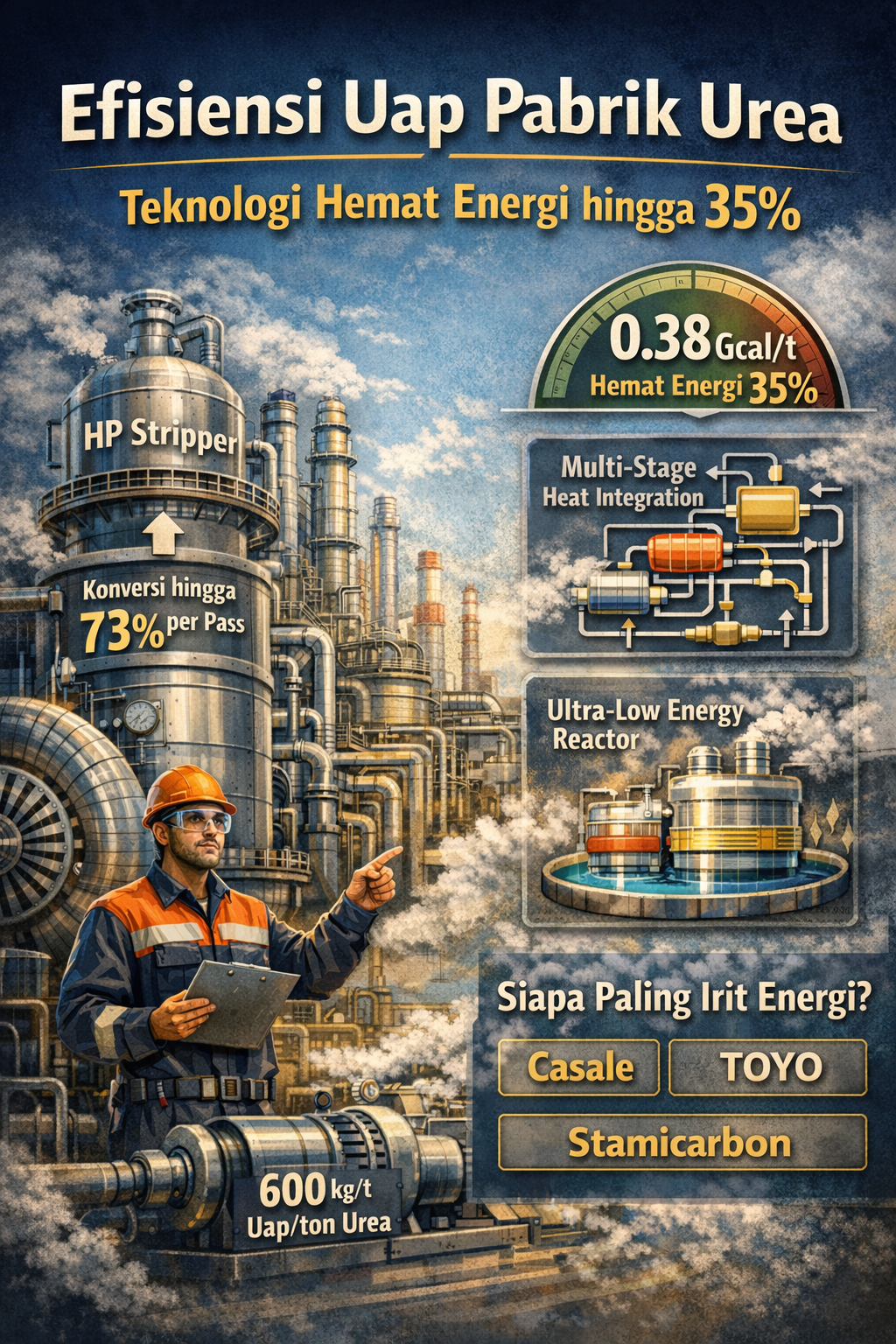
One case in point: a 1980s ammonia‑stripping plant in India clocked ~1.1 Gcal/t (including CO₂ compressor power) before a revamp (bcinsight.crugroup.com). On the other end of the spectrum, Stamicarbon’s Ultra–Low Energy design reports ~567 kg/t of HP steam — about 0.38 Gcal/t — roughly 35% less steam than traditional designs (bcinsight.crugroup.com). Casale’s advanced HYPER‑U (self‑stripping) trims HP stripper duty by ~20% versus older self‑strip plants (bcinsight.crugroup.com).
Conversion efficiency tells the same story. Total‑recycle units typically hit only ~60–64% CO₂ conversion per pass; Casale’s High‑Efficiency Combined (HEC) scheme boosts that to ~72–73%, cutting medium‑pressure (MP) steam from ≈1,550 to 1,100 kg/t — about a 30% energy saving (bcinsight.crugroup.com). Modern integrated self‑stripping units typically use <700 kg/t MP steam (excluding compressor usage) (bcinsight.crugroup.com). CO₂‑stripping processes like Toyo’s ACES historically demanded heavy HP steam (~850–900 kg/t at 20 bar) in exchange for near‑complete conversion, but ACES21‑LP’s lower reaction pressure (e.g., from 152 to 136 bar) trims HP steam by ~3–5% (bcinsight.crugroup.com). Retrofitting an old total‑recycle unit to an ACES‑style synthesis (adding an HP stripper and condenser) can lift capacity by ~50% while cutting energy by >30% (bcinsight.crugroup.com). Swapping in Stamicarbon’s latest stripper has shown ~20% more capacity at 15–20% lower HP steam consumption, with smaller equipment footprints (bcinsight.crugroup.com; bcinsight.crugroup.com).
The economics temper the excitement: feedgas (ammonia) still dominates, at roughly 80–85% of production cost; steam and power sit around ~10–16% (bcinsight.crugroup.com). At 2020 prices, energy ran about $25–40 per tonne of urea, so even a 20–30% steam saving adds only ≈$5–10/t profit (bcinsight.crugroup.com). Still, as fuel costs rise and carbon targets harden, the calculus changes: UNIDO says four Indonesian fertilizer firms cut ~328,000 tonnes CO₂e/year via efficiency moves, potentially saving US$47 million (indonesia.un.org). Indonesia now enforces “Green Industry” standards for ammonia/urea plants (peraturan.bpk.go.id) and targets a 3.95 MtCO₂e fertilizer‑industry reduction by 2030 (indonesia.un.org).
Comparative stripping technologies
Across licensors, the energy gaps are now stark. Self‑stripping designs (ammonia stripping) demonstrate MP steam use below 700 kg/t in integrated configurations (bcinsight.crugroup.com), while next‑gen CO₂‑stripping variants such as ACES21‑LP nibble off further HP steam by dropping synthesis pressure from 152 to 136 bar — a ~3–5% saving (bcinsight.crugroup.com). Modern Ultra‑Low Energy configurations, like Stamicarbon’s, report 567 kg/t HP steam (~0.38 Gcal/t), ~35% below a conventional pool design in that case, with 16% less cooling water (bcinsight.crugroup.com).
Casale’s HEC revamp boosts conversion from the ~60–64% range typical of total‑recycle plants to ~72–73%, dropping MP steam from ≈1,550 to 1,100 kg/t (≈30% saving), and its HYPER‑U trims HP stripper duty by ~20% versus older self‑strip flowsheets (bcinsight.crugroup.com; bcinsight.crugroup.com).
Heat recovery and pressure staging
The design playbook is all about heat that never leaves the loop. Multiple‑stage carbamate decomposition, efficient condensers, and vacuum evaporation (low‑pressure boiling) fed by process vapors now dominate new builds. Casale’s HEC inserts an extra HP carbamate condenser to generate 5.5 bar LP steam for downstream duties (bcinsight.crugroup.com). At Trombay, re‑plumbing heat so that condensers shouldered nearly all LP steam needs let operators pivot away from steam‑turbine extraction and toward low‑pressure steam cleaning (bcinsight.crugroup.com; bcinsight.crugroup.com).
Medium‑pressure pre‑decomposers around ~30 bar are a favorite: after flashing HP solution, a tube‑bundle reactor uses HP carbamate vapors to drive extra conversion at ~30 bar, lightening the MP stripper. In one case, adding a 30 bar pre‑decomposer on an 18 bar flash stream “debottlenecked” the MP section so it could run without any injected steam (bcinsight.crugroup.com).
Vacuum concentration and “melt” concepts
Vacuum (low‑pressure) concentration is now standard in green designs: urea solution is evaporated in stages using heat from condensing carbamate vapors. Casale’s retrofit put a vacuum evaporator on the first concentrator feed, swapping 3.5 bar steam for MP carbamate vapors and saving ~200–230 kg/t of 3.5 bar steam; two extra heat‑recovery exchangers (one condensing LP carbamate, one preheating feed) boosted HP condenser output and trimmed cooling duty (bcinsight.crugroup.com; bcinsight.crugroup.com). That revamp cut specific energy ~27%, matching “best‑available” ammonia‑strip levels (bcinsight.crugroup.com).
Stamicarbon’s Ultra‑Low Energy pool‑reactor reuses heat in three stages — the “urea melt” approach — achieving 567 kg/t (23 bar) HP steam (~0.38 Gcal/t), ~35% below a conventional pool design in that case, with 16% less cooling water (worldfertilizer.com; bcinsight.crugroup.com). The gains come from direct process‑to‑process heat exchange — for example, a combi‑reactor that submerges HP vapors in a reaction bundle, as in the Saipem “HYPER‑U” design (bcinsight.crugroup.com) — and by exploiting “waste” streams such as water‑treatment vapors to supply the final low‑pressure decomposer in Casale’s HYPER‑U (bcinsight.crugroup.com).
Steam networks and internal generation
Modern plants commonly run third‑ or fourth‑pressure steam networks, but the dependence on steam turbines is deliberately pared back. In one upgrade, adding a 5.5 bar LP header from an extra HP condenser enabled a new mid‑pressure decomposer and closed the LP steam gap (bcinsight.crugroup.com). Organic Rankine or similar power recovery is rare; the core focus remains minimizing external heating by maximizing internal recovery.
Engineer’s field guide to energy cuts
Benchmarking is the first gate. Key metrics are HP/MP steam (kg/t or Gcal/t) and per‑pass conversion. If an ammonia‑stripping plant is running much above 700 kg/t MP steam or >800 kg/t HP steam, or a CO₂‑stripper >850 kg/t HP, it is likely over best‑available practice (bcinsight.crugroup.com; bcinsight.crugroup.com). The gap sizes real projects: Trombay logged a 25–30% steam cut (≈1.1 to ~0.8 Gcal/t) after a revamp (bcinsight.crugroup.com), and Ultra‑Low Energy retrofits target ~30–35% reductions (bcinsight.crugroup.com).
Process audits should map heat and mass flows, check steam balances across HP/MP/LP headers, and hunt for dumped heat (coolers, flares, vents). Process condensate quality matters: high urea/ammonia in condensate signals losses. Pinch analysis can expose missed heat‑exchange opportunities. Reactor upgrades — high‑efficiency trays or vortex mixers — can raise conversion and permit lower pressure; plants have reported ~0.05–0.1 Gcal/t savings from internals changes (ijert.org). Operating discipline helps: dial in N/C and H/C ratios (N/C is the ammonia/CO₂ ratio; H/C tunes water/hydrogen in the loop), avoid water dilution — the Energy Star guidance emphasizes “no water recycle in loop” and an optimal NH₃/CO₂ ratio (manuals.plus). Online monitoring of condensate ammonia/urea with new analyzers (bcinsight.crugroup.com) and advanced control (N/C APC) stabilize targets with less manual intervention (bcinsight.crugroup.com).
Heat‑integration retrofits
Adding or enlarging internal exchangers can pay back quickly: a second HP carbamate condenser to split LP steam into 5.5 and 3.5 bar headers raised internal steam and eliminated MP steam injection in one case (bcinsight.crugroup.com). Vacuum pre‑concentrators that use MP carbamate vapors instead of 3.5 bar steam can save ~210 kg/t of 3.5 bar steam in the first evaporator stage (bcinsight.crugroup.com). Mechanical vapor recompression is occasionally viable on vacuum stages if cheap power is available; engines or turboexpanders on flash ports are less common.
Strippers, condensers, and trains
Hardware changes matter. TOYO cites HP steam reductions and lower absorber ammonia load after installing its latest ACES® stripper with improved distribution (bcinsight.crugroup.com). Stamicarbon’s “double‑bundle pool reactor” — the heart of its ULE concept — merges HP reaction with submerged condensation coils; retrofitting a pool condenser in existing plants has delivered ~35% steam savings in that case (bcinsight.crugroup.com). Exchangers must be cleaned or re‑sized; fouling in carbamate condensers or evaporators drives up steam. Where absent, consider multi‑pressure decomposition trains — for example, converting a single HP stripper into an isobaric double‑recycle (IDR) sequence that removes unreacted NH₃ in two HP stages and is known to cut energy, albeit with added complexity (manuals.plus).
Purge handling and condensate quality
Side‑stream hygiene adds up. “NH₃ washing from inerts” recovers burner heat by stripping purge gas with water (or returning it to fuel), according to IPTS guidance (manuals.plus). Redirecting granulator fines back to the urea melt instead of drying saves burner load (manuals.plus). On the boiler side, lowering urea in process condensate through better treatment or reuse improves efficiency; this is where condensate polishing steps (e.g., a condensate polisher) are often integrated into the loop.
Utilities integration and standards
Coupling with ammonia synthesis and site utilities matters. Boilers or cogeneration setups can be tuned (examples include feed preheating and O₂‑enrichment) and US DOE guidance notes excess‑air control and turbine‑extraction optimization as plant‑wide levers . Indonesia’s RECP program highlights the water‑energy link: PUSRI cut water use from 13.5 to 3.6 m³/t — below the 5.5 m³/t standard — with broad process hygiene, which also tends to reduce steam demand (indonesia.un.org). Compliance is tightening: Indonesia’s 2023 Permenperin No. 11/2023 mandates Green Industry certification for ammonia and urea plants (peraturan.bpk.go.id). Where steam comes from boilers, fuel switching can qualify as an energy‑saving measure, and government financing for “blue/green ammonia‑urea” — integrating CCUS or renewables — is on the roadmap, though large‑scale conversions sit beyond the retrofit scope (indonesia.un.org). In practice, utilities housekeeping often spans water treatment, where demineralized water production units (for example, a demineralizer) support stable boiler‑condensate loops.
Checklist and benchmarks
- Current energy use quantified: track HP/MP steam (kg/t, Gcal/t) and electricity (kWh/t); world‑class targets include <600 kg/t HP steam and <1.0 Gcal/t total (bcinsight.crugroup.com; bcinsight.crugroup.com).
- Losses pinpointed: energy balances to identify where heat is dumped (coolers, flares, vents) and high‑ΔT exchangers that are missed or fouled.
- Operating conditions optimized: run at best N/C ratio (≈1.3–1.4) and minimize recycle water; remove air/leaks; apply advanced controllers to stabilize reactor and absorber conditions.
- Revamp planning: where gaps exceed ~10–20% above best practice, evaluate added HP/MP condensers, additional strippers, vacuum evaporators, and licensor studies (Casale, Stamicarbon, Toyo) (bcinsight.crugroup.com; bcinsight.crugroup.com).
- CapEx vs. OpEx reconciled: even 5–10% steam savings can justify upgrades at high fuel prices; Indonesian pilots reported ~$47M in efficiency savings (indonesia.un.org; bcinsight.crugroup.com).
- Performance monitored: install online monitors (e.g., urea‑in‑water analyzers) and leak detection to lock in gains (bcinsight.crugroup.com).
The bottom line on heat integration
Case studies show heat integration is the fulcrum. Adding a vacuum concentrator and extra condensers allowed one plant to generate all LP steam internally and cut MP steam ~27% (bcinsight.crugroup.com; bcinsight.crugroup.com). Deep recovery in HYPER‑U designs has cut downstream LP steam needs by ~60% versus older self‑strip flowsheets (bcinsight.crugroup.com). Piece by piece — from contactors to recovery exchangers — legacy plants can halve steam duty, tightening alignment with Indonesia’s green‑industry goals and global benchmarks (bcinsight.crugroup.com; bcinsight.crugroup.com).
Sources: Comparative data and case studies are drawn from recent industry reports and technical papers (Casale, TOYO, Stamicarbon, UNIDO) and regulatory sources. Each figure above is documented by the cited literature.