

Industry: Landfill | Process: Leachate_Collection_Systems
In tropical Indonesia—where 6–12 m of rain can fall each year—engineered waste cells still churn out thousands of liters of leachate per hectare per day, even with good liners (ResearchGate) (ResearchGate). A Malaysian study pinned initial yields at ~4.2 m³/ha·d, dropping to ~1.4 m³/ha·d after ~10 years—a ~67% decline as waste stabilizes (ResearchGate). For a 10 ha cell, that’s ~42 m³/d at the outset. With COD/BOD often in the thousands mg/L (ResearchGate), letting it sit risks groundwater contamination.
Indonesia’s MoEF Perm. P.59/2016 requires liners and active leachate management to meet discharge limits (ResearchGate), yet most landfills still lack full treatment (pu.go.id). As recently as 2011, only ~3% of Indonesian disposal sites were sanitary landfills; the rest were open dumps (pu.go.id).
Leachate collection and removal system (LCRS)
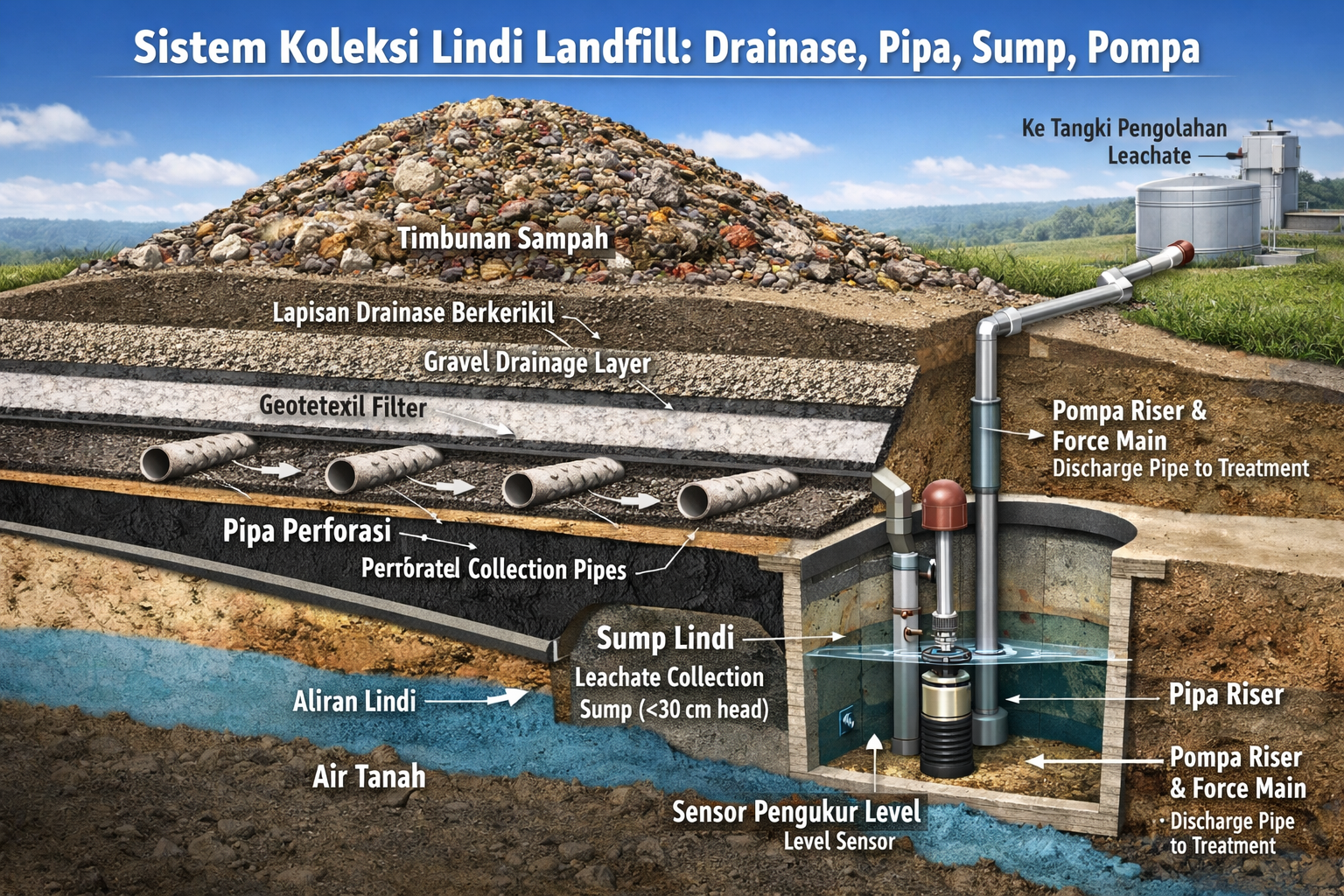
Engineered landfills place a leachate collection and removal system (LCRS; a subsurface network that captures and removes liquid) beneath the waste to intercept every drop before it can pond on the liner or escape. The system is built to keep the hydraulic head (liquid depth/pressure on the liner) very low—≤30 cm (1 ft) by design under extreme loading, per U.S. EPA guidance and 40 CFR 264.301 (EPA).
Permeable drainage layer at the base
Directly above the liner sits a highly permeable drainage blanket (granular or geosynthetic composite) that shuttles leachate by gravity to collector pipes while maintaining minimal head on the liner. Drainage layers are specified with hydraulic conductivities (a material’s ability to transmit fluid) on the order of 10^–3–10^–4 m/s—far higher than liner clays (~10^–9 m/s) or geomembranes (essentially 0) (EPA) (ResearchGate). A common rule is to keep ponding over the liner ≲30 cm; U.S. EPA requires designs to show ≤30 cm (1 ft) maximum depth under extreme loading (EPA).
Practically, the drainage mat—often 20–60 cm of clean gravel or equivalent—plus the pipe network must move flow faster than it arrives (EPA). If a geosynthetic drain is used, it must match ~12 inches of gravel: an EPA memorandum equates this to a geonet transmissivity (flow capacity per unit width) of ≈3×10^–5 m²/s (implying hydraulic conductivity ~10^–4 m/s for a ~10–15 mm core) (EPA). Granular systems may use coarse sand or gravel protected by a sand or nonwoven filter fabric to block fines; lab tests show microbial slime and sediment can cut flow by >80–90% if unchecked (ResearchGate). Designers verify that, under expected infiltration and slopes (usually ≥1–2%), the layer transmits peak flow without exceeding the 30 cm head limit (EPA) (EPA).
Perforated pipe network and layout
Within the drainage layer, rigid PVC or HDPE collector pipes—typically ~100–150 mm diameter and perforated along their length—follow the base grade (often 1–3%) and converge toward low points (EPA). Spacing is set so local ponding between lines never exceeds the one‑foot target (EPA); in practice, that often means a few tens of meters between pipes, depending on waste permeability and rainfall. Plans must show contours, pipe routes and spacings, connections to sumps, and how leachate exits the cell—typically via a force main to a storage or treatment tank (EPA) (SCS Engineers).
Double‑lined landfills add a second, lower system: a primary sump above the primary liner and a secondary “leak detection” sump beneath a second liner. Each has its own pump and riser so flows are separately monitored (EPA).
Sump construction and pump system
The sump—built as a lined pit within the final compacted fill so its top sits flush with the engineered subgrade—accumulates leachate from the pipes. Access comes via vertical risers (manholes) or a short depressed trench so pumps can be inserted and removed as the cell is filled (EPA). One sump may suffice in a monolithic cell; larger or tiered builds often use multiple smaller sumps, each with its own pump, to limit pipe runs.
Submersible pumps are the conventional choice to move leachate to storage or a treatment plant. A submersible pump—often 2–10+ hp, sized for flow and head—is lowered on guides into the sump through the riser; it sits on wheels or rails, drawing liquid through perforations in the riser or sump inlet (SCS Engineers). The discharge runs up the riser to the berm top and into an above‑ground force main. Level sensors (float or bubbler) hold the head setpoint. After startup, capacities run from 100’s to 1,000’s of liters per minute depending on model; a 3–5″ submersible often delivers several m³/hr against 20–30 m of head. Final sizing matches peak inflow with a safety factor.
Maintenance is nontrivial: the full assembly—pump, discharge hose, power cable—must be pulled from the riser for service, emerging coated in sludge. Winches and safety protocols are standard; many sites set the wet‑well top within a small concrete vault to catch any spills (SCS Engineers). Some designs now allow self‑priming pumps mounted above grade for shallower sums, lifting via a suction line and avoiding handling of submersibles and cables in wet waste (SCS Engineers). For deeper cells (>4–5 m depth), submersibles remain more practical.
Where the liquid is treated on‑site, operators specify unit processes and controls appropriate to permits and loads; membrane trains are one option in industrial and municipal contexts (membrane systems). Day‑to‑day operation typically depends on auxiliary items—tanks, level control, and safety hardware—around the wet well and force main (supporting equipment for water treatment).
Performance targets and outcomes
Done right, an LCRS captures essentially all infiltrating liquid and keeps ponding on the liner to seconds or minutes. In the U.S., the ≤1 ft (≤30 cm) ponding target is a legal standard (40 CFR 264.301) (EPA). With high‑K materials and grassy maintenance, observed ponding is often <10–20 cm in normal conditions. Modeling underscores why the capacity margin matters: partial clogging that raises head could allow seepage if designs were looser (ResearchGate), so redundancy and excess throughput are vital.
The quantitative payoff is clear. In Malaysia’s high‑rain setting (~4.2 m³/ha·d initially), a properly sized sump and pump avoided uncontrolled discharges; volumes typically fall to ~1.4 m³/ha·d after ~10 years as wastes stabilize (ResearchGate). Globally, sanitary landfills with composite liners and active pumping show orders‑of‑magnitude lower downstream groundwater contaminant indices than old dump sites. In Indonesia—where many dumps still lack even passive capture—upgrading to these designs, as mandated in MoEF Reg. P59/2016, would cut leachate‑related pollution dramatically (ResearchGate) (pu.go.id).
Design guidance and case references
Design guides and case studies reiterate these fundamentals. USEPA technical guidance (1988) specifies a leachate depth ≤0.3 m and formally outlines geonet/gravel equivalencies (EPA) (EPA). Peer‑reviewed reports emphasize high‑permeability drainage layers and filters to combat clogging (ResearchGate). Industry sources document practical sump and pump installations, maintenance constraints, and alternatives such as self‑priming units (SCS Engineers) (SCS Engineers). Regional research quantifies tropical leachate generation, while Indonesian policy clarifies the regulatory push toward sanitary landfill designs (ResearchGate) (ResearchGate) (pu.go.id).