

Industry: Landfill | Process: Leachate_Pre
Leachate is extremely corrosive—routinely loaded with high COD (chemical oxygen demand, an indicator of oxidizable pollutants), ammonia, chlorides, and metals. Storage assets at modern landfills are therefore engineered like chemical plants, not open basins: fiberglass‑reinforced plastic (FRP), glass‑fused or epoxy‑lined steel, or stainless steel tanks; plus double‑lined ponds with floating covers and leak detection.
Behind those choices is a hard lesson: peak flows after heavy rain or recirculation can dwarf the averages, and any weaknesses in materials or capacity show up fast—in odors, emissions, or worse, leaks to ground.
Corrosion‑resistant tank construction
In corrosive service, FRP tanks deliver “long life (10 to 20 years),” a span the EPA has flagged as cost‑effective for smaller volumes (nepis.epa.gov). Larger tanks often shift to high‑alloy or coated steels: carbon steel with fusion‑bonded epoxy or phenolic liners extends effective life to ~20 years (nepis.epa.gov), while stainless steel “provides excellent service” even in solvent/acid environments (nepis.epa.gov).
Glass‑fused‑to‑steel (porcelain‑enameled) bolted tanks are widely used internationally, marrying steel strength with inert glass coatings for multi‑decade corrosion resistance. Designs typically specify materials—HDPE (high‑density polyethylene), FRP, glass‑coated steel, stainless—tested for acidic/alkaline resistance and abrasion, often with warranties or tested lifetimes of 20+ years. One cited advantage: folded glass‑fused‑to‑steel leachate tanks tolerate pH 3–11 and have 65+ year track records (leachate.co.uk) (nepis.epa.gov).
Impoundment liners and floating covers
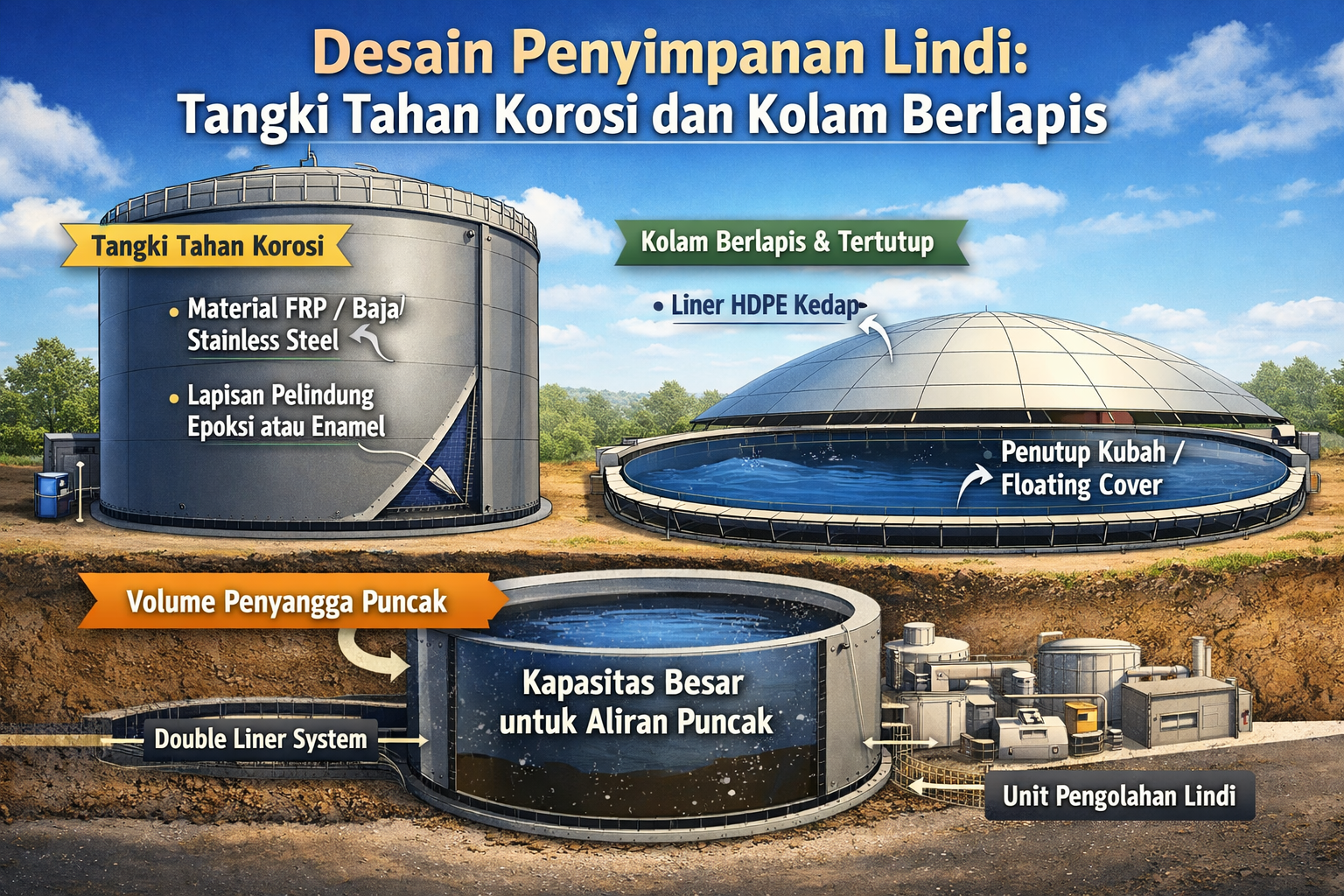
Ponds or impoundments for raw or pretreated leachate require impermeable liners and, in practice, a cover. Modern designs almost always use HDPE geomembranes (synthetic liners) typically ≥2 mm thick. One U.S. facility’s 1993 leachate pond deployed an 80‑mil (2 mm) HDPE geomembrane (geosyntheticsmagazine.com).
Today, most jurisdictions mandate double‑liners with leak‑collection layers: a primary geomembrane to hold leachate, plus a secondary geomembrane and drainage layer to intercept any leakage. A 25‑year performance review reported “no visible signs of degradation” of the primary HDPE liner and “no leakage of leachate into the leakage detection layer” (geosyntheticsmagazine.com).
Open ponds vent odorous gases and admit rain. Regulations reflect that: under U.S. RCRA rules at 40 CFR 264.1080, impoundments with high‑organic wastes require “rigid lids or floating covers” to capture emissions (nepis.epa.gov). In landfill practice, operators deploy floating HDPE covers or fixed membrane domes with venting. In sum, liners+covers prevent groundwater leaks and control odors/VOCs (volatile organic compounds).
Storage capacity for peak flows
Designers size storage for more than steady‑state averages. Peak flows can far exceed dry‑weather rates after heavy rain or when recirculating liquids. A Hong Kong landfill extension projected a combined average leachate flow of ~355 m³/day but peaks up to ~1000 m³/day—about 3× the mean (epd.gov.hk).
To buffer those surges and outages, the treatment plant included ~22,000 m³ of equalization storage (buffer volume ahead of treatment)—roughly 15 days at the 1500 m³/day design rate (epd.gov.hk). Notably, the design capacity of 1500 m³/day far exceeded the ~23 m³/day average from the old landfill (epd.gov.hk).
Guidelines in practice call for storage of many days’ flow or the volume generated by extreme storms. If capacity is too low, peak inflows can overflow ponds or overwhelm treatment. Sizing is data‑driven: use local rainfall statistics, multi‑day storm events, and leachate‑generation models to estimate maxima, then match tank/pond volumes accordingly (the Hong Kong example sized for ~14–15 days of peak flow, per epd.gov.hk).
Regulatory and case‑study evidence
Peer‑reviewed and regulatory references underpin these choices. For example, durable tank materials and coatings—stainless steel, FRP, epoxy—are recommended in EPA design manuals (nepis.epa.gov) (nepis.epa.gov). Pond lining standards (geomembrane thickness, double‑liner systems) and long‑term performance are detailed in geosynthetic case studies (geosyntheticsmagazine.com) (geosyntheticsmagazine.com). Regulatory requirements for covers come from 40 CFR 264 (RCRA) (nepis.epa.gov). Storage capacity examples and flows are documented in detailed landfill EIA reports (epd.gov.hk) (epd.gov.hk).