

A straightforward train—equalization, pH control, chemical precipitation, and clarification—can strip heavy metals and coal fines from prep‑plant blowdown and hit Indonesian limits. Here’s the design, the numbers, and an operator’s guide.
Industry: Coal_Mining | Process: Coal_Washing_&_Preparation_(Prep_Plant)
Coal preparation blowdown (a purge stream from the plant water circuit) doesn’t just carry coal fines. Analyses of comparable effluents have found Fe ~0.8–8.7 mg/L, Cu ~0.3–1.0 mg/L, Zn ~0.1–0.3 mg/L (and Mn, Ni, Cr in similar low‑mg/L range) (springerplus.springeropen.com) (ojs.umrah.ac.id), while suspended solids (coal fines) often measure tens to hundreds mg/L (e.g., ~66 mg/L in one study, ojs.umrah.ac.id). Heavy metals bioaccumulate and pose ecological risks (springerplus.springeropen.com), and some coal‑sector discharges have reported Fe 8.71 mg/L (above Indonesia’s 7 mg/L limit) and Mn ~5–7 mg/L (above the 4 mg/L limit) (springerplus.springeropen.com) (www.scribd.com) (www.scribd.com).
Indonesian regulations for coal mining/power‑plant effluent require pH 6–9, total suspended solids (TSS) ≤400 mg/L, total Fe ≤7 mg/L, Mn ≤4 mg/L, BOD≤30 mg/L, COD≤100 mg/L for coal processing (www.scribd.com) (www.scribd.com). Other metals lack coal‑specific limits, but Indonesian mining rules cap Cu ~1 mg/L, Zn ~5 mg/L, Ni ~0.5 mg/L, Pb ~0.1 mg/L, Cr(VI) ~0.1 mg/L in some categories (www.scribd.com). The treatment goal: drive metals into single‑digit µg/L–mg/L ranges (roughly 90–99% removal) and settle solids below that 400 mg/L ceiling.
Flow equalization and screening
Start with an equalization tank to buffer flow and pollutant peaks, plus coarse screening to remove debris. This stabilizes feed pH and solids load for downstream treatment. Plants commonly pair equalization basins with automated screening; an option is an automatic screen for continuous debris removal.
Primary equipment such as screens and oil removal systems falls under physical separation; packaged options for mining are cataloged under waste‑water physical separation.
Alkaline pH control for hydroxide precipitation
Metals precipitate best in alkaline conditions. A pH adjustment tank doses Ca(OH)₂ slurry or soda ash to raise pH into the 9–10 range, with metals showing optima around Cu ~8.5–9.5; Ni, Zn ~9–10; Pb ~9.5–10.5 (www.waterandwastewater.com). Proper pH control is critical for the precipitation reaction (www.waterandwastewater.com).
Accurate chemical feed underpins this step; plants typically use a dosing pump to meter alkali and acid and hold setpoints within tight bands.
Precipitation, coagulation, flocculation
At elevated pH, metal ions form insoluble hydroxides that can be settled. A precipitation/coagulation reactor adds Ca(OH)₂ or NaOH while mixing. A coagulant (for example, ferric chloride or alum) and/or a flocculant polymer can agglomerate precipitates into settleable flocs (www.waterandwastewater.com) (www.waterandwastewater.com). Coagulant programs are standard practice; off‑the‑shelf chemistries are listed under coagulants.
Bench and pilot data show high removal in a single stage: one lab test attained ~99% removal of Fe, Zn, Cd at pH 10.3 within 15 minutes (www.mdpi.com). An Indonesian pilot using limestone/bentonite raised pH and removed ~98% of Fe (0.998→<0.02 mg/L) and 91% of TSS (66→6 mg/L); Mn removal there was ~27% (ojs.umrah.ac.id) (www.scribd.com).
After dosing, a flocculation basin with gentle mixing lets flocs grow. Operators often lean on specialized polymers; mining‑grade options are organized under flocculants.
Clarification and optional polishing
The clarifier (final settling) removes the precipitated sludge. Designers apply Stoke’s law to size area for ~50–100 µm flocs and target typical surface loading rates of ~0.5–1 m³/m²·h to achieve >90% TSS removal (www.scribd.com). A gravity unit such as a clarifier is set for retention time ~20–30 minutes (per [21]) and/or surface overflow ~0.5 m/h.
Compact plate units can cut footprint; a lamela settler is a frequent alternative. Well‑designed clarification can send effluent TSS to single‑digit mg/L, as seen when TSS dropped from 66 to 6 mg/L in the Indonesian study (ojs.umrah.ac.id). Due to co‑settling, heavy metals also drop with solids; the resulting effluent typically clears the 400 mg/L TSS limit.
Residual pH adjustment ensures discharge within 6–9. If a site needs very low TSS, a sand filter can polish the clarifier effluent; many plants use sand/silica filtration for this purpose. For tighter solids control from surface waters or as pretreatment to membranes, ultrafiltration is a standard solution. The clarifier alone typically suffices to meet the 400 mg/L TSS and low heavy metals levels required.
Performance envelope and compliance
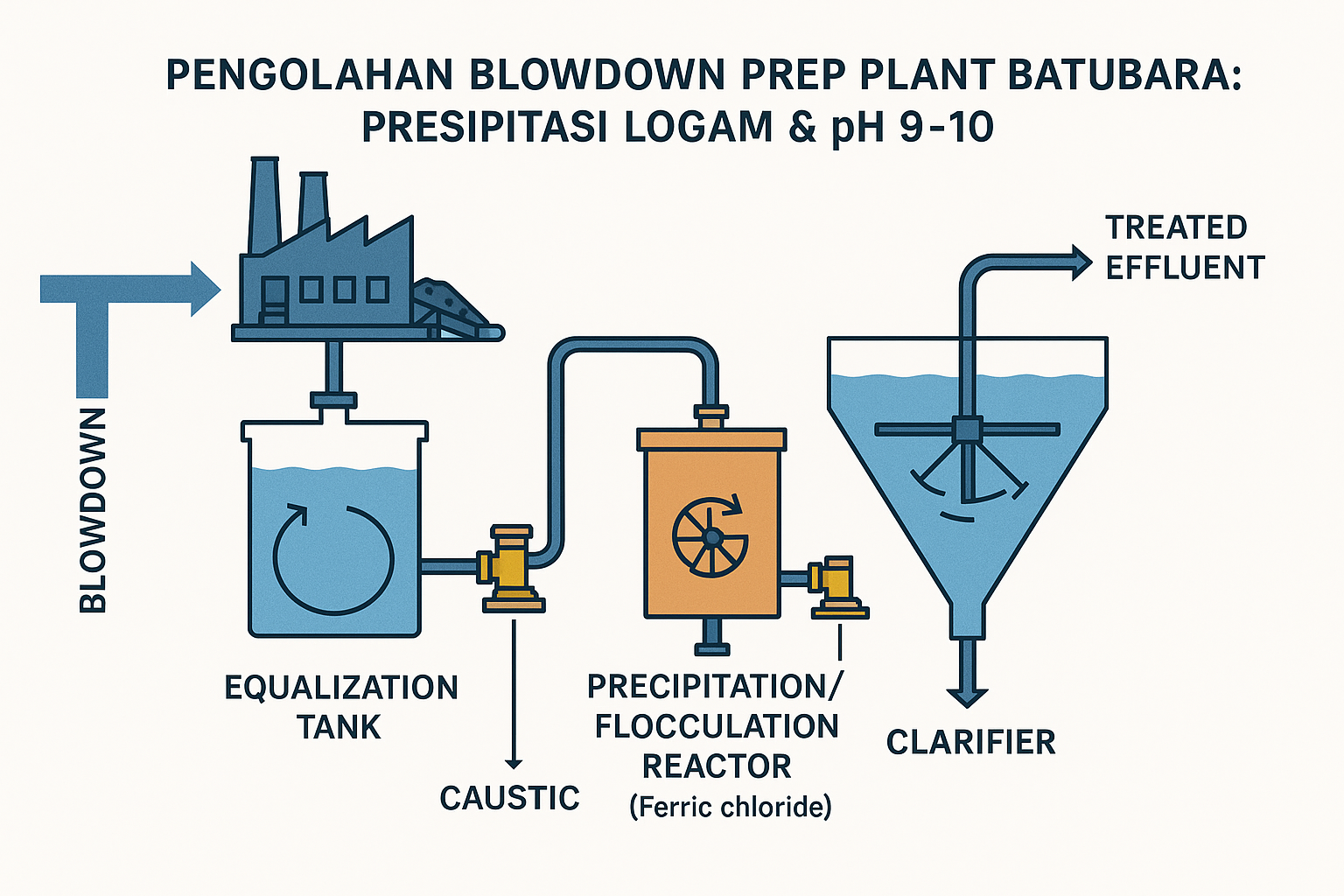
Under optimized pH, >95–99% of dissolved metals precipitate (www.mdpi.com) (www.waterandwastewater.com); at pH ≈10, Fe, Zn, Cd dropped to <1% of initial concentrations (www.mdpi.com). In the Indonesian study, Fe fell from ~1.0 to <0.02 mg/L (well below the 7 mg/L limit), and TSS fell >90% (66→6 mg/L) (ojs.umrah.ac.id) (www.scribd.com).
Surveys of similar systems report >80–90% removal for most heavy metals and organics (BOD/COD) by co‑precipitation and sedimentation (www.waterandwastewater.com) (pubmed.ncbi.nlm.nih.gov). Actual removal depends on influent loading and optimization, especially achieving the target pH. Operators should verify treated effluent meets all limits for TSS, Fe, and Mn; if needed, incremental adjustments—e.g., higher final pH or sulfide precipitation—can target stubborn metals, though standard hydroxide precipitation usually suffices.
Operator guidelines and controls
- Monitor and Equalize: Continuously measure influent flow, pH, TSS, and conductivity. Maintain an equalization tank to buffer surges. Use sample jars to check settling solids. Keep records of inlet concentrations.
- Calibrate Chemical Dosing: Perform jar tests to determine optimal Ca(OH)₂ dose (or other alkali) for target precipitation pH and metal removal. Start dosing Ca(OH)₂ slowly while stirring the mix tank; monitor pH until it reaches the ~9–10 range (www.waterandwastewater.com) (www.waterandwastewater.com). Avoid underdosing (incomplete removal) or gross overdosing (excess pH and chemical waste). If pH overshoots, dose dilute acid to readjust. Where precise metering is needed, a dedicated dosing pump maintains stable feed.
- Reagent Handling: Ensure safe storage of reagents (lime, coagulant, polymer). Check pumps and mixers daily. Maintain backup for pH probes and dosing pumps. Calibrate sensors regularly. Keep a minimum stock of chemicals to handle peak loads. Operations often depend on spare parts; sourcing is simplified via water‑treatment parts and consumables.
- Flocculation Control: Adjust flocculation mixing speed to form robust flocs (visual check: conspicuous “roping” of solids). If flocs are too slow or small, try a small dose of coagulant or polymer. Optimal dosage often is a few mg/L of FeCl₃/Al₂(SO₄)₃ and ≤1 mg/L polymer, but do bench tests for each effluent. Document floc size and settleability routinely.
- Clarifier Operation: Inspect the clarifier for sludge blanket height and clear effluent. Periodically scrub rakes and inlet baffles to prevent short‑circuiting. Maintain a continuous sludge withdrawal rate to keep sludge dry. Measure effluent turbidity or TSS at least weekly to confirm compliance (target ≪400 mg/L).
- Effluent Checks: Test final effluent pH, TSS, and occasional metals (Fe, Mn, Cu, Zn). Ensure pH stays within 6–9 by dosing acid post‑clarifier if needed. Confirm heavy metals (especially Fe, Mn) meet limits (www.scribd.com) (www.scribd.com); e.g., Fe ≤7 mg/L, Mn ≤4 mg/L. Document all readings in a log (for reporting and process control).
- Sludge Management: The settled sludge contains concentrated metals and is hazardous (B3). Dewater sludge routinely (belt filter press or centrifuge). Test sludge metal content; recycle ferric sludge if possible, otherwise transport as B3 waste to a licensed facility. Keep sludge pits covered to prevent rain dilution. Record sludge volume and disposal.
- Maintenance & Safety: Employ standard PPE when handling caustics or acids. Ventilate chemical dosing areas. Schedule routine maintenance of mixers, pumps, clarifier mechanisms and instrumentation. Ensure emergency neutralization acid/base is available in case of excursions. Supporting components and accessories are cataloged under waste‑water ancillaries.
- Record Keeping: Keep a treatment log of flows, chemical additions (kg/day), pH trends, effluent samples, and sludge generation. Compare removal efficiencies (Cin vs. Cef) to design expectations (www.scribd.com) (www.mdpi.com). Adjust operations if performance drifts or regulations tighten.
By diligently following this procedure, operators can reliably treat coal wash blowdown so that discharges meet Indonesian standards. The key goals are: (a) maintain pH at the level needed for hydroxide precipitation (www.waterandwastewater.com) (www.waterandwastewater.com); (b) achieve >90% removal of solids and heavy metals via coagulation/clarification (www.mdpi.com) (ojs.umrah.ac.id); and (c) handle the resulting sludge as hazardous waste. With these controls, treated effluent should consistently have TSS in the single‑digit mg/L and metals below the few mg/L regulatory limits, ensuring compliance and minimal environmental impact.
Sources: Indonesian environmental standards and coal processing studies (www.scribd.com) (www.scribd.com) (www.scribd.com); lab and field data on metal precipitation (e.g., 99% Fe/Zn/Cd removal at pH~10) (www.mdpi.com) (ojs.umrah.ac.id); industry treatability analyses (www.waterandwastewater.com) (pubmed.ncbi.nlm.nih.gov); and coal industry reports (springerplus.springeropen.com) (www.mining.com).