

In nickel ore grinding, the hydrocyclone — not the mill — determines whether particles are fine enough to move on. Plants are now tuning pressure, density, and geometry in lockstep with online particle-size analyzers to hit target P80s and protect recovery.
Industry: Nickel_Mining | Process: Ore_Crushing_&_Grinding
In nickel (Ni) concentrators, classification is the hidden control room for grinding. Hydrocyclone classifiers split mill discharge into a fine “product” stream (overflow) and a coarse “return” stream (underflow), keeping only fines in circulation downstream and sending coarse back for more grinding (defrubber.com; www.jxscmachine.com). Fine particles (lighter, liberated Ni minerals) are carried upward to the overflow via the vortex finder, while coarse, dense particles move outward and downward to the underflow through the spigot (defrubber.com; www.jxscmachine.com).
This closed-circuit classification prevents over-grinding of liberated Ni minerals and maintains mill efficiency by promptly removing fines and returning only oversized particles for regrinding (defrubber.com; www.jxscmineral.com). Industry analysis links higher circulating loads to higher throughput up to an optimum; one widely cited paper reports an optimum recirculating load around ~250% for ball mills under practical cyclone efficiency limits (www.researchgate.net; www.researchgate.net). In practice, ball-mill circuits often run at 100–250% circulating load (www.researchgate.net; www.jxscmineral.com).
Spiral classifiers are still seen in coarse sizing, but hydrocyclones are preferred for finer grinds (typically <150–300 µm) because they handle higher capacities in a smaller footprint and can achieve finer cut sizes — in fact, down to ~0.01 mm according to equipment data (www.jxscmachine.com; defrubber.com). The stakes are high: one case study noted that poor cyclone performance is the most common cause of suboptimal mill operation, as fines remain in the mill and cause energy waste and recovery loss (www.researchgate.net; www.mdpi.com).
Hydrocyclone cut size control (definitions)
Hydrocyclone: a cone-shaped classifier that uses centrifugal forces to separate particles by size/density in slurry; overflow carries fines, underflow carries coarse. Cut size (D50): the particle size with 50% chance to report to overflow; P80: the size at which 80% of a stream’s particles are finer. Vortex finder: the overflow outlet; spigot/apex: the underflow outlet. “Roping”: a rope-like, dense underflow indicating overload/crowding.
Feed pressure and flow
Hydrocyclone performance (cut size and sharpness) depends on feed conditions and geometry (defrubber.com; www.mclanahan.com). Raising feed pressure (often by increasing pump speed or flow) strengthens the centrifugal field, drives finer particles toward the underflow, and makes the cut-size smaller; lowering pressure produces a coarser cut (www.mclanahan.com; defrubber.com). Typical cyclone feed pressures are on the order of 50–150 kPa (about 7–22 psi); increasing pressure within this range refines the separation, but exceeding ~200 kPa can induce turbulence and excessive wear (defrubber.com).
Feed solids concentration
Feed solids concentration is crucial. Moderate pulp densities (~15–30% solids by volume) tend to maximize efficiency (defrubber.com; www.mdpi.com). Too dilute a feed (<15%) “thins out” the slurry, reducing collision and hindered-settling effects so fines can slip into the underflow (defrubber.com). Too dense (>40%) increases viscosity and inhibits fine movement, lowering fineness and efficiency (defrubber.com; www.mdpi.com). Simulations confirm that as feed density rises, the pressure drop across the cyclone increases but overall separation efficiency decreases (www.mdpi.com). In practice, operators adjust dilution water to hold the cyclone feed density around an optimal range (often ~20% solids by volume) to hit the target cut-size.
Inlet, vortex finder, and spigot geometry
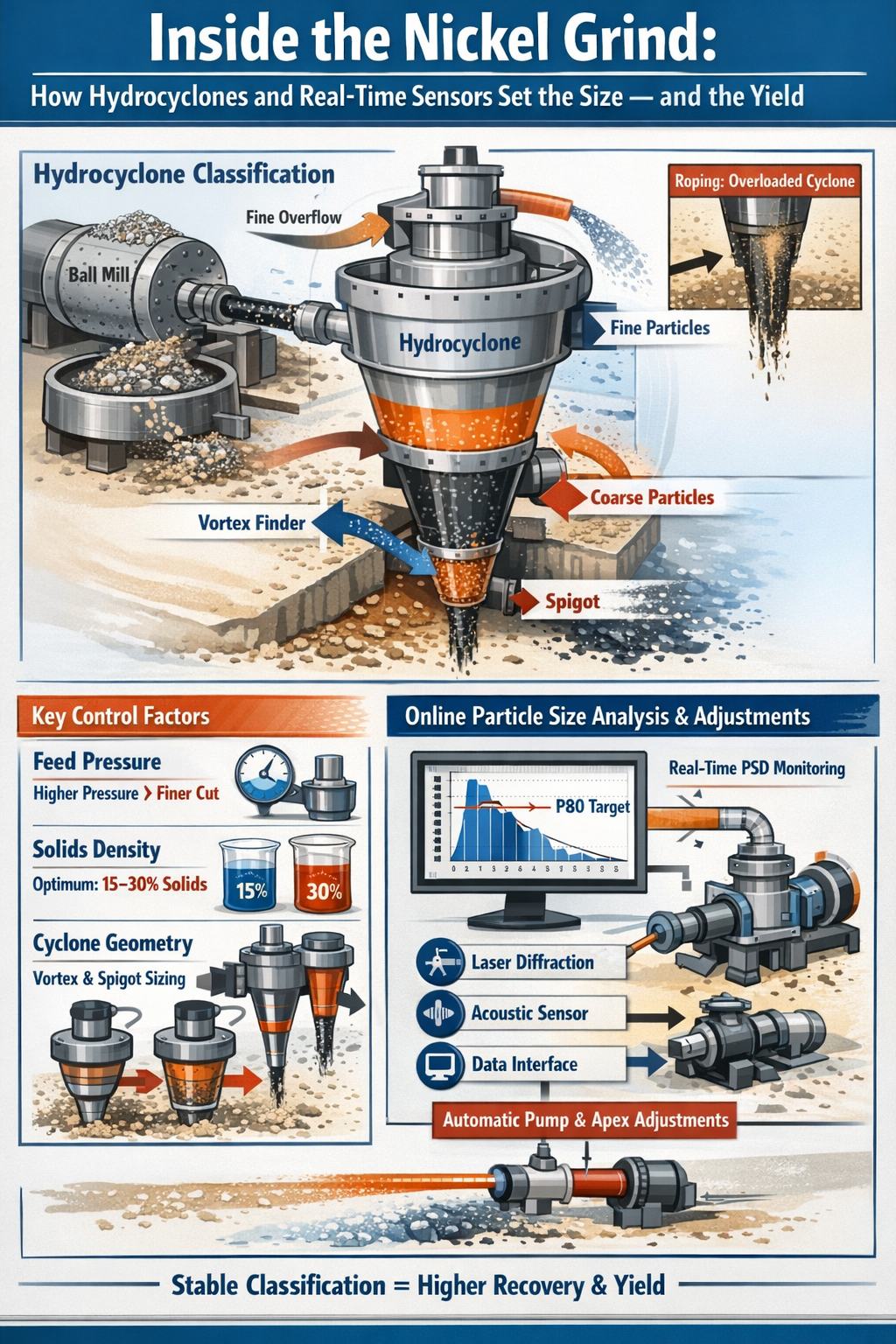
Geometry can be varied to tune separation. The inlet area is typically ~15–25% of the cyclone cross-section; increasing inlet size raises capacity but can slightly degrade efficiency due to turbulence (defrubber.com). The vortex finder (overflow diameter) and spigot/apex (underflow diameter) determine the split: a smaller vortex finder or narrower spigot increases internal pressure and centrifugal force, shifting the cut-size finer (retaining more fine material in the overflow) (defrubber.com; www.mdpi.com). Enlarging the spigot or vortex finder lowers back-pressure and produces a coarser product; modeling shows that enlarging the underflow orifice reduces cyclonic pressure, weakening centripetal forces so more fluid (coarse slurry) exits downward — the net effect is a larger cut-size and more coarse into the mill (www.mdpi.com). Some mills use adjustable-apex valves or liner inserts to tune this effect in real time.
Across setups, operators watch cyclone pressure (∆P) and the split ratio. High ∆P or a “roping” underflow indicates overloading (excess tonnage or too coarse feed) and is corrected by opening the apex or reducing feed flow (www.metso.com; www.scielo.org.za). With these adjustments, tight control is realistic: if a target Ni concentrate requires P80≈50 µm, the control system maintains pressure, dilution, and apex settings so roughly 80% of cyclone overflow is finer than 50 µm. If real-time sampling shows coarser overflow, the loop increments pump speed or constricts the apex to restore cut-size. Well‑tuned closed-circuit hydrocyclones can achieve classification efficiencies — the percent of target-size material reporting to overflow — upwards of 90% (www.researchgate.net; www.scielo.org.za).
Online particle size analyzers
Real‑time particle size distribution (PSD) is now the feedback loop. “Particle size at the cyclone overflow is a critical feedback variable,” Metso writes (www.metso.com). Modern on‑line analyzers use laser diffraction, dynamic image analysis, or acoustic/ultrasonic probes. Malvern’s Insitec analyzers can continuously measure 0.1–2500 µm particles in flowing slurry (www.malvernpanalytical.com); AMS and CiDRA offer similar systems (AMS PSA and CiDRA’s CYCLONEtrac PST) that capture thousands of particle measurements per second in the classifier overflow (advancedminings.com; www.scielo.org.za). These instruments report real‑time PSD or key metrics (P80, D50) into control systems.
The payoffs are operational. Advanced grinding control uses analyzer outputs to adjust mill speed, feed valves, or cyclone pump to keep product size within target bounds (www.metso.com; advancedminings.com). Suppliers report that stabilizing PSD increases throughput and metal recovery: AMS cites “increased throughput and recovery rates” with real‑time grind control (advancedminings.com). CiDRA reports near 100% sensor availability, which lets mills push throughput until a limit (“roping” or overloading) is reached, then back off to avoid inadvertent coarse discharge (www.scielo.org.za; www.scielo.org.za).
Use cases across Ni concentrators
At a Cu–Ni–PGM concentrator, an on‑belt imaging analyzer at the mill feed automatically flagged oversize fragments (e.g., >400 mm) to prevent blockages (www.metso.com). Multiple plants implementing CiDRA’s cyclone probes found they could maintain grind closer to the optimal P80: operators could detect a single cyclone “going bad” (pushing coarser output) and correct it before it compromised the entire battery (www.scielo.org.za; www.scielo.org.za).
More broadly, on‑line PSD monitoring has become a best‑practice trend in comminution. Reviews highlight the shift to more sensors and data‑driven control: plants combine laser diffraction (Malvern Insitec), in‑situ acoustic probes (CiDRA PST), and belt‑based vision systems to capture representative PSD in real time (www.metso.com; www.scielo.org.za). Stabilizing the cyclone overflow size yields energy savings (avoiding overgrinding) and improved mineral recoveries downstream (www.metso.com; advancedminings.com). One methodology study estimated that reducing variability via PSD control could significantly raise net metal production (NMP) by targeting an ideal grind size (www.scielo.org.za; advancedminings.com).
What “good classification” looks like
The picture that emerges is consistent across sources: closed‑circuit grinding became standard when classification was introduced; under typical cyclone efficiency, an optimum circulating load of ~250% often maximizes throughput, and many ball‑mill circuits operate at 100–250% (www.researchgate.net; www.researchgate.net; www.researchgate.net). Hydrocyclones outperform spirals at fine grinds (<150–300 µm) and can reach cut sizes near ~0.01 mm while handling high capacity in a small footprint (www.jxscmachine.com; defrubber.com). But performance hinges on basics: feed pressure in the 50–150 kPa band (and not much beyond ~200 kPa), feed solids around 15–30% by volume (often ~20% in practice), and geometry settings (inlet 15–25% of cross‑section; vortex finder and spigot sized to the target cut) (www.mclanahan.com; defrubber.com; www.mdpi.com).
Supplementing those fundamentals with online PSD — laser diffraction, in‑situ acoustic probes, and belt‑based vision — gives plants the minute‑by‑minute intelligence to adjust hydrocyclone and mill settings, stabilize overflow P80, avoid “roping,” and maximize Ni yield (www.metso.com; www.malvernpanalytical.com; advancedminings.com; www.scielo.org.za).