

Industry: Landfill | Process: Gas_Collection_&_Flaring
Anaerobic decomposition (biodegradation without oxygen) turns buried waste into landfill gas (LFG) that’s roughly a ~50%:50% mixture of CH₄ (methane) and CO₂ (carbon dioxide), with trace CO (carbon monoxide), H₂ (hydrogen), etc. (sib3pop.menlhk.go.id). To prevent potent CH₄ emissions and enable energy recovery, modern sites deploy active collection: wells (vertical or horizontal) that capture gas and blowers that draw it to a central header and flare or power plant. Designs target high capture efficiency—~80–90% of gas produced—using proven engineering practices (journals.sagepub.com) (c.coek.info).
This trend is not academic. Indonesia’s 2022 climate update explicitly flags “methane capture” in the waste sector (flaringventingregulations.worldbank.org), echoing global policy momentum on LFG.
Vertical gas wells: construction details
Vertical gas wells are drilled through the waste mass to near the landfill base. A common design (per Cossu & Stegmann, 2016) uses a 1.0–1.2 m diameter auger hole backfilled with coarse gravel (e.g., 16–32 mm) around a central perforated HDPE (high‑density polyethylene) pipe (c.coek.info). The perforated section—kept to ≤5% of pipe area—gathers biogas, while the upper ~3 m is sealed (e.g., clay/bentonite, a sealing clay) to block air intrusion (c.coek.info). A small riser, often 6″/150 mm, extends above grade with a wellhead (valve, gauges). Typical well depths equal most of the waste thickness—often 10–30 m—to screen the active gas-producing zone.
Well spacing and radius of influence
Wells are laid out so their zone of influence (ZOI) overlaps across the waste body. Practice guides and case studies suggest ~35–50 m spacing between vertical wells (c.coek.info). For large or very deep cells, spacing may be on the higher end (50–60 m); near boundaries or older (lower-permeability) waste it may be tighter. In one source, typical US designs use ~200 ft (~60 m) center-to-center (wastetodaymagazine.com).
Numerical modeling links suction to capture distance: at ~1.5 kPa (kilopascals) vacuum, a well’s 90%‑capture radius is only ~12 m, but at ~4.5 kPa it can reach ~33 m (acsess.onlinelibrary.wiley.com). Designers often assume ~30 m ROI (radius of influence) per well, adjusting with modeling if possible (acsess.onlinelibrary.wiley.com) (acsess.onlinelibrary.wiley.com).
Blowers, headers, and vacuum setpoints
Vertical wells tie into branch headers feeding a looped central header—often a ring—that encircles or traverses the landfill (wastetodaymagazine.com) (c.coek.info). A blower imposes negative pressure—on the order of ~10–30 hPa (hectopascals), i.e., 1–3 kPa—across the field (c.coek.info) (c.coek.info). In practice, engineers aim for roughly 10 inches water (~2.5 kPa) at each well plus margins (e.g., an extra ~12 inches for flare/backpressure), so the blower often produces ~22 inches (~5.5 kPa) at minimum (wastetodaymagazine.com), with evacuated gas flowing to a central blower/flare or utilization unit.
Because friction causes head loss, the blower must deliver more vacuum than the wellhead setpoint. In designs cited by the EPA, one ensures about 10″–12″ water vacuum at each well (wastetodaymagazine.com) plus ~12″ additional to overcome flare resistance, totaling ~22″ (≈55 mbar, millibar). In practice, blowers often operate at ~25–50 mbar (2.5–5 kPa) negative gauge (wastetodaymagazine.com) (c.coek.info). Vacuum is tuned: high enough to overcome waste permeability and lift condensate, but not so high as to draw excess oxygen. Maintaining ~50% CH₄ in the extracted gas is a good target; if CH₄ drops, vacuum is reduced or flow throttled (c.coek.info).
Horizontal collectors in active lifts
Horizontal collectors—perforated pipes laid laterally within waste lifts or cover soils—capture gas early from fresh refuse. Typical trenches are ~0.7 m wide by 1.0 m deep, filled with gravel, with a slotted pipe (often ~63–90 mm ID) centered inside (studylib.net). A solid (blind) pipe segment, grouted with bentonite, extends beyond the waste face to block air (studylib.net). Once ~4 m of new waste is placed over the trench, vacuum is applied (studylib.net).
Because these collectors tap shallow, high‑moisture waste, they often yield a “high early” gas flow. Operators note horizontal systems allow capture of the early methane peak (upper anaerobic phase) without halting filling operations (studylib.net) (studylib.net).
Horizontal spacing and field performance
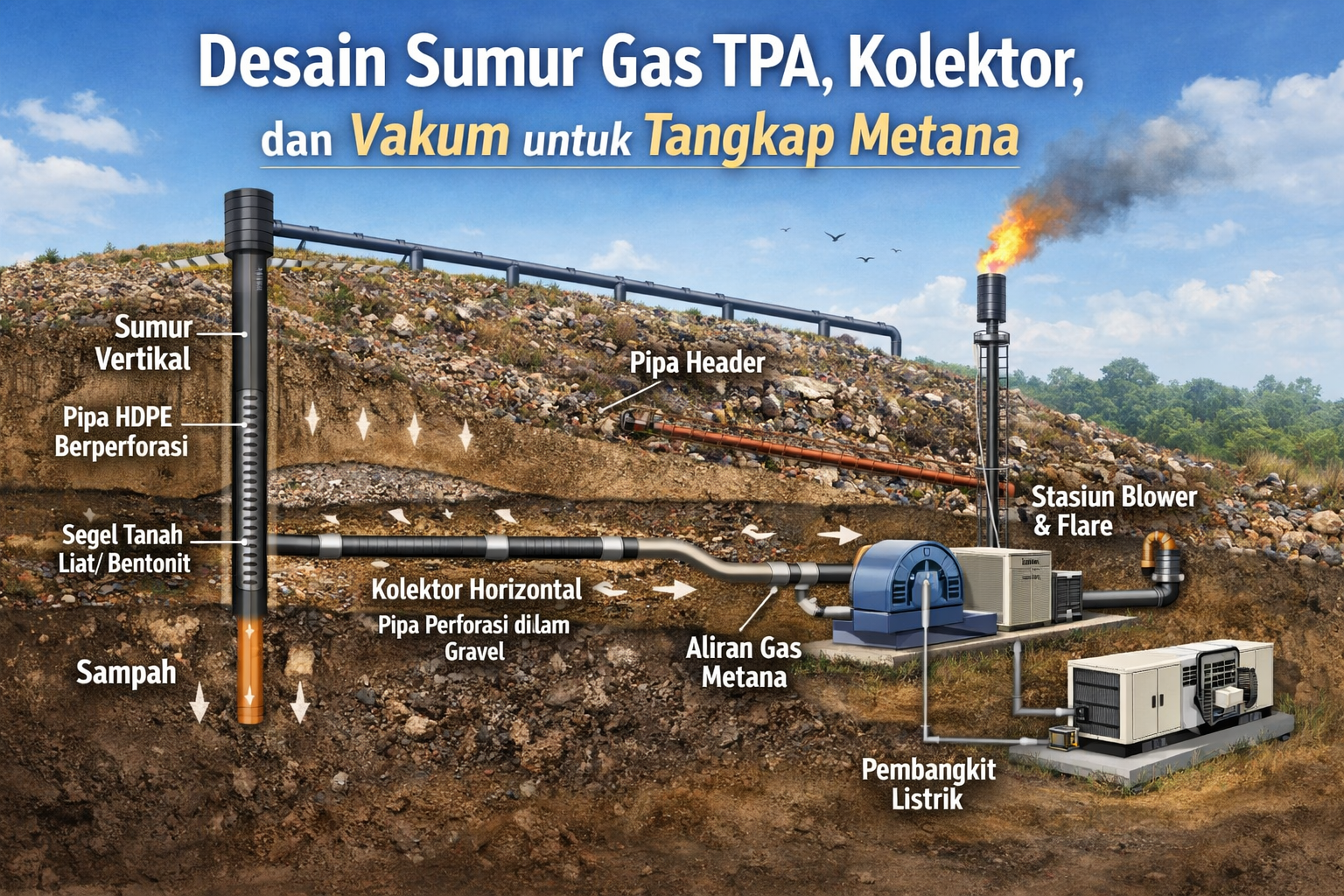
Horizontal trenches are much more closely spaced than deep wells. Best‑practice reports cite designs ranging from ~15 m to 60 m spacing (depending on site conditions and lift height) (ascelibrary.org). Field studies (e.g., Denton, TX) found ~15 m (50 ft) spacing significantly outperforms 30 m for gas collection (ascelibrary.org). Indonesian guides similarly emphasize that horizontal collectors be “close spacing” to scour the landfill for gas (studylib.net) (studylib.net).
By capturing gas as it migrates upward, these trenches complement deeper wells; typical layouts might alternate horizontal trench lines every 15–20 m of waste height or per every thrust cycle.
Pin wells for early-phase capture
For very young cells or interim capture, “pin wells” (spike wells) are used. These are short (~6 m), thin steel tubes (125–150 mm diameter) driven/pushed into the waste (studylib.net). They are quick and cheap, yielding immediate gas recovery in shallow (~6 m) waste. Pin wells are usually installed at very close spacing—about 10–20 m apart—to saturate the upper refuse layer (studylib.net). Although individual pin wells have lower flow than drilled wells, their density gives “quite substantial” combined flow early on (studylib.net), and they can be used until deeper wells become viable.
Design rationale, capture rates, and tuning
Each element—well design, spacing, and vacuum—aims to maximize capture. Modeling of India’s Bagalur landfill showed a carefully spaced active system achieved ~88% methane capture (journals.sagepub.com). Standards (e.g., EU, German regulations) similarly aim for >80% capture efficiency (journals.sagepub.com) (c.coek.info). Without active collection, landfills can lose ~50% of early gas (c.coek.info).
In practice, well fields are tuned during operation: flow rates and methane content are monitored at each well, and valves are adjusted to balance the field and suppress emission “hot spots” (c.coek.info) (c.coek.info). Good design also plans for condensate management (drip legs) and provisions for cover integrity.
Policy and specification notes (Indonesia)
Indonesian waste‑to‑energy guidelines and permit processes assume such gas capture infrastructure in modern landfills. While detailed Indonesian standards for LFG spacing may not yet be codified, the global best‑practices summarized above align with technical norms. In short, Indonesian engineers should specify deep perforated wells with ~35–60 m spacing plus dense horizontal collectors (~10–20 m spacing), operate blowers to maintain ~0.1–0.5 bar suction in the network, and aim for >80% methane recovery (with excess flared).
Reference values and sources
Authoritative sources (EPA/IFC/academic) give very similar guidance: vertical wells (≈1 m diameter, gravel pack, 3 m seal) spaced ~35–50 m (c.coek.info) (c.coek.info), horizontal collectors (perforated pipe in gravel) spaced ~15–20 m (studylib.net) (ascelibrary.org), and blowers providing ~1–5 kPa vacuum (wastetodaymagazine.com) (c.coek.info). These design values are supported by peer‑reviewed studies (e.g., recovered radius vs suction: ~12 m at ~1.5 kPa and ~33 m at ~4.5 kPa; designers often assume ~30 m ROI per well) (acsess.onlinelibrary.wiley.com) (journals.sagepub.com) and industry handbooks (c.coek.info) (studylib.net), enabling quantitative, data‑backed implementation.