

Industry: Brewery | Process: Milling
Grain and malt dust don’t just irritate lungs; they can detonate. The minimum explosive concentration (MEC, the lowest airborne dust level that can sustain an explosion) for grain/malt runs about 50–150 g/m³ — roughly 0.05–0.15 kg/m³ (nasdonline.org).
That threshold is alarmingly easy to reach. In a 10 ft (~3 m) high mill room, a cloud with only ~0.3 cubic inches of dust per ft³ of air can hit the MEC (nasdonline.org). The safety playbook is therefore blunt: keep airborne dust orders of magnitude below MEC, remove ignition sources, and stop dust accumulation before it becomes fuel.
Regulators have codified the how. NFPA 61 (for food/ag processing) requires “mechanical movement of air necessary for normal operation” and says any recirculated exhaust in a dust-hazard area must be filtered to remove dust (studylib.net). OSHA treats brewery mill rooms as hazardous dust locations under electrical codes (osha.gov).
Mill room ventilation and dust capture
Industrial ventilation (natural or mechanical) must supply fresh air and remove dust-laden air. In practice, mills use local exhaust hoods at outlets and conveyors, ducted to a sealed dust collector, with ample make‑up air. Ductwork should hold transport velocity at ≥3,500–4,000 ft/min (~18–20 m/s) so fine dust stays suspended and doesn’t settle; for “general industrial dust” such as grain/feed, the recommended minimum is ~3,500–4,000 ft/min (nordfab.com).
Run properly, these systems keep airborne dust far below MEC. Facilities often target <10 mg/m³ for worker health—5,000–10,000× lower than the 50–150 g/m³ MEC range (nasdonline.org). Ventilation capacity is sized so the space achieves dozens of air changes per hour or, more importantly, so local extraction captures dust before it disperses.
Dust collectors (often baghouses, i.e., fabric-filter units that capture fine particulates) must be explosion-protected. NFPA 68 requires properly sized explosion relief vents or suppression on any dust collector (isystemsweb.com). Vent panels act as deliberate weak points that open on overpressure, directing flames and debris away from people and equipment (isystemsweb.com) (isystemsweb.com).
Design per NFPA 68 allows internal deflagration loads to be relieved without catastrophic enclosure failure, with vents oriented outdoors or through curtain/deflector plates that channel the event away from occupied areas (isystemsweb.com) (isystemsweb.com). Effective systems filter 99+% of particles and include explosion relief panels, flame arrestors, or suppression; vent size and orientation follow NFPA guidance to protect people and plant (isystemsweb.com).
The numerical context underscores the stakes. With MEC at ~50–150 g/m³ (nasdonline.org), a 10 ft (~3 m) high room can hit that limit if about ~0.3 cubic inches of dust per ft³ of air becomes airborne (nasdonline.org). The engineering response is source capture and robust ventilation—high transport velocities in ducts and extraction rates that remove dust before it spreads.
Explosion-proof motors and electrical classification
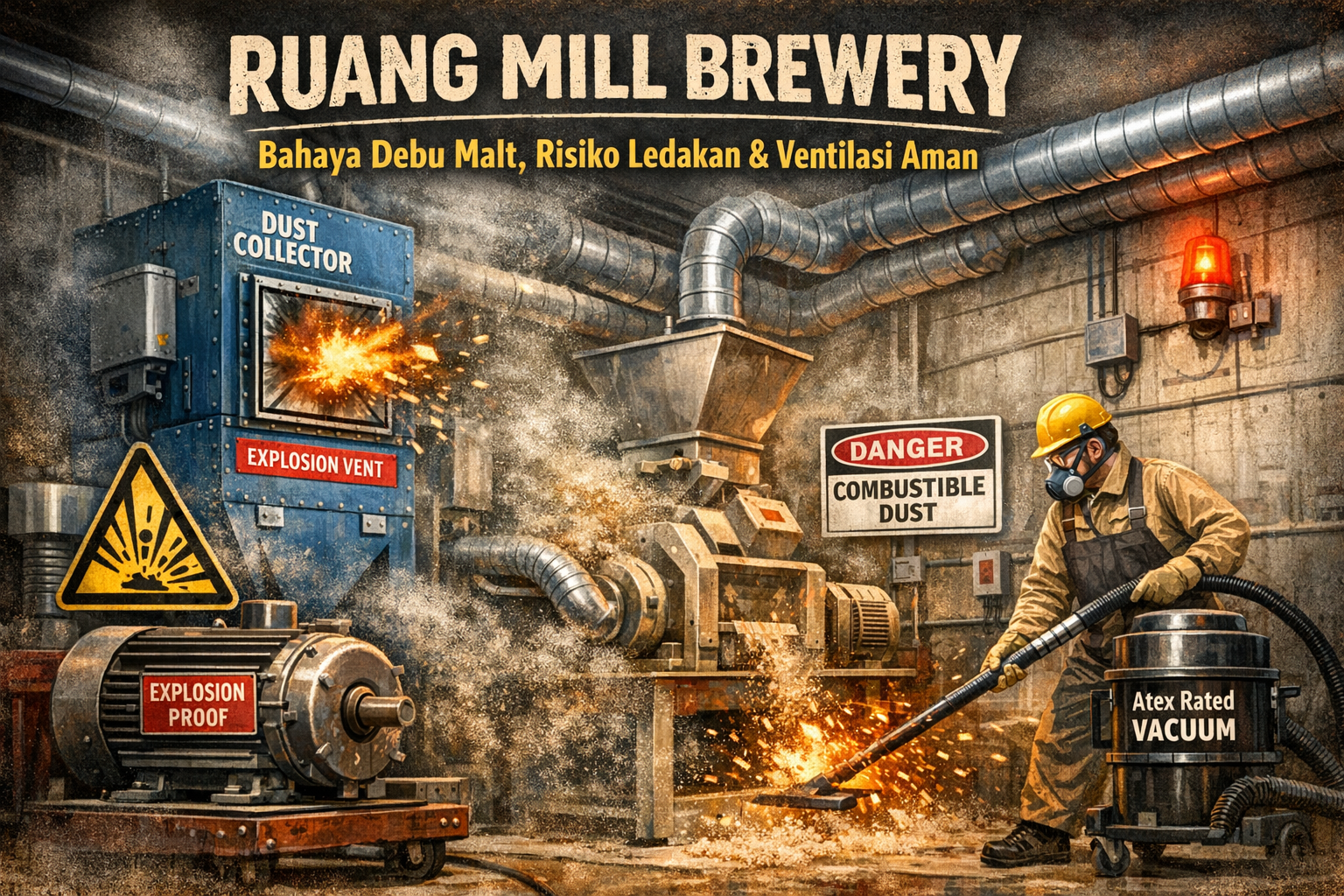
Brewery mill rooms with combustible organic dust are treated as hazardous locations. Under U.S. and IEC frameworks this is typically Class II, Division 1 (NFPA 70/NEC; Class II denotes combustible dust) or Zone 21 (IEC/ATEX; areas where explosive dust atmospheres are likely during normal operation) (osha.gov). All electrical and mechanical equipment in such areas is certified accordingly.
Facilities employ explosion‑proof (flameproof) motors and enclosures — for example, NEMA 7/9 or IECEx Ex d/t devices rated for Class II dust environments (controlledairdesign.com) (osha.gov). A NEMA 9 enclosure, for instance, is “constructed for Class II, Division 1… locations classified as combustible dust” (controlledairdesign.com).
Wiring, switches, junction boxes, and fixtures use dust‑tight, gasketed housings (IP 6X indicates zero dust ingress) and are bonded/grounded to prevent static discharge. Fans, conveyors, grinders, and vacuum systems use Class II‑rated drives or inherently safe designs (e.g., pneumatic/vacuum conveying with no internal ignition source).
The data justify the rigor. Dust from malt or grain is non‑conductive but remains explosive, and static or electrical sparks are common ignition sources (osha.gov). In food/grain facilities, the average has been ~28 dust explosions annually across 2016–2023 (dustsafetyscience.com). Failures often trace to unprotected motors or controls; conversely, certified gear virtually eliminates electrical ignition potential. After a major U.S. sugar milling explosion, OSHA fines and mandated upgrades totaled about $2 million (osha.gov).
Housekeeping thresholds and cleaning tools
Routine cleaning is the last line of defense—and NFPA’s “Dust Pentagon” stresses that “Housekeeping is a critical part of any plan to protect against a combustible dust incident” (dustcenter.org). OSHA guidance citing NFPA 654’s Layer Depth Criterion triggers cleaning when dust exceeds 1/32 inch (~0.8 mm) over 5% of the area (dustcenter.org) (ohsonline.com).
The margins are thin. Grain/malt dust MEC can be reached with layers as thin as 0.25–0.5 mm (nasdonline.org). Many facilities therefore clean daily or per‑shift. NFPA 61 limits visible dust layers to 3.2 mm (1/8”) over no more than 5% of floor area (dustcenter.org), while NFPA 654 (2020) effectively caps total settled dust mass at ≈1 kg/m² (equivalent to 1/32″ over 100% of the floor) (dustcenter.org).
That “paper clip” thickness translation is often used for awareness (ohsonline.com). Managers can audit by measuring dust depth or the swept weight per area. To avoid dispersing dust, facilities use explosion‑safe tools: Class II‑rated industrial vacuums (or air‑powered Venturi vacuums) with HEPA filters, rather than compressed air or ordinary brooms (ohsonline.com) (ohsonline.com).
Many plants schedule vacuuming of floors, machine tops, ductwork, and overheads at shift end. Overhead areas—rafters, beams—often hold dust equal to 5–10% of the floor area, making elevated cleaning essential (ohsonline.com). Case histories report that adopting NFPA‑recommended cleaning, such as daily vacuum cleaning instead of sweeping (e.g., post‑2017 Didion Mill practices), drives dust levels well below thresholds and prevents reoccurrence (ohsonline.com) (dustcenter.org).
Incident patterns and standards baseline
Strict dust‑control protocols correlate with fewer incidents. In 2023, 66% of combustible‑dust deaths were from explosions (dustsafetyscience.com). Globally in 2023, reported combustible dust events included 53 explosions and 62 fatalities (dustsafetyscience.com). In the U.S., grain‑dust surveys note ~10 dust explosions per year (nasdonline.org).
The regulatory scaffolding is clear: NFPA 654/652 detail dust limits and ignition controls (dustcenter.org) (ohsonline.com), NFPA 61 mandates ventilation and filtered recirculation in dust‑hazard areas (studylib.net), and OSHA definitions clarify Class II/Zone 21 hazardous location requirements (osha.gov). All cited material dates within the past decade and emphasizes data‑backed controls.