

Industry: Brewery | Process: Milling_&_Mashing
In May 2024, a dust explosion at a U.K. brewery engulfed a worker in a fireball and lifted the roof off the building (bbc.com). Grain (cereal) dust is easily ignitable thanks to its high surface‑to‑volume ratio (abmequipment.com) (torch-air.com), and the food/grain processing sector accounts for about 24% of global combustible-dust explosions (wood products are 34%) (milleral.com).
The risk is not theoretical. In 2023, DustSafetyScience recorded 53 dust explosions worldwide, with 94 injuries and 62 deaths (dustsafetyscience.com). In Indonesia as well, serious dust incidents have occurred in grain mills. Small breweries are not exempt: an ignition in a mill room can trigger a powerful fireball.
Combustible dust conditions in milling
Dust explosions require the “dust pentagon” — fuel, oxygen, dispersion, confinement, ignition. Barley malt dust meets these conditions during milling. The minimum explosible concentration (MEC; the lowest dust-in-air level that can propagate a flame) is on the order of 40 g/m³ (torch-air.com). In practice, effective dust extraction aims to reduce airborne concentrations by four orders of magnitude — to mg/m³ levels — to stay safely below ignition thresholds.
International standards frame the response. NFPA 61 (agricultural dust) and NFPA 654 (general combustible dust) from the National Fire Protection Association require hazard assessment of any combustible dust process, as do European ATEX rules (ATEX: EU directives governing equipment in explosive atmospheres) (hazardexonthenet.net) (dustexplosion.info). In Indonesia, employers must similarly conduct K3 (safety) assessments for explosive atmospheres, effectively enforcing equivalent precautions.
Ventilation and local dust collection
Local exhaust ventilation (LEV; hoods at sources such as the mill discharge or bucket‑elevator boots) is the first line of defense. As a rule of thumb, hoods use capture velocities on the order of 100–200 ft/min to entrain barley dust (actual design follows ACGIH industrial‑ventilation guidelines) (dustexplosion.info). Exhaust airflows are sized to capture a high fraction of expelled dust and routed to collectors.
Bag or cartridge dust collectors downstream of the mill routinely achieve >99% single‑pass removal of fine particles. Large pulse‑jet “baghouse” collectors are common in breweries because they handle high volumes and dirty airflows (abmequipment.com). Smaller breweries, especially without silos, often use compact cartridge collectors that fit under local volume thresholds and avoid requiring additional explosion‑mitigation features (abmequipment.com).
Filtered exhaust is vented outdoors or recirculated through HEPA‑grade filters (HEPA: high‑efficiency particulate air). Systems maintain a slight negative pressure in the mill room so that leaks draw outside air rather than letting dust escape to adjacent areas (dustexplosion.info).
The operational upside extends beyond safety: the Guild of Brewers notes that effective dust collection markedly reduces respiratory exposure, cuts cleanup time (since <1–5 mg/m³ remains airborne), eliminates settled dust that attracts pests, and reduces slip hazards (coloradobeer.org).
NFPA design anchors and performance
NFPA 61/654 require a dust hazard analysis and appropriate controls — ventilation, suppression, venting, and isolation — before startup. For venting, NFPA guidance specifies vent areas for equipment such as bucket elevators based on grain Kst values (Kst: dust deflagration index, a measure of explosion severity) (manufacturingtomorrow.com).
Performance can be quantified. In one study, a downdraft hood with 2 m³/s flow reduced work‑area dust by >90%. More generally, effective dust extraction keeps airborne dust well below hazardous levels, ideally <1 mg/m³ background.
Explosion-proof motors and electricals
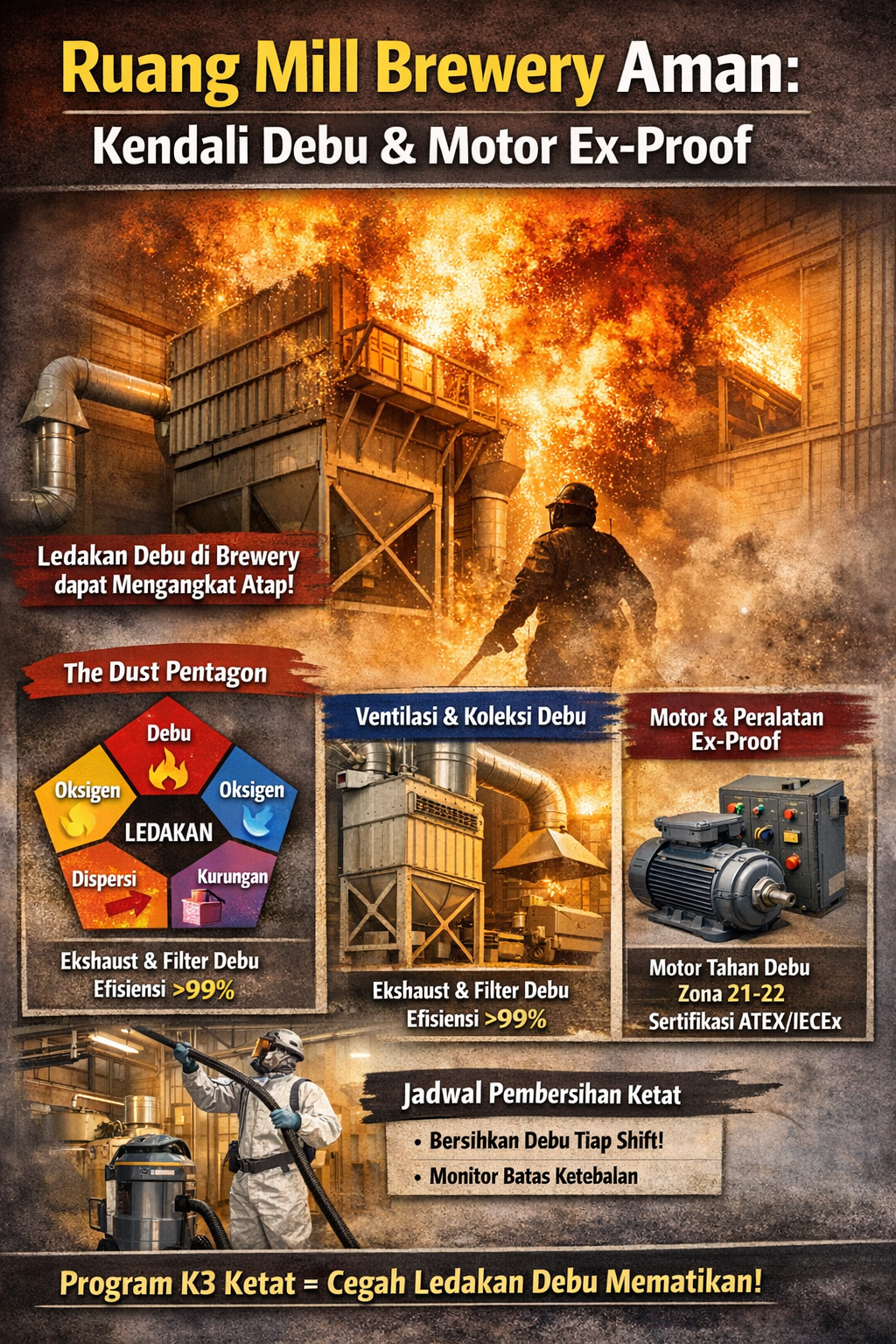
All electrical equipment in the mill room is specified for combustible‑dust atmospheres. In NEC/IEC terms this typically means Class II/Zone 21–22 devices (classification schemes for hazardous dust zones). Area zoning follows ATEX conventions: the open mill or conveyor room is typically Zone 21, while enclosed equipment interiors may be Zone 20 (dustexplosion.info).
Explosion‑proof motors, junction boxes, and lighting are designed to contain internal sparks and exclude dust. NFPA and OSHA requirements both point to such classification — NFPA 61 refers to IEC/NEC standards for “dust‑ignition‑proof” motors, and OSHA’s grain‑facility standard mandates wiring and devices that “will not provide an ignition source” in grain‑dust areas. In practical terms, a 1–2″ spark in a non‑classified motor can ignite a dust cloud; an explosion‑proof motor, often 50–100% more expensive, eliminates that risk by sealing or controlling potential arcs.
Best practice inventories all equipment in dust zones with verified ATEX/IECEx certification. Lighting is suitably sealed (for example, IP66‑rated flameproof fixtures), and sensors or control panels are explosion‑proof or intrinsically safe. Grounding and bonding of metallic equipment drain static. ASEAN or Indonesian standards typically reference IECEx or ATEX equivalence; breweries require equipment rated at least IEC 60079‑14 Category 2D (Zone 21 dust) for a margin of safety.
Cleaning and housekeeping schedule
Even with robust collection, fugitive deposits accumulate on rafters, beams, pipes, and ledges. NFPA 654 identifies that a layer of combustible dust ≈0.8 mm (about 1/32″) covering >5% of an area, or a single patch >1000 ft², constitutes a dust explosion hazard (osha.gov). OSHA guidance for grain‑handling facilities is similarly strict: any grain spill, especially within ~35 ft of conveyors or elevators, is cleaned promptly (osha.gov). Put simply, if visible dust exceeds roughly the thickness of paper coverstock, it is over the hazard threshold.
Housekeeping is vigilant and logged — often daily or per shift in mill rooms. Industrial vacuum cleaners rated for combustible dust (ATEX/IECEx certified) are used to remove settled flour and husk dust (lampuexproof.com). Compressed air or dry sweeping merely disperses dust and is avoided. The UK HSE notes that accumulated dust is the primary culprit in secondary (workroom) explosions, so the goal is “elimination of dust…in workrooms,” which is “vital” (dustexplosion.info).
Clean mill rooms also make inspection easier — leaks at malt conveyors or damaged gear are easier to spot. Conversely, many incidents in bakeries and breweries have traced to poor housekeeping. Indonesian noodle and flour mills have seen serious explosions when maintenance cleaning had been lax. The 2024 brewery blast underscores the stakes (bbc.com).
Putting the program together
Effective programs combine engineered controls and strict practices: powerful exhaust ventilation and filtration, approved explosion‑proof fixtures and motors, and rigorous cleaning regimens. Each element is quantifiable — filter efficiency, zone certification level, dust‑layer measurements — and references such as NFPA 61/654 or international dust standards guide required performance.
Where implemented fully, the measures have been shown to virtually eliminate grain‑dust incidents: facilities with well‑designed collectors report worker dust exposures <1% of allowable limits and no explosion near‑misses (coloradobeer.org) (torch-air.com). By contrast, failure on any front — even minor — can allow a thin film of malt dust to accumulate and a single spark to cause catastrophe (dustexplosion.info) (osha.gov).
Sources: Current industry and regulatory literature, including OSHA/NFPA guidelines and recent incident reports (dustsafetyscience.com) (osha.gov) (osha.gov) (bbc.com) (torch-air.com), and international safety publications (abmequipment.com) (dustexplosion.info) (milleral.com). These references provide data on explosion frequencies, threshold values, and engineering best practices relevant to brewery dust control.