

Industry: Landfill | Process: Gas_Collection_&_Flaring
Landfill operators are increasingly turning to enclosed landfill gas flares — refractory-lined chambers with controlled air/gas mixing — rather than simple open “candlestick” flares. The reason is simple: at around 1,000–1,200 °C and with the gas dwelling in the hot zone for ~0.3 seconds or more, enclosed flares routinely deliver methane and VOC destruction in the 98–99%+ range, with toolkits even citing >99.99% under optimal conditions (flaringmethanetoolkit.com; landfill-gas.com).
That temperature discipline matters for climate math. Methane’s 100‑year global warming potential is ≈28–36× carbon dioxide, and on a 20‑year basis it is up to ~80× (lcdi-indonesia.id; www.eesi.org). Converting 1 t of CH₄ to CO₂ yields only 2.75 t of CO₂ and avoids the ~28–36 t CO₂‑eq that the methane would otherwise impose.
Most regulators now require enclosed flares for long‑term use to ensure stable, high‑temperature combustion. Open flares are cheaper but less reliable in holding the necessary flame conditions.
Enclosed combustor design and air mixing
Enclosed flares are refractory‑lined, contain multiple burner tips, and use induced or forced air to stabilize the flame for smokeless combustion (Figure: sample enclosed flare image). The configuration delivers a defined flame zone and residence time, and it permits exit‑gas sampling to verify performance (flaringmethanetoolkit.com).
Advanced designs can handle very dilute landfill gas — even 10–15% CH₄ — by premixing air with the gas and running at high temperature (www.afvalzorg.com). Low‑calorific flares (with pre‑mix burners) are used at sites with low gas heating value. Properly sized and controlled, the system keeps gas in the hot zone so that, in practice, well‑designed enclosed flares achieve very high destruction efficiencies — often >99% for methane and nearly all VOCs — with toolkits noting >99.99% under optimal conditions (flaringmethanetoolkit.com; landfill-gas.com).
Many systems add auxiliary fuel or a blower to maintain combustion during low‑flow or lean‑gas conditions. After combustion, the only emissions should be CO₂, H₂O, excess O₂/air, and very low levels of regulated pollutants (see below) (landfill-gas.com).
Temperature, residence time, and complete destruction
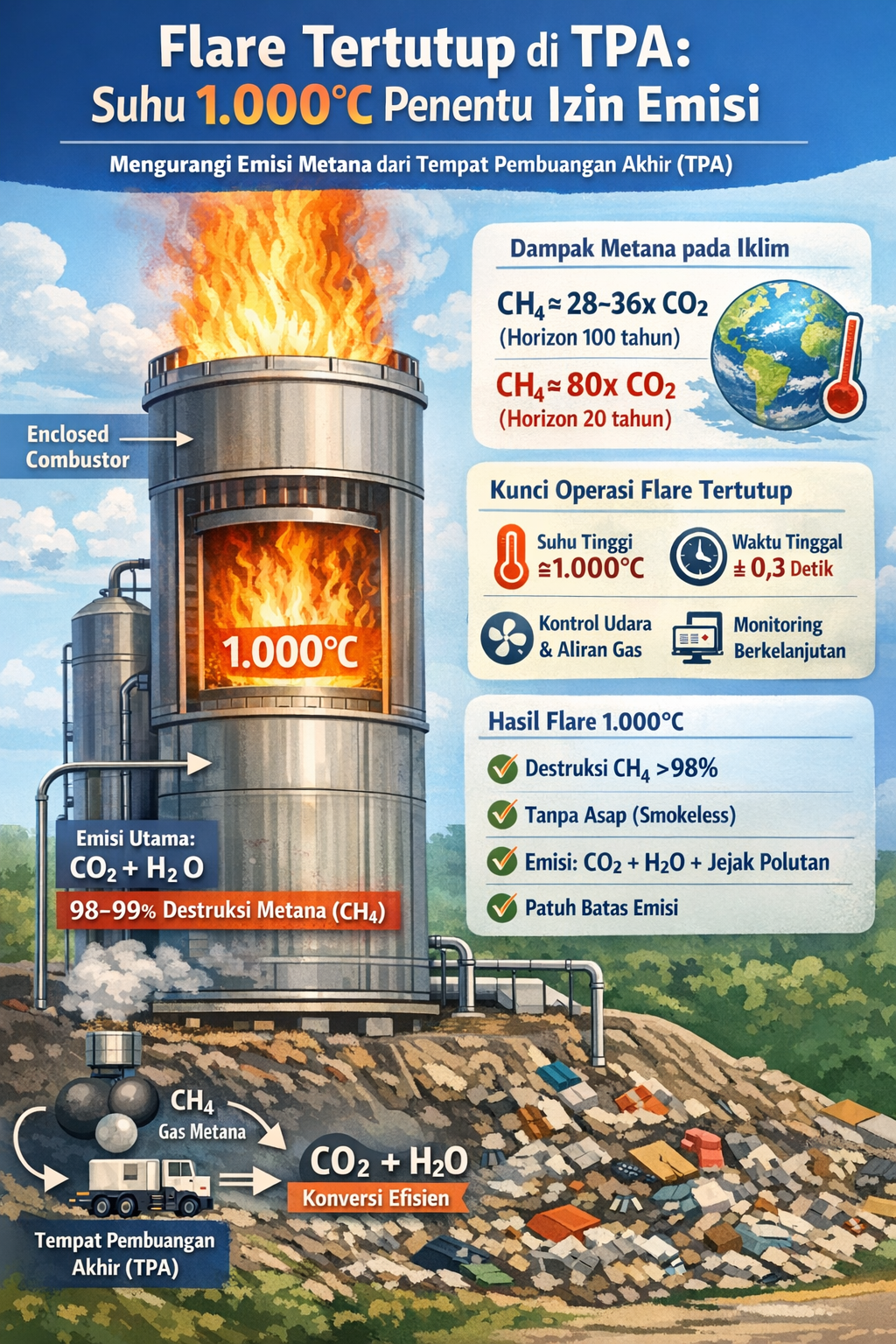
A common rule‑of‑thumb in U.S. EPA and European guidance is ≥1,000 °C in the combustion zone for ~0.3 s or more (studylib.net; landfill-gas.com). Methane’s auto‑ignition is ~537 °C, but practical, robust flaring needs much higher flame temperatures to oxidize all components, especially heavier non‑methane organics.
CHP Gas flares are usually run around 1,000–1,200 °C in the combustion chamber, and UK guidance notes flares operating at 1,000–1,200 °C with ≥0.3 s residence achieve ~98–99% destruction of methane and VOCs (studylib.net; landfill-gas.com). Natural Resources Wales states that flares unable to maintain ~1,000 °C (±100 °C) and the required dwell time are “unlikely to meet the emission standard and must be regarded as noncompliant” (studylib.net; studylib.net).
Under these conditions, well‑designed enclosed flares deliver destruction efficiencies often cited at 98–99% or better for CH₄ and VOCs (landfill-gas.com; flaringmethanetoolkit.com). Incomplete combustion at lower flame temperatures, by contrast, can leave CO, residual hydrocarbons, and NOₓ. Maintaining ~1,000 °C is a built‑in compliance strategy: it virtually guarantees methane and VOC destruction and minimal toxic byproducts (landfill-gas.com; studylib.net).
If acid‑forming species are present in the landfill gas, robust flare design requires monitoring and scrubbing the inlet when those species are high (landfill-gas.com). Where pretreatment is specified in permits, operators may integrate amine‑solvent systems as part of CO₂/H₂S removal before combustion, drawing on equipment categories like amine solvent systems.
Some sites also add adsorption stages for organics management in the upstream train; portfolios include media such as activated carbon where required by design.
Destruction efficiency metrics and byproducts
Regulators typically require either a destruction efficiency (DE) of ≥98% or a strict outlet concentration limit. U.S. EPA New Source Performance Standards (NSPS) allow a landfill to show compliance by either ≥98% methane destruction or a flare outlet NMOC (non‑methane organic compounds) concentration ≤20 ppmv (parts per million by volume) (www.ecfr.gov).
Stack testing using EPA Method 25/25C (FID analyzer; flame ionization detector) or Method 18 (speciated organics) is used to verify CO₂/CH₄ levels and compute DE (www.ecfr.gov). If these conditions are met, essentially all CH₄ is oxidized; the residual CO₂ in exhaust is not regulated beyond global warming accounting.
Combustion at ~1,000 °C will form some CO and NOₓ, and many jurisdictions set limits on these (as ppm or mg/Nm³). At this temperature, visible smoke is typically eliminated. Other hazardous organics (e.g., dioxins, furans) are negligible if the flame is consistently above ~850–900 °C with good residence time. Acid gases (HCl, HF, SO₂) may appear in flue gas only if present in the landfill gas; hence the emphasis on inlet monitoring and, if needed, scrubbing (landfill-gas.com).
Continuous monitoring and permit compliance
To demonstrate compliance, operators continuously monitor key parameters and perform periodic emission checks. NSPS requires a combustion‑chamber temperature monitor (±0.5 °C or ±1%) with a data logger for any enclosed combustor, with the flame temperature maintained at or above the design setpoint (typically ~1,000 °C) (www.ecfr.gov). A deviation beyond design — e.g., >±100 °C — triggers corrective action (studylib.net).
Flares must either meter the volumetric flow of incoming landfill gas at least every 15 minutes or have any bypass line car‑sealed and checked; U.S. EPA rules require a flowmeter on the flare inlet, or a car‑sealed bypass valve inspected monthly (www.ecfr.gov; www.ecfr.gov). Open flares must confirm the continuous presence of a flame (e.g., UV‑beam or thermocouple) (www.ecfr.gov).
Composition checks of inlet LFG (landfill gas) may be done to verify operation within design range, and periodic stack tests measure regulated pollutants. Under U.S. rules, flares must meet either the DE or outlet NMOC standard through Method 25/18 testing — effectively checking VOC destruction (www.ecfr.gov). Regulators may also impose limits on CO, NOₓ, or visible emissions.
In many jurisdictions, monitoring is “operational‑parameter”–based: certified flare type/size and verified temperature/residence time are accepted as proof of compliance, shifting emphasis to temperature logs, flow rates, and flame diagnostics rather than frequent stacks (landfill-gas.com). Natural Resources Wales explicitly states that flares not meeting 1,000 °C and 0.3 s should be considered non‑compliant (studylib.net). Operators keep records of combustion temperature and gas throughput to show continuous compliance.
Indonesia’s permitting context and practice
In Indonesia, environmental permits (Izin Lingkungan) for landfills similarly condition any flare operation. While no dedicated landfill‑flare regulation is identified, the government explicitly promotes landfill gas capture — including flaring to convert methane to CO₂ — as a greenhouse mitigation strategy (lcdi-indonesia.id).
Practically, operators maintain detailed logs (flame temperature, flow, operating hours) and conduct stack tests for CO, NOₓ, and total VOC content per national air quality standards, with permits often setting numeric limits (e.g., mg/Nm³). In the absence of flare‑specific criteria, international benchmarks are used — e.g., ≥98% methane destruction or equivalent low outlet VOC, and maintenance of ~1,000 °C flame — with compliance data from temperature sensors and emission tests submitted to authorities (no visible smoke; CO/NOₓ/VOC below regulatory limits).
Where permits specify upstream removal of problematic constituents, some projects align their trains with categories such as CO₂/H₂S amine solvent removal to manage acid‑forming gases before combustion.
Bottom line: hot, long, and logged
Enclosed flares, often with auxiliary fuel, are engineered to burn landfill gas at ~1,000 °C with ≈0.3 s residence time, ensuring ~98–99%+ methane and NMOC destruction (landfill-gas.com; studylib.net). Compliance is demonstrated by continuously proving those conditions (temperature, flow, flame) and periodically verifying via stack tests that pollutant limits — or destruction efficiency — are achieved (www.ecfr.gov; www.ecfr.gov).
Sources: Authoritative engineering and regulatory publications on LFG flares (studylib.net; landfill-gas.com; www.ecfr.gov; www.ecfr.gov); U.S. and UK agency guidance and EPCoidm (EPA, NRW) standards (studylib.net; www.ecfr.gov); landfill gas chemistry and climate data (lcdi-indonesia.id; www.eesi.org); case studies and technology notes (www.afvalzorg.com; flaringmethanetoolkit.com).