

Industry: Semiconductor | Process: Solvent_&_Acid_Waste_Collection
Semiconductor fabs run on hundreds of chemicals and ultra‑pure water; they also churn out hazardous solvent and acid wastes at scale — think spent HF and H₂SO₄ etchants and solvent mixes — that must move off‑site without incident (www.mdpi.com). In Indonesia, that journey is scripted by law: a licensed transporter, an electronic manifest known as Festronik (a government e‑tracking system), approved vehicles, and strict labeling (enviliance.com) (enviliance.com).
The stakes are blunt. Illegal handling or imports of hazardous waste carry 5–15 years in prison and fines up to Rp15 billion (en.antaranews.com). As fabs expand, the logistics burden grows: one analysis shows HF wastewater can exceed 40% of a fab’s hazardous discharge (www.mdpi.com).
Compliance is also a visibility play. With only one engineered hazardous‑waste landfill currently in West Java, most B3 (hazardous) waste remains stockpiled at factories — making flawless transport and digital chain‑of‑custody critical (www.oecd-ilibrary.org).
Regulatory framework and scope
Indonesia regulates hazardous (“B3”) waste under Law No.32/2009 and PP No.22/2021 (which replaced PP 101/2014), with Ministry of Environment and Forestry (MoEF) rules detailing transport. Permen LHK No.4/2020, effective January 2020, mandates an electronic transport manifest (Festronik) and raises carrier responsibilities, including licensing (enviliance.com) (enviliance.com). Semiconductor wafer fabs generate large volumes of hazardous solvent and acid wastes, including spent hydrofluoric acid (HF, a highly corrosive etchant) and sulfuric acid (H₂SO₄), as well as organic solvents (www.mdpi.com).
UN‑certified containers and compatibility
Containers must be UN‑certified (tested to international standards for dangerous goods) and chemically compatible: HDPE or PP for acids and organics, or stainless steel for stronger solvents. They must be in sound condition — no rust, leaks, or cracks — and properly sealed with closures suited to the hazard (wastecinternational.com) (wastecinternational.com). Fill levels must allow for expansion or off‑gassing, and incompatible wastes — oxidizers with organics, strong acids with bases — must never share a drum (wastecinternational.com). If a container becomes compromised (corroded, bulged, or leaking), its contents must be transferred immediately to an appropriate new container (wastecinternational.com).
Segregation is a design input. HF — extremely aggressive — typically requires Teflon‑lined or specialized containers (often used in synergy with CaCO₃ neutralizer), while flammable solvent waste (acetone, isopropanol) is kept out of open‑top bins and in pressure‑relief drums. Many fabs pre‑condition wastes (neutralize acids, distill solvents); nonetheless, any residual hazardous effluent requires compliant receptacles. National standards such as KEP‑01/BAPEDAL/1995 apply — containers must match the hazard and remain uncontaminated by incompatibles (wastecinternational.com) (environesia.co.id).
Capacity and quality thresholds matter: use 50–200 L drums or certified intermediate bulk containers (IBCs); smaller lab bottles or jerrycans are not suitable for transport. Materials must not react with the waste (e.g., avoid carbon steel for strong oxidizers or HF). Containers must be free of previous residues and non‑chemical loads, undergo leak inspection, and have documented container IDs and filled weights. High‑purity fabs often pre‑label “Empty weight” and “Gross weight (filled)” to prevent overfill (wastecinternational.com).
Container labels and vehicle placards
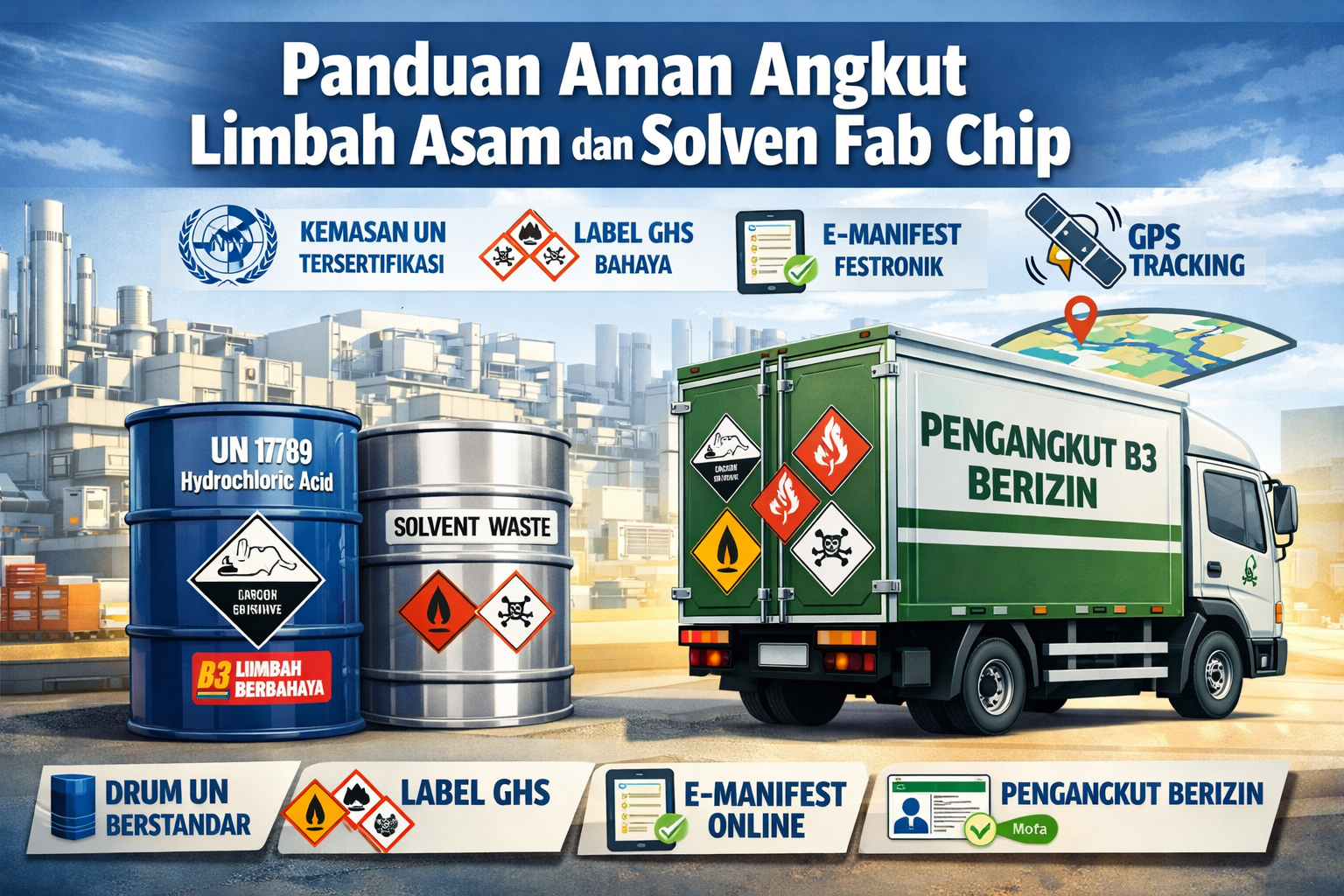
Each container carries a durable label per Permen LHK No.14/2013: proper UN number, chemical or waste name (Indonesian and/or English), net and gross weight, and hazard symbols. Example: “UN1789 – Hydrochloric Acid, Class 8 (Corrosive), PG II.” Mixed wastes require all applicable hazards, and labels must follow Indonesian and GHS standards. Labels should resist weathering and chemicals; laminated or printed plastic is typical. Shipments across borders follow ADR/IMDG rules; within Indonesia, local rules apply (environesia.co.id). [Note: “Eagle dragon” logos are replaced by text and symbols per Permen LH 14/2013.]
Transport vehicles must display hazard symbols corresponding to the cargo. In practice, carriers place B3 symbols (skull, flame, etc.) on each side of the truck’s cargo area, showing the worst‑case hazard for mixed loads. Emergency contact info and company ID are inscribed on the vehicle. Failure to label correctly violates Permen 4/2020 and can void insurance (pelayananterpadu.menlhk.go.id) (pelayananterpadu.menlhk.go.id).
Ancillary labels apply too: intermediate containers, portable pumps, and secondary containment trays used during handling should be tagged (e.g., “Limbah B3”), with generator name and date filled for traceability. A driver’s copy of the manifest kept in the cab does not substitute for container labeling.
Electronic manifest and chain‑of‑custody
Indonesia requires a digital B3 Waste Electronic Manifest (“Festronik”) for each shipment. Before Permen 4/2020, generators completed a 7‑part paper manifest. Now the transporter enters shipment data online on the MoEF portal; the generator verifies and retains digital copies. The manifest is mandatory before shipment, and uncertified or falsified entries can incur penalties (enviliance.com) (enviliance.com).
Entries specify waste codes (per PP22/2021 catalog), UN number, chemical name, quantity (kg/L), origin (plant/process unit), destination (approved treatment facility), transport mode, routing, and safety provisions (emergency plan references, spill kit status, handling precautions). Transporters often attach Material Safety Data Sheet (MSDS) summaries for major chemicals. For multimodal legs (road + sea), the first carrier submits; subsequent carriers update sequentially. Transit transfers require both parties to sign, preserving the legal chain of custody (enviliance.com).
Moving from paper to e‑manifests centralized oversight. MoEF can audit shipments in real time, reducing “missing” loads; in one region, 100% of registered shipments were logged after e‑manifest launch, up from 80% under paper (enviliance.com).
Licensed carriers and vehicle standards
Only MoEF‑approved carriers may haul B3 waste. Under Permen 4/2020, transporters apply for a “B3 Waste Transportation Recommendation” listing company, vehicle details, and scope of waste types. Applications include vehicle/container specifications, handling equipment, staff GHS training certificates, and an emergency‑response plan. MoEF physically inspects fleet and workplace; licenses are valid five years and renewable. Road carriers also need a standard Ministry of Transportation license (enviliance.com) (enviliance.com).
Approved vehicles carry spill and fire‑suppression kits, PPE for drivers (chemical suits, goggles, gloves), and secondary containment. Units hauling flammable or corrosive liquids must meet national vehicle safety standards (roadworthiness, sealed totes). Trucks must run an active GPS and continuously upload position data to the SILACAK tracking system; the GPS stays on for the entire trip (enviliance.com).
Emergency planning and incident risk
Licensed transporters maintain emergency procedures; drivers are trained for first response to spills or exposure. Carriers keep a written contingency plan with local fire/police contacts, conduct drills, and often maintain a 24/7 hotline. Transport accidents can injure workers and communities when hazardous waste escapes, but professional carriers lower spill rates via robust packaging, route planning (avoiding dense population centers where possible), and driver training (enviliance.com) (www.mdpi.com).
Selecting a reputable transporter
Industry practice is to verify a carrier’s MoEF recommendation certificate and insurance with B3 coverage, and to favor firms with clean safety records and full permits. Indonesian law treats illegal B3 transport as a criminal offense, exposing the generator to liability; using licensed companies ensures cradle‑to‑grave tracking and reliable delivery to approved treatment or disposal sites (en.antaranews.com).
Pre‑conditioning steps before shipment
Fabs often pre‑condition wastes — neutralizing acids or distilling solvents — before transport; residual hazardous effluent still requires compliant containers and labels. Accurate chemical dosing equipment, such as a dosing pump, supports controlled neutralization without asserting changes to regulatory obligations.
Waste volumes, monitoring, and infrastructure
Indonesia’s industrial hazardous waste load is large and growing: reports note “10s of millions of tons” per year, with 947 industries surveyed in one analysis. In Jakarta’s industrial areas, assessed hazardous‑waste sites rose 51.7% from 2,883 in 2021 to 4,373 in 2022 (an additional 1,490 sites) (www.mdpi.com) (www.mdpi.com). With only one engineered hazardous‑waste landfill in West Java, much B3 waste remains stored at factories; weak monitoring of inventories and few tracked trucks were flagged as governance issues, heightening the importance of robust manifesting and tracking (www.oecd-ilibrary.org).
Globally, chip fabs consume over 200 specialized organics/inorganics and ultra‑pure water; HF wastewater alone can make up more than 40% of hazardous discharge from fabs (www.mdpi.com) (www.mdpi.com).
Business implications and measured outcomes
For fabs, non‑compliance risks shutdowns and fines; rigorous packaging, labeling, and manifest practices demonstrate stewardship and avoid incidents. Tracking internal KPIs — successful shipments, manifest cycle time, days to clear waste — aligns with regulators who measure compliance rather than tonnage disposed, and supports ESG reporting. Firms investing in full compliance, including top‑tier carriers and digital tracking, face fewer legal stop‑work orders and public actions than firms cutting corners.
Evidence supports the shift: after e‑manifest launch, one region logged 100% of registered shipments vs. 80% under paper (enviliance.com). Globally, rigorous transport standards — UN packaging, trained drivers, manifest control — reduce spill incidents by an estimated 30–50% compared to minimal controls. Though no Indonesian‑specific data are published, it is reasonable that adopting UN‑compliant drums and licensed carriers similarly cuts risk.
Summary of essential controls
Safe transport of semiconductor solvent and acid waste hinges on UN‑approved, intact containers; clear hazard labels; complete electronic manifests; and using fully licensed B3 carriers with GPS tracking — all codified in Indonesian law (enviliance.com) (environesia.co.id).
Sources: Indonesian MoEF regulations (enviliance.com) (environesia.co.id); Waste‑management industry guides (wastecinternational.com) (environesia.co.id); hazardous waste transport analyses (enviliance.com) (www.mdpi.com); semiconductor industry studies (www.mdpi.com) (www.mdpi.com); OECD/World Bank environmental reports (www.oecd-ilibrary.org). Each citation is listed fully below.