
From 2‑roller to 6‑roller mills, “more rollers = finer control” — and tiny adjustments of 0.05–0.1 mm can swing extract, runoff speed, and astringency. Lab sieve data and tight maintenance keep the crush on target.
A brewery’s first critical variable isn’t the mash temperature — it’s the space between two steel rollers. Milling sets up everything that follows, and the gap changes in fractions of a millimeter determine if husks stay intact, starches convert, and lauters run on time. Industry guidance is explicit: adjust roller gaps by ~0.05–0.1 mm at a time (crispmalt.com).
Across mill types, as the number of rollers increases, so does the ability to control each grist fraction — or, as suppliers put it, “more rollers = finer control” (crispmalt.com). That control comes with higher capital and maintenance costs (crispmalt.com).
Roller configurations and fraction control
A 2‑roller mill (single “nip,” the point where rollers draw in and crush grain) is a low‑cost option suited to well‑modified malts and simple infusion systems (crispmalt.com) (crispmalt.com). A 4‑roller adds a second nip: the first pair makes the primary crush, and the second (often less fluted) breaks coarse kernels — “hard ends” — and can protect intact husks (crispmalt.com).
6‑roller mills (three nips) add another break and screening stage, enabling very fine control over each fraction (crispmalt.com). These designs are cited as best for all malt types — including under‑modified malts (less enzymatic and structural modification during malting) — and modern lautering setups such as deep lauter‑tuns or mash filters (a plate‑and‑frame separation system) (crispmalt.com) (www.scribd.com). Brewmax adds that while hobby breweries traditionally use 2‑roller mills, 4‑ and 6‑roller machines are becoming affordable — and multi‑nip (“multi‑roller”) mills help keep husks intact, reducing unwanted astringency (polyphenols) in wort (brewmax.net).
Crush profile and lautering outcomes
The aim is straightforward: expose maximal starch for extraction while preserving the husk (grain’s outer shell) so it can form a filter bed in the lauter‑tun (the wort separation vessel). As Crisp puts it, “the smaller the particle the more extract you recover, but the run‑off will be slower” (crispmalt.com).
If the crush is too coarse, large endosperm (starchy core) lumps may not hydrate fully, hurting starch conversion and “spirit yield” (crispmalt.com) (www.mdpi.com). If it’s too fine, excessive flour and broken husk slurry can leak below lauter grates (slotted plates), causing slow runoff and lost extract (crispmalt.com) (www.mdpi.com).
In practice, brewers aim for roughly 50–80% of the grist mass in large particles (retained on ~1.4 mm sieves) to hold a solid filter bed, with only a small flour fraction (<10% below 0.25 mm) (brewingforward.com) (www.mdpi.com). One pilot study found an industrial mill delivered ≈60–68% of the crushed malt mass above 1,000 µm and only ≈8–9% below 250 µm (www.mdpi.com). Industry guidelines (Briess, Brew‑Like‑A‑Pro, etc.) typically suggest ~50–85% on #14 (1.4 mm sieve) and <5–10% on #60 (0.25 mm) (brewingforward.com).
Each fraction has a role: husks act as the lauter filter bed (crispmalt.com); coarse and fine grits carry most of the starch — the bulk of extract (crispmalt.com); flour (<0.25 mm) contains residual starch and enzymes but contributes little to filter support. A cited 70:20:10 ratio — 70% grits, 20% husk, 10% flour — is common for distilling washes (crispmalt.com). Critically, most beer polyphenols (natural phenolic compounds that can drive astringency) come from the husk: MDPI researchers report that 70–80% of beer’s polyphenols originate in malt husks, and that keeping husks more intact (e.g., via wet or gentle milling) eases wort clarification (www.mdpi.com).
Gap settings and mill maintenance
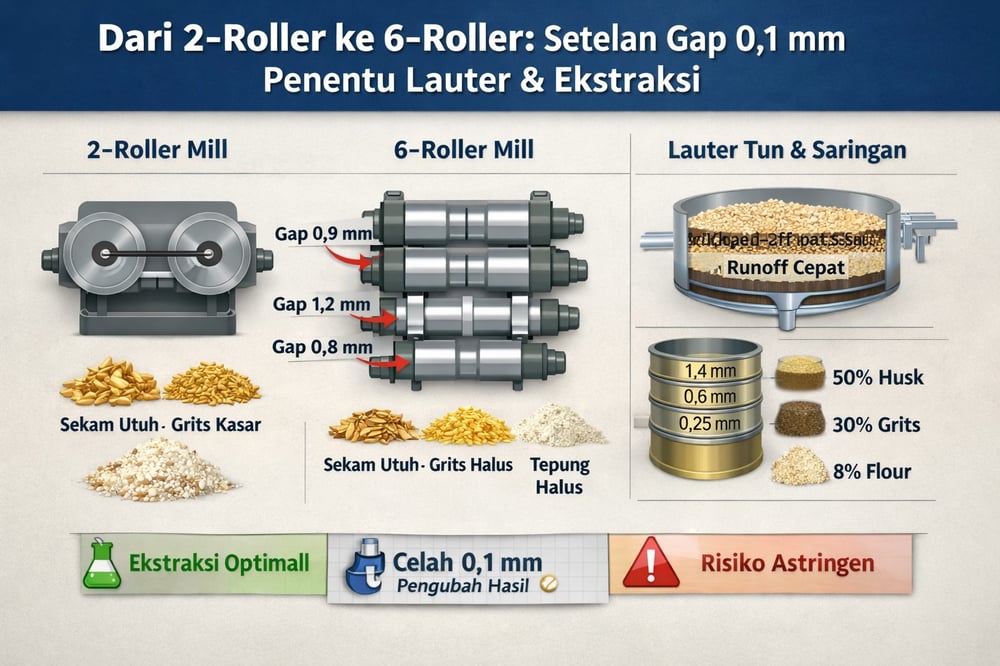
Operators “use fractions of a millimeter” when setting roller gaps; changes are typically ~0.05–0.1 mm (crispmalt.com). On a 4‑roller mill, a common starting point is about 1.5 mm (top) / 1.2 mm (bottom) — a 0.3 mm differential — then fine‑tuned from there (crispmalt.com). Smaller gaps yield a finer grist; larger gaps yield a coarser one.
After any change, the gap should be checked across the entire roller length with feeler gauges, since wear or misalignment can cause uneven gaps (crispmalt.com). In day‑to‑day practice, closing the gap 0.1 mm can raise the husk percentage, or opening it can reduce flour, and settings should be recorded meticulously (crispmalt.com).
Rollers must remain parallel and undamaged. Uncrushed kernels or “tailings” indicate a gap that is too wide or misaligned. Once rollers wear — developing irregular grooves or flats — no adjustment will fully restore performance (crispmalt.com). Older mills (e.g., Porteus) often used fixed “gauge” settings that no longer reflect the actual gap when worn (crispmalt.com).
Routine maintenance matters: checking bearings, cleaning the mill, and using magnets to trap metal debris are cited as standard practice (crispmalt.com). In summary: set the gap with fine increments, keep rollers parallel, and verify often — even a few hundredths of a millimeter can significantly shift the crush profile.
Laboratory sieve analysis and targets
To verify the crush, breweries use lab sieve analysis (ASBC, the American Society of Brewing Chemists, “manual sieve test”). The standard method stacks sieves — for example 1.4 mm, 0.6 mm, 0.25 mm — to separate husk, coarse grits, and fine grits/flour by weight (brewingforward.com). A typical test takes ~100–130 g of freshly milled sample, shakes it in the sieve stack for a set time, then weighs each fraction (brewingforward.com).
Manual tests can show ~10–16% typical variability, so good technique is important (brewingforward.com). Results give a quantitative crush profile (e.g., “50% above 1.4 mm, 30% in 0.6–1.4 mm, 8% <0.25 mm”). One case study found an industrial mill yielded roughly 68.5% on a 1 mm sieve, 13.5% on 0.5 mm, 7.4% on 0.25 mm, and 8.0% fines (www.mdpi.com).
Benchmarks help interpret results. Malting suppliers often suggest ranges — for example, Briess: ~70–85% husk, 10–20% between 0.25–1.4 mm, and <5% fines for reliable lautering (brewingforward.com). Others accept ~50–60% husk for economy, with up to ~10% fines (brewingforward.com). Breweries compare each run to such guidelines and adjust the mill gap or service rollers when fractions drift.
Suppliers recommend doing grist analysis regularly and whenever malts change; for example, sampling on a schedule or when mixer changes occur, and noting each session’s husk/grit/flour proportions (crispmalt.com) (crispmalt.com).
Data feedback and process choices
Mill selection and precise tuning directly shape the crush profile. Sieve data provide objective feedback: one brewery found that tightening the gap by 0.1 mm raised the large‑grit percentage by several points, justifying the change in brewing yield. Each parameter — mill design, gap, roller health — becomes a controllable variable informed by data.
The industry’s through‑line is consistent: pick the mill that matches the system (from 2‑roller “traditional single infusion Mash Tuns” to multi‑nip mills for deeper tuns or filters), and then keep feeding it data to balance extraction and filtration (crispmalt.com) (crispmalt.com) (brewingforward.com).
