

In the prep plant’s quiet corners, circuits for particles below 0.5 mm decide yield, ash, and profit. The data show froth flotation—backed by the right reagents—beats gravity alone on ultrafines, while reflux classification sharpens cuts where spirals struggle.
Industry: Coal_Mining | Process: Preparation
Fine-coal—typically defined as smaller than 0.5 mm—has outsized impact on both yield and waste. In modern plants, gravimetric methods such as jigs and spirals take the coarser end (≥0.5 mm), while froth flotation cleans the ultrafines (Laskowski via ResearchGate). Laskowski notes that flotation for particles <0.5 mm produces the highest-quality clean coal (same source).
The regulatory mood music is changing, too. Indonesia’s PP 22/2021 declassified coal combustion waste (fly ash) as non-hazardous (voi.id), a signal toward reuse of coal residues. By analogy, recovering coal fines reduces disposal and adds value. Overall, well-tuned fine coal circuits integrate equipment and reagents to maximize combustible recovery—often >80%—while meeting product-grade targets (e.g., concentrate ash around 10–15%) (MDPI).
Size-based roles in prep plants
Gravity handles the coarse; chemistry handles the ultrafine. Spirals and other gravimetric devices treat ~1–0.2 mm effectively, but as particles drop below ~0.2–0.1 mm, hydrodynamics shift and entrainment dominates. That’s the point where froth flotation—selectivity driven by hydrophobicity (water-repelling behavior)—takes over (Laskowski via ResearchGate).
Spiral concentrators: slimes sensitivity and trade‑offs
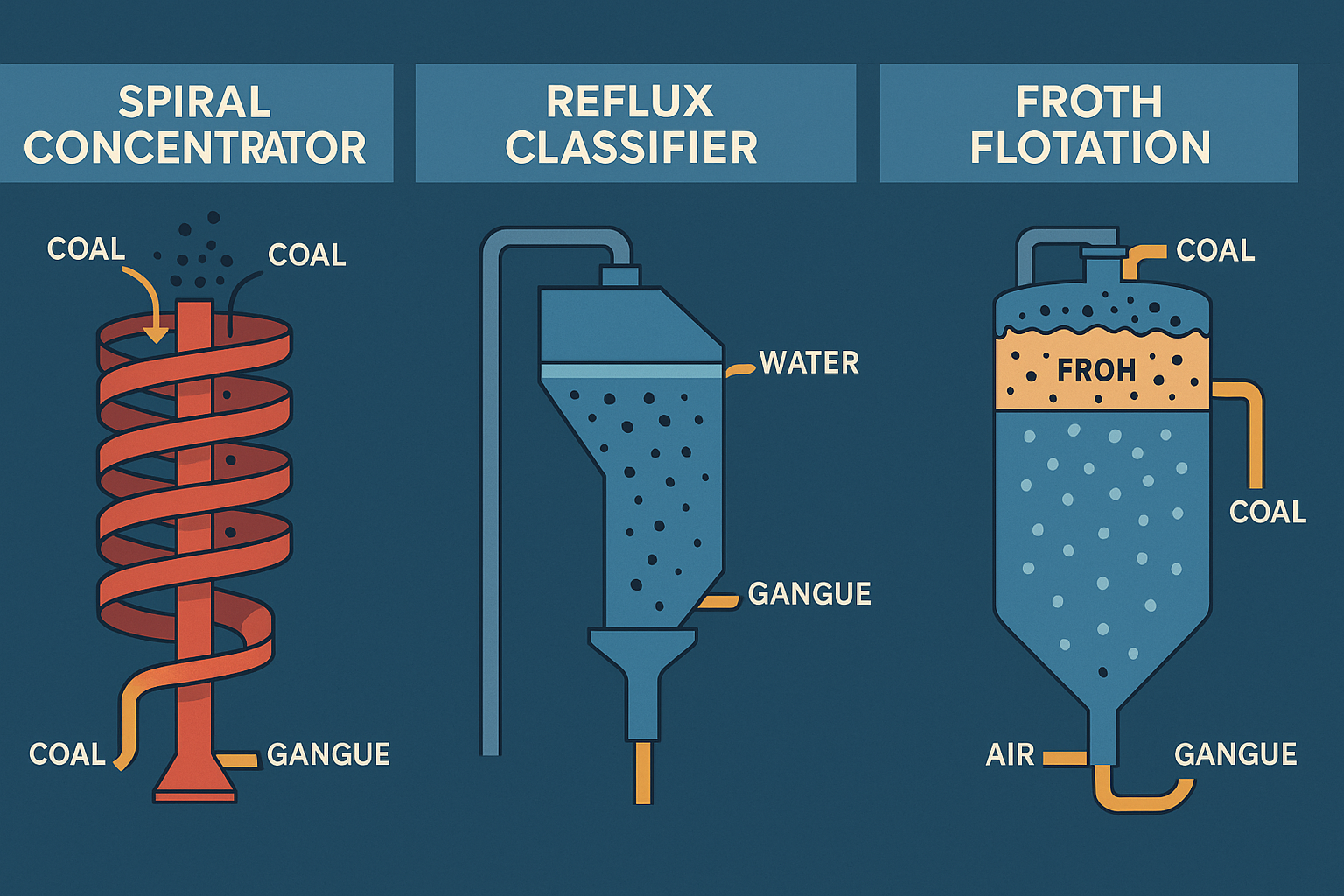
Spiral concentrators are compact, low-cost gravity units widely used for fine coal around ~1–0.2 mm, separating heavy gangue from light coal via laminar flow and buoyancy. Each unit typically treats a few tonnes/hour, but the devices are sensitive to slimes (very fine particles) below 50 μm (micrometers). In heavy-mineral trials, each 1% increase in <45 μm slimes caused about a 5% drop in mineral recovery (ResearchGate). In practice, feeds with >5–6% ultrafines often yield sharply lower recoveries (ResearchGate).
Advantages include modest capex, no moving parts aside from splitters, and simple operation; rough calculations show thousands may be used in large plants (ResearchGate). Drawbacks are clear: they become ineffective below ~0.2–0.1 mm, require relatively high water flow (20–30% solids), and are affected by feed distribution. Under realistic feeds, a study on high-capacity spirals noted a “sacrifice in recovery” versus traditional spirals (ResearchGate). Raising spiral feed solids or feed rate tends to reduce recovery in a grade–recovery trade-off (ResearchGate).
Performance ranges widely. In well-operated circuits on deslimed feed ~0.5–3 mm, spirals can recover 50–70% of combustible material to moderate ash. In a lignite tailings study (35.9% initial ash) that combined a shaking table and a multi-gravity separator (spiral-like), the circuit achieved ~63% clean-coal yield at 18% ash, equating to 79.5% combustible recovery (organic efficiency 95.5%) (ResearchGate) (ResearchGate). In a direct comparison on Australian fines, froth flotation of the full fines stream produced “yields substantially superior” to spiral treatment of only deslimed fines (AusIMM).
Reflux Classifier: sharp separations at fine sizes
The Reflux Classifier (RC) integrates an inclined fluidized bed with parallel wash channels. Fine particles stratify in the fluidized bed, heavy coal is re-circulated via channels into the concentrate launder, and the result is high-grade separation. For coal down to 0.075 mm, RC suppresses size effects and yields very precise cuts; over 0.25–2.0 mm, it achieved an imperfection Ep (a measure of cut sharpness) of just 0.06–0.08—extremely sharp, given spirals often register Ep ~0.2–0.3 (ResearchGate). With close channel spacing, RC has processed feed as fine as tens of microns.
Advantages include higher separation efficiency and throughput than conventional spirals or dense-medium cyclones (DMC), especially on fine feeds (ResearchGate), far less floor space, and no tall supporting structures (ResearchGate; FLSmidth). In lab tests on low-grade tailings, FLSmidth’s Reflux Concentrating Classifier doubled the upgrade ratio of the older design and rejected ~99.9% of gangue (FLSmidth) (FLSmidth). Galvin also notes grade consistency and robustness exceeding spirals (ResearchGate).
Trade-offs: as a newer technology, RCs have higher capital cost than spirals and require precise control of the fluidization rate. However, studies show the unit produces very clean fines without excessive water—for example, one pilot test recovered >95% of fines into a concentrate. In flowsheets, RCs are often placed after hydrocyclone overflow to recover fine coal and treat particles spirals miss. In one R&D trial, adding reflux flotation after rougher cells raised coal recovery from ~90% to >95% (note: this example pertains to analog reflux flotation cells, illustrating stage-wise recovery) (ResearchGate). Summaries indicate RC can operate on feeds with <3% valuable content, tripling upgrade ratios compared to older designs (FLSmidth; ResearchGate).
Froth flotation circuits and residence time
Froth flotation remains the default method for ultrafine coal (<0.5 mm), separating based on hydrophobicity: air bubbles attach to hydrophobic coal but not to hydrophilic ash. Mechanical (agitated) cells and columns (including Jameson and cycloflotation) are both used; modern circuits often favor columns for better selectivity. In practice, “rougher + cleaner” trains on coal fines frequently achieve ≥80% combustible recovery at concentrate ash around 10–15% (MDPI).
One study on −0.21 mm coal reported >80% recovery of combustible at ~12% ash with optimal frothers (MDPI). Comparative trials show flotation yields appreciably higher recovery than gravity alone: Bensley & Keast‑Jones found flotation of “complete fines” gave “substantially superior” yields to a spiral treating the same material; even on deslimed fines, flotation matched or exceeded spiral performance (AusIMM).
Typical residence times in multi-cell circuits are 3–5 minutes; throughput and residence must be balanced since more mixing (short‑circuiting) lowers recovery. Designs for ultrafine coal often target plug‑flow behavior—e.g., large height‑to‑diameter columns (AT‑Minerals). Newer approaches, including Two‑Stage Fast Flotation and reflux flotation cells, show promise; a two‑stage reflux flotation test on coal tailings achieved ~95% total recovery (ResearchGate).
Reagent strategy: collectors, frothers, depressants
Flotation chemistry hinges on three reagent classes: collectors (hydrophobizing oils), frothers (surfactants that create and stabilize froth), and depressants (agents that prevent unwanted minerals from floating). Collectors—often kerosene, diesel, or designed surfactants—adsorb on coal to make it hydrophobic; dosages are on the order of a few hundred g/t. Traditional kerosene often underperforms on low‑rank or oxidized coals. Wang et al. (2025) reported novel tetrahydrofurfuryl‑ester collectors that dramatically improved flotation; one (THF‑butyrate) delivered 79.8% higher combustible recovery than kerosene at the same dose—e.g., boosting recovery from ~20% to ~36% on their test coal—due to stronger, faster adsorption and more uniform dispersion (MDPI) (MDPI).
Frothers control bubble size and froth stability. Common choices include alcohols and ethers such as MIBC (methyl isobutyl carbinol), methanol, pine oil, and 2‑ethylhexanol. In a column flotation study that tested nine frothers, 2‑ethylhexanol (2EH), Dowfroth (MAC), and a proprietary F‑2 delivered the best results, achieving >80% recovery with ~10–15% ash; by contrast, MIBC produced lower recovery under the test conditions (MDPI). Mechanistically, different frothers generate different bubble size distributions and froth strengths; smaller bubbles increase surface area (and recovery) but make froth wetter, requiring a balance to avoid ash entrainment (MDPI). As Laskowski notes, froth that is “too stable” hinders drainage and keeps hydrophilic particles in the froth, while “unstable froth” sacrifices recovery (MDPI). To manage tight operating windows, plants typically meter collectors, frothers, and depressants with accurate dosing pumps.
Depressants increase the hydrophilicity of unwanted minerals (ash formers) so they sink. Common options include sodium silicate (for silicate/clay), and organic starch or dextrin; in reverse flotation circuits (where ash floats), reagents such as sodium sulphide or ferric sulphate are used for pyrite. In general, depressants prohibit collector adsorption or otherwise render particles hydrophilic (Laskowski via ResearchGate). Practical dosing ranges cited include sodium silicate ~500–1000 g/t and starch/dextrin ~50–200 g/t depending on circuit strategy. Recent work confirms starch and dextrin adsorb on bituminous coal via hydrophobic interactions, reducing active sites for oil collectors; humic/starch additives are commonly applied in rougher‑scavenger cells to suppress pyrite and select coal, and using starch in cleaner cells can raise gangue rejection at a modest yield cost (MDPI) (MDPI).
Putting the circuit together
Most plants combine methods. Spirals and other gravity units recover coarse fines (0.5–5 mm) at low operating cost; RCs extend gravity into the very fine realm (down to <0.1 mm) with minimal footprint and sharp separation—albeit at higher capital cost (ResearchGate; FLSmidth). Ultimately, froth flotation is required for ultrafine coal, regularly delivering >80% recoveries at low ash when reagents are well chosen (MDPI; MDPI). Selecting between, or integrating, spirals, reflux, and flotation depends on feed particle-size distribution and target ash. In one practical example, retrofitting a flotation circuit can boost recovery of the final 0.5–0.0 mm stream from ~65% (gravity alone) to >85%.
Across all options, chemistry is decisive: collectors must render coal hydrophobic (novel collectors can raise recovery by ~80% over kerosene, per the THF‑butyrate data, MDPI); frothers must stabilize a mobile yet drainable froth (MDPI); and depressants must immobilize clays/pyrite. Plants source and manage these mining reagents as part of established programs for chemicals for mining applications. Accurate lab flotation curves and washability/separability analyses should guide equipment selection and reagent regimes to meet specific feed grades and market specifications, ensuring economically optimal fine‑coal recovery (ResearchGate; AusIMM; MDPI; ResearchGate; MDPI; MDPI). Indonesian regulation cited: PP No.22/2021 (voi.id).