

Industry: Landfill | Process: Leachate_Collection_Systems
Landfill leachate collection systems (LCS) — the network of perforated pipes, gravel, and sumps that move landfill “juice” off the liner — clog often and everywhere. Engineers attribute the problem to fines settling out, dense biofilm growth, and chemical precipitates that fill voids and perforations (wasteadvantagemag.com). CDM Smith analyses have repeatedly found calcium carbonate (CaCO₃, a mineral scale) as the dominant precipitate in fouled pipes (wasteadvantagemag.com).
Operators also report a rise in “black goo” — organic films and slimes — and mineral scaling that can dramatically slow outflow (scsengineers.com). In Indonesia’s humid climate, leachate generation is year‑round, so poorly maintained systems stagnate quickly (researchgate.net). A recent review notes that “most of landfills in Indonesia currently do not have sufficient landfill leachate treatment facilities” and many still operate as open dumps with little control (researchgate.net) (researchgate.net). The takeaway: treating LCS maintenance as mission‑critical prevents hydraulic head from rising and leachate from backing up onto the liner or escaping.
Regulatory cleaning and inspection intervals
Regulators formalize the cadence. Florida rules require LCS pipes to be jet‑cleaned every five years or videotaped for condition (scsengineers.com). Ontario law calls for annual CCTV (closed‑circuit video) inspections for the first five years of operation and cleaning whenever an inspection indicates it is necessary (ontario.ca). Industry practice typically falls in the 5–10 year range for major cleaning, with interim spot‑checks.
Effective sessions follow a sequence: drain leachate from pipes and sumps; clean both horizontal collection pipes and vertical riser pipes (a riser is the vertical pump well; leaving slime on its inlet blocks suction); vacuum out displaced liquids and solids so debris does not settle in the gravel sump; then conduct a camera inspection to confirm success (scsengineers.com) (scsengineers.com) (scsengineers.com). SCS Engineers recommends that before inserting a jet nozzle, “remove as much leachate as possible from the collection pipe and the sump,” then clean the pipes and use a vacuum truck to capture washwater; after cleaning, always videotape the pipe interior and repeat the cleaning if blockages remain (scsengineers.com). One field note warns that jetting dislodges calcite and microbes into the sump which, if not removed, will “prevent the flow of leachate in the sump into the riser pipe,” eventually halting pump‑out (scsengineers.com) (scsengineers.com).
High‑pressure water jetting (4,000–10,000 psi)
High‑pressure jetting (also called hydroblasting) uses a self‑propelled nozzle to scour pipe interiors with pressurized water. Typical operating pressures range from 4,000 to 10,000 psi (pounds per square inch); engineers advise limiting pressure to about 7,500 psi to avoid damaging HDPE or PVC pipe walls (wasteadvantagemag.com). Rotating or “flushing” nozzles distribute jets evenly to peel off deposits without focusing a point load on the wall (wasteadvantagemag.com).
Advantages include broad applicability, no hazardous chemical generation, and the ability to break up fiber, biofilm, and scale. Florida specifically lists “water pressure cleaning” of pipes as acceptable maintenance (wasteadvantagemag.com). In practice, a well‑drained pipe with 7–10k psi jets and sufficient flow can often clean up to about 1,500 feet of LCS per week, depending on buildup severity (wasteadvantagemag.com). Trials have shown extreme jets remove intact chunks of precipitate, but methodical, staged passes (often from outlet toward inlet) are needed as one debris piece flushed tends to be followed by another (wasteadvantagemag.com) (wasteadvantagemag.com). A practical benefit: jet‑cleaned material flows to the sump for removal if vacuuming is planned (scsengineers.com) (scsengineers.com), and there is no special disposal of chemicals beyond managing dirty water.
Limitations are real. “Jetting under water may drastically reduce the effectiveness” — if the pipe is partially submerged, jets lose energy (scsengineers.com). Dislodged solids tend to accumulate at intersections or near inlets, and many LCS designs lack access points to remove them (wasteadvantagemag.com) (wasteadvantagemag.com). If washwater is not vacuumed, calcite and microbes will reduce sump capacity and bottleneck riser perforations (scsengineers.com) (scsengineers.com). Heavy clogs can force slow, repeated passes that raise time and cost (wasteadvantagemag.com) (wasteadvantagemag.com).
Chemical cleaning (acidic recirculation)
Chemical cleaning uses acids and specialty solvents to dissolve sludge and scale in‑situ. Typically an acid (like HCl or proprietary blends) is circulated through a pipe section using a closed loop or “resurge” system; the solution is flushed through, allowed to soak for hours, then neutralized (e.g., with soda ash) and removed (wasteadvantagemag.com). The chemicals themselves are standard industrial chemicals.
Advantages include the ability to penetrate and dissolve uniform layers of scale or biofilm that resist mechanical force. Industry tests showed chemical treatment removed most precipitate — especially in lower‑length zones — and restored flow where heavy buildup persisted (wasteadvantagemag.com) (wasteadvantagemag.com). In a 2014 full‑scale trial, chemical cleaning cleared over 2,000 feet of 8″ pipe per week (versus ~1,500 feet for jets) at roughly $20–$40 per foot processed (wasteadvantagemag.com). Acid blends (e.g., from Progressive Environmental Services) “penetrate, disperse, dissolve, and remove scaling and corrosion by‑products, biofilm and all other existing microbial activity” (wasteadvantagemag.com). Because the chemicals remain in contact, tight clogs in dead‑legs or non‑perforated piping can be dissolved given enough time. For severely clogged or “black goo”–choked systems, chemical methods were judged “best” — especially in deep or multi‑access areas where mechanical methods faltered (wasteadvantagemag.com) (wasteadvantagemag.com).
Handling strong acids requires caution and a plan for waste capture. Large volumes may be needed for long runs, and the neutralized effluent must be contained. If there is no on‑site pH‑neutralizer or disposal alternative, chemical cleaning adds regulatory steps. Specialty materials and equipment rentals add cost, but in the cited demonstration the per‑foot cost was on par with jetting ($20–$40/ft), with faster rates offsetting the chemicals (wasteadvantagemag.com). Chemical cleaning still produces solids that drop out downstream; vacuum/sump disposal planning mirrors jetting and is usually handled by specialized contractors. Operationally, chemical cleaning requires closed‑loop pumps, hoses, and a containment plan for spent liquid — tasks that hinge on accurate chemical dosing (see dosing pumps) and appropriate supporting equipment.
Jetting versus chemical: rate, cost, effectiveness
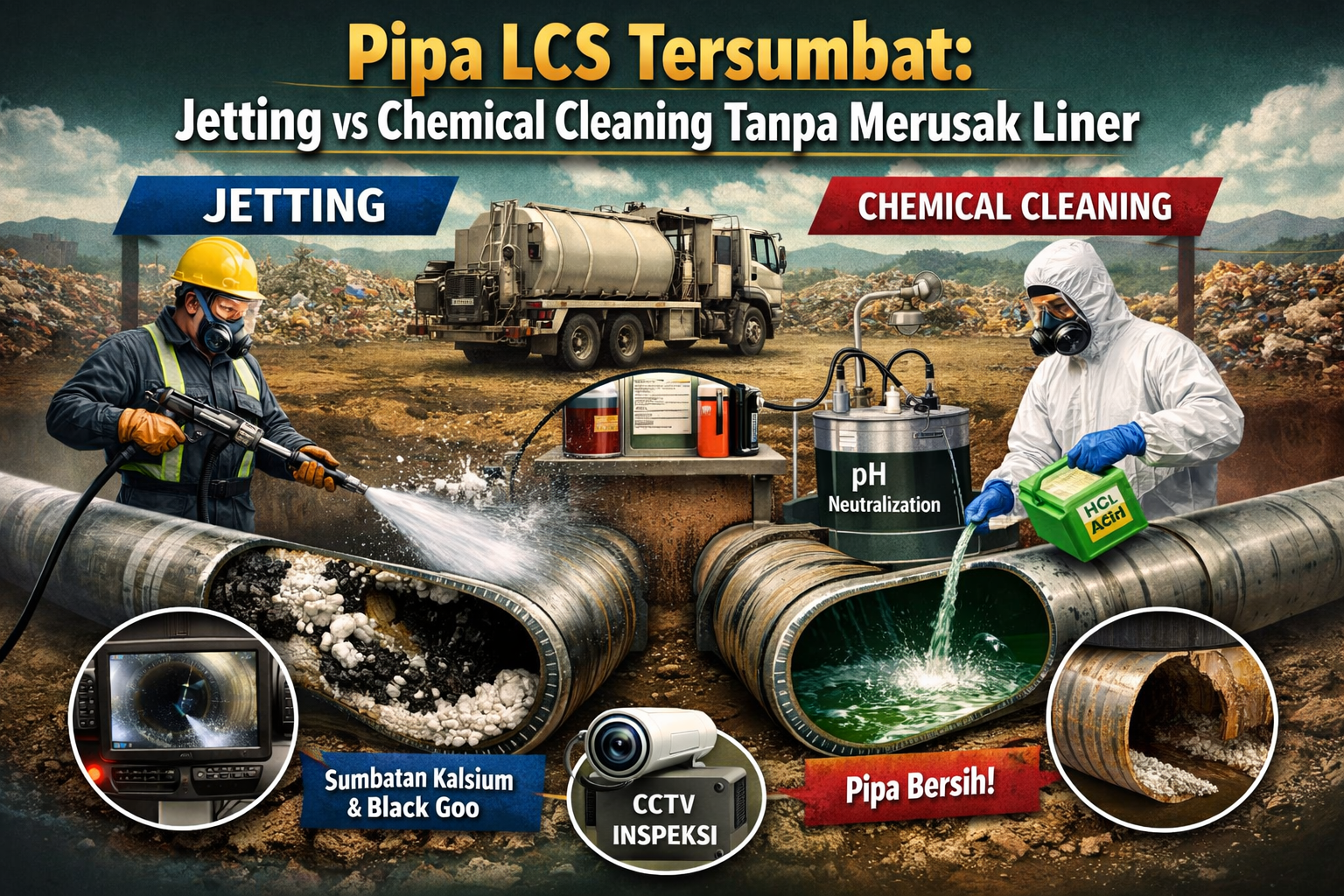
Cleaning rate: one demonstrated case found jetting could process up to ~1,500 ft of 8″ pipe per week, while chemical flushing cleaned over 2,000 ft/week under similar conditions (wasteadvantagemag.com).
Cost per foot: both methods yielded roughly $20–$40 per foot of cleaned pipeline in that study (wasteadvantagemag.com). At those figures, a 1,000‑meter (≈3,300 ft) LCS would cost on the order of $66,000–$132,000 per cleaning.
Effectiveness on deposits: jetting excels at breaking loose large particulates, but struggles to evacuate fines at bends and transitions (wasteadvantagemag.com). Chemical cleaning excels at dissolving uniform scale and killing biofilms, reaching non‑perforated or remote sections that jets cannot physically enter; in the demonstration, chem‑cleans restored flow in stagnant zones the jet left partially blocked (wasteadvantagemag.com) (wasteadvantagemag.com).
Damage risk: jets, if misused, can puncture pipe (hence limits near 7.5 kpsi). Chemical agents must be compatible to avoid embrittlement (most modern pipe resists mild acids). Both methods typically avoid excessive force on the wall.
Operational practicalities: jetting needs a high‑pressure pump, hose reel, and upstream access; chemical cleaning needs closed‑loop pumps, hoses, and a containment plan for spent liquid. Both methods produce large volumes of sludge in the sump; vacuum trucks are recommended in either case (scsengineers.com) (scsengineers.com).
In summary, chemical cleaning is often faster and more thorough for heavily fouled pipes — especially where multiple access points allow injection into lower portions, non‑perforated stretches, and vertical risers (wasteadvantagemag.com) (wasteadvantagemag.com). Jetting is well‑suited for routine removal of loose deposits and biological growth when reusable equipment is available. Dye‑trace or pilot studies may help decide: if initial jetting finds only light biofilm, periodic jet clears may suffice; if heavy mineral scale persists, an escalated chemical plan is indicated.
CCTV inspections and condition monitoring
CCTV — closed‑circuit video inspection — is the most objective way to verify pipe condition. After any cleaning event, running a camera confirms that perforations are open and identifies leftover debris. Experts emphasize that “videotaping is the best way to verify that the pipe was cleaned successfully” (scsengineers.com). Florida rules allow either cleaning or video inspection at permit renewal; if a video finds blockages, the operator performs maintenance and submits a report (scsengineers.com). Ontario requires annual inspections during startup and cleaning “whenever an inspection indicates that cleaning is necessary” (ontario.ca).
Technically, standard sewer CCTV rigs can be used (typically requiring ≥6″ diameter pipe and two accessible ends; nepis.epa.gov). In long runs, fixed cameras advance with walking heads or tethered reels. For smaller lines or limited access, photographic probes or “zoom” cameras can image partial sections with recognition limits. Recording date‑stamped video provides documentation for compliance and planning. Although no readily available public statistics quantify the ROI of CCTV in landfills, hauling in camera crews is a fraction of a full cleaning job, so many operators budget post‑cleaning CCTV into each maintenance cycle.
At minimum, CCTV should follow any jetting or chemical clean to confirm clearance (scsengineers.com). Proactively, periodic camera checks (e.g., yearly or at permit review) help catch issues early. Recommended practices include inspecting again whenever leachate extraction seems impeded (slow emptying, rising pump levels) so that a problem can be diagnosed by camera before emergency de‑clogging is needed.
Recommended maintenance practices
- Maintenance interval: a practical target is cleaning LCS pipes every 5–10 years if no problems appear, using interim CCTV checks sooner if high leachate flows or unexpected sump surges occur (many U.S. states use 5‑year checks; Ontario required five straight years annually) (scsengineers.com) (ontario.ca).
- Pre‑clean preparation: pumping out as much leachate as possible so pipes are as dry as can be maximizes cleaning effectiveness; insert vacuum lines into sumps if needed (scsengineers.com) (scsengineers.com).
- Scope of cleaning: horizontal mains and vertical risers should be included; biological slime often accumulates at the riser inlet and can block flow (scsengineers.com).
- Debris removal: arranging a vacuum truck (or integrated vacuum on the jet unit) to extract washwater and solids during cleaning prevents redeposition; SCS stresses vacuuming spent fluid as the pipe is cleaned (scsengineers.com) (scsengineers.com).
- Verification: videotaping every cleaned run and comparing before/after ensures perforations are clear; if residual obstruction appears, repeat cleaning; maintain video records in the operating log (scsengineers.com).
- Documentation and action: video findings serve as triggers; if blockage is evident, immediate remediation is indicated (regulations require operators to act on CCTV results) (scsengineers.com) (ontario.ca).
- Method selection: for lightly encrusted pipes or routine maintenance, high‑pressure jetting is safe and avoids chemicals; for heavy scaling or bio‑concretions, chemical cleaning (or a combination) works faster on entrenched clogs (wasteadvantagemag.com) (wasteadvantagemag.com). Many sites rotate methods (e.g., jet yearly and use chemical every 10 years).
- Cost and performance tracking: logging feet cleared per day and cost per foot refines estimates; the CDM/PES study suggests $20–40/ft as a planning figure (wasteadvantagemag.com). Measuring outcomes (flow rate or sump drawdown time) quantifies performance before and after maintenance.
- Local adaptation: waste composition and climate matter. Because Indonesian waste is often high‑organic and the climate humid, more frequent cleaning may be needed; trends in leachate volume rise or pump run‑time can serve as indirect sensors. Additional preventative steps (e.g., waste sorting to remove more organics, or leachate recirculation to stabilize chemistry) are options if recurring clogs are found.
Sources
Authoritative engineering guidance and case studies were used, including U.S. EPA reports and consulting literature. Key references include a 2014 CDM Smith/PES demonstration of cleaning methods (wasteadvantagemag.com) (wasteadvantagemag.com), SCS Engineers field recommendations on jetting risks and video use (scsengineers.com) (scsengineers.com), and Indonesian landfill reviews (researchgate.net) (researchgate.net). All figures and quotes above are drawn from these sources.