

Industry: Semiconductor | Process: Chemical_Mechanical_Planarization_(CMP)
The dirtiest water in a chip fab isn’t always where you think. Chemical mechanical planarization (CMP—slurry‑based polishing of wafers) can consume ~30–40% of all fresh water in a typical facility—so a 1,000 m³/day fab implies 300–400 m³/day of CMP effluent (ResearchGate).
That effluent is a concentrated mix: nano‑scale abrasive particles (silica, ceria, alumina) and dissolved metals. Copper‑CMP streams, for example, have been measured at ~500 mg/L COD (chemical oxygen demand, a measure of oxidizable organics) and up to 100 mg/L dissolved Cu (ResearchGate).
Regulators are closing in. Tight limits (often TSS <10–50 mg/L; Cu, Ni, Zn ≪1 mg/L; COD/BOD <20–50 mg/L) are becoming the norm—Indonesia’s 2025 update tightens metal limits and requires real‑time monitoring for metal‑processing industries (Greenlab).
CMP effluent profile and limits
Abrasive solids dominate the load—>90% silica by weight in one study (ResearchGate). These particles are colloidal: SiO₂ typically carries a negative surface charge at operating pH; CeO₂ can be positive under some conditions; Al₂O₃ is amphoteric (behavior changes by pH). To reliably meet TSS, metals, and COD/BOD (biochemical oxygen demand) targets, the treatment train has to neutralize those charges, settle the flocs, and polish the fines.
Coagulation–flocculation design parameters
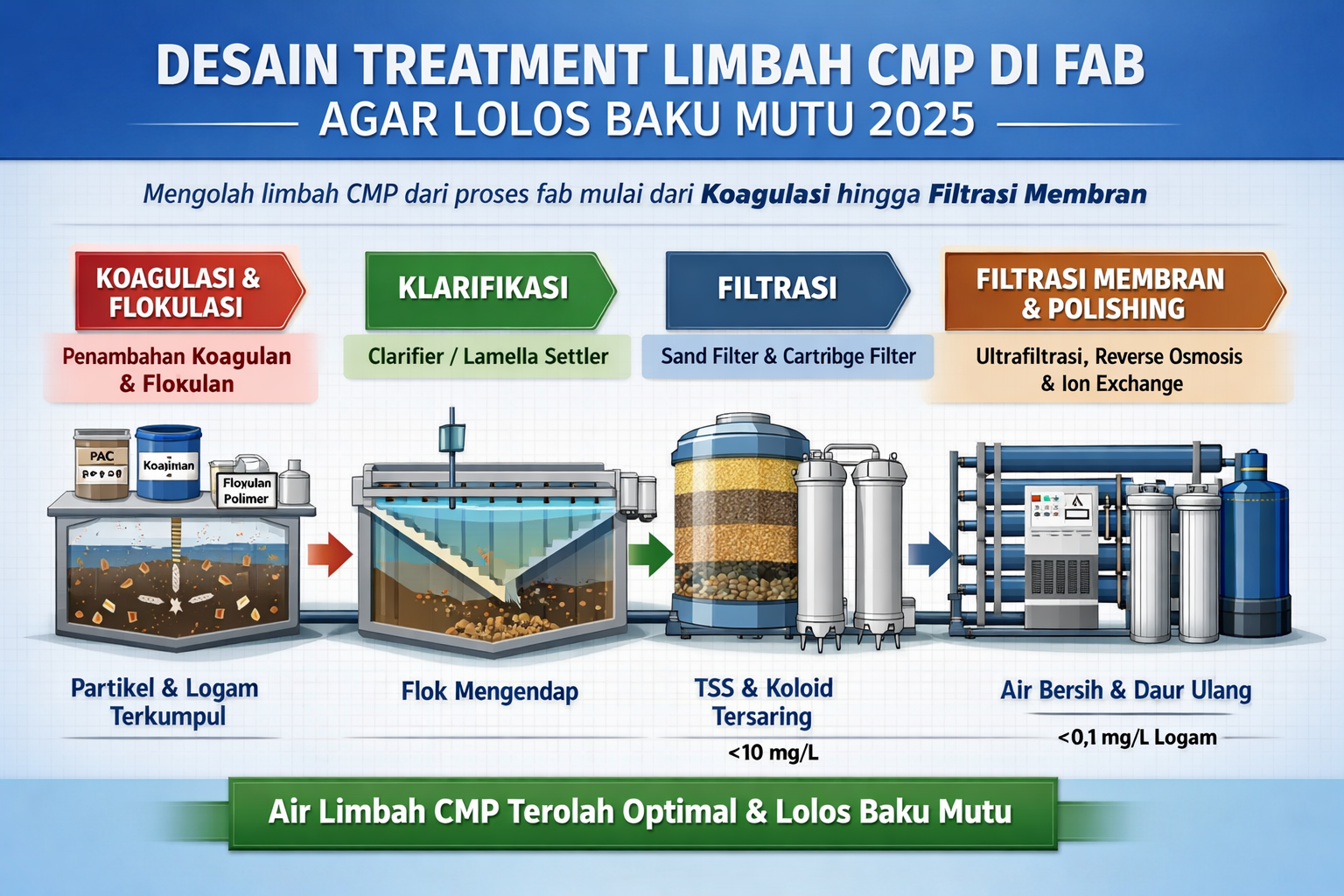
The first major step is chemical coagulation/flocculation. Metal‑salt coagulants (alum, polyaluminum chloride/PAC, ferric chloride) neutralize particle charges and form hydroxide precipitates that “sweep” out suspended solids while co‑precipitating metals (ResearchGate).
Jar tests on real CMP wastewater peg optimum dosages in the low tens of mg/L: one study found PAC ~5 mg/L achieved high solids/Cu removal at moderate turbidity, while highly turbid slurries (7,000 NTU—nephelometric turbidity units) needed ≈30 mg/L (ResearchGate). The same work recommended pH ≈8.5±0.5 and a cationic flocculant (~1 mg/L) to drive aggregation and maintain effluent quality (ResearchGate).
On dosing hardware, fabs typically meter PAC via dosing pumps and source aluminum‑based coagulants such as PAC alongside cationic flocculants to match jar‑test targets. Under optimized conditions, >95% of abrasive colloids can be captured; electrocoagulation trials (Al/Fe electrodes) reported 96.5% turbidity removal and ≥99% Cu removal (ResearchGate).
In practice, conventional chemical coagulation removes >90% of suspended solids and co‑precipitates trace metals into sludge. Dissolved Cu/Ni/Zn often hydroxyl‑precipitate at high pH or adsorb to flocs; with pH control at ~7–9 for Fe/Al coagulants, residual metals can drop below discharge limits (ResearchGate) (ResearchGate). If needed, a secondary step such as sulfide precipitation or an adsorptive resin can polish heavy metals to <0.1 mg/L.
Clarification hydraulics and sludge handling
Floc‑laden water flows to a settling or flotation clarifier. In well‑designed rectangular units or lamella clarifiers (HRT—hydraulic retention time—~30–60 min; overflow rate ~1–2 m³/m²·h), 90–95% of flocs settle. Electrocoagulation bench data showed clear effluent with turbidity <10 NTU and COD <100 mg/L (ResearchGate).
Gravity settling remains the workhorse. Plants deploy a standard clarifier or compact lamella settlers to boost surface area without expanding footprint. Clarifiers remove >90% of post‑coagulation TSS, typically yielding TSS <50 mg/L in effluent. Dissolved‑air flotation can substitute for low‑density flocs—the DAF process is often selected where buoyant fines are prevalent.
The settled sludge is metal‑rich and requires dewatering. CMP solids can settle faster than typical colloidal sludge, but heavy aluminosilicates may need flocculant aids or lamella plates to curb carryover. Periodically, sludge thickening or disc filters concentrate solids—often to 2–5% cake—for disposal or recycling (e.g., metal recovery).
Media and membrane filtration
Clarified effluent still carries <1–10 µm fines and residual colloids. A cloth or sand‑media filter—often a multi‑layer bed with 25–50 µm sand—polishes TSS to <10 mg/L (turbidity <1 NTU). Many facilities standardize on sand/silica media filters or add a final cartridge filter stage for consistent low‑NTU performance.
For reuse, membranes take over. Ultrafiltration (UF, pore size ~0.01–0.1 µm) can remove >98% of remaining turbidity and achieve near‑complete particle rejection (ResearchGate). One study reported UF pretreatment removed 98–99.4% of turbidity (and partial TOC—total organic carbon); subsequent reverse osmosis (RO) polished conductivity to ~6 µS/cm and turbidity to 0.01 NTU (ResearchGate).
UF skids are commonly deployed as ultrafiltration pretreatment ahead of RO, while high‑recovery brackish lines handle conductivity polishing—standardized packages such as brackish‑water RO are typical for fab reuse loops.
Metals polishing options
Even without RO, a final ion‑exchange or adsorption stage can strip dissolved metals to ≤0.1 mg/L where permits require it. Fabs that pursue modular polishing often specify packaged ion exchange systems to target Cu/Ni/Zn bleed after coagulation and clarification.
Slurry‑specific treatment challenges
Silica slurries (SiO₂) form stable anionic colloids (surface –OH groups; IEP— isoelectric point—~pH 2). Coagulation typically uses Fe/Al salts at pH 7–9; silica can be somewhat soluble at high pH. Because silica often dominates CMP solids (≈90% of particulates, ResearchGate), good floc growth is critical. Optimized PAC dosing (5–30 mg/L) with polymer has aggregated silica from 1000s of NTU to settleable flocs (ResearchGate). Rapid‑settling clarifiers or DAF units then remove gelled silica flocs.
Ceria slurries (CeO₂, often ~50–100 nm particles) behave differently: surface charge can be positive at low pH (e.g., +38.9 mV at pH 4, ResearchGate). Ceria can adsorb anions (e.g., silicates) and may precipitate more readily on a mild pH increase. Coagulants used for silica often work, but floc growth differs; practitioners report ceria is “sticky” and forms dense flocs once destabilized. pH control near neutral and adequate mixing are emphasized in trials.
Alumina slurries (Al₂O₃) are amphoteric (IEP ~pH 8–9), dissolving at extremes and precipitating near neutral. Under CMP conditions (often pH ~7–9), Al₂O₃ may remain dispersed. Lowering pH below ~6 or raising above ~9 can form Al(OH)₃; designs may include a pH swing (via H₂SO₄ or NaOH) to favor coagulation. In short, alumina‑based waste often needs careful pH adjustment before/with coagulant dosing.
Performance benchmarks and economics
Done right, the coag–clarifier–filter train hits demanding specs. Literature reports >95% solids removal and >90% metal removal in a single coagulant step (ResearchGate), effluent COD <100 mg/L (ResearchGate), and after multi‑stage filtering, turbidity down to ~0.01 NTU (ResearchGate). That translates to effluent TSS in the single‑digit mg/L range and metals (Cu, Zn, etc.) <0.1–0.5 mg/L in advanced designs.
Economically, integrated designs also pencil out: membrane‑based systems powered by waste heat have been cited at ~$3/m³ for large loads—far lower than legacy electrochemical methods (ResearchGate). Given CMP is 30–40% of fab water (ResearchGate), the business case spans water savings and regulatory risk reduction. In Indonesia’s context, new 2025 rules mandate online monitoring and stricter metal limits (Greenlab), reinforcing the case for multi‑barrier trains that can consistently deliver final TSS <1 mg/L and metals below permit.