

Industry: Semiconductor | Process: Wafer_Cleaning_&_Etching
Modern fabs are water hungry and regulation heavy, and the gap between what they send down the drain and what they’re allowed to discharge is vast. Fluoride from HF etches regularly shows up at 250–1500 mg/L—far above typical environmental limits of about 15 mg/L (sciencedirect.com). Silicon dioxide (SiO₂) colloids from CMP (chemical–mechanical polishing) can hit 500–2000 mg/L (sciencedirect.com), and heavy metals like Cu, Ni, Fe, and W often span 1 to the 100s mg/L range.
Regulators, especially in Indonesia, set ultra‑strict limits—heavy metals typically well below 1 mg/L and fluoride/arsenic in the ppb range—for Class 1–2 water bodies (sciencedirect.com) (fliphtml5.com). At the same time, fab water demand is set to double by 2035, with TSMC alone using 101 million m³ in 2023—trendlines pushing the industry to near‑zero liquid discharge and multi‑stage reuse (idtechex.com).
One foundational move: segregating drains by chemistry (HF versus organics, acids versus ammonia), which lets fabs target contaminants more simply; Winbond is cited with 20+ separated lines (idtechex.com). This practice shows up throughout the treatment train.
Multi‑stage treatment train design
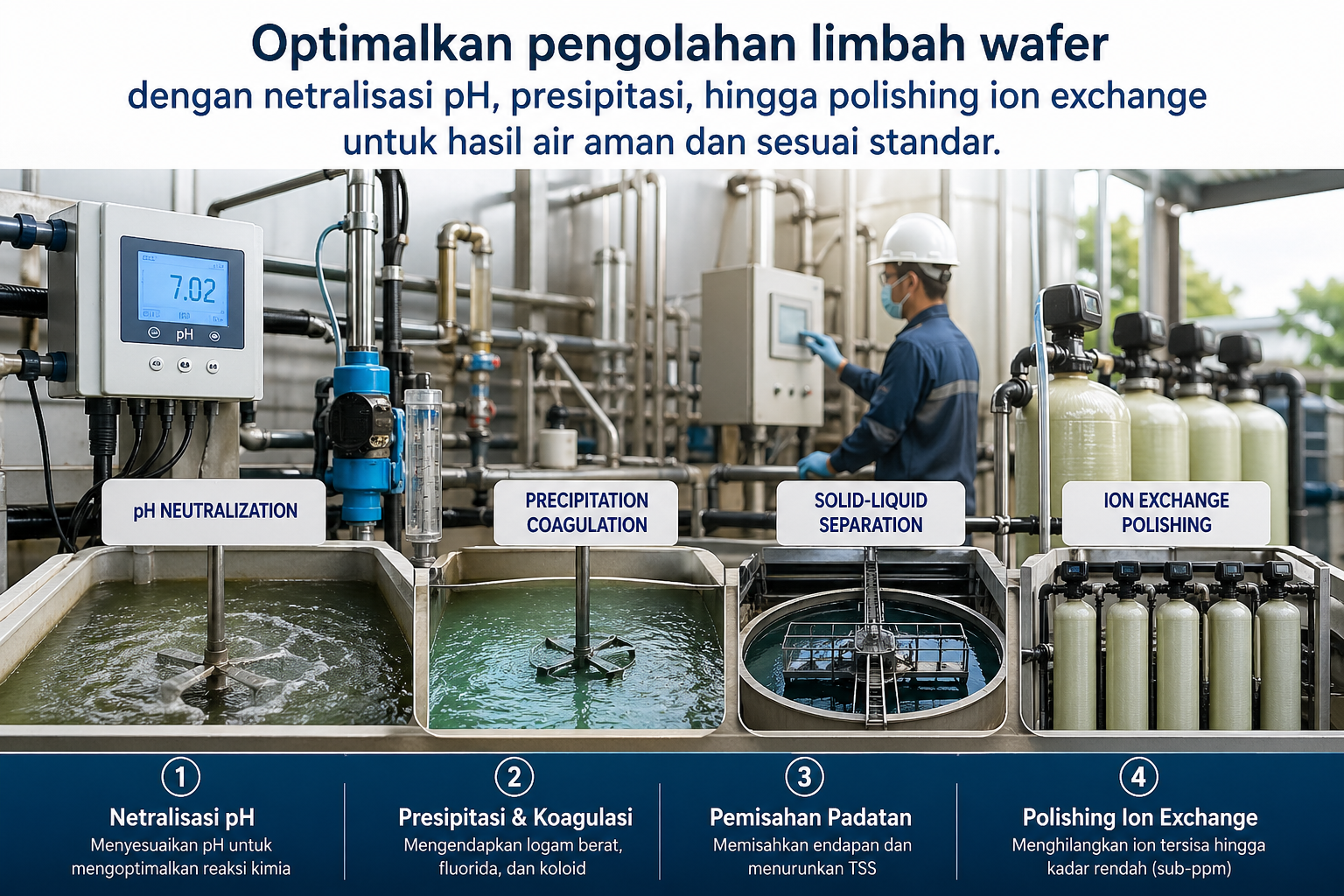
The core sequence is consistent: (1) flow equalization/buffer, (2) pH neutralization, (3) chemical precipitation/coagulation, (4) solid–liquid separation, and (5) polishing—typically ion exchange—with membranes or oxidation added as needed. Equalization stabilizes flow and composition so downstream chemistry behaves predictably; the rest is about stepping contaminants down stage by stage to hit limits. Many systems automate neutralization upfront to protect downstream steps (prab.com).
Equalization and pH neutralization
In the equalization tank, mixing homogenizes the wastewater while automated pH control doses acid or caustic to a mid‑range—often about pH 6–7—so downstream reagents function well (prab.com). Fabs commonly neutralize HF and H₂SO₄ streams with NaOH here, and the ramp up in pH is deliberate: metals remain largely dissolved below pH 5–6 but start to precipitate by pH 7–8; for example, Fe(OH)3 forms rapidly near pH 3.5–4 (especially after oxidation), aluminum around pH 5–6, copper around pH 5–6, zinc around pH 7–8, while manganese generally needs pH ≥9–10 (fliphtml5.com). Automated control is typically enabled by precise feed systems such as a dosing pump.
In an analog multi‑metal system (acid mine drainage), neutralizing to pH ≈8.2 with NaOH removed ≥92% Cu, Zn, Fe, Al but less than 16% Mn—showing why pH alone is a powerful first cut, with special handling for Mn (fliphtml5.com). At pH 8–9, common semicon metals typically drop out as hydroxides.
Chemical precipitation and coagulation
Dedicated reactors then drive metal and fluoride removal. Lime (Ca(OH)₂) or soda ash (Na₂CO₃) secures metal hydroxide precipitation and captures fluoride via Ca²⁺ + 2F⁻ → CaF₂(s). Coagulants—FeCl₃, Al₂(SO₄)₃, or polyaluminum chloride (PAC)—aggregate colloidal silica into settleable flocs (sciencedirect.com). Maintaining pH around 8–9 during this step maximizes hydroxide precipitation, and studies show Fe (~97%) and Al (~93%) precipitate by pH 5–6, Cu (~95%) by pH 6, and Zn (~89%) by pH 7–8 (fliphtml5.com).
Fluoride removal is similarly strong: calcium dosing routinely strips >90% F⁻, with a recent semiconductor wastewater case delivering about 2.1 mg/L fluoride after coagulation–UF (sciencedirect.com). Where PAC is used, plants often specify industrial grades analogous to a polyaluminum chloride coagulant to optimize floc formation.
Solid–liquid separation equipment
Precipitates are removed in clarifiers or flotation units. Compact inclined plates such as a lamella settler or Dissolved Air Flotation (DAF; micro‑bubbles float flocs) typically capture 95–99% of the freshly formed solids, cutting TSS (total suspended solids) by over 90% to around 10–20 mg/L. This protection of downstream filters and ion exchangers is essential for reliability.
Where gravity separation is favored, a conventional clarifier provides the detention time to settle hydroxide and CaF₂ sludges efficiently; where oils or light flocs are present, DAF units offer fast removal at compact footprint.
Ion‑exchange polishing
Polishing targets the last dissolved ions. A two‑bed ion exchange (IX) arrangement—strong‑acid cation resin (H⁺ form) followed by strong‑base anion resin (OH⁻ form)—exchanges residual cations (Na⁺, Ca²⁺, trace metals) and anions (F⁻, Cl⁻, SO₄²⁻, PO₄³⁻), reducing salts to sub‑ppm and, with adequate resin volume and regeneration, metals into the low ppb range. Resins are regenerated with HCl or H₂SO₄ on the cation bed and NaOH on the anion bed. Plants commonly deploy packaged polishers akin to an ion‑exchange system to consistently meet stringent limits.
In practice, polisher effluent meets Class 1 discharge targets—e.g., <0.1–0.5 mg/L for most metals—when upstream precipitation has removed >90–95%. Case systems using UF/RO/pH control have reported ~90% total recovery, implying very low reject concentration (prab.com). High‑purity services may also opt for mixed resins, as in a mixed‑bed polisher, for final trace removal.
Membranes and advanced oxidation
Many fabs layer membranes onto this core. UF (ultrafiltration; pressure‑driven sieving at nanometer‑scale pores) and RO (reverse osmosis; high‑pressure desalination) are integrated for polishing or reuse; UF/RO/ZLD (zero liquid discharge) trains have achieved about 90% water recovery while cutting chemical use (prab.com). As pretreatment to RO, compact skids like an ultrafiltration module help stabilize effluent quality before desalination.
Advanced oxidation—UV/H₂O₂ or ozonation—handles trace organics from cleaners once salts are down (prab.com). For reuse loops that demand desalination, plants turn to modular options within membrane systems or, for brackish‑strength streams, a brackish water RO package to control TDS (total dissolved solids).
Performance and discharge compliance
The staged approach routinely posts high removal efficiencies. Designs target about 99% removal of key pollutants, and test data show that at pH 8–9, hydroxide precipitation removes >92% Cu and Zn, ~97% Fe, and ~99% Al, with higher pH or selective chemistry typically needed for Mn (fliphtml5.com). Calcium precipitation routinely reduces fluoride from the hundreds of mg/L to a few mg/L; one coagulation–UF case delivered ≈2.1 mg/L fluoride in the effluent (sciencedirect.com).
Overall solids drop by >95%, and when organics are present, COD/BOD reductions of >80–90% are typical for the full train. Ion exchange commonly slashes residual conductivity by 90%+ (a proxy for salt removal), restoring ion levels near tap‑water quality for discharge. Within Indonesia’s Government Regulation No. 22/2021 (Annex VI, Class 2) framework—described as “demanding limits fitting for direct discharge”—expected effluent levels are achievable: Cu, Zn, Ni <0.1 mg/L; F <1 mg/L; COD <10 mg/L. Vendor case studies indicate >90% volume reduction (minimizing discharge) and high heavy‑metal capture onto sludge (prab.com) (fliphtml5.com).
Segregated streams and reuse operations
Best practice is to keep streams separate so the chemistry can be simplified: for example, routing fluoride‑rich waste to dedicated lime‑precipitation skids and returning polished water to general washdown, while plating or CMP rinses pass through solids capture before joining the main flow (idtechex.com). Winbond’s 20‑line separation is a prominent example of how isolation improves removal and opens the door to by‑product recovery such as CaF₂ or metal‑hydroxide sludges (idtechex.com). Supporting equipment packages—controls, tanks, mixers—are typically bundled as water‑treatment ancillaries to keep operation stable.
The rigor mirrors what fabs already do on the front end for ultrapure water: multiple ion‑exchange and RO stages are standard in UPW production (idtechex.com). Advanced effluent designs have similarly integrated UF, RO, vacuum evaporation, automated pH control, and advanced oxidation into compact skids to minimize waste (prab.com).
What remains the industry norm
A 4–5 stage chemical train—buffer/equalization, neutralization, precipitation/coagulation, flocculation/filtration, and ion‑exchange polishing—remains technically sufficient for semiconductor rinse waters. The performance of each step is documented: pH 8–9 precipitates >90% of principal metal ions (fliphtml5.com); calcium dosing removes fluoride effectively (sciencedirect.com); and ion exchange polishes salts to meet discharge criteria (prab.com) (idtechex.com). According to recent reviews and case data, these multi‑step chemistries are still the norm for deep contaminant removal (fliphtml5.com) (prab.com) (idtechex.com).