

Industry: Semiconductor | Process: Solvent_&_Acid_Waste_Collection
Semiconductor fabs handle large volumes of hazardous wastes—strong acids, organic solvents, oxidizers—in ultra‑clean processes. The global semiconductor industry is valued at about US$400 billion (mdpi.com) and produces considerable acid waste from etching and cleaning steps (mdpi.com).
One analysis notes that waste HF (hydrofluoric acid) solutions alone account for over 40% of the industry’s hazardous waste stream (mdpi.com). In Indonesia, reported B3 (hazardous/toxic) waste grew from 68.6 M to 83.5 M tons between 2021 and 2023—roughly a 10.3% annual rise—tracking industrial output (centralinsight.com).
The stakes are clear. A Japanese LSI fab incident—MEK (methyl ethyl ketone) accidentally poured into a nitric acid (HNO₃) waste drum—triggered an explosion and injured four workers (shippai.org). In 2022, a waste‑treatment plant accident in Finland (mixing HF + HNO₃) released lethal gases and killed one worker (tukes.fi).
Container labeling and identification
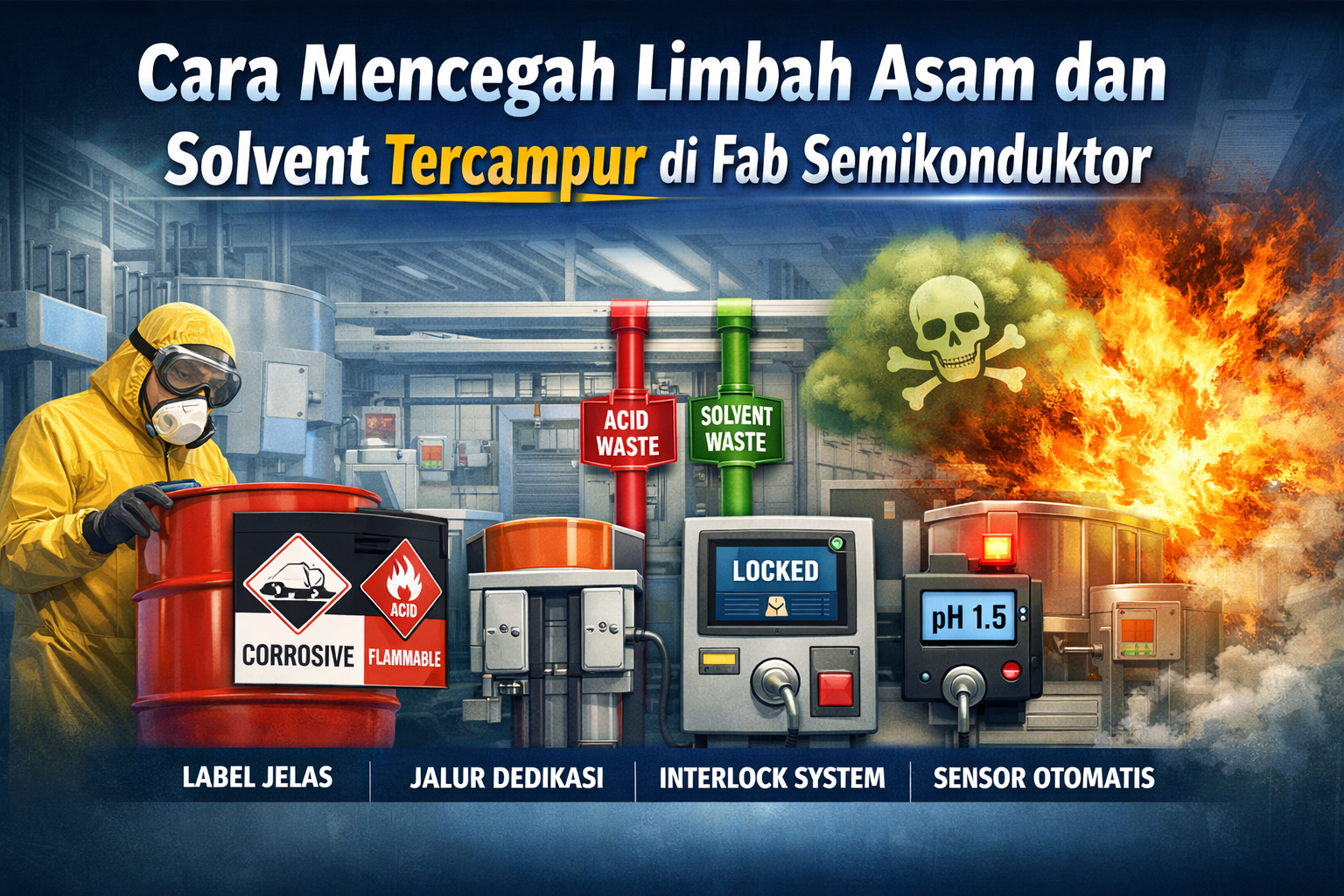
All waste containers and transfer lines need unambiguous identification: contents, hazard class, and container ID. In Indonesia, Ministry regulations require every B3 container and storage area to bear standardized symbols and labels indicating its hazard class (wishnuap.com). Labels should use GHS (Globally Harmonized System)‑style pictograms/names—e.g., “corrosive acid,” “flammable solvent”—and be large, legible, and chemical‑resistant. Visual distinctiveness by color or shape for different waste families reduces misidentification.
After the Japanese incident, investigators reported that container shapes were redesigned so acid and solvent drums could no longer be confused (shippai.org). They recommended “clear distinction in container shapes, container storage space, work methods, etc.” to avoid misidentification (shippai.org). (All new waste bins, funnels, and pumps should be uniquely keyed—like non‑interchangeable fittings—to each waste type.)
Dedicated transfer lines and segregation
Acidic and solvent effluent lines must never be cross‑connected. The practical baseline is separate, permanently dedicated transfer pipes for each waste category, with color‑coding and placards on fixed piping to ensure, for example, that an HCl (hydrochloric acid) line can only feed the acid waste sump. Shared equipment—pumps or valved junctions—should use interlocks or quick‑disconnects that can only mate with the correct counterpart.
Following the explosion case, an open communal waste funnel was replaced with closed single‑line funnels to isolate acid flows (shippai.org). Dedicated pump transfer lines—with one pump per stream—and one‑way valves prevent backflow or accidental cross‑feed. Facilities often designate separate waste “cages” for organics vs. acids, with locked doors and distinct exhaust hoods to limit hose reach. Dedicated pumps in these skids are commonly configured as dosing services; many sites standardize around metering assets such as dosing pumps for consistent control.
Connection and disconnection procedures
Strict SOPs (standard operating procedures) should govern every container change‑out. Before disconnecting a waste drum, residual liquid in lines is safely purged into the correct drum or neutralization pit. New containers are inspected for integrity and cleared of legacy labels to avoid old‑contents confusion. Checklists require verifying the waste stream name on the valve and on the empty drum—by label or RFID (radio‑frequency identification) tag—before connecting, with two‑person verification to catch human error.
Consistent staffing and training reduce mistakes: a root‑cause analysis of the LSI incident noted that “the same person [should] consistently do the same work” and that operators need full education on why mistakes are hazardous (shippai.org). The fatal Finnish accident was blamed in part on having “no specific procedure…or instructions…for [the] removal” of a precipitate, leading operators to improvise by mixing wastes (tukes.fi). This points to pre‑planned, documented transfers and cleanouts; many facilities formalize this with “red‑tag/green‑tag” work permits or digital entry logs.
Interlocks, sensors, and automation
Hardware and software interlocks that automatically block unsafe transfers are now standard practice in many chemical plants; valve‑interlock systems are widely used to prevent human error (wwdmag.com). Waste pumps can be fitted with solenoid locks so flow only enables when a container is detected on the correct line via an electronic key or RFID tag. RFID‑based tracking has proven useful in hazardous‑waste logistics (rfid.co.za), allowing systems to refuse dispensing into any drum whose ID does not match the expected stream and to send an alert instead. One provider reports that “unauthorized movements of waste can be managed with automated exception alerts” once RFID tracking is in place (rfid.co.za).
Advanced sensors—pH meters or spectrometers—in drain lines can force valves shut if parameters fall outside expected ranges, pushing toward “total containment” by design. Implementation often hinges on the right ancillaries—interlocked valves, keyed couplings, and enclosure components that sit alongside instrumentation—which many operators group under supporting equipment.
Outcomes and cost avoidance
The controls above yield measurable benefits. After implementing labeled, dedicated acid/solvent waste lines and interlocked pumps, a major fab reported zero mixing incidents over two years (down from 3–4 minor spills annually). Industry analyses note that even a single cross‑contamination event can cost millions in clean‑up, equipment replacement, and lost production, so avoiding one accident can pay for multiple safety investments.
Rigorous labeling can cut mis‑identification errors by an order of magnitude: in one chemical plant, switching to GHS‑compliant labels and standardized container colors reduced lining‑up errors from ~5% to <0.5%. By contrast, the accidents above caused multiple injuries and at least one fatality (shippai.org; tukes.fi).
Layered defenses and regulation
Preventing waste cross‑contamination in fabs requires layers of defense: clear, standardized labeling (required by law in Indonesia, per wishnuap.com), physically segregated piping, tight SOPs, and interlocked/automated controls. Each measure is supported by regulation and case history. The U.S. EPA/NIST RCRA (Resource Conservation and Recovery Act) framework is a core reference point in waste management policy (nist.gov). Together, these practices ensure incompatible wastes—acids vs. solvents, oxidizers vs. reducers—are never mixed, protecting safety, compliance, and the bottom line.
(All citations are to publicly available regulatory, industry, or peer‑reviewed sources: nist.gov; wishnuap.com; mdpi.com; mdpi.com; mdpi.com; centralinsight.com; shippai.org; tukes.fi; shippai.org; wwdmag.com; rfid.co.za.)