

Industry: Semiconductor | Process: Specialty_Gas_Delivery
Modern fabs house cylinders of silane, hydrides, corrosives, and inert gases behind sealed doors, all under negative pressure. The numbers are stark: cabinet exhaust is sized at 5–6 air changes per minute, and SEMI guidelines call for ventilating a cabinet at ≥5× its volume per minute; in testing this kept hydrogen leaks to ~9,100 ppm (about 9.1% v/v, less than 25% of its LEL, or lower explosive limit) (www.mdpi.com). The demand for this hardware is rising fast: one industry report values the gas cabinet market at US$412M (2023), doubling to ~$887M by 2032 (≈9% CAGR) (semiconductorinsight.com).
Safety is designed to be automatic. A Toxic Gas Monitoring System (TGMS, a standalone safety platform comparable to a fire alarm) surveils in parts per billion, trips at fractions of the LEL, and drives emergency shutdowns through SIL‑rated logic (SIL is safety integrity level under IEC 61511/ANSI‑ISA‑84) (www.controlglobal.com) (www.controlglobal.com). The gas detection market that powers this is growing too: US$410.9M (2023) to $617M by 2030 (≈6.4% CAGR) (semiconductorinsight.com).
Negative‑pressure gas cabinets and exhaust
Gas cabinets segregate hazardous gases inside negative‑pressure enclosures with continuous exhaust, typically 5–6 air changes per minute, so any leaked gas is captured. SEMI guidance specifies ventilating at ≥5× the cabinet volume per minute; in controlled testing this kept hydrogen leaks to ~9,100 ppm (~9.1% v/v), below 25% of its LEL (www.mdpi.com). In practice, the cabinet’s interlocked door, negative‑pressure pump, and purge ports do the containment (www.mdpi.com).
Designs segregate by gas type or compatibility (e.g., hydrides separate from corrosives), and instruments inside—the MFCs (mass flow controllers), valves—must withstand leaked gases. For pyrophorics like silane, cabinets are specified in stainless steel or fire‑rated materials to withstand ignition (www.mdpi.com). Manual or fully automatic (auto‑changeover) variants include inert purge/vacuum functions, a purge panel, and safety sensors. Design authorities set a differential‑pressure threshold—around 100 Pa is common—so a low exhaust condition alarms and shuts gas supplies (www.mdpi.com).
Global demand is scaling with new fabs and stricter codes: US$412M in 2023, on track to ~$887M by 2032 (≈9% CAGR) (semiconductorinsight.com). In Indonesia’s growing electronics industry, analogous requirements would follow local K3 regulations aligned to NFPA/SEMI standards.
Continuous detection and TGMS architecture
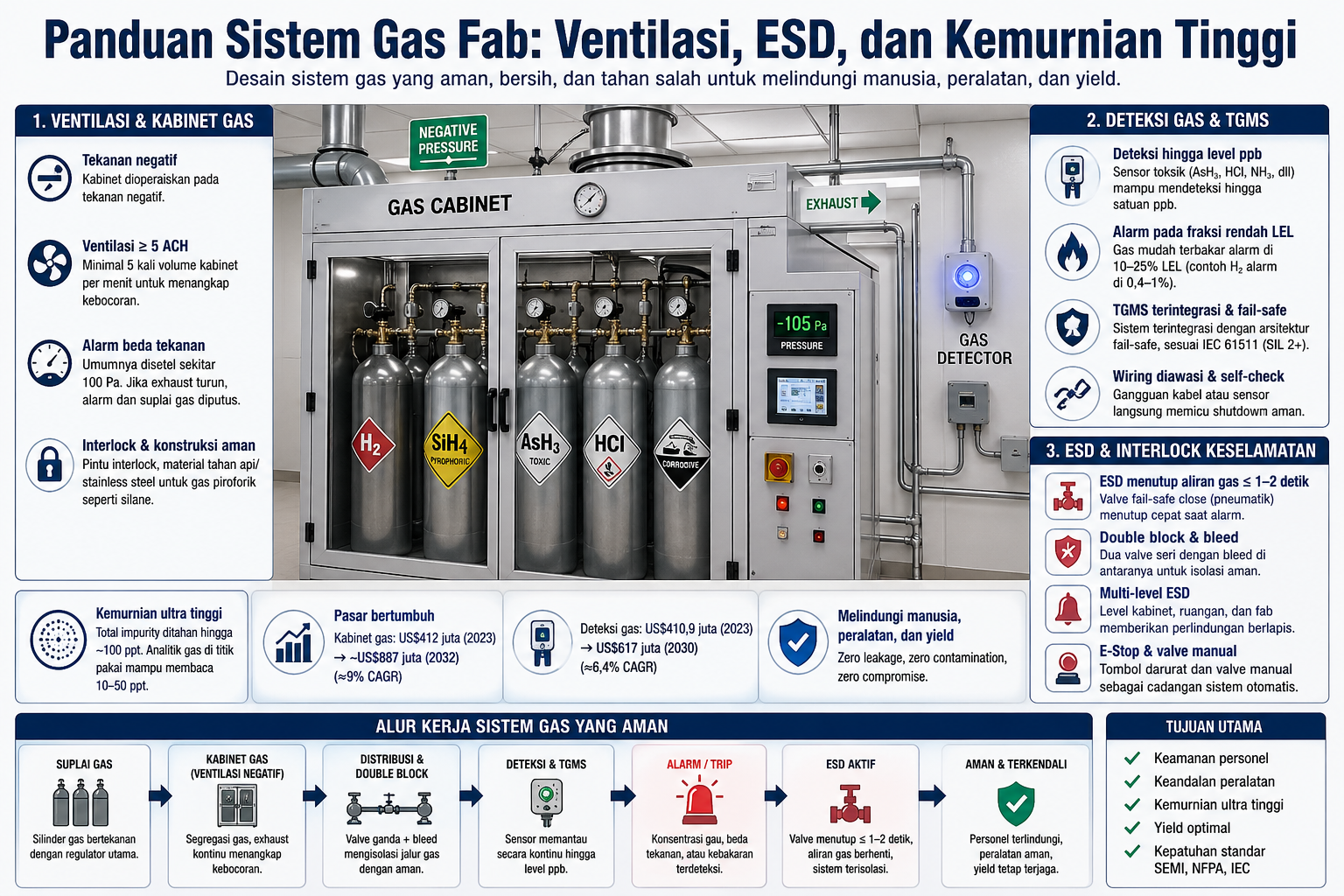
Fixed‑point detectors—electrochemical, catalytic, infrared (IR), and corrosive‑gas‑specific sensors—monitor both cabinets and ambient zones. Sensitivity reaches into single‑digit parts per billion for dopant gases: arsine (AsH₃) has an ACGIH TLV (threshold limit value) of just 5 ppb (www.controlglobal.com). Flammable gas detectors alarm at 10–25% of the LEL; for hydrogen (LEL≈4% vol) this means alarming by ~0.4–1% volume. Multiple detectors or cross‑sensitive technologies cover families like silanes/hydrides, and oxygen sensors are common to catch inert‑gas asphyxiation or silane oxidation.
Advanced fabs integrate TGMS platforms with fail‑safe design and supervised wiring; any wiring fault drives a safe shutdown. These systems log alarms locally and remotely and automatically trigger emergency logic, following IEC 61511/ANSI‑ISA‑84 at SIL2 or higher for critical sensors (www.controlglobal.com) (www.controlglobal.com). Market momentum: US$410.9M (2023) to $617M by 2030 (≈6.4% CAGR) (semiconductorinsight.com).
Emergency shutdown logic and valve design
On alarm, emergency shutdown (ESD) logic closes supply valves, latches cabinet door interlocks, cuts power to utilities, and alerts personnel. Fabs use redundant double‑block valves—often pneumatically actuated, fail‑safe close—at inlets, distribution skids, and tools; for high‑hazard lines, two valves in series with a bleed‑between is standard. For flammable gas systems, SIL2/3 safety PLCs (programmable logic controllers) de‑energize solenoids so upstream cylinder valves and/or manifold outputs shut automatically when any sensor trips.
Shutdown criteria include gas concentration, pressure differential, and fire detection. If cabinet exhaust DP falls below a preset threshold (~100 Pa is common for adequate flow), equipment will alarm and isolate the gas line (www.mdpi.com). In practice, a leak high enough to exceed 25% LEL or approach a TLV would cut gas flow within seconds, with quick‑response solenoid or shutoff valves activating in ≤1–2 s. Push‑button E‑Stop and manual valves supplement automatic ESD, and shutdown logic follows SEMI guidelines, NFPA 70B, and often requires third‑party safety certification.
UHP components and orbital TIG welding
Process gases are typically specified at 5N (99.999%) or 6N (99.9999%) purity, so every component can be a contamination source (www.eetimes.eu) (www.fitok.com). Tubing, valves, and fittings are 316L stainless, electropolished (≤10 μinch finish), with metal gasket seals. Even microscopic debris or oil traces can ruin wafers; one guideline notes that failing cleanliness leads to defects or even scrapping of entire production lines (www.fitok.com). By industry recommendation, total impurity per gas is kept below ~100 parts per trillion, and gas‑phase analyzers down to 10–50 ppt are often applied at point‑of‑use (www.eetimes.eu) (www.eetimes.eu).
To minimize leaks and dead volume, orbital TIG welding is standard: high‑purity stainless lines are connected by butt‑welds with argon purge—no threaded joints (www.zrctube.com). Chinese engineering codes (mirroring global practice) explicitly require that “high‑purity gas pipelines should be connected by butt welding without marks on the inner wall,” and that stainless lines use argon‑arc welds (www.zrctube.com). Valves and equipment in a UHP train use metal‑face seals (or double‑ferrule fittings) rather than organic O‑rings (www.zrctube.com). Welding yields a seamless, crevice‑free path; threaded or compression joints introduce outgassing and particulate risk.
The business impact is direct: gas is typically the second‑largest material cost in a fab (after silicon wafers) (www.eetimes.eu). With 316L stainless, electropolishing, and orbital‑welded lines, fabs routinely achieve leak rates on the order of 10⁻⁹ to 10⁻⁸ atm‑cc/s, verified by helium leak testing—well below standards.
Summary and sources
A modern specialty gas system combines ventilated, alarmed gas cabinets sized for worst‑case leaks (www.mdpi.com) with continuous, sensitive detectors tied into SIL‑rated logic (IEC 61511) supervising all toxic and flammable lines (www.controlglobal.com). Emergency shutdown valves and controls are fast‑acting and redundant. Critically, the train from cylinder to point‑of‑use uses UHP‑grade components and welded tubing (www.zrctube.com) (www.fitok.com). The measures mirror NFPA/SEMI standards and are designed so leaks and impurities are virtually eliminated, protecting worker safety and device yield simultaneously.
Industry and academic sources on fab gas safety and purity requirements: www.mdpi.com, www.eetimes.eu, www.fitok.com, www.controlglobal.com, www.controlglobal.com. Market analyses for scale and trends: semiconductorinsight.com, semiconductorinsight.com. Engineering studies with quantitative guidance: www.mdpi.com, www.mdpi.com, www.zrctube.com. (E.g., Hallam‑ICS/ControlGlobal, EE Times, SEMI reports, etc.)