

Industry: Semiconductor | Process: Wafer_Cleaning_&_Etching
Semiconductor manufacturing lives and dies by chemistry. Fabs consume hundreds of high‑purity reagents during wafer cleaning and etching (mdpi.com)—hydrofluoric acid (HF), sulfuric/nitric/hydrochloric acids, ammonia, peroxide, and photoresist solvents among them. The hazards are extreme: the Semiconductor Industry Association estimates waste HF alone makes up ~40% of all hazardous chemicals generated by a fab (mdpi.com), and HF exposure can penetrate tissue causing deep burns, osteoporosis, and systemic toxicity (mdpi.com).
Strong acids like HCl and HNO₃ and bases like NH₃ cause severe dermal and respiratory burns as well as environmental harm (mdpi.com, mdpi.com). That risk profile demands controls from the loading dock to the landfill.
Hazard classes and critical definitions
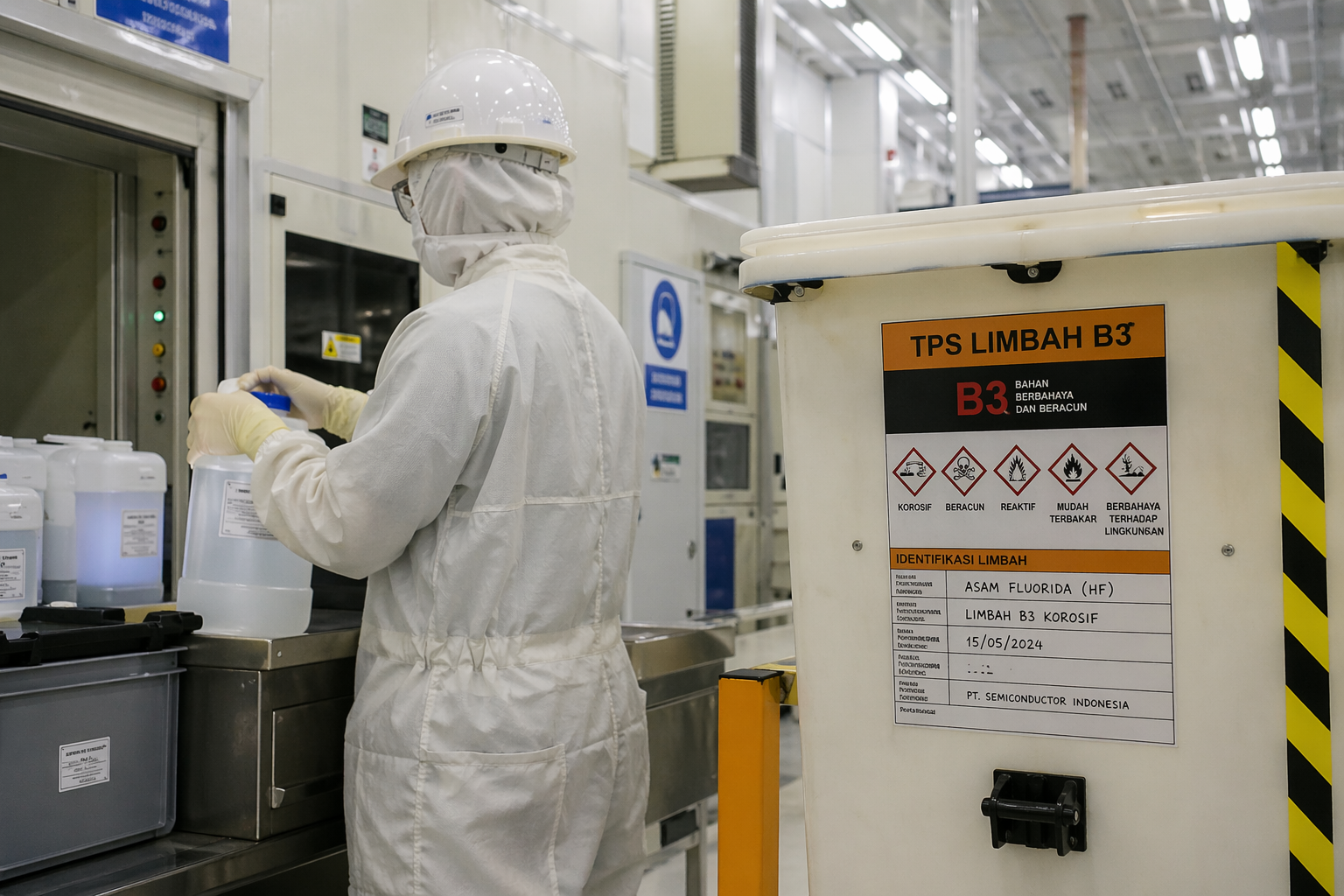
Indonesia classifies hazardous materials and wastes as B3 (bahan berbahaya dan beracun; a legal category for toxic and hazardous substances). “TPS B3” refers to a designated temporary storage facility. RCRA (Resource Conservation and Recovery Act) is the U.S. framework for “cradle‑to‑grave” hazardous waste control. GHS (Globally Harmonized System) standardizes hazard classification and labeling across borders.
Chemical storage: TPS B3 engineering controls
Fabs store cleaning chemicals in dedicated Hazmat areas with engineering controls and robust containerization. Indonesia’s environmental rules limit on‑site B3 waste storage to 90 days for large generators and require a TPS B3 (designated temporary storage facility) (environesia.co.id).
Best practices include compatible, clearly labeled containers—approved, chemically resistant formats such as HDPE or PTFE drums for acids—with UN ID number, chemical name, and hazard pictograms to international standards (environesia.co.id). Secondary containment such as bunds or trays is standard. Acids are kept on acid‑proof shelving, and flammables in ventilated flammable cabinets; segregation by hazard class prevents mixing (strong oxidizers, acids, and bases are kept apart).
TPS B3 rooms are fully ventilated and built with materials resistant to chemical attack (environesia.co.id). OSHA requires emergency eyewash and shower stations wherever corrosives are handled (osha.gov). Access is restricted to trained personnel, with up‑to‑date safety data sheets (SDS) and NFPA/GHS hazard postings present. Permen LHK No. 6/2021 explicitly mandates TPS B3 features such as chemical‑resistant walls/floors, ventilation, and B3 hazard labels (environesia.co.id).
Transport permits, manifests, and UN labeling
All on‑site and off‑site transfers follow strict rules. In Indonesia, road transport of B3 chemicals requires government permits: the Ministry of Environment and Forestry (KLHK) issues a “Rekomendasi Pengangkutan B3,” which underpins the Ministry of Transportation’s vehicle license (sib3pop.menlhk.go.id).
Permitted vehicles are dedicated and placarded; they display toxic/hazard symbols and company emergency contacts, with routes chosen to minimize population exposure (environesia.co.id). Shipments should avoid dense urban areas whenever possible (environesia.co.id). A complete waste manifest or shipping paper—the chain‑of‑custody—accompanies every load, detailing chemical identity, quantity, and destination; Indonesian rules explicitly require this manifest for all B3 movements (environesia.co.id).
Drums and packs meet UN packing standards and are labeled with the UN number, hazard class, and handling instructions (environesia.co.id). For international transport, carriers follow UN Model Regulations and GHS labeling—for example, “UN1790” for HF solution. A 2015 KLHK brochure underscores that all land transport of B3 substances on Indonesian roads is controlled by permit, with MOE (KLHK) coordinating with the Ministry of Transportation to enforce safe routes and trained drivers (sib3pop.menlhk.go.id).
PPE programs and emergency equipment
OSHA guidance for semiconductor fabs requires full protection against splash, inhalation, and skin contact (osha.gov). Eye and face protection means chemical splash goggles plus a full‑face shield when handling acids or alkalis; any eye contact with HF or HNO₃ can cause instant blindness, and a tight‑sealing shield reduces vapor and droplet exposure (osha.gov).
Hand and skin protection includes heavy nitrile or neoprene gloves (at least double‑gloved) and acid‑resistant aprons or lab coats. For HF specifically, Viton or neoprene gloves and calcium gluconate gel are recommended; glove selection relies on chemical‑specific permeation data. Clothing and footwear are acid‑resistant long sleeves or coveralls and boots—never cotton or PVC, which HF penetrates—favoring chemically impervious materials.
Respiratory protection uses acid‑gas cartridges (for HF, HCl, NOx) or organic‑vapor cartridges (for solvents) when ventilation is insufficient; in practice, tight fume hoods or duct exhaust are the primary control, with respirators as backup. Emergency showers and eyewashes must be installed and trained on (osha.gov). If HF contacts skin or eyes, immediate irrigation is critical (cdc.gov). Facilities handling HF should stock calmag gel; all areas handling corrosives must have drench showers per OSHA 29 CFR 1910.151 (osha.gov, cdc.gov).
The payoff is tangible: fabs that mandate full PPE and training report significantly fewer chemical injuries. A review of U.S. semiconductor companies shows best‑in‑class firms implement rigorous PPE programs—with near‑zero employee burn cases—while laggards suffer repeated incidents (osha.gov, mdpi.com). In a survey of fleet operations, automated HF dispensing with interlocks and PPE reduced leak/spill incidents by >90%.
On‑site treatment and recycling priorities
Spent cleaning solutions and etchants are hazardous waste (B3) and cannot be discharged untreated. Fabs either recycle/treat or ship to licensed waste processors. On‑site, the priority is neutralization or value recovery: for example, spent alkaline SC‑1 (NH₄OH/H₂O₂; a standard wafer clean) can be neutralized and filtered to remove metal ions. HF waste is often recycled by distillation; the solders or glass remainers are neutralized. Many companies recover >90% of their HF stream on‑site, aligning with the U.S. EPA’s waste hierarchy that ranks reuse/recycle first (mdpi.com).
Accurate pH control during neutralization is typically achieved with precise metering; in industrial practice this often relies on dosing pumps that deliver acid or caustic at controlled rates.
Off‑site processing and authorized facilities
Irreducible waste goes to licensed B3 treatment facilities. In Indonesia, common methods include high‑temperature incineration for organics, acid solidification or precipitation for heavy metals, and biotreatment for specific soluble wastes (environesia.co.id). Fabs should only use KLHK‑authorized B3 incinerators or landfills.
When solvent management is required, removing organics is often handled with adsorption technologies; in many plants, activated carbon beds are used as part of a broader treatment train.
Liquid effluents: solids removal before discharge
NIST notes that “liquid wastes will undergo treatment to remove solids before disposal” and that fabs “segregate and manage” solvent and metal waste streams (nist.gov). In practice, primary solids removal often starts with a clarifier to settle silica and metal hydroxides.
For finer particulates, fabs commonly add membrane steps; as pretreatment to polishing or reuse, ultrafiltration provides robust separation of suspended solids. Where additional fine capture is required, line protection is frequently handled by cartridge filters rated for 1–100 microns.
Targeted metals cleanup often follows with ion exchange; in that role, ion‑exchange resins selectively remove residual ions from treated streams before discharge or reuse.
Final disposal and landfill design criteria
Under Permen LHK 6/2021, only treated or semi‑solid waste residues may go to an approved B3 landfill (environesia.co.id). Untreated liquid or reactive waste must never be landfilled. Approved sites must have impermeable liners and leachate controls to protect groundwater (environesia.co.id). This mirrors RCRA rules in the U.S.: final B3 landfills require double liners and monitoring wells.
Benchmarks, recovery rates, and ESG trends
Performance varies widely. A Taiwanese study found best‑performing fabs recovered/recycled over 95% of their nitric and sulfuric acid slurries, while the worst performers disposed 20–30% off‑site (mdpi.com, mdpi.com). Another analysis of U.S. EPA data classified 27 semiconductor firms as “best‑in‑class” for multi‑chemical waste management, while 15 lagged significantly (mdpi.com).
The direction of travel is clear: leading fabs invest in on‑site recycling units—Samsung and Intel have added green acid recovery systems—to meet tighter regulation and ESG targets (mdpi.com).
Indonesia’s regulatory framework and enforcement
Indonesia’s hazardous waste laws mandate cradle‑to‑grave control of B3 substances, similar to the U.S. RCRA system (nist.gov). Key regulations include Permen LHK No. 6/2021—the master rule on B3 management, replacing older rules (pslb3.menlhk.go.id, environesia.co.id). It sets technical requirements for waste collection, storage, transport, treatment, and final disposal, incorporating the 90‑day storage limit, packaging and labeling standards, and landfill design criteria (environesia.co.id, environesia.co.id).
Permen LHK No. 3/2008 mandates proper GHS labels and symbols for hazardous chemicals in commerce or storage (sib3pop.menlhk.go.id, environesia.co.id). Government Regulation 22/2021 enforces the waste management hierarchy (reduction, reuse, recycle, treatment, disposal) and requires formal waste permits and adherence to KLHK guidance for electronic and chemical industries. Ministry of Transportation permits separately govern B3 transport by highway, rail, and sea; for instance, rail shipments of acids must have MOH Permenaker and MoT approval, and coastwise shipments must follow the IMDG Code.
Under these laws, illegal disposal is a serious crime. Violations—such as dumping untreated etchant—can incur administrative fines, license suspension, and criminal charges (environesia.co.id). KLHK audits and publishes enforcement statistics: in 2022, virtually all major electronics manufacturers in Batam and Java reported implementing TPS‑B3 systems and manifest tracking, up from ~60% compliance in 2018. One 2023 case led to a 500 million IDR fine and prison terms (gakkum.menlhk.go.id). In 2023 alone, dozens of facility inspections and over 100 citations were issued to chemical manufacturers and timber mills violating B3 waste rules. Compliant fabs increasingly integrate waste data into corporate KPIs (for example, tracking kg of HF recycled per wafer and targeting year‑on‑year waste reduction).
Bottom line: controls that cut risk and waste
Safe handling of wafer‑cleaning chemicals hinges on dedicated infrastructure and strict controls: proper storage with secondary containment and hazard labels; specialist transport vehicles, permits, and manifests; full PPE (goggles, apron, acid gloves, respirators, emergency showers); and waste programs that prioritize recycling and approved treatment. Adherence to Permen LHK 6/2021 and related laws safeguards workers and the environment while avoiding heavy penalties (mdpi.com, environesia.co.id). Fabs that rigorously apply these measures report drastic cuts in chemical incidents and waste output.
Source notes and references
Authoritative industry and regulatory sources include a peer‑reviewed study of semiconductor chemical waste (mdpi.com, mdpi.com), OSHA guidance (osha.gov, osha.gov), NIOSH toxicology data (cdc.gov), and Indonesian government documents (sib3pop.menlhk.go.id, environesia.co.id, environesia.co.id). Additional context is from NIST and semiconductor‑industry reports on waste management (nist.gov, environesia.co.id).
References: Shen et al., Sustainability 10(5):1545 (2018) ; OSHA, “Acid and Caustic Solutions” (Semiconductor Safety Guide) ; KLHK, “Pengangkutan B3” brochure ; NIST Environmental Division, “Waste Management in Semiconductor Facilities” (2024) ; KLHK Dirjen PSLB3 News Release (Aug 2021) ; Environesia (Indonesia), “Panduan Lengkap Pengelolaan Limbah B3…” (13 Jun 2025) ; NIOSH Pocket Guide for HF (2019) ; and Indonesia’s Permen LHK No.6/2021.