

Industry: Desalination | Process: Reverse_Osmosis_(RO)
Reverse osmosis (RO, a pressure‑driven membrane process) doesn’t quit — until fouling does what fouling does. Operators of large sea‑water RO trains used in industry and power generation face a familiar math: normalized permeate flow droops by 10–15%, differential pressure (ΔP) climbs ~15%, or salt rejection falls ~10%, and it’s time to clean (shanghai-cm.com; avistamembranesolutions.com). That “15% flow decline or ΔP increase” trigger is industry shorthand (shanghai-cm.com), whether the plant is running brackish feed or high‑load SWRO systems.
The stakes are real. Across seven full‑scale RO/NF (nanofiltration) installations, fouling cost ≈24% of RO OPEX (operating expenditure) and ≈11% for NF, with energy and membrane replacement leading the tab (researchgate.net; researchgate.net). When Clean‑In‑Place (CIP) is frequent, downtime during cleaning can dominate CIP costs; with infrequent cleaning, chemical cost dominates (researchgate.net). Scaling and biofouling are the usual suspects (satprogress.com).
CIP triggers and preparation basics
Data drives timing. Plants monitor normalized flux and salt rejection, adjusted for feed temperature and pressure, and clean when flux is <85–90% of baseline or ΔP is >15% above the clean reference (shanghai-cm.com; avistamembranesolutions.com). Visual signs (colored deposits) and microbiology can prompt earlier action.
Prep is procedural: calibrate flow/pressure gauges to within ±2% error; size the cleaning pump for ~1.5× design flow; and choose a CIP tank 10–20% larger than the system volume (shanghai-cm.com). Establish pH monitoring on all return lines and isolate membranes by opening vent valves and fully opening concentrate lines (shanghai-cm.com). Chemical dosing precision is helped by an accurate dosing pump, and operator safety starts with PPE and a closed‑loop recirculation path rated for temperature and chemistry.
Standard two‑step cleaning sequence
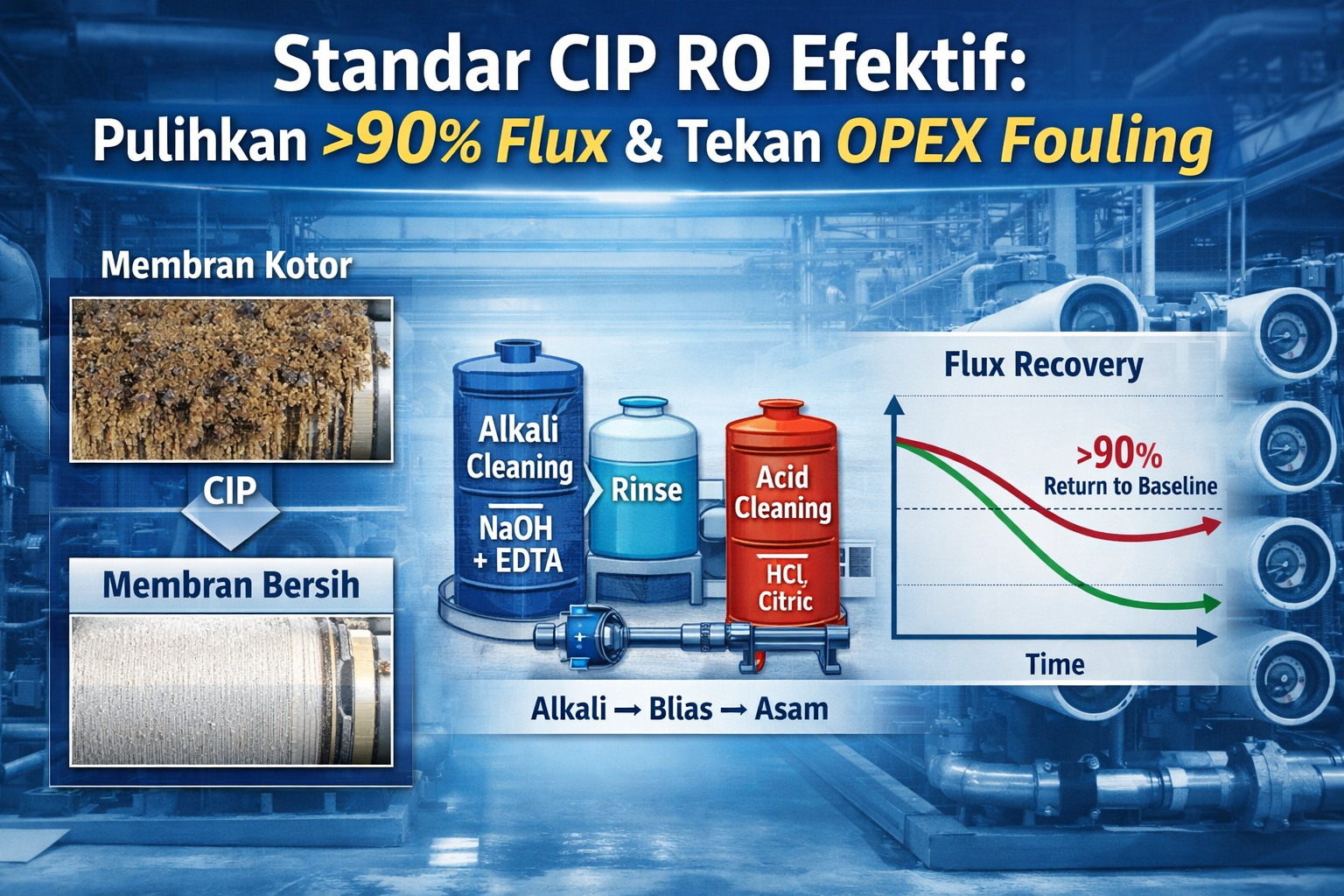
Operators generally run six stages: pre‑rinse, alkaline cleaning, intermediate rinse, acid cleaning, disinfection (optional), and final rinse/neutralization.
Pre‑rinse: flush with permeate or DI water at low pressure (~50% design flow) for 15–30 minutes to remove loose debris and residual feed, avoiding dilution of cleaning solutions (shanghai-cm.com).
Alkaline (high‑pH) cleaning: circulate 0.1–0.5% w/v sodium hydroxide (NaOH) with a chelant (e.g., Na‑EDTA) and nonionic surfactant at 35–40°C to remove organics and biofilms; run at moderate flow (e.g., 8–10 m³/h for an 8″ vessel) and low transmembrane pressure (TMP, the driving pressure across the membrane) <0.2 MPa for ~60–90 minutes, then soak 4–6 hours to penetrate biofilm (shanghai-cm.com).
Intermediate rinse: flush 20–30 minutes to near‑neutral pH to prevent acid/alkali carryover.
Acidic (low‑pH) cleaning: dissolve inorganic scale with 1–2% citric, sulfamic, or HCl at ~25–30°C; circulate 60–90 minutes and optionally soak 1–2 hours (shanghai-cm.com). Calcium sulfate and silica scales resist typical acids; specialized reagents are often required.
Biocide/disinfection (optional): for severe biofouling or after long shutdowns, recirculate oxidizing biocides such as peracetic acid (0.5–1%) or hydrogen peroxide (H₂O₂, 0.5–2%); some protocols use 1–3% H₂O₂ for ~30–60 minutes (mdpi.com). Any chlorine or biocide in CIP effluent must be neutralized before discharge to meet local water‑quality regulations (mdpi.com).
Final rinse and neutralization: rinse with permeate to pH ~6–8 before return to service; sodium bisulfite can quench residual oxidants. Post‑CIP checks of flux and conductivity, and even TOC or microbial counts, confirm foulant removal. Laboratory FTIR/SEM analyses have shown that aggressive alkali+acid cleaners can remove organic films and scale layers, virtually restoring the membrane surface without damaging the polyamide (mdpi.com).
Conventional chemistries and safer blends
Workhorse chemicals still carry the load. Caustic soda at 0.1–0.5% saponifies oils and solubilizes proteins/polysaccharides; acids (1–2% citric, sulfamic, or HCl at pH ~2–3) dissolve carbonate/oxide scales, especially with corrosion inhibitors (shanghai-cm.com). Chelants such as 0.05–0.1% Na‑EDTA or sodium citrate complex metals (Fe, Ca, Mg), and nonionic surfactants (0.01–0.1%) aid wetting; doses are kept low to control foaming.
Oxidizing biocides are a special case: sodium hypochlorite (NaOCl) at 50–200 ppm can be effective but risks polyamide degradation unless immediately neutralized with sodium bisulfite. Many operators prefer H₂O₂ (1–3%) with a stabilizer; a recent study found that adding H₂O₂ to CIP (with NaOH and HCl) significantly improved biofilm removal and microbial kill (mdpi.com). A mild counter‑pH soak (e.g., brief citric after NaOH, or mild NaOH after acid) prevents pH shocks downstream.
Proprietary formulations bundle these modes. Suppliers cite better cleaning efficacy, reduced chemical usage and frequency, and safer handling from pre‑mixed liquids/powders with inhibitors and indicators; enzyme‑enhanced and hydrogen‑peroxide blends are options. Avista notes that specialty cleaners such as its RoClean products target broad foulant classes and can extend system run times, reduce cleaning frequency, and increase the life of RO elements (avistamembranesolutions.com; avistamembranesolutions.com). In one study, a custom protocol (3% NaOH + hypochlorite + H₂O₂ + HCl) outperformed a single‑step 6% NaOH + citric approach for biofilm removal (mdpi.com). Plants often stock membrane cleaners and upstream membrane antiscalants to pair prevention with cleaning.
Chemical handling and compliance
Safety and compatibility matter as much as efficacy. Strong acids and bases require PPE and ventilation; equipment should use chemically compatible pump heads, tanks, and gaskets. Strong oxidants (e.g., chlorine dioxide or persulfate) and very high NaOH can degrade polyamide; membrane supplier limits such as pH <12.5 during cleaning are observed.
Waste handling is regulated. CIP waste is neutralized to pH ~6–9, then filtered or settled before discharge. In Indonesia, Government Reg. No. 82/2001 and region‑specific bylaws prohibit discharges that exceed quality values; CIP effluent must meet limits for pH and contaminants such as BOD, heavy metals, and toxic organics (mdpi.com). Best practice consolidates CIP waste in settling tanks, neutralizes to pH ~6.5–8, and removes solids; local limits are checked (often 150–300 mg/L COD, 30–50 mg/L surfactant). Jakarta’s PP 21/2021 sets maximum concentrations for heavy metals and organic toxicity if CIP waters enter sewers. NSF‑listed “food‑grade” membrane cleaners are available where potable or ultrapure water is produced (info.nsf.org).
Troubleshooting the cleaning cycle
Incomplete cleaning or low flux recovery often traces to under‑dosing, insufficient contact time, wrong chemistry, or low temperature. Plants recalculate total system volume (including piping) to avoid weak solutions and adjust soak time and temperature; dosing tools such as an online calculator help get concentrations right (membranechemicals.com; shanghai-cm.com).
Excessive foaming signals too much surfactant; doses are reduced or antifoams selected. Biofilm regrowth between cleanings suggests sublethal treatment; oxidizing steps (H₂O₂ or peracetic acid) are added, and upstream carbon loading is cut with pretreatment such as an activated‑carbon filter. Residual oxidants are neutralized (e.g., post‑bleach bisulfite) to prevent membrane damage (mdpi.com).
Membrane damage or gel layers after cleaning point to overly aggressive pH/temperature or poor rinsing; plants recheck compatibility and rinse to neutral. High chemical consumption can reflect oversizing, leaks, frequent cycles, or dead volumes; careful volume surveys, recirculation/reuse of solutions, and better pretreatment (coagulant/antiscalant programs) reduce use (membranechemicals.com). Persistent silica or iron scaling needs targeted chemistry: strong alkali (pH>11) or specialized silica reagents (often risky) and reductive cleaning for iron/manganese (dithionite/bisulfite, or citric plus hydrosulfite as suggested in one patent) (patents.google.com). Oxygen control and upstream filtration help remove iron particulates before RO; polishing with a cartridge filter supports this.
Optimization levers that cut downtime
Normalization and analytics anchor the schedule: flux and rejection are trended after correcting for temperature and salinity, and a just‑in‑time cleaning interval (e.g., every 50–150 days) is tuned to the fouling rate (avistamembranesolutions.com; wwdmag.com). Automated CIP (pre‑programmed sequences, motorized valves) saves labor and reduces solution use via tighter control; in one RO plant, manual CIP increased fouling costs by ~2% OPEX relative to automated (researchgate.net). Integrated membrane systems increasingly ship with dedicated CIP skids to streamline these steps.
Parallelization softens lost production: in multi‑train plants, an N+1 strategy keeps at least one train online while another cleans, often during off‑peak demand. Preheating solutions accelerates kinetics so lower concentrations achieve the same effect; where feasible, the minimum effective NaOH or acid strength is chosen after serial dilution tests. Recirculation and reuse (decanting solids, filtering between uses) further trims chemical consumption; solution heating can be recovered for the next batch. Logs of pre/post‑CIP performance, chemical volumes, and downtime support metrics such as liters of NaOH per m² per CIP and days gained per cleaning — the basis for ongoing optimization.
The payoff is measurable. Plants report >90% flux recovery under effective regimes, and energy use falls ~10–20% versus fouled operation (mdpi.com). One facility cut CIP downtime by 25% with automation and staged cleanings, saving over $100,000 per year. Another reduced NaOH usage by 30% after switching to a surfactant‑blend cleaner without sacrificing recovery. Continuous upstream dosing of a scale inhibitor and antiscalant program complements these gains by extending run times.
Pretreatment and system choices
Pretreatment is the first defense. UF (ultrafiltration) pretreatment ahead of RO catches colloids and reduces bioload; it is widely used for drinking water and surface/ground sources and integrates cleanly with UF modules. Media trains that include dual‑media sand for 5–10 µm particles and carbon polishing lower particulate and digestible carbon; in practice, many RO feeds are finished over an activated‑carbon stage to moderate biofouling. Continuous biogrowth control upstream can also leverage non‑chemical UV disinfection; a compact ultraviolet unit provides a 99.99% pathogen kill rate at low operating cost without chemical residuals.
On the chemical side, prevention programs rely on upstream antiscalants and precise dosing. Specialty blends, often supplied alongside cleaning and antiscalant chemistries, are adjusted by jar tests and trended performance. Accurate injection via a dosing pump improves control and reduces both overfeed and underfeed events that lead to premature CIP.
Some systems explore online cleaning methods, particularly in brine concentrators: pigging and CO₂ scouring have been tested to maintain performance while online (mdpi.com). Membrane selection also matters: fouling‑resistant coatings and chlorine‑tolerant types can enable periodic chlorination for biofilm control without full CIP. For brackish feeds up to a maximum TDS of 10,000, robust brackish‑water RO trains match optimized CIP to upstream load; where space or project timelines are tight, containerized options and rentals are often paired with a flexible CIP plan.
Regulatory and environmental guardrails
Compliance is not optional. Indonesian rules (Government Reg. No. 82/2001 and local bylaws) require industrial effluents to meet pollutant limits; wastewater exceeding the quality value is prohibited (mdpi.com). CIP waste, typically high in pH and containing surfactants and chelants, is treated to pH ~6.5–8 and solids are removed before discharge, with local thresholds observed (often 150–300 mg/L COD, 30–50 mg/L surfactant). Jakarta’s PP 21/2021 enumerates maximum concentrations for heavy metals and organic toxicity for sewer discharges. Where membranes produce potable or ultrapure water, residual cleaning agents are minimized; NSF‑listed options (e.g., sodium citrate‑based cleaners) support compliance (info.nsf.org).
Bottom line for RO operators
Effective RO CIP restores performance and protects budgets. Regular monitoring and cleaning at ~10–15% flow loss, a two‑step alkaline‑then‑acid regimen, and advanced chemistries where indicated are the backbone (shanghai-cm.com; avistamembranesolutions.com). Plants that normalize data, automate sequences, recirculate solutions, and match chemistry to foulants report >90% flux recovery and ~10–20% energy savings versus fouled operation, with >95% of fouling resolved under well‑managed programs (mdpi.com). Given that fouling can absorb ≈24% of RO OPEX and downtime can be the largest cost factor when cleaning is frequent (researchgate.net; researchgate.net), the return on an optimized CIP program is both operational and financial.