

Industry: Brewery | Process: Fermentation
On the cold side of a brewery—fermentation and packaging, where temperatures stay low—microbes don’t get thermal help to die off. That leaves beer exposed to classic spoilers: one review found Lactobacillus brevis and Lactobacillus lindneri alone account for roughly 75% of beer-spoilage incidents (researchgate.net). The response is meticulous Clean‑in‑Place (CIP)—the sequenced, circulated cleaning chemistry designed to remove soils and sanitize without disassembly—and a final step that renders tanks and lines microbe‑free.
Done right, CIP is a quality and cost lever. A comparative study of microbreweries estimated that optimizing CIP—streamlining water, caustic, and energy—could save on the order of £1,000 annually per brewery (researchgate.net).
Cold-side CIP sequence and parameters
A typical cold-side CIP cycle—targeting residual wort, beer, hops, and yeast—runs: pre‑rinse, alkaline caustic wash, rinse, acid wash for beerstone/scale, final rinse, and final sanitizer. Each step is optimized for time, concentration, and flow. “Cold side” refers to post‑boil operations where heat isn’t used; CIP is a circulated, closed-loop cleaning method; beerstone is mineral scale. Concentrations are commonly expressed as v/v (volume/volume), and sanitizer strength sometimes in ppm (parts per million).
Pre‑rinse: circulate water (often ambient or warm, not hot) to flush debris. One study found a single 100 L water rinse removed most caustic from vessels up to ~1,200 L (researchgate.net).
Caustic wash: alkaline detergent (typically sodium hydroxide) at 1.5–4% v/v is circulated at least 25–35 minutes; studies recommend ≥2% v/v (from a ~30% stock) for ~35 minutes (researchgate.net). High temperature (40–60 °C) showed no clear benefit over room‑temperature for the same duration in that study (researchgate.net), although industry guides still run caustic hotter—e.g., 85 °C for 30 minutes in plate coolers for heavy soils (asianbeernetwork.com). Mechanical action via spray balls or agitation is used to scour surfaces.
First rinse: rinse thoroughly (hot or ambient) to remove caustic. Cleanliness is validated with ATP swabs—adenosine triphosphate swabs that detect residual biological matter—where <10 RLU (Relative Light Units) on a Hygiena UltraSnap indicates “clean” (researchgate.net).
Acid wash (beerstone removal): circulate dilute acid—commonly phosphoric or a nitric/phosphoric blend—periodically or after heavy beers to dissolve mineral scale. A yearly nitric/phosphoric pass is often recommended to passivate (restore the protective oxide layer on) stainless steel. Industry advice notes that acid CIP is crucial for preventing scale build‑up and maintaining heat‑transfer efficiency (asianbeernetwork.com). Concentration and time should follow supplier guidance; an example is 0.5% nitric at ambient for 15–30 minutes.
Final rinse: rinse out acid thoroughly; again, ~100 L water is typically sufficient for a ~1,200 L vessel (researchgate.net).
Final sanitizer: circulate or hold a no‑rinse sanitizer to kill remaining microbes (see the PAA vs. iodophor section below). Where accurate chemical metering is part of the SOP—e.g., hitting 0.1–0.2% sanitizer strength—breweries use precise addition methods such as dosing pumps to support repeatability.
Wort coolers and transfer line hygiene
Each fermentation vessel and bright tank is CIP’d after emptying, and transfer hoses/lines are flushed or circulated with the same CIP chemicals. Plate wort‑coolers/heat exchangers follow similar logic: many breweries run a hot‑water rinse, then hot caustic (e.g., 2–4% at ~80–85 °C for 30 minutes for heavy loads) followed by a cold‑water rinse (asianbeernetwork.com). Acid is run less frequently—weekly or in slack times—to strip hard scale. One study validated <10 RLU ATP cleanliness after a 2% caustic/35‑minute CIP (researchgate.net). Cutting chemical volumes directly saves money: reducing caustic from 200 L to 100 L per cycle was projected to save £1,000+/year (researchgate.net).
Sanitizer selection: PAA and iodophor
Iodophor (iodine‑based sanitizer) is widely used and inexpensive, with rapid kill against yeasts and bacteria. Iodine exposure at ≈15 ppm for 10 minutes yields a ≥5‑log (99.999%) reduction of beer‑spoilage organisms (realbeer.com). It can be used at ~25–50 ppm (0.0025–0.005%) without a rinse (morebeer.com). Downsides: a strong smell and potential flavor impact—even low‑level residues “can affect beer flavor” (morebeer.com). Iodine stains plastic and must be thoroughly rinsed; it also leaves halide in wastewater. Some regulators—e.g., DEFRA in the UK—now ban iodophors in food processing outside limited agricultural uses (kersia.uk).
Peracetic acid (PAA) sanitizers, typically stabilized with hydrogen peroxide, are broad‑spectrum oxidizers that decompose to vinegar and water. They are no‑rinse because the residue (acetic acid) is essentially a fermentation nutrient. At typical use—e.g., 0.1–0.2% solution, or 1–2 mL/L of a 5% concentrate—PAA achieves rapid microbial kill. Industry reports note a cold‑water PAA (“mixed‑peracid”) wash can sanitize fermenters while omitting a separate acid rinse (thebrewermagazine.com), effectively controlling microorganisms without flavor taint (thebrewermagazine.com). Trade‑offs include corrosivity/irritation at high doses and a sharp (vinegar‑like) odor during cleaning (morebeer.com). In practice, breweries often use a holding dose—about 1% v/v of a 5% PAA stock (~0.05% PAA)—for ~10 minutes as a final sterilization step (researchgate.net).
Comparing the two: iodophor’s advantages are cost and low foam; PAA’s are thorough sterilization and no‑odor/no‑taste at use levels. Many modern breweries favor PAA‑based sanitizers for routine CIP—no post‑rinse saves water—while reserving iodophor for spot sanitizing where needed (thebrewermagazine.com, morebeer.com).
Sterile gas purging and counter‑pressure transfer
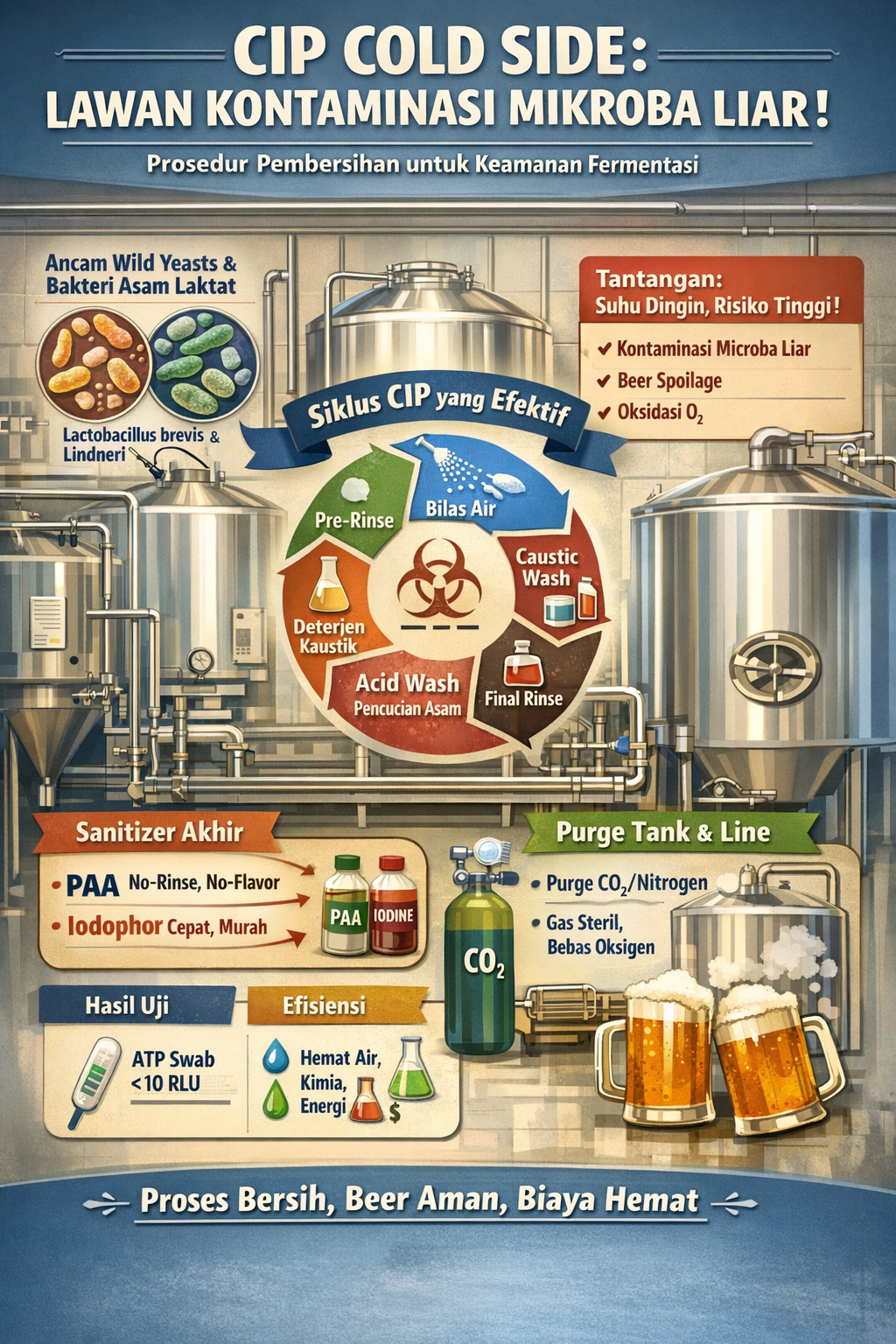
After cleaning and before filling, purging vessels and lines with CO₂ or nitrogen displaces oxygen and airborne contaminants, creating an anaerobic “blanket” that protects flavor and inhibits aerobic microbes (zybrewtech.com). Industry guidance recommends purging fermenters with CO₂ before filling and purging lines, hoses, and receiving vessels with CO₂ or nitrogen before transfers (zybrewtech.com, zybrewtech.com). Even <0.1 ppm O₂ can degrade beer.
If air must be used, it should be sterile‑filtered through 0.2 μm hydrophilic (water‑wettable) filters. In‑line 0.2 μm “sterile vent filters” are often fitted on tank vents so any gas entering or leaving a vessel is microbe‑free. During transfers, pressurizing the receiving tank with CO₂ (a counter‑pressure transfer) both fills the tank and keeps oxygen out (zybrewtech.com, zybrewtech.com). For sanitary mounting of sterile filters on tanks and lines, brewers use food‑grade hardware such as stainless cartridge housings.
The bottom line: purging with sterile inert gas or filtered air is a simple, effective final control that reduces oxidation and blocks contaminants from leaks or vents (zybrewtech.com, zybrewtech.com).
Verification, water use, and compliance
A CIP/sanitation program is monitored by microbial swabs, ATP assays, and finished beer quality. Industry tests often use an ATP swab threshold of <10 RLU to declare equipment clean (researchgate.net). Brewers also check vibration of turbidity and spore counts.
Water and chemical use per barrel is a powerful KPI. Craft breweries typically use 10–12 L of water across all processes per 1 L of beer, while large brewers achieve 3–6 L/L (viravix.com). Because cleaning drives a large share of that, optimizing cold‑side CIP—such as cold PAA washes and shorter cycles—can significantly cut resource usage. Some breweries report reducing total water usage by adopting no‑rinse acids and gas blanketing. Cost analyses confirm payback: halving caustic volume and rinse yields about £1,000 in annual savings for a small brewery (researchgate.net).
From a regulatory and quality standpoint, a documented CIP program supports food‑safety audits (HACCP/ISO 22000) and permits. While Indonesia has no brewery‑specific CIP law, general food‑safety standards (SNI/ISO for beverages) require validated sanitation steps. In practice, adhering to the best‑practice steps above meets government or industry requirements for contamination control.
Outcome: clean tanks, stable beer, lower costs
The data point to a thorough, verified CIP cycle—right detergents, time, and rinses—plus an effective final sanitizer and sterile‑gas purge as indispensable on the cold side. This regimen consistently yields clean equipment (as measured by ATP swabs), prevents costly spoilage, and achieves measurable savings in water, energy, and rework (researchgate.net, researchgate.net).
Sources: peer‑reviewed studies and industry guides were used to compile these recommendations (researchgate.net, realbeer.com, zybrewtech.com, thebrewermagazine.com, morebeer.com, researchgate.net, viravix.com).