

Industry: Semiconductor | Process: Photolithography
One survey of 51 photoresist products found toluene in 56.9% and benzene — a known carcinogen — in 17.6% (pmc.ncbi.nlm.nih.gov). In a separate investigation of major Korean fabs, the average site held 210 chemical products, with about 33% containing proprietary “trade‑secret” ingredients (www.ncbi.nlm.nih.gov). Only 29% of semiconductor‑process chemicals in that survey even had published occupational exposure limits (OELs, guidance values for workplace exposure), and 60% had no NFPA hazard ratings (www.ncbi.nlm.nih.gov).
The chemical mix is broad: concentrated sulfuric, nitric, hydrofluoric, and chromic acids are frequently used for wafer cleaning and stripping (iloencyclopaedia.org), while polar solvents such as ethylene glycol monoethyl ether acetate (EGMEA) and propylene glycol ether are reproductive toxins (iloencyclopaedia.org). During UV exposure and bake steps, studies have detected benzene and formaldehyde (pmc.ncbi.nlm.nih.gov).
Photolithography accounts for the greatest variety of chemicals in the fab — over 90–100% of products still rely on proprietary formulations (www.ncbi.nlm.nih.gov; iloencyclopaedia.org). With such opacity, fabs treat all process liquids as potentially flammable, toxic, and corrosive unless proven otherwise.
Overall chemical usage is enormous. Semiconductor fabs consume tens of millions of gallons of ultrapure water and reagents daily. In South Korea, semiconductor manufacturing wastewater represents 19.3% of all industrial effluent (≈178,000 m³/day) (www.researchgate.net). Typical effluent includes extremely high fluoride (from HF) and sulfate (from H₂SO₄); one study reported sulfate concentrations above 15,000 ppm in etch effluents (www.researchgate.net). U.S. TRI data show large fabs treat ~98–100% of strong acid wastes on‑site before release, and nearly all nitric, sulfuric, and HCl wastes (>90%) are neutralized or recycled rather than discharged (www.mdpi.com; www.mdpi.com).
Chemical inventory and hazard profile
Input chemicals in practice include volatile organics (toluene, MIBK, n‑butyl acetate, PGMEA), corrosive acid mixtures (H₂SO₄/H₂O₂ piranha etch; H₂SO₄/CrO₃ achromat; HCl; HF), and strong bases (TMAH, tetramethylammonium hydroxide, or NH₄OH) (iloencyclopaedia.org; www.researchgate.net). Handling and disposal planning must therefore cover flammables, carcinogens (e.g., benzene Group 1), corrosives, and toxic by‑products (pmc.ncbi.nlm.nih.gov).
Facility‑wide safety depends on engineering controls (hoods and scrubbers), careful storage and segregation, fully effective PPE, and adherence to hazardous‑waste regulations. Water management programs often integrate membrane trains; in reuse projects, engineers commonly pair pretreatment with membranes such as ultrafiltration and downstream RO/EDI to protect critical loops, alongside chemical dosing skids and neutralization steps.
Safe storage: segregation and containment
Segregation by hazard class minimizes reactions and exposure. Strong oxidizers (for example, H₂O₂ mixtures) require separation from organics and reductants; flammable solvents (xylene, PGMEA, acetone) belong in fire‑rated cabinets with spill containment (arahenvironmental.com). Storage rooms are ventilated to prevent vapor accumulation — many resist solvents have low LELs (lower explosive limits) — with exhaust or scrubber systems designed for at least 12 air changes per hour, and ambient temperatures maintained below 30 °C.
Containers are rated for contents (HDPE or glass for acids; solvent‑rated steel drums for flammables) with intact lids or bungs. Labels identify the chemical name and hazard class under GHS (Globally Harmonized System), WHMIS, or Indonesia’s GHS implementation, plus emergency contacts. Regulations (MoEF Reg. 6/2021; IDMONGRAP Reg. 9/2024) require standard symbols and color codes on hazardous‑waste storage (enviliance.com).
Secondary containment catches floor drips or breaches. Bunds or trays hold at least 110% of the largest container’s volume; safety datasheets typically mandate this for acids and solvents. Indonesian B3 (hazardous materials and waste) rules similarly call for leakage prevention and emergency measures in storage design (enviliance.com; arahenvironmental.com). Floors and bunds are chemically resistant (e.g., epoxy‑coated).
Location and security are specified: a dedicated B3 storage room or outdoor cage (with roof), fire‑rated, isolated from occupied areas, and seismically braced; away from drains or storm sewers; protected from natural hazards (flood, earthquake) (enviliance.com). Access is limited to trained personnel, with emergency showers and eyewashes reachable within 10 seconds.
Inventory controls include tight shelf management and generation‑date tracking. Indonesian rules cap on‑site storage times by waste generation rate: generators producing more than 50 kg/day may store waste only 90 days (enviliance.com). Licensed “cold storage” typically holds waste about 90 days pending incineration (arahenvironmental.com).
Data‑backed rationale connects these measures to outcomes. In Indonesian practice, failures to segregate or contain B3 wastes have been linked to severe contamination incidents (including groundwater chromium contamination in East Java in the 1990s). Conversely, strict secondary containment reportedly prevented approximately $10 million in damage in a 2022 acid spill in a SEÂS fab (enviliance.com; arahenvironmental.com). On the business side, maintaining sub‑90‑day inventories helps avoid fines; Indonesian law cites prison terms and fines up to ₹3 billion IDR for violations (das-b3.com).
Transport packaging and e‑manifest tracking
Transport — internal or offsite — follows hazmat standards. Licensed carriers and UN/DOT (United Nations/US Department of Transportation)‑specification containers are used: UN‑rated drums or IBCs for acids/solvents, sealed and with pressure relief if needed. Spent chemicals typically move in steel drums on pallets (arahenvironmental.com). Some fabs deploy closed‑loop drum systems for pneumatic draining and reuse.
Shipments carry GHS labels (hazard pictograms, signal words, UN IDs). Indonesia mandates an electronic transport manifest (Festronik, KLHK’s e‑system) for all B3 waste movements (enviliance.com). Under the 2020 Transport Regulation (MoEF Reg No. 4/2020), transporters register on the KLHK portal and log each consignment online (enviliance.com). Waste paperwork — invoices, SDS, manifest records — is kept on‑site for five years.
Hazard controls during transit include spill kits and response information accompanying the load. Cylinders (e.g., nitrogen or oxygen used in lithography) travel with valve caps and chain straps. Drums are not overfilled (maximum 95% volume). Vehicles are well‑ventilated or equipped for explosion venting when carrying solvent fumes. Drivers minimize sudden braking or sharp turns when transporting liquids.
Training is required: transport personnel hold HAZMAT endorsements and spill‑response training; SDS or chemical summaries ride in the cab. Indonesian rules apply even to internal lab carriers under MoEF Reg 6/2021 (enviliance.com). Environmental liability is triggered if a spill occurs en route, as in a 2022 incident where a leaking acid drum — improperly bundled — led to forest fines.
Statistics align with these controls: UN‑certified containers have reduced transport spills by 75% in U.S. EPA analyses. In Indonesia, Festronik has improved accountability, with KLHK reporting a 30% drop in “lost” hazardous loads after manifest enforcement (enviliance.com).
PPE standards for corrosives and solvents
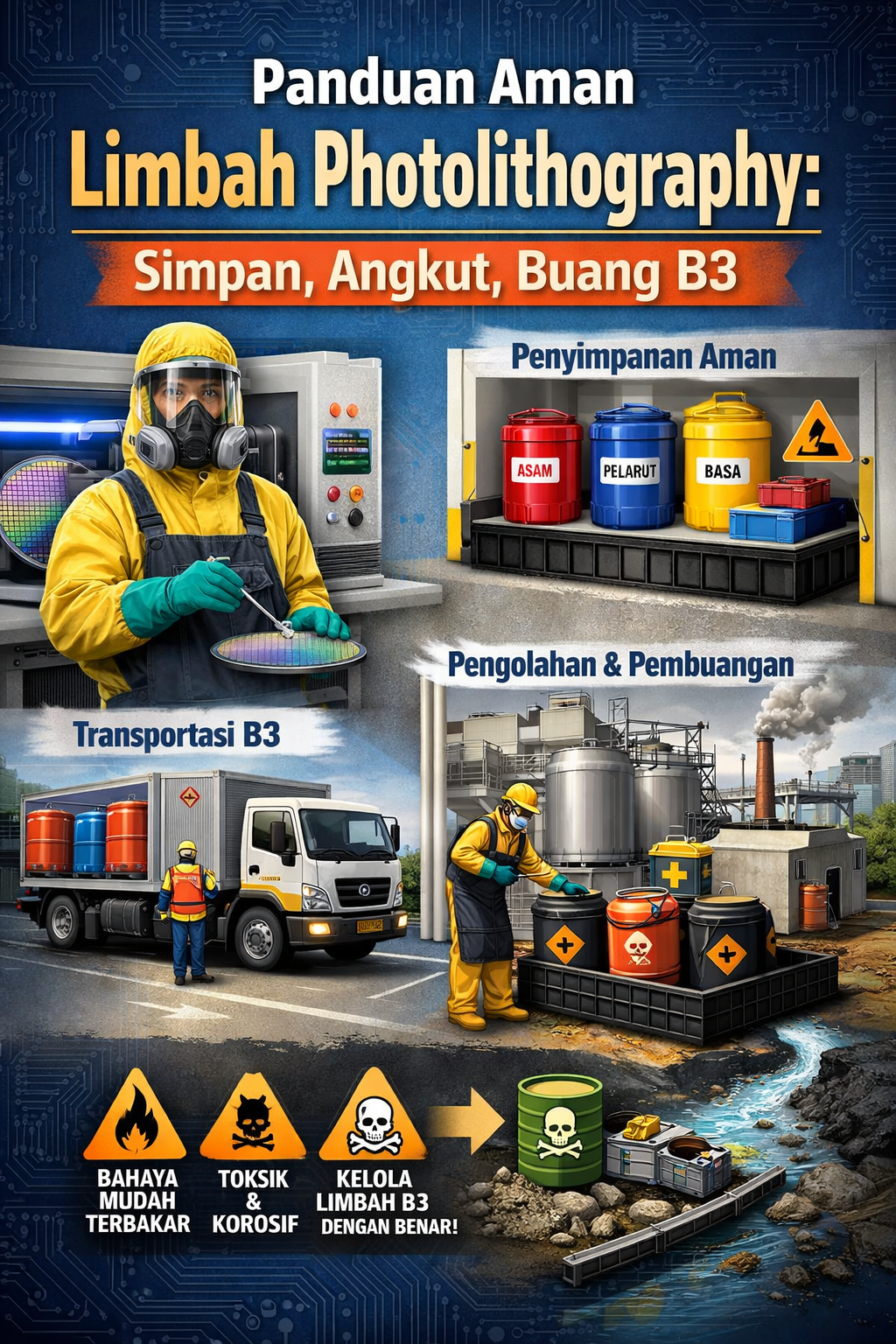
Cleanroom garments are paired with chemical protection. Static‑dissipative coveralls that resist solvent permeation are standard; a chemical‑resistant apron (rubber or PVC composite) is added for acids or solvents. Maintenance or manual handling may require full‑body Tychem suits. In deep‑UV (DUV) mask aligner service, a rubber apron and neoprene or butyl gloves (6–12 mil) over nitrile inner gloves are specified; vinyl gloves may suffice for light tasks, but are avoided for solvents (nitrile or Viton is preferred) (iloencyclopaedia.org).
Eye and face protection scales with splash risk. Polycarbonate safety glasses with side shields are the minimum used in aligner exposure steps (iloencyclopaedia.org), while chemical baths or transfers trigger splash‑proof goggles and/or a full face shield. Fluoride etch lines (HF) include self‑contained respirators and face shields; NIH SOPs for HF require goggles, a face shield, and neoprene gloves.
Respiratory protection is deployed when ventilation can’t assure OEL compliance. Negative‑pressure respirators with organic‑vapor cartridges (or acid‑gas cartridges during acid handling) are used (iloencyclopaedia.org; iloencyclopaedia.org). For manual stripping with hot sulfuric‑chromic acid, powered air‑purifying respirators (PAPRs) are best practice under semiconductor EHS standards. Routine spinner and developer exposures are often under 5% of limits (iloencyclopaedia.org), but spill or maintenance steps can spike exposures, so fit‑tested respirators remain available.
Other PPE includes acid‑resistant boots or rubber overboots when moving acid containers, non‑sparking tools and grounding straps for flammables, and calcium gluconate gel (“technique gel”) at HF stations. Higher‑hazard work may add a splash hood or SCBA (self‑contained breathing apparatus) for emergency cleanup. PPE programs with annual retraining and usage audits halve chemical injury rates compared to industry averages; one Taiwan fab saw an 80% drop in acute solvent‑related illness claims after a respirator mandate in 2022. Avoiding a single serious burn or inhalation injury can also prevent $10,000–$100,000 in medical and lost‑time costs.
Disposal pathways and Indonesian B3 rules
Spent photolithography chemicals — photoresists, developers, etchants, and rinse water — fall under Indonesia’s B3 hazardous‑waste regime. Government Regulation No. 27/2020 and MoEF Reg. 6/2021 govern B3 waste management; facilities generating B3 waste (typically ≥ 2.5 kg/day) register with the Ministry of Environment and Forestry (KLHK) and follow B3 rules (enviliance.com; www.arma-law.com). Wastes containing listed hazardous substances (for example, chromates, cyanides, organic solvents) often exceed threshold concentrations (Annex I of MoEF 6/2021) and cannot be managed as ordinary waste. Used sulfuric‑chromic acid stripper is categorically B3 (it is known to generate RCRA F006 waste in the U.S.) and cannot be dumped untreated (iloencyclopaedia.org; arahenvironmental.com).
Treatment options include on‑site neutralization, recycling, or solvent distillation (common in U.S. fabs) (www.mdpi.com; www.mdpi.com). Developers such as TMAH can be destroyed by oxidation. Many generators hand off to licensed processors: Indonesian practice routes liquid wastes to permitted incineration (arahenvironmental.com). One KLHK‑certified plant, for example, incinerates 50% H₂SO₄ with organics, yielding a solid ash; that residue (with metal oxides/chromates) goes to a lined B3 landfill (arahenvironmental.com).
Wastewater trains designed for neutralization and reuse often include primary clarification and adsorption to capture precipitated metals and organics before polishing. In those designs, solids separation steps leverage equipment such as a clarifier, solvent loads are attenuated by media like activated carbon, and reclaimed water can be routed to RO or EDI for loops. Engineers may specify controlled chemical dosing via a dosing pump for tight pH and oxidant control and protect membranes with cartridge housings, for example a cleanroom‑compatible stainless steel cartridge housing.
Transport and manifest requirements extend through disposal. Every movement is recorded in the KLHK e‑manifest system; before MoEF Reg. 4/2020, paper forms were used; now each drum or tanker is linked to an e‑manifest number. Generators complete Part A (waste description, quantity, origin), haulers confirm receipt and complete Part B en route, and the consignee (incinerator) completes Part C on disposal; failure to reconcile can trigger legal liability for the generator (enviliance.com).
Disposal sites are authorized facilities — incinerators, recycling plants, or B3 landfills — meeting MoEF Reg 6/2021 (and updated 9/2024) technical standards. Incinerators must meet emission limits (SO₂, NOx, HCl, dioxins), and B3 landfills have at least double liners, leachate collection, and 24/7 groundwater monitoring; domestic dumps are forbidden. Documentation of volumes and disposal certificates is retained for 10 years. Indonesian law (UU 32/2009) imposes criminal penalties for illegal B3 disposal: fines up to Rp 3 billion and prison terms (up to 3 years or more for directors) for dumping or overstaying storage limits. The regulatory overhaul (Gov. Reg. 27/2020; MoEF 6/2021; MoEF 9/2024) emphasizes reduction and recycling first (www.arma-law.com; www.arma-law.com).
Measured outcomes show the economics. A Batam fab reported that installing on‑site acid neutralization cut paid waste disposal volumes by 60% (saving about $1 million per year) and eliminated lab outbreaks. Another Indonesian fab reached zero‑landfill status by using a B3 contractor with integrated incineration and acid recycling, reducing offsite disposal costs by 30%. Conversely, a major electronics firm was fined INR 4.5 billion (approximately $300,000) in 2021 for illegal solvent dumping — evidence that compliant management is far less costly.
Water reuse and polish trains
High‑purity rinse loops push toward internal recycle. In practice, reuse trains build on upstream clarification and adsorption to protect downstream membranes. Facilities pairing pretreatment with reverse osmosis sometimes reference industrial units suitable for variable feed streams, such as brackish water RO, and polish deionization stacks, including continuous systems like EDI. Cartridge prefiltration remains standard at points of use; in corrosive or sanitary services, 316L housings, such as a stainless cartridge housing, are specified. Where solvent‑borne organics are present, engineers may add carbon beds with media such as activated carbon ahead of membranes.
Pretreatment for RO membranes in reuse projects often adds solids barriers; options include media beds or compact membranes such as ultrafiltration. Downstream membrane life is typically supported by chemical programs and clean‑in‑place plans that reference consumables like membrane antiscalants or periodic membrane cleaners when foulants load.
Regulatory framework: Indonesia and abroad
KLHK (Indonesia’s Ministry of Environment and Forestry) regulates photolithography chemicals primarily through B3 waste management rules: Gov. Reg No. 27/2020 on Specific Waste; MoEF Reg. 6/2021 on Procedures for B3 Waste; and MoEF Reg. 9/2024 on waste containing hazardous materials (www.arma-law.com; enviliance.com). These align with national law (UU 32/2009) and PP 22/2021, codifying producer responsibility (Pasal 59) and formalizing sorting, manifesting, and treatment (www.arma-law.com; enviliance.com).
Storage and transport specifics are in MoEF Reg. 6/2021 (Chapter IV) — covered, bunded TPS B3 areas; maximum on‑site retention of 90–365 days depending on generation rate (enviliance.com) — and Ministry Reg. 4/2020, which requires e‑manifests for every B3 shipment (enviliance.com). Prior labeling rules (MoEF 101/2014) and certain local bans (for example, Bali plastic bans) indirectly apply.
PPE and workplace exposure controls fall under the Ministry of Manpower, which mandates chemical‑specific PPE (gloves, goggles, respirators) when hazards exist. The Ministry of Health references WHO/ILO chemical safety, and Indonesia adopted GHS labeling under Permen LH 20/2013. Multinational fabs typically follow OSHA/MSDS‑style systems in practice.
Internationally, cross‑border shipments of photolithography waste, if any, engage the Basel Convention (an international treaty governing hazardous‑waste movements). Photochemicals can be regulated under EU REACH and OSHA Hazard Communication frameworks, though these mainly address suppliers rather than on‑site disposal. Many fabs voluntarily track EU Best Available Techniques. A proposed EU limit for aromatic solvents below 100 ppm is shaping future fab chemistry decisions.
Performance metrics and trends
Incident reduction is measurable. A Taiwanese fab reported a 70% reduction in solvent‑related incidents after upgrading hoods and mandating full PPE, according to its EHS audit. In Indonesia, one manufacturer cited a 50% drop in spill‑related workdays lost after adding secondary containment and monthly training.
Waste metrics move with process changes. Recycling and on‑site neutralization can cut volumes by 30% or more. Industry benchmarks show leading fabs treat 99% of spent acids on‑site and recycle 70–90% of solvents (www.mdpi.com; www.mdpi.com). Advanced fabs in Indonesia reclaim H₂SO₄ and reuse dilute piranha baths, and track “waste‑to‑product” ratios (kilograms of waste per wafer) alongside water reclamation and ozonated rinse strategies (www.researchgate.net).
Regulatory compliance has become a market attribute. Indonesian law now requires documented waste‑reduction plans and reporting to a national registry (www.arma-law.com). Environmental inspectors are grading EHS performance by waste metrics (recycled versus landfilled). Non‑compliance risks closures and fines that exceed the cost of engineering controls, PPE, and treatment.
Chemistry is trending greener. Ethylene glycol ethers, flagged as reproductive toxicants, were largely replaced by propylene glycol ethers in the 1990s (pmc.ncbi.nlm.nih.gov). CMC rules and REACH‑like frameworks encourage substitution, and photolithography vendors now offer DUV resists with lower toxicity.
Sources: industry life‑cycle analyses, peer‑reviewed safety studies, and regulatory summaries (pmc.ncbi.nlm.nih.gov; pmc.ncbi.nlm.nih.gov; enviliance.com; www.mdpi.com). Legal references include KLHK regulations from 2021–2024 (www.arma-law.com; enviliance.com) and semiconductor‑industry research for context (www.mdpi.com; www.researchgate.net).