

Semiconductor photolithography depends on air so clean it’s effectively empty—and on temperature and humidity held so tight that a 300 mm wafer doesn’t grow by 78 nm when the room drifts 0.1 °C. The result is a multi‑stage HVAC machine that recirculates air dozens to hundreds of times per hour through cascaded filters, at an energy cost that can hit ~1.25 kW/m².
Industry: Semiconductor | Process: Photolithography
In a modern fab, the air is as much a product as the chips. Photolithography bays run to ISO Class 1–3 (equivalent to Class 10–100 federal), a regime where particles larger than 0.1–0.2 µm are essentially banished. The only way to get there is a cleanroom HVAC design built on cascaded filtration—coarse pre‑filters, fine filters, and terminal HEPA/ULPA—plus relentless airflow control, tight shells, and positive pressurization.
That design is not optional. It’s the difference between overlay that holds and masks that wander. And it’s why, by some estimates, cleanroom HVAC alone eats 50–75% of a facility’s already outsized energy draw, with total consumption around ~1.25 kW/m², or about 25× a normal office at ≈0.06 kW/m² (cleanroomtechnology.com). As one design lesson: this “harsh energy load” makes sealing, efficient fans and fan‑filter units (FFUs) non‑negotiable.
Multi‑stage filtration stack and layouts
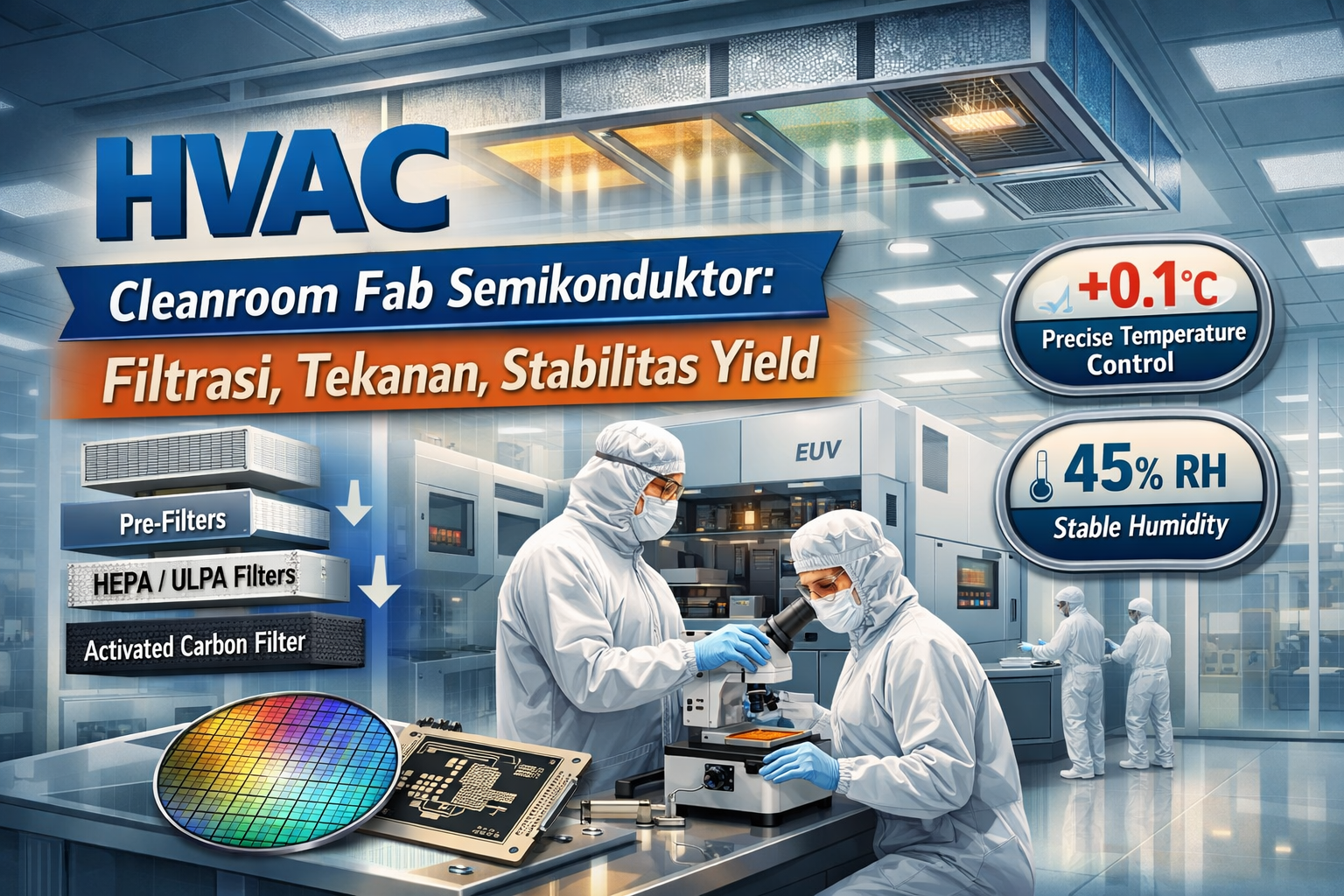
The filtration train starts with coarse pre‑filters (MERV—Minimum Efficiency Reporting Value—8–11) to strip out large dust (>5 µm), then finer stages (MERV‑14+), and ends at the ceiling or supply walls with terminal HEPA/ULPA. HEPA (high‑efficiency particulate air) H13/H14 delivers ≥99.95–99.995% removal at the MPPS (most penetrating particle size, ≈0.3 µm) (handbook.ashrae.org), while ULPA (ultra‑low penetration air) U15+ hits ≈99.999% at ~0.12 µm (cleanroomtechnology.com).
To reach ISO 5 and cleaner, fabs routinely install 70–100% ceiling coverage of HEPA (handbook.ashrae.org), or go to full supply walls with horizontal laminar flow at ~0.45 m/s (handbook.ashrae.org). Quantitatively, HEPA captures 99.97% of 0.3 µm particles (cleanroomtechnology.com), so a Class 1,000 cleanroom (≈ISO 5) with 100 f³ of air would admit at most ~100 particles ≥0.5 µm (gconbio.com). Modern fabs push to ISO 3–4 (class 10 or better), effectively zero particles ≥0.1 µm; that level typically requires ULPA at tool benches or full overhead coverage.
Some fabs add gas‑phase stages in make‑up air—activated carbon or chemical filters—to scrub VOCs and corrosives, though particulate remains the primary concern (eureka.patsnap.com). Activated carbon media are a common sorbent option (activated carbon). The layered strategy yields measurable outcomes: virtually zero submicron particulates in fab air (ISO Class 1 or 2) and extremely low microbial counts (eureka.patsnap.com).
Airflow, pressurization, and air‑change rates
Positive pressurization—typically 0.005–0.05 in. WC above adjacent areas—prevents unfiltered infiltration (cleanroomtechnology.com; handbook.ashrae.org). Air changes per hour (ACH—the number of times the room volume is replaced each hour) are high by design: Indonesian guidance cites ~90–150 ACH for ISO 6 (Class 1,000) and ~30–60 ACH for ISO 7 (gcccleanroom.com). ASHRAE notes that in fabs “a very high air change rate…is not typically needed for cooling” but is “mainly for controlling and diluting particle concentrations” (handbook.ashrae.org).
In practice, the HVAC loop recirculates or replaces all air dozens to hundreds of times per hour through that coarse→fine→HEPA/ULPA cascade, inside an airtight shell with positive pressure—because that is what ISO Class 1–3 cleanliness demands.
Tight temperature and humidity bands
Dimensional stability is ruthless math. Silicon’s linear thermal expansion is about 2.6×10^−6/°C (semiconwafers.com): a 300 mm wafer (0.3 m) grows roughly 0.78 µm per 1 °C. Fused‑silica (quartz) photomasks, at ≈0.5×10^−6/°C (micquartz.com), shift only ~0.1 µm per 1 °C over 200 mm. Even these sub‑micron numbers matter at sub‑10 nm nodes, so fabs typically hold temperature to ±0.1–0.5 °C; EUV scanners run at ±0.1 °C (eureka.patsnap.com), while general µm‑scale lithography might allow ±0.5 °C (≈1 °F) (gconbio.com).
Humidity control is just as strict. Photoresists are hygroscopic; RH (relative humidity) directly affects resist sensitivity, line width, and overlay accuracy. ASHRAE is explicit: “photoresist chemicals used in photolithography” require the tightest RH control; both RH and temperature are critical for dimensional control and resist chemical stability (handbook.ashrae.org). Typical fab dewpoints are 7–12 °C (roughly 50±10% RH at room temperature) (handbook.ashrae.org).
High‑end fabs enforce RH stability of ±1–2%; holding ±2% RH can require make‑up air dewpoint held to ±0.5 °C (handbook.ashrae.org). Indonesian guidance sets a broader baseline—20–24 °C and 45–55% RH with ±2 °C/±5% tolerance—while noting “some special processes may demand more precise control” (gcccleanroom.com). In practice, lithography zones often target 20–22 °C ±0.1 °C and 45% ±1% RH, with some advanced fabs using air locks and double‑door vestibules with purge before exposing wafers.
Dimensional consequences at the nanoscale
At these scales, a 0.1 °C swing produces tens of nanometers of drift. Our 300 mm wafer example moves by ~0.078 µm (78 nm) for just 0.1 °CΔ—large enough to swamp multi‑nanometer alignment specs. Humidity effects vary by material: quartz masks are nearly immune (CRH—coefficient of hygroscopic expansion—≈0) (elveflow.com), but polymer films are not (polyester film masks ~8 µm/m per 1% RH; gelatin layers ~100 µm/m/%RH) (elveflow.com). Hence inorganic masks and tight RH (often ~40–60% RH) are ubiquitous (eureka.patsnap.com). Consistent humidity also reduces ESD (electrostatic discharge) and particle adhesion; poor RH control elevates both, ASHRAE notes (handbook.ashrae.org).
The payback shows up in yield. Fabs that hold tighter ±0.5 °C/±5% conditions—compared with looser ±2 °C/±10%—see measurably lower overlay error and defect rates, by direct observation on the line.
Standards, classes, and the energy trade
Standards lock in the targets. ISO 14644‑1, adopted in Indonesia as SNI ISO 14644‑1 (gcccleanroom.com), classifies cleanrooms by particle counts. ISO 5 (Class 100) allows ≤100 particles ≥0.5 µm/ft³ (gconbio.com). Indonesian practice explicitly follows SNI 14644‑1 to ‑3 (gcccleanroom.com), and common design guides set 20–24 °C and 45–55% RH (gcccleanroom.com).
All of it costs. Cleanrooms can consume ~1.25 kW/m²—about 25× an office—with HVAC using 50–75% of that (cleanroomtechnology.com). Every extra 0.1 °C of precision or 1% RH stability adds load; active dehumidification to ±2% RH carries a large latent cooling penalty. Engineers lean on economizers, heat recovery, tight shells, and smart controls to balance costs. Practical decisions—percent recirculation vs fresh air, filter echange frequency, FFU placement—flow from node needs: sub‑7 nm logic fabs typically target ISO 3–4, ΔT ±0.1 °C, ΔRH < 2% (handbook.ashrae.org; eureka.patsnap.com).
Source notes and reference links
Figures and requirements are supported by ASHRAE Handbook (Chapter 19, “Clean Spaces”) on filtration, pressurization, and environmental control (handbook.ashrae.org; handbook.ashrae.org), industry write‑ups on HEPA/ULPA layouts and efficiencies (cleanroomtechnology.com; handbook.ashrae.org; handbook.ashrae.org), ISO/SNI guidance in Indonesia (gcccleanroom.com; gcccleanroom.com), and technical notes on EUV scanner tolerances and humidity ranges (eureka.patsnap.com; eureka.patsnap.com). Material coefficients and class limits are cited from semiconductor and cleanroom resources (semiconwafers.com; micquartz.com; gconbio.com), and energy benchmarks are from cleanroom industry coverage (cleanroomtechnology.com). Hygroscopic effects and CRH coefficients are taken from microfabrication notes (elveflow.com).