

Breweries lean on concentrated caustics and acids to clean-in-place (CIP) — and they use a lot of water doing it. A best-practice playbook is emerging that couples safer storage, strict PPE, and automated dosing to cut exposure and consumption.
Industry: Brewery | Process: Clean
Breweries routinely push concentrated sodium hydroxide — often ~30–50% NaOH stock — and strong acids through tanks to strip soils and biofilms in their clean-in-place (CIP) cycles, a standardized method of cleaning interior surfaces without disassembly (alliancechemical.com). The chemistry is unforgiving: these agents are highly corrosive and can cause severe burns or toxic exposures if mishandled.
Resource use is equally stark. A typical brewery may consume on the order of 5–12 liters of water per liter of beer produced — most of it during CIP washes (viravix.com; www.craftbrewingbusiness.com). As a result, automation is accelerating: one market study pegs the global CIP chemicals market at USD 15.85 billion in 2024, rising to about $37.9 billion by 2034 (CAGR ~9.1%), with over half of demand coming from food and beverage industries that require strict hygiene (www.towardschemandmaterials.com; www.towardschemandmaterials.com). Modern breweries (e.g., AB InBev) target 3–6 L per L of beer by optimizing CIP (viravix.com), and regulatory pressure on food safety and environmental compliance is rising (www.towardschemandmaterials.com).
Sensor-based CIP systems that cut waste and manual handling are gaining ground (www.brewops.com; www.craftbrewingbusiness.com). Here is the best-practice blueprint that breweries are adopting to store and handle CIP chemicals safely — and to let automation do more of the heavy lifting.
Brewery CIP chemical profile
Core agents are caustics (e.g., sodium hydroxide/NaOH) for organic soils; acids (phosphoric, nitric, sulfuric) for mineral scale; and oxidizing sanitizers (chlorine, peracetic acid, hydrogen peroxide) (alliancechemical.com). A UK study observed standard cycles using ~32% NaOH stock (diluted to 2% for cleaning) and ~5% peracetic acid — concentrations that make even small spills hazardous (www.researchgate.net).
All CIP chemicals are treated as hazardous. In Indonesia, most are classified as B3 (“beracun berbahaya”, or hazardous/toxic) substances under PP No. 74/2001 and related rules. Every container carries a clear GHS (Globally Harmonized System) hazard label (greenchem.co.id; alliancechemical.com). Safety Data Sheets (SDS) are maintained for each chemical, and guidance in Section 8 on handling, storage, and personal protective equipment (PPE) is followed (www.brewersassociation.org; alliancechemical.com).
Dedicated storage design criteria
Storage sits in a dedicated, secure area separated from food/product zones, with good ventilation (e.g., exhaust fan or HVAC vent) and temperature stability that avoids direct sun or heat (greenchem.co.id; greenchem.co.id). Guidance specifies siting far from ignition sources and out of direct sunlight (greenchem.co.id; greenchem.co.id). Locating storage outside the main brewery space reduces cross‑contamination and provides containment via walls and roof.
Segregation and containment are explicit. Acid and alkali solutions never share the same rack or space — accidental mixing can trigger violent reactions (alliancechemical.com). Flammables, if present, sit in cool, separate cabinets; toxics/oxidizers are locked away from incompatibles (alliancechemical.com; greenchem.co.id). Shelving and bins are sturdy; floors are impermeable. All drum/tote storage includes secondary containment — drip trays or bund walls — to catch leaks; Alliance Chemical explicitly recommends drip trays and sealed bunding under large containers (alliancechemical.com).
Labeling follows GHS conventions. Every container and storage cabinet is clearly labeled with identity and hazard symbols (alliancechemical.com; greenchem.co.id). In Indonesia, GHS labeling is mandated for workplace chemicals (greenchem.co.id). Storage rooms are marked “Chemical Storage – Authorized Personnel Only,” with emergency contact information posted; laminated SDS boards remain accessible.
Access is controlled. Only trained staff enter; storage is kept locked when unattended and inventory is charted. Warning labels and no‑eating signs deter unauthorized entry (greenchem.co.id). Emergency equipment — a fire extinguisher suitable for chemical fires, a spill kit, and eyewash signage — is stationed visibly near the storage area.
PPE selection and maintenance
Gloves are chemical‑resistant. Nitrile or neoprene gauntlets (covering wrists and forearms) are recommended over latex or vinyl for caustics and acids, with glove material matched via SDS compatibility charts; disposable gloves are not reused once contaminated, and all gloves are inspected and replaced at the first sign of wear or pinholes (studylib.net; www.brewersassociation.org; www.brewersassociation.org).
Footwear is knee‑high and chemical‑resistant (rubber or PVC) with steel toes and slip‑resistant soles; boot height covers ankles and shins, knee‑boots are lined to prevent chafing, and compliance with ASTM/ANSI chemical‑resistance standards is confirmed (studylib.net; studylib.net).
Protective clothing is impervious. Aprons or coveralls made from PVC, neoprene, or rubberized fabric protect the body; for strong acids/alkalis, full‑body suits may be warranted. Cloth uniforms or cotton coveralls are avoided unless fully coated for chemical resistance; arms and legs are fully covered, and contaminated gear is changed or laundered immediately rather than worn into other areas (alliancechemical.com; studylib.net; studylib.net; www.brewersassociation.org).
Eye and face protection combines sealed, ANSI‑approved safety goggles with a full‑face shield for high‑risk tasks (such as pouring concentrated acid or drum cleaning); shields meet ANSI or ANSI/ISEA chemical splash standards. Bucketful spills or pressure spray cleaning demand both shield and goggles; eyewear is clear (no dark tint) and includes side shields (alliancechemical.com; studylib.net).
Respiratory protection is available where open handling of volatile or fuming chemicals occurs (e.g., bleach, peracetic acid), using cartridges appropriate for acid gas, chlorine, and related hazards; sealed tanks and ventilation typically minimize the need, yet respirators remain on hand for poor ventilation or spills, and full respiratory PPE training is ensured (alliancechemical.com).
Additional controls include chemical splash kits for spill cleanup and labeling PPE by user or chemical to avoid cross‑contamination (studylib.net). SDS Section 8 remains the benchmark (“Consult Section 8 of the SDS for protective equipment suggestions”) (www.brewersassociation.org). PPE is treated as the last line of defense, with engineering and administrative controls prioritized first.
Automated dosing and sensors
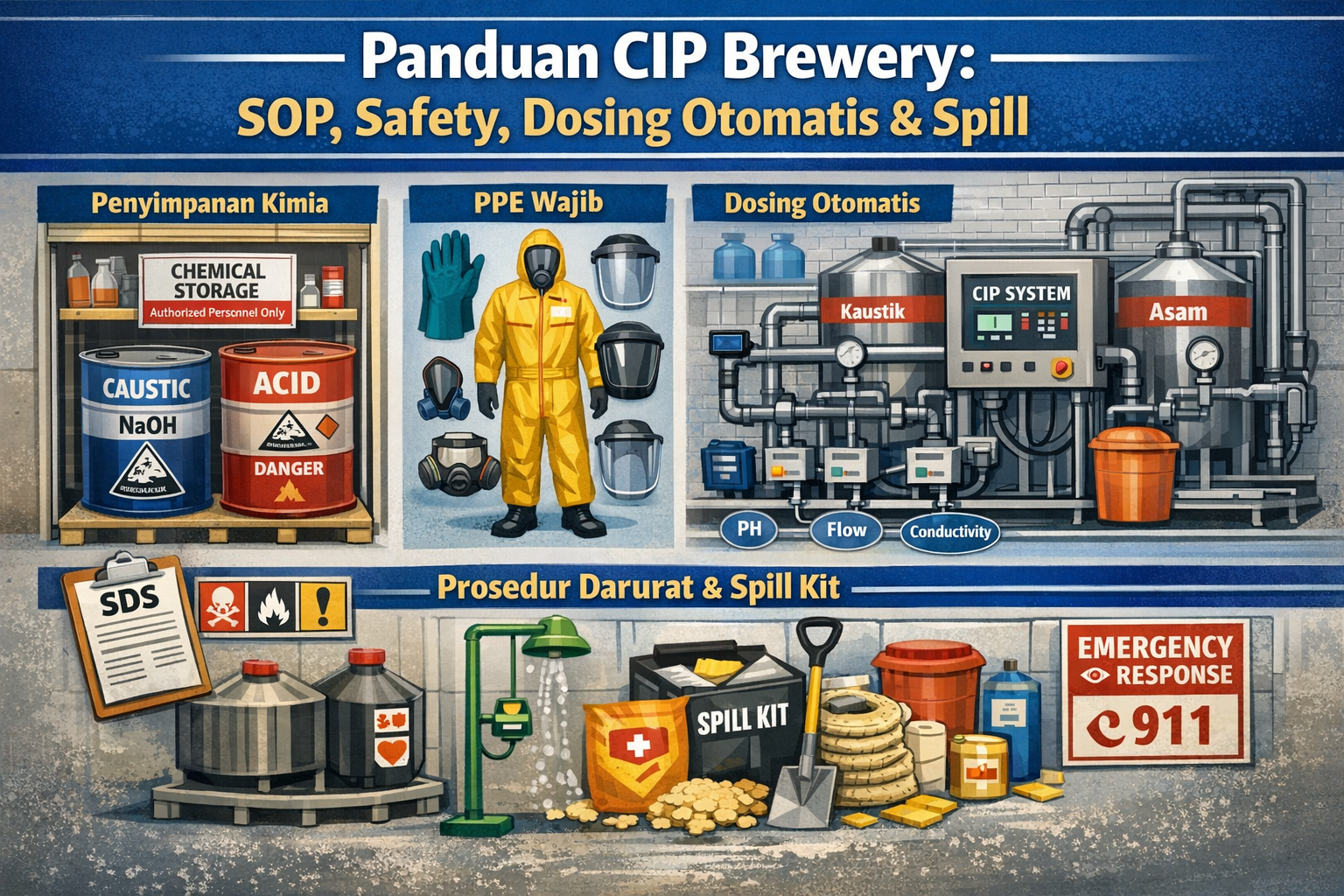
Automated CIP dosing systems reduce manual handling by using metered tanks of concentrated cleaners, metered pumps for accurate chemical dosing, flow meters, and PLC (programmable logic controller) controls; conductivity, pH, and turbidity sensors dynamically adjust chemical feed to hit target concentrations (alliancechemical.com).
One brewery implemented conductivity sensors that stop the caustic wash at exactly the needed strength, reducing chemical waste and ensuring consistent pH; inline sensors have been shown to significantly reduce water and chemical usage by preventing over‑dispensing (www.brewops.com; www.craftbrewingbusiness.com). In practice, breweries report up to tens of percent savings in water and caustic usage after moving from timed/manual CIP to sensor‑based automation.
PLC/SCADA (supervisory control and data acquisition) integration enables scheduling of CIP cycles and remote shutdowns. Pre‑skidded, “plug‑and‑play” CIP modules (e.g., Alfa Laval CIP skids) meter and clean automatically; automation reduces operator exposure by shifting dosing from open pours to closed‑line transfers initiated at a control panel. Studies in other food sectors note that automated CIP greatly cuts dosing errors and contact risk (www.craftbrewingbusiness.com; www.brewops.com). The net result: lower chemical bills, less downtime, and fewer manual splash incidents.
Emergency response and spills
Emergency showers and eyewashes are placed within 10 seconds (≈30 ft) of hazards per ANSI/OSHA; at least one emergency eyewash fountain with continual tepid water flow and a safety shower are located near the CIP area, marked with signs and tested weekly. In case of contact, affected areas are washed for at least 15 minutes, and contaminated clothing is removed while rinsing (alliancechemical.com).
Spill kits are staged adjacent to chemical storage and CIP stations. Contents include neutralizing agents (sodium bicarbonate for acid spills; mild acid such as vinegar or citric salt for caustic spills), absorbent booms and pillows, and PPE; Alliance Chemical recommends kits with acid/caustic neutralizers explicitly. On a spill, PPE is donned, leaks are contained (e.g., closing valves, uprighting leaking jugs), neutralizer is applied, and residues are removed without washing large volumes into drains; cleanup residues are disposed as hazardous waste per regulations (alliancechemical.com).
Ventilation is prioritized during incidents. Strong fumes (e.g., acid or chlorine gas) trigger immediate evacuation and ventilation; mechanical ventilation (hoods, fans) runs automatically during CIP recirculation and vents are kept unobstructed. If a chlorine‑containing sanitizer (like bleach) is accidentally mixed with acid, even in small amounts, evacuation and emergency services are initiated due to life‑threatening chlorine gas risk.
First‑aid instructions covering skin/eye contact and inhalation per the SDS are posted near storage and CIP areas. Training covers eye flushing for 15–20 minutes, cooling acid burns with water (without applying neutralizers on skin), removing contaminated clothing, and seeking medical help for significant exposures. Eyewash stations provide flow‑through rinsing to continuously flush chemicals; a handheld chemical‑resistant shovel and a containment berm are kept for major spills (alliancechemical.com).
Drills and documentation are routine. Facilities conduct regular emergency drills (spill cleanup, shower use) and log incidents with corrective actions. In Indonesia, major chemical incidents are reported to labor/environment authorities under PP No. 74/2001 and implementing regulations. Prompt flushing and ready neutralizers limit injuries that often stem from corrosive burns and eye damage; conversely, lack of eyewash access is frequently cited in industrial injury reports. SDS and safety posters in the CIP area remain current, with “Emergency Notice” signage listing first‑aid steps and emergency contacts.
Efficiency metrics and market context
Optimized SOPs matter. Studies show that using, for example, 2% caustic for 35 minutes at 20–60°C achieves cleanliness with minimal waste; one analysis estimated >£1,000 per year savings in chemicals and energy for a microbrewery after SOP improvements (www.researchgate.net).
Water savings add up. Controlling the final rinse by conductivity avoids wasteful overflow; final rinses often account for over 50% of CIP water use (www.craftbrewingbusiness.com). Even a few liters saved per cycle translate to thousands of liters per year for a medium‑sized brewery.
The market signal is clear. CIP chemicals are forecast to grow at ≈9% CAGR between 2025 and 2034 (www.towardschemandmaterials.com). Investment in safety and automation pays back in yield, quality, and reduced liability.
Summary and sources
A ventilated, segregated, and contained storage area; SDS‑driven PPE protocols; and automated dosing with inline sensors and accurate chemical dosing form a defensible stack that minimizes worker exposure, chemical waste, and downtime. Each measure is grounded in industry guidance and data (alliancechemical.com; alliancechemical.com; www.brewops.com; www.towardschemandmaterials.com). The citations above also provide demographics, regulatory context, and case‑study metrics to ground each recommendation.