

Industry: Brewery | Process: Bottling_&_Kegging
Beer bottling and canning lines shed more than rinse water. Spilled beer rich in sugars and organics, cleaning and clean‑in‑place (CIP) rinses, and debris combine into a high‑variability stream with total chemical oxygen demand (COD, a measure of oxidizable organics) often in the 2,000–10,000 mg/L range and biochemical oxygen demand over 5 days (BOD₅) at 1,200–3,600 mg/L in raw brewery effluent (mdpi.com).
CIP cycles drive extreme pH swings, with acid steps near pH≈3 and alkaline steps up to pH≈12 (mdpi.com; mdpi.com). One industry survey logged bottle‑washer effluent at pH 10.0–11.4 with BOD in the hundreds (380–660 mg/L) and total suspended solids (TSS) at 160–240 mg/L (nepis.epa.gov).
Discharging that variability downstream risks overloads and breaches. Indonesia’s brewery effluent standards, for instance, set BOD ≤75 mg/L, COD ≤170 mg/L, TSS ≤70 mg/L, and pH 6–9 (fr.scribd.com), so pretreatment must significantly lower loads before the main wastewater treatment plant (WWTP).
Packaging wastewater loads and variability
The packaging hall contributes spilled product and wash waters with organics and solids; COD commonly spans 2,000–10,000 mg/L and BOD₅ 1,200–3,600 mg/L in raw brewery effluent (mdpi.com). CIP swings from pH≈3 to pH≈12 complicate treatment (mdpi.com), while bottle‑washer effluent has been reported at pH 10.0–11.4 with BOD 380–660 mg/L and TSS 160–240 mg/L (nepis.epa.gov).
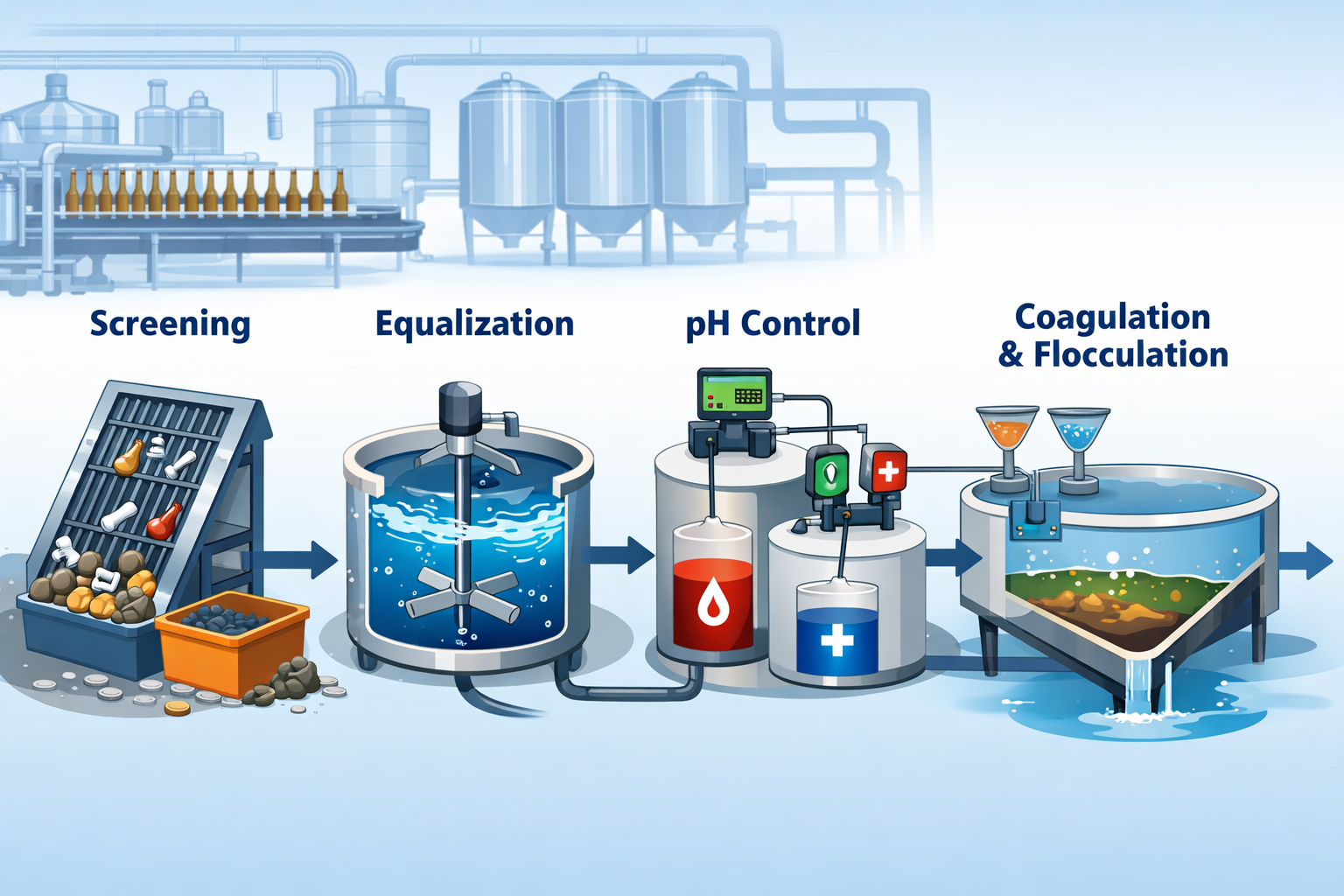
Screening and debris interception
A coarse bar screen with 10–20 mm spacing removes broken glass, bottle caps, labels, and large solids to protect pumps and operators. Beverage facilities routinely pass bottle rinse flows through a sieve or coarse strainer before treatment (nepis.epa.gov). Screens and coarse solids handling fall under primary physical separation, and a coarse strainer can complement the bar screen. A small grit chamber or settling pit can capture heavy inorganics and sand—minor in packaging streams but useful for preventing downstream sedimentation.
Flow and load equalization
A mixed equalization (EQ) tank buffers batchy flows and load spikes from filling, wash‑downs, and CIP, delivering steadier influent to downstream processes (mdpi.com). Flow monitoring in industrial contexts shows peaks around 1.7× the average (nepis.epa.gov), so sizing for 4–6 hours of average‑flow retention is a common rule of thumb pending site data. Mechanical mixing or light aeration prevents settling and stratification, and equalized flow has been observed to stabilize hydraulics and pollutant loading (nepis.epa.gov).
pH control strategy and dosing
Downstream biology and chemicals work best in the neutral range, so the post‑EQ target is pH 6.5–8.0. High‑pH waste is neutralized with dilute acid (e.g., sulfuric), while low‑pH waste uses alkali (NaOH) or carbon dioxide; CO₂ forms carbonic acid and is used in some breweries (mdpi.com). Inline pH probes and controls align with the requirement that wastewater be 6–9 before discharge (mdpi.com; mdpi.com). Accurate chemical feed is typically handled by a dosing pump, and pH measurement/control hardware falls under wastewater ancillaries.
Chemical coagulation and flocculation
After pH adjustment, coagulation/flocculation aggregates colloids and suspended solids for removal. Typical coagulants include ferric chloride, aluminum sulfate (alum), and polymer‑enhanced ferric/aluminum such as polyaluminum chloride (PAC). Reported optimal doses for brewery streams are 300–1000 mg/L of active coagulant plus roughly 20–100 mg/L polymer (mdpi.com), with one test finding 675 mg/L PAC plus 40 mg/L anionic polymer optimal (mdpi.com). PAC and polymer programs are available as PAC and flocculants.
Rapid mixing for coagulant addition, followed by slow flocculation, precedes clarification. A conventional gravity clarifier or settling tank captures flocculated solids.
Removal performance and nutrient effects
Suspended solids removal is high: one industrial PAC/polymer test achieved 86.8% TSS removal (mdpi.com), and coagulation commonly removes on the order of 80–95% of turbidity/suspended solids (mdpi.com; mdpi.com).
Organic load reduction is partial because soluble organics remain after solids removal. Studies report 25–60% COD removal; one PAC program yielded about 26.5% COD removal with BOD₅ around 34% (mdpi.com), while a polyamine–PAC combination reached 59–60% COD removal (mdpi.com). Phosphorus typically complexes with metal coagulants, with >90% removal reported (mdpi.com), and total nitrogen removal around 50% was observed in one test (mdpi.com). Coagulant acidity/alkalinity can shift pH, but prior neutralization stabilizes effluent around pH 6–7.
Clarification and sludge management
Coagulation produces a chemical sludge requiring handling. An industrial test reported flocculated sludge at about 4.5–5% solids and a yield near ≈1.0 kg dry solids per kg COD removed (mdpi.com). Removing 50 kg COD/day would generate roughly 50 kg dry sludge, or about 1 ton wet sludge at ~5% DS. Provision for thickening and dewatering is part of wastewater ancillaries.
Quantified outcomes and example
From a starting point of COD ~2,000 mg/L and TSS ~200 mg/L, coarse screening and quiescent removal may skim 10–20% of TSS. With tuned coagulation (e.g., PAC or ferric plus polymer), studies indicate >80% TSS removal—cutting 200 mg/L to about ~40 mg/L (mdpi.com; mdpi.com). COD typically drops by ~30–50%, to ~1,000–1,400 mg/L depending on chemistry (mdpi.com; mdpi.com), with BOD₅ falling by a similar fraction into the few‑hundreds mg/L. Phosphorus sinks to near zero, and pH holds in the neutral range.
On a load basis, every 100 kg/day of BOD or COD entering pretreatment sees 30–60 kg/day removed before the main WWTP. Meeting limits like BOD ≤75 mg/L, COD ≤170 mg/L, TSS ≤70 mg/L, and pH 6–9 (fr.scribd.com) requires downstream biological polishing; this pretreatment reduces the shock to the biological step (mdpi.com). Biological systems at the main plant can be selected from biological digestion platforms as appropriate to site design.
Design summary and equipment anchors
The dedicated pretreatment train is straightforward: screening to remove broken glass and large solids, an EQ tank to buffer flows and loads, pH adjustment to 6.5–8.0, then coagulation/flocculation followed by clarification. In practice that maps to coarse screening via physical separation with optional strainers; pH control with a dosing pump and probes under ancillaries; chemistry using PAC and flocculants; and solids capture in a clarifier. Empirical data show this combination typically cuts suspended solids by ~80–90% and reduces organic load by 30–60%, with >90% phosphorus removal (mdpi.com; mdpi.com).
Source references
Joyce et al. (1977), “State of the Art: Wastewater Management in the Beverage Industry,” EPA‑600/2‑77‑048, US EPA (nepis.epa.gov; nepis.epa.gov).
Miino et al. (2025), Applied Sciences 15(6):2999, “Treatment of a Real Brewery Wastewater with Coagulation and Flocculation” (mdpi.com; mdpi.com).
Shabangu et al. (2022), Water 14(16):2495, “Chemical Coagulation in South African Brewery Wastewater” (mdpi.com; mdpi.com).
Government of Indonesia (1995), Keputusan MENLH 51/1995: Baku Mutu Limbah Bagi Industri Bir (Brewery Effluent Standards) (fr.scribd.com).
Aremanda et al. (2020), Equilibrium J. Chem. Eng. 6(2): Brewery Effluent Treatment with Coagulants (water use stats) (jurnal.uns.ac.id; jurnal.uns.ac.id).