

Industry: Brewery | Process: Clean
In brewing, biofilm removal is a process problem with product consequences. The playbook now centers on a rinse–caustic–rinse–acid–rinse–sanitize sequence with tightly defined parameters: a cold pre‑rinse (5–10 min), an alkaline wash (1–4% sodium hydroxide/NaOH, 20–60 min), an intermediate rinse, an acidic wash (phosphoric/nitric at ~0.5–2%, 10–30 min), another rinse, a disinfection step (chemical or hot‑water) for 10–60 min, and a final rinse (studylib.net) (studylib.net).
Each stage has a job: the caustic (alkaline) stage saponifies fats and solubilizes proteins/carbohydrates, the acid step dissolves mineral scale (calcium oxalate “beerstone”) and helps passivate stainless steel, and the sanitizer kills residual microbes (alliancechemical.com) (micetcraft.com). In practice, microbreweries often run ~2% (v/v) NaOH (from ~32% stock) for ~35 min, followed by ~1% peracetic acid/PAA (from ~5% stock) for ≥10 min; one study found no significant cleanliness gain raising NaOH from ambient (10–20 °C) to 40–60 °C over a 35‑min cycle—suggesting energy can be saved by ambient or modest heating (academicjournals.org). Typical recommended settings remain 1–2% NaOH at ~60–80 °C for 20–45 min, and phosphoric/nitric acid at 0.5–2% for 10–30 min (alliancechemical.com) (alliancechemical.com).
Multi‑stage CIP parameters and flow
Using this multi‑stage approach achieves broad cleanliness: sodium hydroxide at 1.5–4% has been shown to remove most adherent soils in fermenter loops—especially at elevated temperatures—while acid cleaners (0.5–2% phosphoric/nitric) strip beerstone and reduce pH residues (studylib.net) (studylib.net) (alliancechemical.com).
A final sanitizing wash—often hot water or an oxidant—targets remaining Lactobacillus, Pediococcus, wild yeast, or spores. Many breweries rely on PAA or hydrogen peroxide blends because these are effective at low temperature and leave minimal toxic residues (micetcraft.com) (christeyns.com). PAA is described as a “powerful disinfectant even at low temperatures” with broad‑spectrum activity (spores, bacteria, yeast) and rapid breakdown to non‑corrosive byproducts (micetcraft.com). Where sanitizer supply is standardized, breweries often route these through programmatic dosing—an application for a precise dosing pump—or via general purpose biocides when labeling matches food applications.
Hydraulics matter. Industrial guidelines stress turbulent flow (>1.5 m/s) and robust spray coverage, since high shear thins the “sublaminar layer” and helps strip soils (christeyns.com). Optimized for concentration, temperature, contact time, and flow, a well‑designed multi‑stage cycle is reported to reduce surface soil and slurry by >95% (mdpi.com) (studylib.net).
Oxidizing additives in CIP chemistry
Modern protocols often add oxidizers to boost cleaning and sanitizing. While chlorine bleach was common historically, brewers now favor peroxygen/peracid chemistries—PAA or hydrogen peroxide blends—for safety and environmental reasons (micetcraft.com) (christeyns.com). Some detergents blend peroxide into the alkaline wash; others use PAA in the final sanitizing step (∼0.5–1% in CIP). Adding sodium hypochlorite or hydrogen peroxide to a caustic wash introduces reactive oxygen species that oxidize lipids and proteins in the biofilm matrix, easing removal; a PAA‑based sanitizer then rapidly inactivates residual spores and cells (micetcraft.com). Empirically, oxidizing add‑ons can improve biofilm reduction—Birko Corp reports that strong oxidizers (peracetic or chlorine dioxide) “have also shown effectiveness against biofilms” in brewery lines (birkocorp.com).
Enzymatic EPS disruption strategies
Enzyme‑based CIP formulations target the extracellular polymeric substances (EPS) that glue biofilms together. Polysaccharidases like α‑ and β‑amylases (which hydrolyze starch‑like polysaccharides) account for roughly 25% of the global enzymatic CIP market (ift.onlinelibrary.wiley.com), often combined with proteases and DNases in commercial cocktails to cleave sugars, proteins, and extracellular DNA (pmc.ncbi.nlm.nih.gov).
By degrading the EPS matrix, enzymes weaken mature biofilms and expose deeper cells to sanitizers (pmc.ncbi.nlm.nih.gov). In practice, an enzyme rinse (≈30–60 min) is run prior to or in place of the alkaline wash, then followed by a normal sanitizer; enzymes do not directly kill microbes but make the biofilm more permeable to disinfectants (ift.onlinelibrary.wiley.com) (pmc.ncbi.nlm.nih.gov). Adoption is emerging but offers lower temperature operation, reduced chemicals, and easier effluent treatment once tailored to a brewery’s specific biofilms.
Monitoring hygiene and hotspots
Verification closes the loop. After CIP, brewers use ATP (adenosine triphosphate) swabs for a rapid hygiene readout; a cleaned fermenter should yield below ~30 relative light units (RLU) (academicjournals.org). Typical hotspots include the Krausen line, thermowell corners, welded joints, and valves, with welds and scratches consistently giving higher RLU than smooth tank walls (academicjournals.org). Failing spots get manual attention or an extra pass. In automated setups, conductivity sensors in CIP lines ensure dose consistency and that rinses end at a neutral conductivity (craftbrewingbusiness.com), coordinated by an inline dosing pump.
Chemical delivery and coverage diagnostics
Under‑dosing is a common root cause, so brewers verify caustic concentration and temperature (inline sensors or titration), and check spray balls or jet heads for clogs that create “shadow zones.” Long transfer lines or filter membranes may need an extra high‑pressure cycle. Riboflavin (vitamin B₂) fluorescent dye is sometimes used to reveal shadow areas not wetted by CIP flow (christeyns.com).
Materials, schedules, and high‑risk assets
Routine maintenance closes gaps: worn gaskets and seals are replaced; stainless steel is kept passivated; water hardness is monitored because excessive Ca/Mg fuels beerstone. If biofilm is recurrent, scheduling is escalated for high‑risk equipment—wort coolers, plate heat exchangers, and yeast handling tanks—using more frequent or aggressive CIP (studylib.net). For instance, wort coolers or centrifuge lines might use 4% NaOH and 85–90 °C washes daily (studylib.net).
Effluent neutralization and compliance
CIP wastewater—often high‑pH or acidic—is neutralized before discharge, with spent acid balanced against spent caustic to meet permits (including references to Indonesian waste rules under BPOM) (alliancechemical.com). Supporting neutralization and handling often resides within general water‑treatment ancillaries in the utility area.
Pinpointing biofilm reservoirs
Persistent contamination tends to originate in bottlenecks—vessels that do not fully drain, cooling jackets, overflow troughs, or old yeast vats. Microbial plating (e.g., on MRS agar for Lactobacilli) identifies spoilage organisms; repeated recovery of Lactobacillus brevis or Pediococcus triggers targeted cleaning or enzymatic treatments. Localized brush cleaning during an operation stop—akin to “enhanced cleaning” on floors and high‑contact surfaces—can remove entrenched mats (birkocorp.com) (birkocorp.com).
Water use, automation, and ROI data
CIP is resource‑intensive. An efficient brewery averages ~7 gallons of water per gallon of beer, much of it for CIP and cooling (craftbrewingbusiness.com). Automating CIP with conductivity sensors trimmed rinse time by stopping water when chemistry “blips” cleared, saving thousands of liters per week (craftbrewingbusiness.com). One microbrewery, by optimizing CIP (lower temperatures, right concentrations), saved over £1,000 annually in chemicals and energy (academicjournals.org). A case study reports switching to automated CIP reduced cleaning downtime by ~30% (alliancechemical.com).
Sensors, recycling, and “green” sanitizers
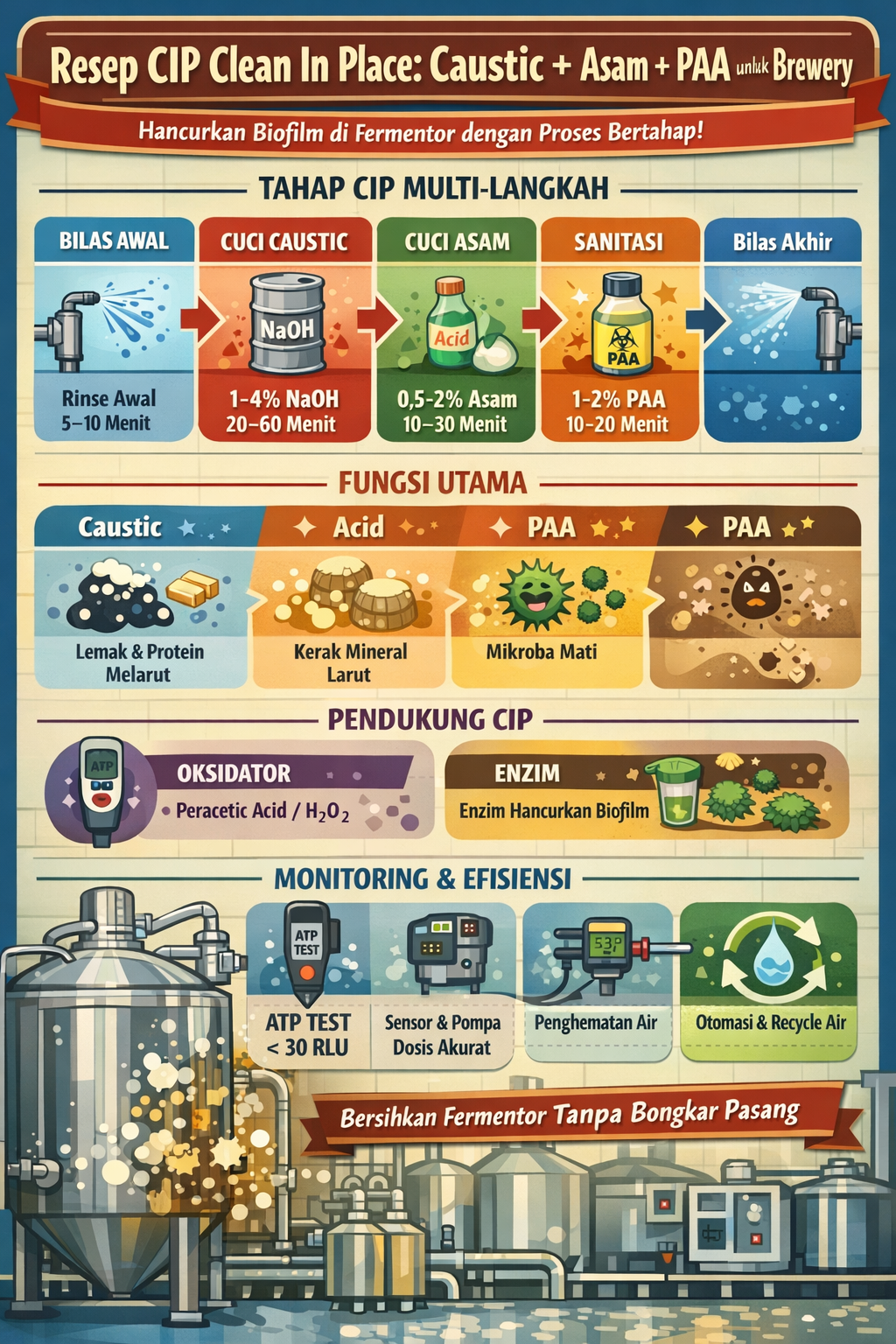
Emerging trends include sensors and data‑logging: automated dosing pumps with pH/conductivity feedback deliver consistent, recorded treatments, and tools from BrewOps and others signal when rinse water is truly clean (craftbrewingbusiness.com). On sustainability, breweries are piloting CIP water recycling via membrane filtration of CIP effluent (studylib.net)—an area where compact ultrafiltration trains are commonly considered as part of membrane approaches. “Green” sanitizers like ozone or electrolyzed water are also being explored; both kill biofilms without chemicals (cwtozone.com). Enzyme‑based detergents are gaining interest, with potential to reduce chemical/energy use and shorten cleaning time, although adoption in breweries remains nascent (ift.onlinelibrary.wiley.com) (ift.onlinelibrary.wiley.com).
Regulatory alignment and records
Disinfectants used must be food‑grade and authorized (e.g., PAA is approved for CIP in food facilities). Indonesian breweries would follow BPOM and MOI guidelines requiring no harmful residues; all CIP water is neutralized (pH ~6–8) before beer contact, and effluents meet wastewater standards. CIP documentation and batch records support audits; with on‑line sensors documenting conductivity and temperature, brewers can prove each tank met cleaning specs before filling.
Conclusion
Combining a strong caustic wash, an acid rinse, and a final sanitizer is foundational for brewery hygiene. Specialty additives—PAA oxidizers and EPS‑targeting enzymes—break up stubborn biofilms that survive conventional cycles. Monitoring via ATP swabs and sensors verifies results, while automation saves thousands in utilities and reduces downtime (academicjournals.org) (craftbrewingbusiness.com). The outcome is reduced biofilm risk, protected flavor consistency, and more efficient, sustainable CIP.
Sources
Authoritative research and industry reports were used, including peer‑reviewed studies on CIP efficacy (academicjournals.org) (mdpi.com), comprehensive reviews on biofilm/CIP (ift.onlinelibrary.wiley.com) (pmc.ncbi.nlm.nih.gov), and industry analyses on CIP techniques (studylib.net) (craftbrewingbusiness.com). Inline citations indicate the source of each key point.