

Industry: Brewery | Process: Lautering_&_Wort_Boiling
During wort boiling, proteins unfold and aggregate with nitrogenous and polyphenolic components to form the “hot break” trub—large particles built as tannins hydrogen‑bridge denatured proteins and nucleate flocs (beer-brewing.com) (braukaiser.com).
The result hinges on what’s in the kettle and how it’s boiled: concentration and type of malt proteins (notably proline‑rich albumins) and hop/malt polyphenols, plus boil vigor, drive coalescence, while a weak boil yields a cloudy, fine break (braukaiser.com) (beer-brewing.com).
Malt modification matters too: highly modified malt and ample boil time increase precipitation; under‑modified malts yield less soluble protein and a “fine” break. High‑insoluble adjuncts (e.g., wheat) or raw grains can raise haze precursors (beer-brewing.com).
Water chemistry is critical: high bicarbonate/alkalinity buffers wort at higher pH and inhibits protein precipitation—hard, carbonate‑rich water often produces a weak break (beer-brewing.com). Typical hot‑break trub is on the order of 200–400 g/hl (wet basis) and ≈80–85% water; a practical in‑house check is a clear background in a test sample, e.g., <100 mL trub in 1 L after 5 minutes settling (beer-brewing.com). Un‑precipitated proteins/polyphenols can cause fermentation issues and haze in finished beer (beer-brewing.com).
Wort pH window and isoelectric effects
Protein solubility is lowest near the isoelectric point—~pH 4.9 for wort proteins—so precipitation improves as pH approaches that value (braukaiser.com). In a typical boil, pH falls by ~0.1–0.2 units (e.g., ~5.3–5.5 to ~5.2–5.3) due to hop acids, Maillard acids, and Ca–protein interactions (braukaiser.com).
Brewers target a mash pH ≈5.2–5.5 (room temp) to achieve a boil pH ≈5.2–5.4. Lowering boil pH into the mid‑5s enhances break formation; pushing below ~pH 5 offers diminishing returns and can negatively affect hop utilization (braukaiser.com).
Practically, a wort pH ≈5.0–5.3 (measured at 20–25°C) is “required for effective clarification,” while performance markedly falls off below ~pH 4.5 (goodbeer.solutions). Vendor data add that premium kettle finings perform optimally at ~pH 5.3 and are essentially inactive below pH 4.4 (murphyandson.co.uk). Pilot testing confirms the pattern: wort <pH 4.8 may not benefit from kettle finings, while wort >5.5 may suffer incomplete break (goodbeer.solutions).
Calcium ions as pH lever and floc builder
Calcium (Ca²⁺) is the most important brewing ion for hot‑break efficiency. In the boil, Ca²⁺ precipitates wort phosphates as insoluble calcium phosphate, releasing H⁺ and lowering wort pH (brewing-products.com). Wort without calcium sits near pH ~5.8–6.0; with typical Ca treatment it falls to ~5.3–5.5, often achieved with ~50–150 mg/L Ca²⁺ (via salts such as CaCl₂ or CaSO₄) (brewing-products.com).
Chemically, Ca²⁺ also complexes with negatively charged protein sites, forming heavier, insoluble protein–calcium complexes that settle more readily; the pH shift also enhances proteolytic activity (optimum ~pH 4.5–5.0) and increases free amino nitrogen (FAN) while removing high‑molecular nitrogen (brewing-products.com). Low‑Ca wort tends to remain alkaline and yields a poor break. Data point: Ca‑stabilized wort pH ≈5.3–5.5 vs no‑Ca pH ≈5.8–6.0 (brewing-products.com).
Kappa‑carrageenan kettle finings
Kettle finings are hot‑side additives, typically seaweed extracts whose active principal is κ‑carrageenan (a sulfated polysaccharide). Carrageenan carries a large negative charge and binds positively charged amino acid residues on coagulating proteins, forming gelatinous carrageenan+protein complexes that precipitate as larger flocs once the wort cools (beerandbrewing.com) (goodbeer.solutions) (lallemandbrewing.com). Settling accelerates with floc size (per Stokes’ law), so modest coagulation yields big sedimentation gains (goodbeer.solutions).
Purified κ‑carrageenan is fully soluble only above ~60°C, so addition typically occurs 10–15 minutes before the end of the boil to ensure dissolution and mixing; as the wort cools in whirlpool or early fermentation, the flocs densify and settle (goodbeer.solutions) (lallemandbrewing.com). Typical additions: 0.5–1.5 g per 100 L (5–15 g/hL) of wort, often premixed in 80–90°C water; many products are offered as tablets or granules for easy dosing (researchgate.net) (goodbeer.solutions).
In trials, κ‑carrageenan sharply reduces wort turbidity and improves beer stability. One study using 50 mg/L (≈5 g/hL) lowered beer haze from 11 to ~1 EBC unit (~90% reduction) after filtration; at 20 g/hL diatomaceous earth (DE), the treated beer was ~1 EBC while the untreated control remained ~34 EBC (researchgate.net). Carrageenan pretreatment also cut DE needs dramatically: the carrageenan beer filtered with 0.05 g/L DE had less haze than the reference filtered with 0.40 g/L, with breweries reporting roughly six‑fold wort turbidity reductions and better cold‑break yield without taste impact (researchgate.net) (goodbeer.solutions) (murphyandson.co.uk).
Dosing guidance and process control
Timing: add carrageenan when wort temperature is ≥70°C and ≥10 minutes before boil end for complete dissolution (some products allow whirlpool addition, but boiler addition avoids clumping) (goodbeer.solutions) (lallemandbrewing.com).
Concentration: start around 50–100 mg/L κ‑carrageenan (~5–10 g per 100 L). Trials show little clarity gain beyond ~100–200 mg/L. Adjust upward (up to ~150–200 mg/L) only if initial tests show insufficient sedimentation; over‑addition wastes material (researchgate.net) (goodbeer.solutions).
Verification: a post‑boil Imhoff cone (a conical lab vessel for settle‑out checks) with >5% sediment volume indicates too much finings; an optimal sediment fraction is ~2–4% of wort volume (lallemandbrewing.com). Preparation: premix the dose in hot (80–90°C) wort or brewing liquor; do not add dry powder directly. Tablets (e.g., Protafloc) contain dispersant and can be dosed directly (goodbeer.solutions).
Process control: after yeast pitch, check clarity and adjust next‑batch dosing accordingly; in large breweries, dosing is often automated based on flow or volume during late boil—an application well served by an accurate chemical dosing pump (lallemandbrewing.com). In summary, a practical regimen is ~0.5–1.0 g per 5 gal (20 L) of wort, added ~10 minutes before flameout, yielding about 3–5% sediment by volume (researchgate.net) (lallemandbrewing.com). Note that kettle finings mainly improve cold‑break clarity; they typically do not change hot‑break turbidity noticeably, with effects appearing as the wort cools (goodbeer.solutions).
Material concentration and regulation notes
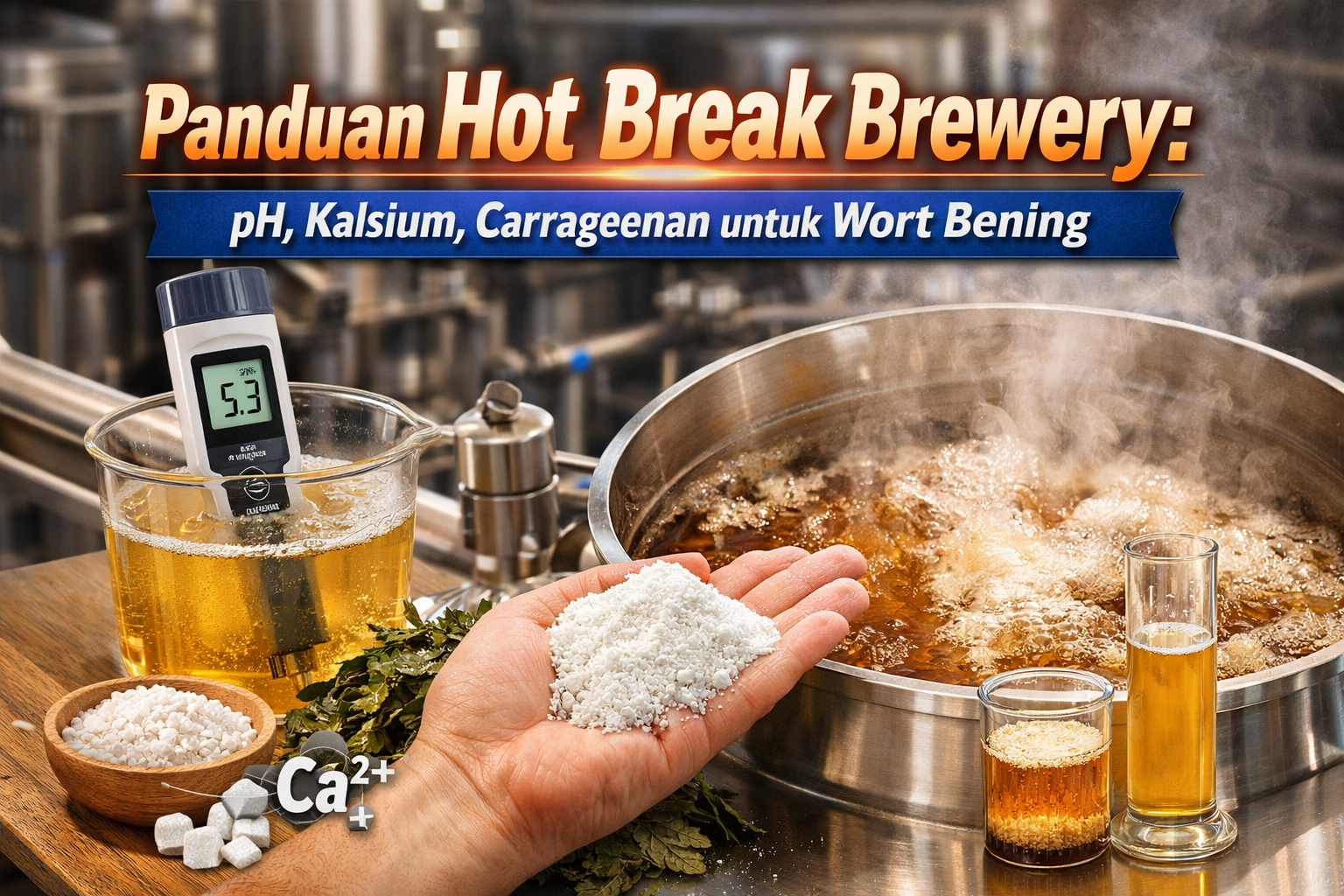
Modern kettle finings from Euchema/Eucheuma contain ~20–30% κ‑carrageenan, versus ~2–5% active carrageenan in raw Irish moss—hence lower dosing for refined material (lallemandbrewing.com). Carrageenan is vegan and GRAS; carrageenan (karagen, E407) is an approved food additive in Indonesia (compliance should follow local labeling/purity rules) (global-regulation.com).
Operational targets and measurable payoffs
Data‑backed targets: maintain wort pH ≈5.2–5.4 (achieved with sufficient calcium, ~50–100 ppm) to maximize protein precipitation; run a vigorous rolling boil; and dose κ‑carrageenan at ~5–15 g/hL late‑boil (brewing-products.com) (goodbeer.solutions) (researchgate.net).
Breweries report up to ~90% reduction in haze precursors with finings, enabling shorter clarification, lower filtration costs, and clearer bright beer; one European study showed carrageenan‑treated worts needed only 12.5%–33% of normal DE to reach <1 EBC haze, effectively cutting DE usage by ~75–90% in trials (researchgate.net). Quantitatively monitor pH, calcium (ppm), and trub volume; for example, raising Ca by ~50 ppm might lower wort pH by ~0.2 units, which significantly improves cold‑break yield (brewing-products.com) (brewing-products.com).
Sources and further reading
Full technical detail and data: braukaiser.com; brewing-products.com; researchgate.net; goodbeer.solutions; murphyandson.co.uk; regulatory context: global-regulation.com.