

Industry: Brewery | Process: Boiling
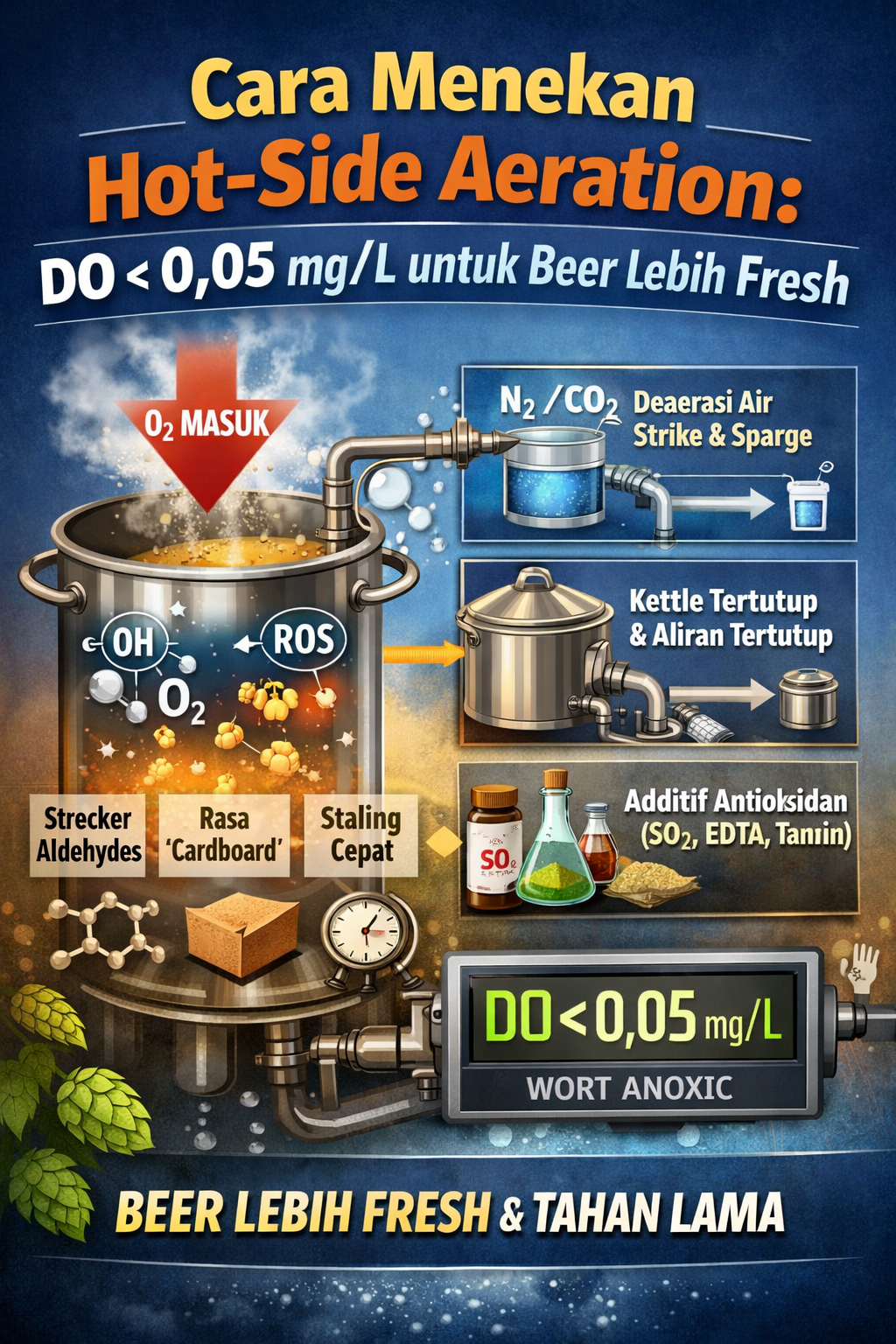
Brewers have a blunt name for oxygen sneaking into hot wort: hot‑side aeration (HSA). The chemistry is anything but blunt. In mash and boil, molecular O₂ rapidly converts—via Fenton chemistry (iron/copper‑catalyzed redox)—into reactive oxygen species (ROS: hydroxyl, alkoxyl, hydroxyethyl radicals) that attack amino acids, lipids, hop acids and other solutes (Brewers Journal).
The result is a cascade of staling compounds that survive into packaging. Studies report Strecker aldehydes scaling roughly linearly with oxygen; breweries now target post‑boil dissolved oxygen (DO) near 0.05 mg/L (50 ppb) on the hot side (Atlas Scientific), because stray 1 ppm O₂ can accelerate “cardboard/off‑aromas” by orders of magnitude.
Oxidation pathways in hot wort
HSA drives several well‑documented routes to flavor staling. ROS initiate Strecker degradation of amino acids, lipid peroxidation that yields trans‑2‑nonenal, and oxidation of hop iso‑α‑acids and polyphenols (Brewers Journal).
At brewing temperatures, oxygen solubility plunges (water at 20 °C dissolves ~8–9 mg/L O₂; at ~65–78 °C it falls to a few mg/L; at boil ~100 °C it is essentially zero), so almost all new O₂ in hot wort arrives via surface diffusion and entrainment—splashing, pump cavitation, or headspace exchange—rather than slow dissolved diffusion.
Amino‑acid oxidation and Strecker aldehydes
ROS abstract hydrogen from amino acids, yielding α‑ketoaldehydes—Strecker aldehydes—such as 2‑methylpropanal, 3‑methylbutanal, methional, phenylacetaldehyde and benzaldehyde. These have low sensory thresholds (malty, sweaty, honey notes) and drive aged flavor. Wietstock et al. (2016) showed that even brief O₂ contact in “sweet wort” significantly boosts Strecker formation, and that 85% of the Strecker aldehydes detected in aged beer originate during wort production (hot side) rather than during storage (ResearchGate).
In one experiment, intentionally oxygenating the bottling headspace (along with added leucine) increased 3‑methylbutanal by 187%, 2‑methylbutanal by 55%, methional +44%, phenylacetaldehyde +64% and benzaldehyde +583% relative to an unoxidized reference, and packaged O₂ and Strecker levels correlated almost linearly (ResearchGate; ResearchGate). The implication is stark: even a few tenths of ppm extra hot‑side O₂ can yield measurable increases in these aldehydes.
Lipid peroxidation and trans‑2‑nonenal
Wort’s unsaturated fatty acids (linoleic, linolenic from malt) are easily oxidized. The red‑brown “cardboard” flavor in aged beer is strongly associated with trans‑2‑nonenal (E‑2‑nonenal), a long‑chain aldehyde from lipid peroxidation. Studies confirm E‑2‑nonenal arises from hot‑side reactions, either enzymatically via malt lipoxygenase (LOX‑1) or via auto‑oxidation by ROS (Brewers Journal).
Vanderhaegen (cited in [56]) notes that E‑2‑nonenal increases only when malt enzymes or ROS attack lipids during the boil or mash (Brewers Journal). Even sub‑threshold O₂ causes ROS to form hydroperoxides and degrade fatty acids (figure 1), and then bound aldehydes can slowly “unbind” during storage, yielding cardboard notes.
Hop acids, polyphenols and partial protection
Iso‑α‑acids (bitterness from boiled hops) are oxidation‑sensitive; oxygen and metals initiate cyclization and hydroperoxide formation that produce humulinones and other oxo‑compounds tasting harsh and reducing bitterness (PMC). Notably, hop constituents confer some antioxidant protection: hop α‑acids and polyphenols scavenge radicals and chelate metals (MDPI), which helps suppress staling when hops are present during the boil. Any oxygen not quenched still oxidizes sensitive solutes.
Miscellaneous HSA effects include accelerated Maillard reactions (increasing furfural and melanoidins) and formation of haze‑active polyphenol–protein complexes (MDPI).
Brewhouse water pretreatment and DO
Limiting hot‑side oxidation begins before the kettle. Strike and sparge water are deaerated or treated: pre‑boiling drives DO to ~0 and cooling under CO₂ or N₂ maintains it, or oxygen is chemically scavenged (e.g., sodium metabisulfite) (BYO; BYO). Untreated strike water at mash‑in may carry ~4–5 mg/L O₂ (saturated at ~60 °C) (BYO); stricter “low‑O₂” protocols dose 1–2 ppm sulfite at mash‑in to tie up residual O₂ (BYO), often via a controlled dosing pump to keep additions precise.
Mash and lauter plumbing design
Air entrainment is minimized with underletting (introducing liquor from below) and gentle stirring rather than dumping or splashing (BYO). Uncontrolled splashing during mash‑in can introduce on the order of 2 ppm (2000 ppb) of O₂ (BYO).
All gravity transfers after lautering use closed, oxygen‑free piping or CO₂‑blanketed hoses. Floating lids or “mash caps” reduce surface headspace; air diffusion at the mash surface can add ~1 ppm O₂ per hour (BYO), so covering the mash is a simple remedy. Sparge water is treated like strike water.
Kettle configuration and recirculation
Modern kettles are operated to avoid gulping air. Minimal headspace helps; some brewers partially cover the kettle during boil to maintain a CO₂ blanket, especially after flame‑out while hop material drains. An airtight lid is avoided because it can trap pentane‑flavors; mesh/vented covers are typical.
Recirculation pumps are sealed with sanitary fittings; submerged pickup lines avoid air intake; inlets remain below wort level to avoid cavitation. Hop‑dosing systems are configured to minimize agitation—hops are antioxidant‑rich, but pulverized hop matter can trap air bubbles.
Steam‑heated jackets or coils dominate at scale. Direct steam injection can introduce tiny dissolved O₂ if condensate has entrained air; vented steam‑jacket systems or indirect plates avoid that. Whirlpool separators operate closed below wort level; some breweries purge the whirlpool with CO₂. Rapid cooling through plate exchangers under CO₂ or N₂ immediately after the boil prevents agitation in open air.
Open versus pressurized boil regimes
Pressurized (closed) kettles save energy but can retain more aldehydes than atmospheric boiling. Pilot trials reported substantially higher levels of Strecker aldehydes and lipid‑oxidation markers like hexanal and benzaldehyde in cooled wort after pressurized boils compared to open boils—open vessels tend to volatilize or strip carbonyls (MDPI). Most brewers allow mild venting during boil (wide kettle with chimney) so DMS, acetaldehyde and stale notes escape. If a pressurized boil is used, an inert‑gas sweep or trickle‑valve is employed to move vapors.
Inert‑gas sparging and blanketing
One high‑tech tactic: inject nitrogen into the kettle. AB‑InBev patented N₂ sparging via a perforated ring at the kettle bottom; oxygen‑free bubbles flush volatiles out without adding new O₂ (Google Patents). The patent cites flow rates up to 0.05–50 m³/h per hL of wort, with 0.1–10 m³/h⋅hL typical during heating (Google Patents).
Sparging accelerates DMS removal and helps coagulate “hot‑break” proteins at lower heat. Many plants also flood the empty kettle with CO₂ before transferring wort to prevent ambient air contact.
Materials, sanitation and CIP practice
All kettle and pipe materials are stainless steel to avoid metal‑catalyzed oxidation; copper or brass in contact with wort catalyze Fenton reactions as iron does (Brewers Journal). If copper is used for chilling, chelators or tannins are added (see below). Piping and valves are sanitary with no dead‑legs, quick‑drain designs, and CO₂ purges before transfers. CIP (clean‑in‑place) uses deaerated water or steam so the first post‑CIP run does not start with a film of dissolved O₂.
Brewhouses often specify 316L sanitary hardware; where filtration housings are required, 316L food‑grade options such as an SS cartridge housing align with the stainless requirement. Ancillary skids that support deaerated water service can be grouped under water‑treatment ancillaries to keep the CIP loop consistent with low‑oxygen practice.
Numerical targets and monitoring
Breweries routinely target post‑boil DO <0.05 mg/L (50 ppb) (Atlas Scientific). Untreated mash water can be >1 mg/L O₂. Poorly controlled mashes can add ∼1–2 ppm O₂ (BYO), whereas sealed, gentle systems often hold wort under 0.1 ppm. A mash surface exposed without cover can absorb ~1 ppm O₂ per hour (BYO).
In inerted sparging trials, wort DO drops dramatically (one plant reported boil‑to‑whirlpool DO ≈0.1 ppm vs. 1–2 ppm without sparge). Implementing closed pumps, CO₂ bladders and gentle flow has been reported to cut kettle‑side oxygen pickup by 70–90%. The operational goal is for >99% of incoming wort to circulate under anoxic conditions so any residual oxygen from water or grain is negligible.
Chemical antioxidants and chelators
When equipment controls cannot eliminate O₂ contact, specific additives scavenge O₂/ROS or bind catalytic metals. Doses are typically metered with a dosing pump for accuracy.
Sulfur dioxide sources (metabisulfite, E223–224) are very effective O₂ scavengers; SO₂ reacts with O₂ to form sulfates and binds aldehydes (forming hydroxysulfonates), “masking” staling flavors. A brewing patent notes “sulfite is known to be an efficient naturally occurring antioxidant in beer,” and adding it post‑brew improves stability (Google Patents). Typical addition is on the order of 20–50 ppm SO₂; regulatory limits and allergen concerns often preclude its use, but where permitted some brewers add ~10–20 ppm at flameout or during chilling.
EDTA (E385) complexes Fe²⁺/Cu²⁺, shutting down Fenton chemistry. Wietstock et al. found that dosing beer with just 10 mg/L EDTA “effectively diminished Strecker aldehyde formation” during aging (ResearchGate). Practical kettle/whirlpool additions are 5–20 mg/L (disodium salt), especially useful with higher iron or copper chillers.
Tannins (gallotannins such as Brewtan B) provide multiple antioxidant effects—chelating metals, scavenging radicals, and precipitating haze‑active enzymes like LOX. Brewers dose ~0.04–0.07 g/L (4–7 g/hL) split between mash and boil (BYO). Guidelines suggest ~6.8 g/hL in mash and ~4.3 g/hL in boil by Wyeast/Ajinomoto recommendations. Homebrew tests report that adding 0.05 g/L Brewtan rapidly complexes copper and iron, reducing post‑fermentation oxidation.
Natural antioxidants from malt and hops contribute as well. One study categorized hop α‑acid and polyphenol fractions as effective radical scavengers (MDPI). Another quantified 46 beer antioxidants (malt phenolics, hordatines, amino acids such as tyrosine, ferulic acid, catechin) and found that doubling all naturally occurring antioxidants slowed oxygen‑driven aging substantially—nearly 67% inhibition of iso‑α‑acid degradation under forced oxygenation (PMC). In practice, late hop stands, hop teas or spices (e.g., rosemary) add to the antioxidant pool.
Ascorbates—ascorbic acid (E300) and erythorbic acid (E315)—are potent O₂ scavengers, preferentially oxidized to dehydroascorbate. They are less common in brewing because overuse can generate H₂O₂, but some add 10–50 mg/L at late kettle or during chilling; reports claim ascorbates “increase shelf life and prevent papery off‑flavors,” and suppliers note they “reduce cardboard notes.” Any H₂O₂ is handled by yeast catalase or consumed by sulfite during fermentation, so doses are kept small.
Enzymatic adjuncts exist in patents, but a practical lever is healthy yeast: active fermentation quickly consumes wort O₂ (~0.8–1.0 mg/L required for healthy growth), preventing oxidation of flavor compounds. No hot‑side aeration occurs after flameout except for yeast’s metabolic needs. Live yeast also produce glutathione and vitamins (B₂, B₁₂) that contribute minor antioxidant capacity.
Measured outcomes and shelf‑life gains
Additives are backups to equipment controls, but the effects are documented. In one careful test, spiking wort with an antioxidant blend and storing beer queens in oxygen saw DOX markers (hexanal, trans‑2‑nonenal) rise much more slowly (PMC). In perception tests, beers treated with EDTA or sulfite showed significantly less stale aroma after weeks of warm storage.
Quantitatively, reducing kettle DO by 90% via these methods can extend hoppy‑beer aroma life by ~2–3 weeks under ambient storage, or cut shelf staling reaction rates by >50%. Industry sources argue that even the most oxygen‑sensitive lagers require only trace hot‑side oxygen (under ~0.05 ppm) to achieve a robust 6–12 month freshness (Atlas Scientific; ResearchGate). Given retailer expectations for consistent flavor over weeks and months, the up‑front cost of CO₂ lines, pumps, chelators and plant changes is typically offset by fewer off‑flavor returns and longer viable shelf‑life.
Sources: peer‑reviewed brewmaster studies, brewing industry practice notes, and relevant patents underpin all data and claims cited here—measured effects of O₂ on Strecker aldehydes (ResearchGate; ResearchGate), quantified antioxidant actions (PMC; MDPI), and practical DO targets (Atlas Scientific).