

Industry: Fertilizer_(Ammonia_&_Urea) | Process: Ammonia_Synthesis_Loop
Ammonia synthesis is unforgiving thermodynamics wrapped in heavy steel. Plants run at 90–300 bar to push the N₂+H₂⇄2NH₃ equilibrium toward product, but practical temperatures of 350–450°C cap NH₃ at ≲20%—so single-pass conversion is inherently <30% (pubs.acs.org) (patents.justia.com). That’s why the hardware—converter design, catalyst loading, and heat control—does the real economic work.
Even small wins matter. One standard reference estimates that lifting an ammonia converter’s effluent NH₃ by just 1% on a 1200 tonne/day plant can recover ≈$1.2 million/year, largely because higher per‑pass conversion trims recycle flow and slashes compressor and refrigeration loads (chempedia.info) (patents.justia.com) (chempedia.info).
Today’s low‑energy plants almost universally opt for staged cooling and multiple catalyst beds—a sharp contrast to the old single‑bed quench era (chempedia.info) (patents.justia.com).
Converter architectures and flow paths
Axial (downflow) converters remain the traditional workhorse. The classic Kellogg‑style unit is a vertical, multi‑bed “quench” converter (3–4 beds) with recycle gas or steam injected between beds to absorb heat (chempedia.info). A single adiabatic bed would only reach ~11–12% NH₃ in the effluent; using three beds with intercooling typically raises this to ~18.5% NH₃ (≈30% per‑pass conversion) (patents.justia.com) (patents.justia.com).
Radial‑flow converters push gas through the catalyst from an outer annulus toward a central tube (or vice versa). Haldor Topsoe’s S‑200 is a two‑bed radial‑flow converter with intermediate (indirect) cooling between beds (chempedia.info). Indirect cooling in radial beds can boost throughput by ~15–20% for the same catalyst mass, a reason this design is widely used for retrofits (chempedia.info). Casale’s “axial‑radial” retrofit similarly converts existing axial reactors to a cooled radial arrangement by installing new internals (chempedia.info).
Tube‑cooled and other multi‑bed designs tighten temperature control further. Some converters (e.g., TVA/Synetix designs) embed coolant tubes within the catalyst beds for nearly isothermal operation (chempedia.info). Kellogg’s advanced KAAP process uses four radial beds in one shell, with fixed intercoolers after the first three beds and a shifted catalyst mix (chempedia.info). In practice, more than three beds yields only marginal conversion gains, so modern designs focus on the number and spacing of beds (and quench flows) rather than simply adding volume (patents.justia.com).
Catalyst selection and staged loading
Industrial ammonia catalysts are primarily iron‑based (magnetite/wustite) or ruthenium. Modern wustite (FeO) catalysts are about 70% more active than older magnetite—delivering higher per‑pass conversion at moderate gas hourly space velocity, GHSV (volumetric flow per catalyst volume) (pubs.acs.org). Ruthenium on carbon (Ru/C) is far more active: in Kellogg’s KAAP process, Ru/C catalysts are ~10–20× more active than magnetite (pubs.acs.org). Ru is particularly fast at lower temperatures and is not poisoned by product NH₃, though it is expensive and sensitive to H₂ (pubs.acs.org).
Loading the right catalyst in the right bed is a proven lever. A staged approach—iron upstream (cheaper, works well at high H₂/N₂ and minimal NH₃ inhibition), then Ru/C downstream to drive the last increments of conversion—consistently improves yield. Tripodi et al. report that “loading the last stages with Ru/C (instead of Fe‑wustite) always improved ammonia yield” under fixed conditions (pubs.acs.org). In one case, swapping a third Fe bed for Ru/C gave a ~8× increase in reaction rate and allowed higher GHSV for the same outlet conversion (pubs.acs.org). Downstream beds are often smaller but more active, balancing per‑stage conversion.
There are diminishing returns to simply adding catalyst volume or beds. One simulation of a four‑bed converter showed that optimizing temperature and flow profiles—not more catalyst—raised N₂ conversion from 19.5% to 25.9%, lifting NH₃ effluent from 11.8% to 18.4% (+42% relative gain) (www.scirp.org). The practical target remains ≈30% N₂ conversion per pass with minimal recycle by placing high‑activity catalyst where it is most effective and matching catalyst volume to the heat‑removal scheme (patents.justia.com) (www.scirp.org).
Temperature control and heat removal
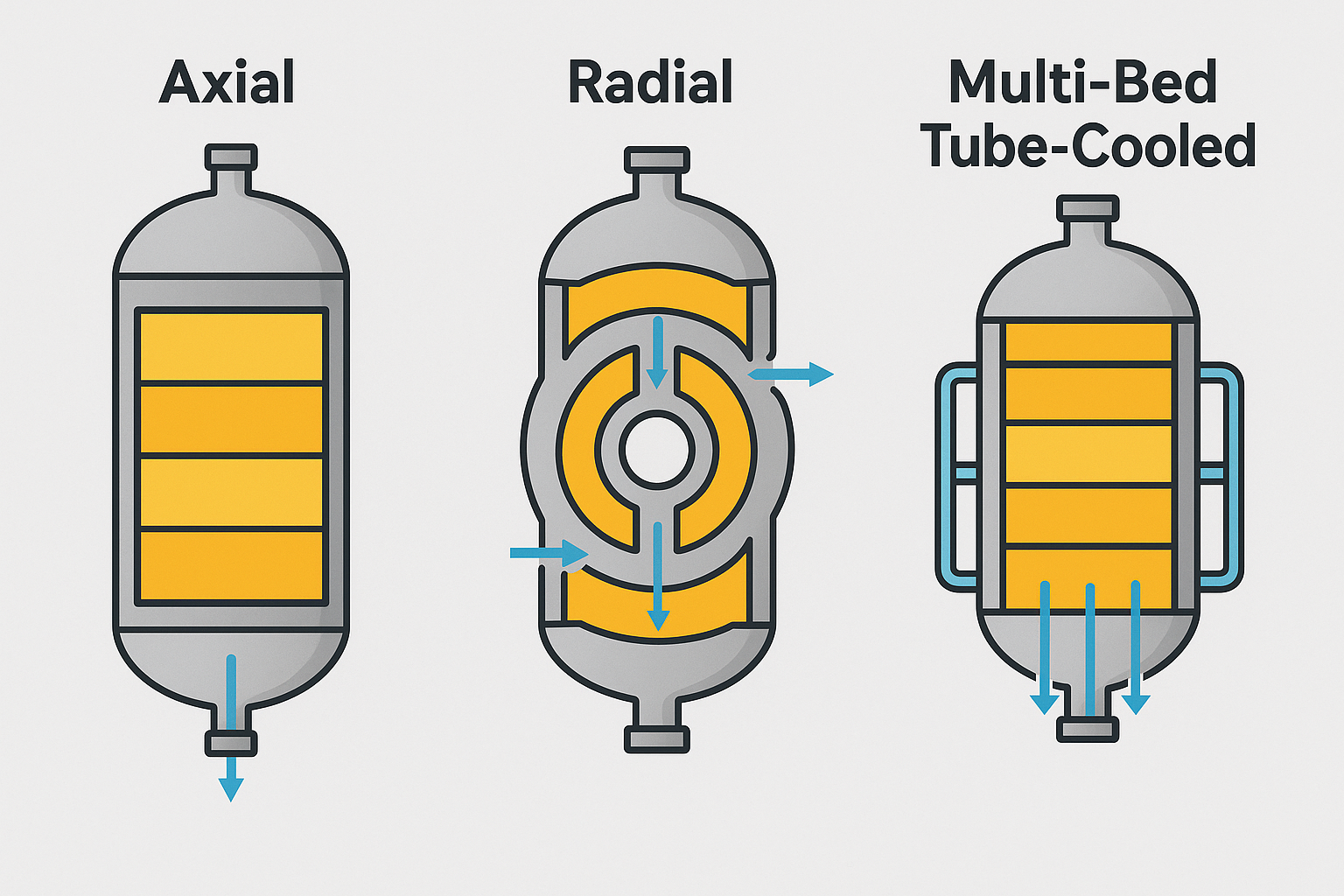
The synthesis reaction is strongly exothermic (ΔH⁰≈–92.4 kJ per 2 NH₃), so without cooling a 400°C inlet can spike to ~600–700°C adiabatically—pushing equilibrium back to reactants (patents.justia.com). Heat removal, therefore, is performance‑critical. Three strategies dominate: adiabatic beds with intercooling (cooling between fixed beds), direct internal cooling (coolant coils/tubes in the bed), and quench cooling (injecting cold gas between beds).
In a comparative study, a three‑bed adiabatic reactor with intercooling (AICR) reached ~30% N₂ conversion when each bed was fed at ~696 K; an internal direct cooling reactor (IDCR) achieved the same conversion at a much lower coolant inlet of 495 K; and an adiabatic quench reactor (AQCR) optimized to 26% N₂ conversion with a first‑bed inlet of 635 K (hero.epa.gov).
Catalyst integrity sets upper bounds: nickel/iron catalysts begin sintering above ~823 K (550°C), so converters typically target ~500–600 K at outlet before cooling to ~300–350 K to condense NH₃ (www.scirp.org). Tighter temperature control increases the NH₃ fraction; the economic lift from even small gains is material—again, ≈$1.2 million/year for a +1% effluent increase on a 1200 MTPD plant (chempedia.info)—because it reduces recycle, compressor duty, and refrigeration loads (patents.justia.com) (chempedia.info).
Where plants run coolers and chillers hard, operators align utilities with heat‑removal goals; in practice that can include metered chemistry management using equipment such as an accurate dosing pump for the cooling section, and programs that deploy a scale inhibitor to keep heat‑exchange surfaces consistent. These supporting actions sit alongside the converter’s core design choices.
How designs translate to per‑pass gains
Modern cooled, multi‑bed converters routinely achieve ~25–30% conversion per pass, compared with uncooled single‑bed systems that barely exceed 10–12% (patents.justia.com). For context, an optimized reactor might convert 65–70% of the equilibrium amount (≈20% per pass at 200 bar) in the first stage, then use a high‑activity catalyst to extract the remaining potential conversion downstream (pubs.acs.org).
Data/Stats highlights embedded across designs: typical N₂:H₂ feed is 1:3, pressure ~150–200 bar, inlet ~300–400°C. A three‑bed mixed‑bed reactor can reach ~18–20% NH₃ (≈30% conversion) per pass (patents.justia.com). Conversion per stage often reaches ≥20% (per‑pass) for the first bed (pubs.acs.org). Reactor outlet is kept <550°C to protect catalyst (www.scirp.org). Studies show up to +42% relative gain in conversion via temperature‑profile optimization (www.scirp.org), and retrofit projects report capacity increases ≈15–20% from cooling improvements (chempedia.info). These optimizations translate into large energy and cost savings in large ammonia plants (patents.justia.com) (chempedia.info).
As utilities and auxiliaries scale with throughput, plants may also maintain cooling‑water chemistry programs that use a targeted corrosion inhibitor in parallel with temperature‑control strategies—supporting the same heat‑management priority underscored by the converter designs above.
Sources and referents
This analysis draws on peer‑reviewed studies and industry references: Khademi and Sabbaghi (2017), Chem. Eng. Res. Des. 128, 306–317 (hero.epa.gov); Tripodi et al. (2021), Ind. Eng. Chem. Res. 60(2), 908–915 (pubs.acs.org) (pubs.acs.org); Akpa & Raphael (2014), World J. Eng. Tech. 2(4) (www.scirp.org); and standard reactor handbooks and patents (patents.justia.com) (chempedia.info). Each technical claim above is linked in‑line to its source.