

Industry: Fertilizer_(Ammonia_&_Urea) | Process: Process_Cooling_Systems
In ammonia/urea plants, cooling water runs past high‑pressure process streams. One compromised heat‑exchanger tube and ammonia, ammonium salts, or urea decomposition products can enter the loop—fast. Even trace leaks are critical: copper condensers can release ammonia vapor under pressure and contaminate not just the cooling loop but boiler feedwater, forcing shutdown (www.metrohm.com).
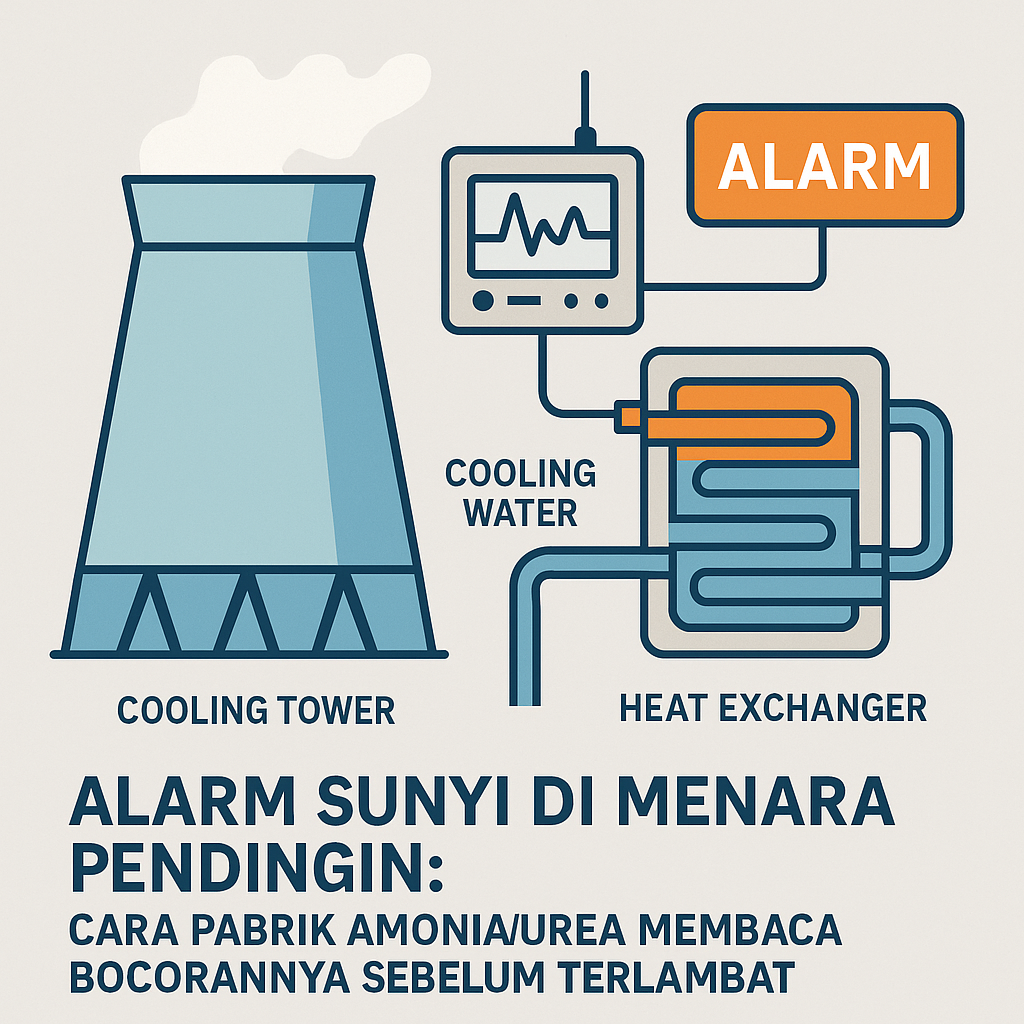
Plants respond with multi‑parameter monitoring on each exchanger circuit. Unexplained shifts in pH, conductivity, phosphate or nitrate, or heat duty (via LMTD, the log‑mean temperature difference), plus outlet temperature changes, trigger alarms. Operators log pH, conductivity, hardness, temperature drop, and flow continuously. A power‑plant analog shows the pattern: a feedwater‑heater tube leak was flagged by a rising steam‑extraction valve position, increased feed‑pump amp draw, and a falling feedwater outlet temperature (heat-exchanger-world.com). The same principles apply when ammonia slips into cooling water.
Multi‑parameter leak indicators and trends
Because ammonia shifts ion balance, conductivity often jumps. In one documented incident, a cooling‑loop moved from a normal ~400 µS/cm (microSiemens per centimeter) to 6426 µS/cm under a heavy ammonia leak, with a specification limit of less than 2500 µS/cm; pH crept to ~8.6 against a 7.3–7.8 target (www.lautanairindonesia.com) (www.lautanairindonesia.com). Heat‑exchange performance also betrays trouble: if multiple parallel exchangers show imbalanced temperatures or if the outlet temperature deviates for a given load, a leak becomes suspect (heat-exchanger-world.com).
Ammonia‑specific online analyzers (ISE, colorimetry)
Given ammonia‑nitrogen (NH₃/NH₄⁺) is the primary contaminant, plants install ammonia‑specific analyzers. Online NH₃‑ISE (ion‑selective electrode) solutions continuously measure dissolved ammonia; Metrohm® describes an NH₃‑ISE looped through a process analyzer covering 0–100 mg/L (www.metrohm.com). Samples are buffered to about pH 11 (via TISAB) to read “true” ammonia, with dynamic standard addition for stability, and alarms drive immediate treatment adjustments (www.metrohm.com) (www.metrohm.com). These systems are proven in power plants where condenser in‑leakage is a known risk (www.metrohm.com).
Plants often pair ammonia readings with nitrate/nitrite probes, turbidity, total organic carbon, or VOC surrogates for redundancy (www.law.cornell.edu) (www.metrohm.com). When analyzer alarms trip, chemical feed changes follow—often controlled by a dosing skid where a dosing pump modulates additions based on signals.
Regulatory detection thresholds and frequency
Modern guidance (US EPA 40 CFR 63.1086) suggests defining exchanger loops so a leak of about 3.06 kg/hr (≈3 ppm at 51,000 L/min) is detectable; plants size sensor sensitivity to catch leaks at or below that limit of concern (www.law.cornell.edu). The rule also enforces frequent checks—monthly for existing systems and weekly for new installations—until a sustained six‑month leak‑free period allows reduced frequency (www.law.cornell.edu). In one US example, continuous monitoring at exchanger inlets and outlets caught leachables or VOCs indicative of leaks (www.law.cornell.edu).
Chlorine demand as an indirect signal
Chlorinated circuits show another tell: free chlorine residual collapses when ammonia forms chloramines. A sudden drop often accompanies NH₃ ingress, prompting changes to oxidizer dosage or selection. In practice, an NH₃ analyzer can signal a Chemical Distribution System to add more corrosion inhibitors, chlorine, or other treatment chemicals before extreme damage occurs (www.metrohm.com). Plants typically implement this through their broader cooling‑tower chemical program integrated to analyzer alarms.
Emergency isolation and blowdown protocol
Once a leak is confirmed, the response centers on isolation, containment, and chemistry control. The leaking exchanger is removed from service or bypassed rapidly; parallel coolers or spares pick up load where available. If an in‑line unit cannot be fully isolated without a process stop, flow is reduced and the loop is discharged (blowdown) to avoid concentration growth. Valves to drains or blowdown tanks are opened to flush contaminated sections into waste. The goal remains consistent: physically prevent more ammonia‑rich process fluid from entering the common cooling loop.
In one case, a critical ammonia condenser (HE 127C) continued operating under leak conditions; operators immediately increased blowdown and injected chemicals locally while scheduling tube repair for the next turnaround (www.lautanairindonesia.com).
Chemical treatment set‑points and pivots
Alkalinity control shifts first. If ammonia has raised pH, plants feed mineral acid (e.g., sulfuric or hydrochloric) to bring pH back toward neutral; driving bicarbonates to CO₂ gas reduces carbonate scaling (www.chemtreat.com). If nitrification depresses pH via H⁺ generation, caustic stabilizes the 7–8 operating range. Corrosion‑film protection is then rebuilt: plants often double or triple inhibitors so steel corrosion rates hold under disturbance, a strategy supported by an ammonia‑plant report of ~0.06 mmpy with out‑of‑spec water (www.lautanairindonesia.com). Programs commonly center on corrosion inhibitors with targets below industry alarms (often less than 0.1–0.3 mmpy).
Scale and particulate control also tighten. Shock doses of dispersants and anti‑scaling polymers are applied; in the documented incident, a satellite injection delivered 30 ppm of a mineral‑dispersing agent (“Dekascale S25”) to the affected loop and 5 ppm of a biodispersant (“SUNCW5 DM10”) to mitigate fouling (www.lautanairindonesia.com). Plants often rely on scale inhibitors and dispersant chemicals at these moments to keep heat transfer surfaces clean.
Biology gets equal attention. Nitrifiers thrive on leaked ammonia, so oxidizer feed is increased to suppress growth—accepting chloramine formation where NH₃ is present—or plants switch to non‑oxidizing biocides (examples include bromine or glutaraldehyde‑based) to target nitrifiers explicitly. In one summary after treatment, residual free chlorine was held at ~0.23 ppm against a 0.2–0.5 ppm target even under heavy contamination (www.lautanairindonesia.com), a control step commonly executed within a biocides program.
Blowdown strategy and interim operations
Contaminated loops are purged more aggressively, overriding cycles‑of‑concentration to dump ammonia‑bearing water to effluent or a dedicated treatment sump. During a several‑month emergency case, blowdown dew points were raised by manual control to dilute nitrates and chlorides. Operations ease stress on the network: non‑critical exchangers cycle offline for cleaning or run at lower duty, and the damaged unit is held only as long as absolutely necessary. Repairs—tube plugging, welding, or exchanger replacement—are scheduled for the next turnaround.
Measured outcomes and decision points
Programs define measurable goals: no single exchanger carries more than a setpoint of NH₃, conductivity returns to specified levels (stated as less than a chosen mS/cm), and corrosion stays within tolerance (e.g., under 0.1 mpy, mils per year). In practice, if an online analyzer detects ammonia above a threshold (often set in the low ppm, parts per million), an alarm triggers the leak protocol; labs then verify decline through nitrate drops or pH normalization. Business decisions—continue operations versus shutdown—hinge on these trends.
The Lavaan Air case showed that, with rigorous control, even a ~660 ppm ammonia spike did not cause system failure; chemical adjustments stabilized cooling‑loop performance and bought time until maintenance (www.lautanairindonesia.com). After approximately three months, most water parameters approached targets—free chlorine ~0.23 ppm (target 0.2–0.5 ppm), phosphate ~5.9 ppm—even as conductivity and nitrates remained high; the corrosion rate sat at a trivial 0.06 mpy, well under the 0.26 mpy limit (www.lautanairindonesia.com) (www.lautanairindonesia.com).
Discharge limits and documentation
In Indonesia, discharge standards raise the stakes for speed. Ministerial Regulation No. 5/2014 sets ammonia limits often in the single‑digit mg/L range; a cited plywood mill limit is 4 mg/L (www.pengolahanlimbah.com). A cooling system leak sending hundreds of mg/L risks heavy fines, so emergency plans include coordination with environmental and process safety teams, routing contaminated blowdown to waste treatment or preventing mixing with pristine effluent. Actions are documented with samples and timestamps to demonstrate prompt containment.
Baseline practice and references
Standard references such as the ASHRAE Handbook and ChemTreat’s Water Essentials outline baseline water‑treatment practices. Field data align: continuous online NH₃ monitoring combined with robust inhibitor/biocide programs both detects leaks early and mitigates damage (www.metrohm.com) (www.lautanairindonesia.com).