

Inside the amine loop: how urea plants keep CO₂ solvents clean, cut foaming, and curb losses
Urea and ammonia producers can slash amine makeup and corrosion by mastering solvent degradation, filtration, and reclaiming. The playbook: control heat and oxygen, filter out solids and hydrocarbons, and remove heat‑stable salts with a reclaimer.
Industry: Fertilizer_(Ammonia_&_Urea) | Process: CO2_Removal
In CO₂ removal trains, the solvent is the heartbeat. Amines such as MEA and MDEA (common CO₂‑capture amines; MEA is “lean” to CO₂ when regenerated; MDEA is a tertiary amine) carry the load in absorber–stripper cycles, but they steadily degrade, forming corrosive impurities and “heat‑stable salts” (HSS) that sap capacity and trigger foaming and metal attack. Industry reviews flag the risks and the fixes, from temperature control to solids filtration and solvent reclaiming (ResearchGate) (ResearchGate).
In practical terms, that means an operating strategy built around three anchors: limit thermal and oxidative breakdown, strip out solids and hydrocarbons, and periodically remove HSS and other soluble byproducts. The result is lower amine losses and fewer upsets—without breaching hazardous‑waste rules.
Thermal and oxidative breakdown
Thermal degradation concentrates where it’s hottest: the stripper reboiler, typically 100–120 °C. In MEA systems, MEA carbamate can cyclize to 2‑oxazolidone and react onward to oligomers like N,N′‑di(2‑hydroxyethyl)urea; at higher temperature these can polymerize into insoluble “resins” (ResearchGate). The literature notes thermal effects are minor if the reboiler stays below ~110 °C, but MEA degradation accelerates sharply above that threshold (ResearchGate) (ResearchGate). By contrast, tertiary amines such as MDEA are inherently more temperature‑resilient, with minimal thermal breakdown up to ~200 °C (ResearchGate).
Oxidative degradation is the other driver. Dissolved O₂ (from flue or process gas) and trace metals like Fe/Cr (often from corrosion) catalyze formation of aldehydes and organic acids—chiefly carboxylate anions that bind amines. At the TCM Mongstad plant, 30 wt% MEA showed formic acid in lean solvent rising to ~3,000 mg/L over ~1,850 operating hours, dominating the HSS burden (TCM). A simplified scheme tracks O₂ → glyoxal/glycolate → formate/glycolate → ammonium formate with simultaneous NH₃ and aldehyde release; small NOₓ can nitrosylate to trace nitrosamines (TCM).
Impurities and heat‑stable salts
Contaminants such as SO₂, H₂S, or CO worsen HSS formation: amines plus SO₂ (a stronger acid than CO₂) yield sulfate/sulfite salts, and trace HCl from impure water feeds chloride salts. Crucially, HSS are non‑regenerable in normal stripping, so they accumulate—reducing CO₂ capacity, increasing vapor pressure (amine losses), and promoting metal corrosion that creates iron‑rich particulates (ResearchGate) (ResearchGate).
Common HSS in MEA units include ammonium formate, acetate, glycolate, oxalate, malonate, succinate, sulfate, and others (ResearchGate). Typical accumulation in continuous MEA plants runs ~1–3 g/L HSS (0.3–1% w/w) after a few thousand hours, and U.S. DOE studies suggest MEA losses near ≈1–2% of inventory per month without mitigation (TCM). Solvent choice matters: primary amines (MEA) generally degrade faster than sterically hindered or tertiary amines (MDEA).
These dynamics apply whether a plant relies on a conventional amine package or a proprietary blend. Many CO₂ removal units source a regenerable amine solvent designed to remove CO₂ and H₂S to <1 ppm; an example of the class is a CO₂/H₂S removal amine solvent.
Particulates, foaming, and filtration trains
Degradation throws off insolubles—polymeric “resins,” metal hydroxides/carbonates from corrosion—and entrains hydrocarbons that supercharge foaming. “Liquid hydrocarbons and solid particles are foaming promoters…even in small sizes,” notes supplier guidance, calling for removal to “very low levels” (Pall). In one field case, liquid carry‑over downstream of standard separators exceeded 1000 ppmw, clearly triggering foaming (Pall).
Best practice adds a multi‑stage filtration and coalescing scheme. Plants commonly filter a side‑stream of the lean amine—recommended at ~10–20% of flow—through particulate and carbon media (Digital Refining Q&A). For particulates, operators deploy cartridge filters (often polypropylene) to capture rust, iron sulfide, and tarry oligomers; separate polypropylene cartridges on both rich and lean lines help maintain clarity (Feature‑Tec) (Digital Refining Q&A). Housing choice matters in chemical service; many units prefer steel filter housings for high‑pressure amine loops.
To strip surface‑active organics and oils, a lean‑side activated‑carbon bed polishing ~10–20% of flow is widely recommended, which alone can markedly reduce emulsion foaming (Digital Refining Q&A). For that duty, plants specify activated carbon in granular or cartridge form following the particulate stage to remove solids and residual hydrocarbons (Feature‑Tec).
Upstream, gas‑phase coalescers ahead of the absorber knock out sub‑micron aerosols and liquid droplets. Case studies show upgrading to coalescers can reduce entrained liquid to target bands around ~500–1000 ppmw, with one 3.5 m ID vessel running coalescer cartridges (SepraSol™ type) trimming liquids from >1000 ppmw to acceptable levels (setpoint ~1965 ppmw) (Pall) (Pall).
Operating targets and monitoring
Filter differential pressure should be trended and elements replaced before blinding; saturated carbon beds will lose adsorption capacity (Digital Refining Q&A). Plants commonly keep lean amine 5–10 °C warmer than inlet gas to prevent hydrocarbon condensation that seeds fouling and foaming (Digital Refining Q&A). As a rule of thumb, liquid content downstream of filtration should be ≪1000 ppmw; any sustained excursion above ~500 ppmw signals underperformance and likely foaming hysteresis (Pall) (Pall). Routine swaps are supported by water treatment parts and consumables programs that standardize cartridges and media.
Removing heat‑stable salts and tars
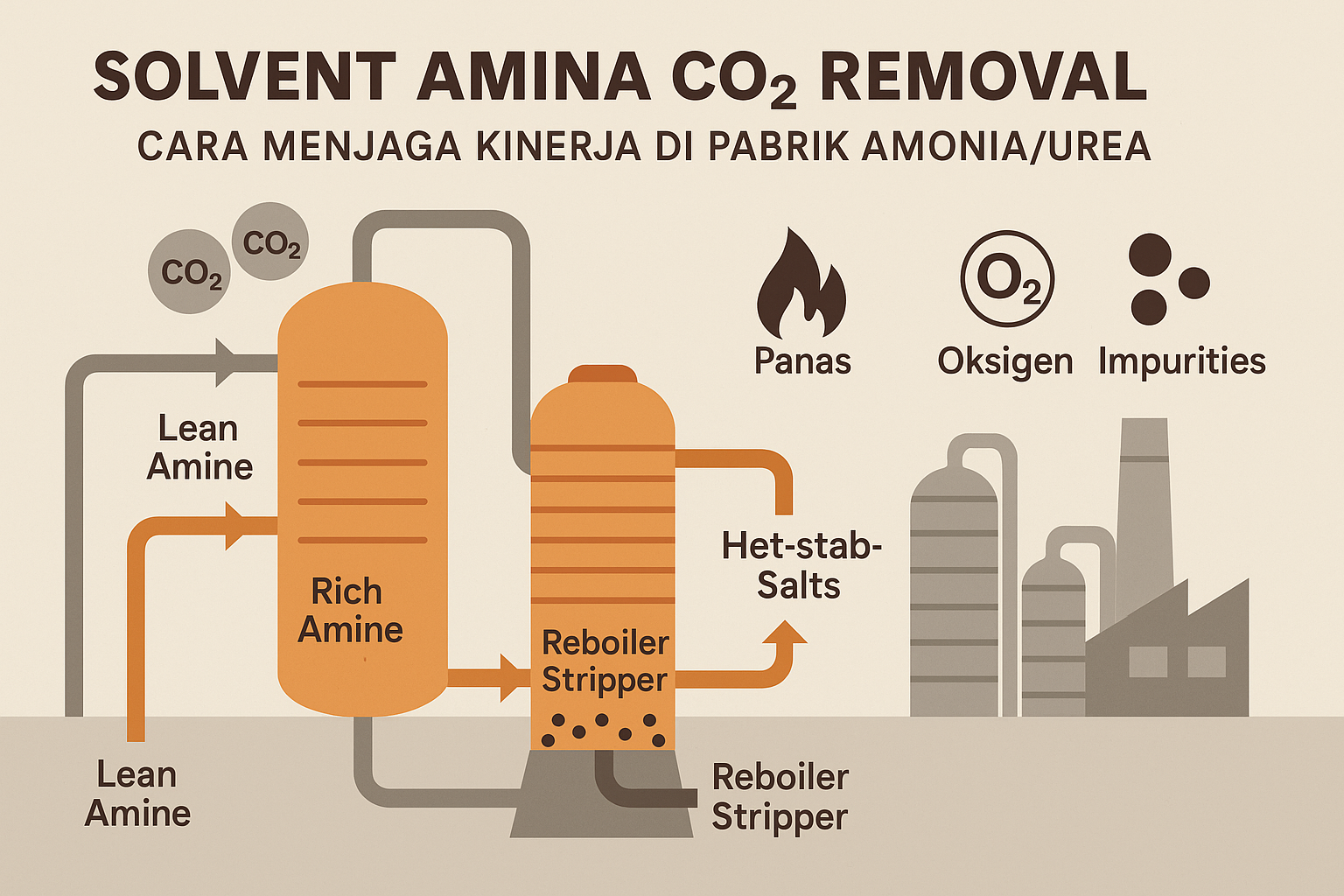
Soluble degradation products—chiefly HSS—build up unless removed by purge or reclamation. Industry aims to hold total HSS to a few thousand ppm; formate is often limited around 0.5–1.0 g/L, with one reference citing a 500 ppm AFPM formate limit versus 1000 ppm in practice (Digital Refining Q&A).
The workhorse solution is a vacuum distillation “amine reclaimer” that vaporizes water and amine overhead while leaving HSS and heavy tars in the bottoms. Studies show >90% of amine can be recovered overhead, with most HSS retained in the residue (ResearchGate). One modeling study reported an energy duty of ~12 kWh per kg of HSS removed at modest vacuum, with lower pressures cutting energy further at the cost of larger equipment (ResearchGate) (ResearchGate). In practice, running the reclaimer weekly or biweekly can cut HSS by ~80–90% compared with bleed‑only, and a 2019 analysis concluded vacuum distillation is generally more economical than electrodialysis for HSS removal (ResearchGate).
Selective ion removal can supplement reclaiming. Anion‑exchange resins (chloride‑form) scrub HSS anions (formate, acetate, glycolate, etc.) with base regeneration, and electrodialysis can remove ionic species—yet both leave neutral polymeric tars and organics untouched, so they typically polish rather than replace thermal reclaiming (Digital Refining). Plants implementing ion removal often source ion-exchange resins or full ion exchange systems for side‑stream polishing.
By contrast, a pure bleed‑and‑replace approach—purging ~0.5–3% of amine inventory per day—is often uneconomical at high degradation rates (Digital Refining). The economics of reclaiming are stark: if a unit is losing ~1% amine per month to HSS formation, recovering ~80% of that with a reclaimer yields nearly a five‑fold cut in fresh amine purchases. As a benchmark, fresh MEA demand can run ~0.5–3 kg per ton CO₂ without reclamation versus perhaps ~0.1–0.5 kg/ton with a well‑operated reclaimer (process‑dependent).
Regulatory context in Indonesia
When you remove the bad actors, you must handle them. In Indonesia, spent amine, reclaimer bottoms, and associated sludges are B3 (hazardous) waste under Government Regulation No. 27/2020, and any company “producing B3 waste” must hold a B3 waste management license if it recycles the waste—or hand it to approved facilities (HHP) (HHP). On climate policy, Presidential Regulation 14/2024 on CCS opens a path for industrial emitters, and industry notes ~16 CCS/CCUS projects planned by 2030 (BSD‑KADIN) (BSD‑KADIN). For ammonia/urea plants, getting solvent management right reduces OPEX and aligns with national targets.
Targets and the operating playbook
Maintain solvent integrity by limiting high‑temperature residence and oxygen in the regenerator; actively purifying the circulating amine is non‑negotiable (ResearchGate). Install fine particulate and hydrocarbon filters—often on a recycle side‑stream—for solids and oil control (Digital Refining) (Digital Refining Q&A), plus inlet coalescers to cap liquid carry‑over (Pall) (Pall).
Quantitatively, target HSS below ~0.1–0.2 wt% and keep major anions ≲1000 ppm (formate guidance around 0.5–1.0 g/L, with one source citing 500 ppm AFPM vs 1000 ppm practice for formate) (Digital Refining Q&A). Use activated‑carbon adsorbers and deaeration steps to capture dissolved contaminants, and schedule regular reclaiming; vacuum distillation typically runs ~10–12 kWh per kg‑HSS (ResearchGate).
Done together, these controls can halve—or better—the amine makeup rate, cut corrosion/foaming incidents by >50%, and keep plants compliant with hazardous‑waste regulations (ResearchGate) (Digital Refining) (HHP).
Sources and further reading
Solvent stability and degradation mechanisms: ResearchGate. Oxidative pathways and pilot data: TCM, TCM. HSS chemistry and corrosivity: ResearchGate, ResearchGate. Filtration/coalescing practices: Pall, Pall, Digital Refining Q&A, Feature‑Tec. Reclaimer performance and energy: ResearchGate, ResearchGate. HSS limits and operations: Digital Refining Q&A, Digital Refining. Indonesian regulations: HHP, HHP, BSD‑KADIN, BSD‑KADIN.