

Industry: Landfill | Process: Leachate_Collection_Systems
Landfill leachate—the contaminated liquid formed as water percolates through waste—is a chemically aggressive fluid (high organics, ammonia, heavy metals, chlorides, variable pH) that must be conveyed and pumped for decades without failure. The materials choice is decisive: collectors and pumps that use robust, corrosion‑resistant construction avoid leaks, outages, and costly maintenance.
International experience—and local rules—are converging on one answer. Indonesian landfill design guidance explicitly specifies HDPE (high‑density polyethylene) piping for leachate drains (ro.scribd.com). A recent analysis ranked HDPE far above PVC (polyvinyl chloride), galvanized steel, and carbon steel for leachate pipes (link.springer.com), citing inertness, flexibility, and long service life.
HDPE piping in primary drains
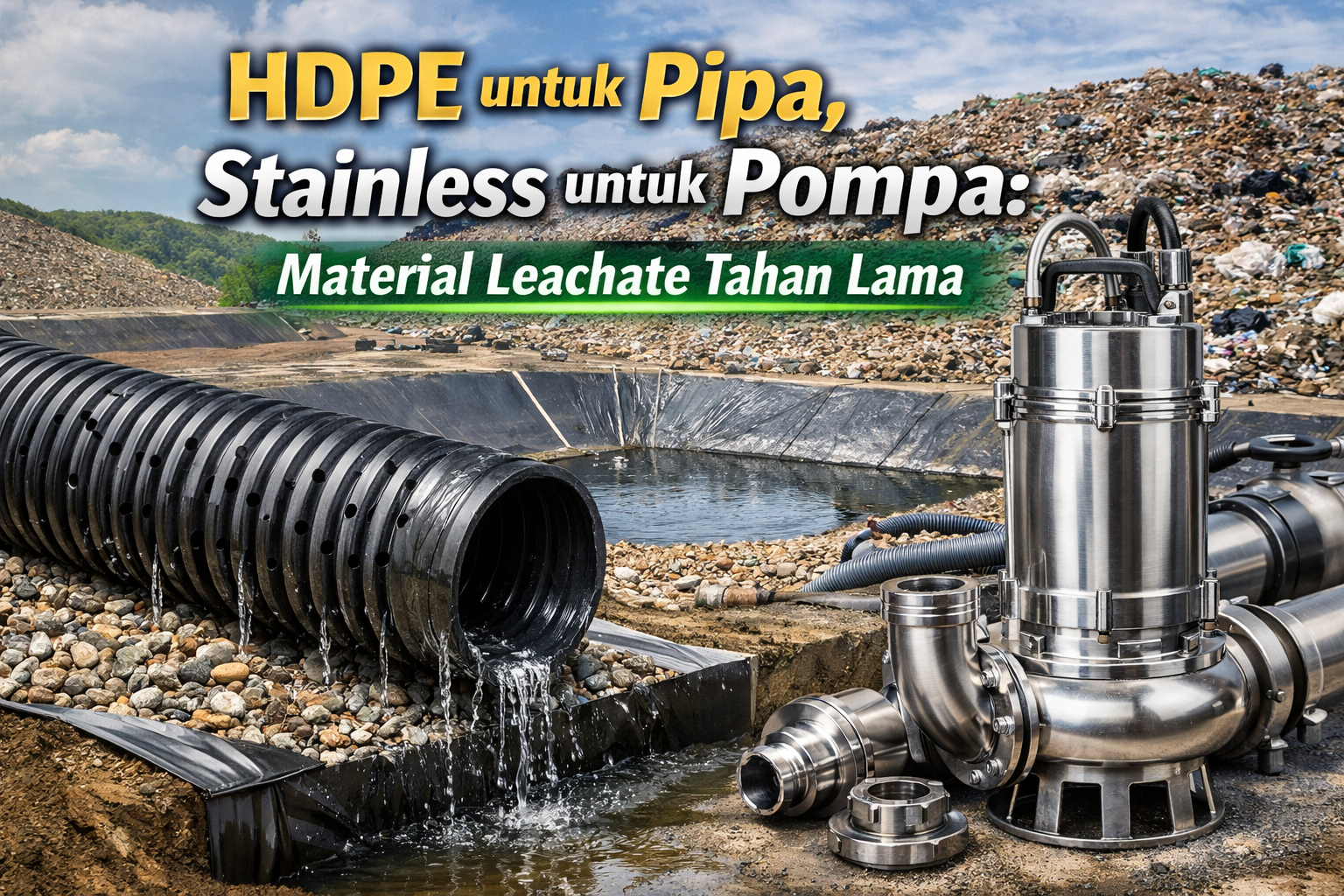
In practice, HDPE pipes—often dual‑wall corrugated with perforations—are the industry standard for primary and secondary leachate drains. HDPE resists acids, alkalis, salts, and organics far better than metal or older plastics, and its design life is generational: modern polyethylene (PE) pipe formulations routinely achieve 50–100+ years under buried service (infrastructurenews.co.za) (worldpoly.com).
SAPPMA notes that, in practice, 100‑year lifespans are becoming “the norm” for PE pipelines (infrastructurenews.co.za). An EPA report likewise confirms HDPE’s long‑term durability, citing data showing “minimal degradation” for buried PE pipelines over 100+ years (worldpoly.com). By contrast, traditional steel or PVC lines corrode or become brittle in a few decades under leachate contact.
Comparative performance and standards
Laboratory and field studies bear this out. One multi‑criteria analysis of landfill piping concluded “HDPE has the best performance” by far, ranking PVC, galvanized steel, and seamless steel below it (link.springer.com). PVC can resist low‑concentration acids (acidic leachate), but it is attacked by sulfuric and chlorinated compounds and joint failures occur over time. Metal pipes—even galvanized or coated—corrode rapidly in fouled leachate (chlorides and sulfates cause pitting), especially under anaerobic conditions. HDPE’s polymer structure avoids electrochemical attack, so no corrosion factor needs to be added to its thickness.
In practice, this means HDPE lines seldom need replacement, whereas studies note that repeated repair of corroded metal/rigid‑plastic lines can outweigh the higher initial cost of HDPE (nepis.epa.gov) (nepis.epa.gov). Indonesian standards reflect this reality: a government “Pedoman Persampahan” (waste management guideline) explicitly requires leachate drains to use networks of perforated HDPE pipe (ro.scribd.com). The base of these drains is also lined, and perforated HDPE collects leachate while containing migration.
Reliability and market trajectory
Reliability is quantifiable: well‑maintained HDPE pipes still exceed 50 years without degradation (infrastructurenews.co.za), whereas steel would need recoating or replacement multiple times. The market is voting accordingly: the global HDPE pipe market was about US$27.9 billion in 2024 and is forecast to grow at ~5.4% CAGR (reaching ~$41.8 billion by 2033) (datahorizzonresearch.com).
Pumps and sump wetted materials
Leachate lift stations (sumps) and pumps see a hostile mix (ammonia, VOCs, chlorides). The industry standard is stainless steel (SS) for all wetted pump components—typically alloys 304L or 316L. Austenitic stainless steel forms a self‑healing chromium oxide film that resists attack by organic acids and chlorides (nepis.epa.gov) (nepis.epa.gov). In particular, 316L (added molybdenum) is specified when chloride levels are appreciable: it “has improved corrosion resistance” over 304 and can handle concentrated acids to a degree (nepis.epa.gov).
Testimonials note that 316 stainless pumps can handle “toxic and corrosive chemicals” as readily as water, and are “built to last” under such service (www.marchpump.com). Empirical evidence from wastewater and chemical pumping concurs: stainless‑steel impellers and casings outlast cast iron or plastic by several times in corrosive feeds. For example, pump suppliers observe that “stainless steel pumps are more corrosion resistant than cast iron. If you’re dealing with … a hostile environment or corrosive fluids, stainless steel is a better option,” with durability “significantly less prone to cracking” (www.aspumps.com). (Even though [58] is an industry blog, it echoes the consensus that in landfill service stainless greatly extends mean time between failures.)
Accessories, screens, and strainers
By comparison, pumps of lesser materials (cast iron, bronze, or standard carbon steel) often require liners or sacrificial anodes, and still must be replaced on a 5–10 year schedule. In contrast, stainless alloys need only occasional cleaning. Guidance notes that when long lifetimes are demanded, higher upfront cost in stainless is offset by minimal maintenance (sassda.co.za) (sassda.co.za). Accessories (valves, strainers, screens) follow suit: stainless steel or high‑performance plastics (e.g., UHMWPE) are typical. To protect pumps, sumps commonly apply debris barriers; an automatic screen can maintain continuous removal of rags and solids, as in an automatic screen, while a suction‑side strainer adds point protection. Supporting equipment integrated for wastewater duty is available through wastewater ancillaries.
Some landfills even use plastic/proprietary polymer pumps for leachate (e.g., PP or PVDF resin) if pH is neutral, but these are typically peristaltic or diaphragm types with much lower flow. For large‑volume pumping, stainless centrifugal or submersible pumps are the rule. Typical choices by use: leachate pumps with 316L or 304 stainless steel wetted parts—chosen for chloride and organic acid resistance (nepis.epa.gov)—and many pump models advertise 316SS bodies for “acidic and alkaline liquid.” Accessories (valves, strainers, screens) likewise employ stainless or UHMWPE; on sump tops and non‑wetted metalwork, painted mild steel is acceptable. The result: a properly specified stainless‑steel pump system can operate for decades with minimal corrosion. By contrast, a mixed‑metal pump installation in leachate might see impeller pitting and mechanical failure within a few years.
Life‑cycle cost and regulatory context
Choosing HDPE and stainless steel may raise initial project cost, but industry analyses show it sharply lowers life‑cycle cost (LCC). Stainless steel shines in LCC comparisons: because it “lasts the lifetime of the process” with virtually no corrosion maintenance, the full‑service‑life costs can be 50–70% lower than cheaper materials that require frequent recoating or replacement (sassda.co.za). In one review, a stainless steel walkway (analogous to piping surface area) had higher upfront cost but “no corrosion protection required” and “significant financial benefits over the full service life.” (sassda.co.za)
HDPE’s long lifespan means no replacement crews in 20 years (avoiding shutdowns and replacements)—a saving often exceeding its rough cost premium. Quantitatively: an HDPE leachate pipe network comes with a 50–100 year expected life (infrastructurenews.co.za) (worldpoly.com), whereas a steel/PVC network might need patching or replacing in 20–30 years under real leachate exposure. Multiple field studies (and the EPA) warn that cumulative replacement of failing cheaper pipes exceeds the cost of using HDPE from the start (nepis.epa.gov). Likewise, stainless pumps may cost 2–3× more than a cast‑iron pump on day one, but if the stainless pump lasts 20–25 years versus 5–7 years for cast iron, the annualized cost is lower and downtime is avoided. The EU’s Landfill Directive mandates robust leachate control, effectively requiring corrosion‑resistant systems; Indonesian waste guidelines specify HDPE for drains (ro.scribd.com). As global landfill infrastructure expands, the HDPE pipe sector alone is growing on a multibillion‑dollar scale (datahorizzonresearch.com).
Summary: HDPE vs. alternatives
- HDPE: Highly corrosion–resistant. Long life (~50–100+ years design) (infrastructurenews.co.za) (worldpoly.com). Low leakage/failure rates. Preferred in guidelines (ro.scribd.com).
- PVC/CPVC: Good for many diluted acids/alkalis but vulnerable to strong acids/chlorides. Lower installation cost but cold‑temperature brittleness and joint failures over time.
- Steel (galvanized or coated carbon steel): Susceptible to rust and chloride pitting. Requires expensive coatings and frequent inspection. Corrosion allowance must be added (often 5–10 mm thickness). Shorter life in high‑organic leachate.
- Concrete: Rarely used for small pipes (used only for large collection sewers), but porous unless fully coated. Not recommended for the primary network.
In short, HDPE’s net present cost (life‑cycle) under leachate service is the lowest, even if raw material cost is higher (nepis.epa.gov) (nepis.epa.gov).
Sources and design guidance
Authoritative reviews and data—Environmental Science & Pollution Research (link.springer.com), EPA engineering manuals (nepis.epa.gov) (nepis.epa.gov), industry analyses (infrastructurenews.co.za) (worldpoly.com) (www.marchpump.com)—uniformly support HDPE and stainless steel for leachate systems. Indonesian design guidance likewise specifies HDPE drainage piping (ro.scribd.com). These sources quantify durability (lifespans, cost comparisons) so project designers can make evidence‑based choices favoring robust, corrosion‑resistant materials.