

Industry: Aquaculture | Process: Recirculating_Aquaculture_Systems_(RAS)
In intensive recirculating aquaculture systems (RAS), the enemy is often invisible. Fine particles under 30 µm and refractory dissolved organic compounds (DOC, dissolved organics that resist quick biodegradation) build up as stocking density and feed loads rise — and conventional solids removal can’t catch them (dpi.nsw.gov.au) (dpi.nsw.gov.au). High DOC stains water “tea‑coloured” and can halve biofilter nitrification efficiency by 40–50% (dpi.nsw.gov.au), letting nitrite creep to toxic levels and making the system less stable (dpi.nsw.gov.au) — in one example, just 2.8 ppm nitrite cut perch fingerling growth by 5% (dpi.nsw.gov.au).
That is why farms are pushing beyond drum or sand filters. Drums may skim ~90% of particles above 50 µm, yet capture less than 10% under 55 µm (academic.oup.com). Operators still rely on mechanical steps like sand media — often the same dual‑media concept used in sand/silica filtration — but “advanced clarification” has become the lever for what escapes baseline screens.
Foam fractionation mechanics and limits
Protein skimmers (foam fractionators) use microbubbles to adsorb dissolved proteins and tiny particles; hydrophobic organics and colloids attach to bubbles and exit as foam (sludge). Microbubbles are typically generated by Venturi injectors (gas injection via pressure differential) or mixing pumps; the approach targets fines left after basic filters (dpi.nsw.gov.au) (ras-aquaculture.com). Historically, capture of sub‑30 µm material has been challenging without added oxidants, with reports of only 6–38% total suspended solids removal by skimmers alone (academic.oup.com).
Performance data underscore the limit: in a commercial seawater RAS, a skimmer alone removed ~2–4% of microparticles and trimmed turbidity by ≈1.2% — essentially negligible (researchgate.net) (researchgate.net).
Ozone oxidation and micro‑flocculation
Ozone (O₃), a powerful nonselective oxidant, breaks down dissolved wastes and microbes. In RAS water, it reacts with unsaturated organics and nitrite, and “micro‑flocculates” colloids via partial oxidation and polymerization so fines clump and are easier to remove by fractionation, filtration and sedimentation (dpi.nsw.gov.au) (aquaculturemag.com). It oxidizes DOC into smaller, often more biodegradable molecules (making them biofilter‑cleavable) and can precipitate some organics, easing downstream conversion to nitrate (dpi.nsw.gov.au) (aquaculturemag.com). Nitrite is directly oxidized to nitrate (dpi.nsw.gov.au).
Disinfection, too, is dose‑dependent. In pure water, just 0.01–0.1 mg/L (milligrams per liter) residual ozone for 15 seconds cuts bacterial loads sharply; in typical RAS water with organics, ~0.1–0.2 mg/L for 1–5 minutes achieves significant disinfection, while effluent often requires ~0.2–0.4 mg/L for 1–5 minutes (dpi.nsw.gov.au) (dpi.nsw.gov.au). Field trials show even non‑sterilizing dosing reduces heterotrophic bacteria indirectly by cutting soluble substrates (oceanrep.geomar.de) (aquaculturemag.com), yielding higher ORP (>270 mV, oxidation‑reduction potential) and lower BOD (biochemical oxygen demand) in ozonated tanks versus controls (aquaculturemag.com) (sciencedirect.com). As ozone decomposes, it yields oxygen, which elevates dissolved oxygen (DO) in water and biofilters, supporting nitrification and fish respiration (dpi.nsw.gov.au). In one RAZONE project case, ORP rose into 270–290 mV, letting the farm hit design production density without fish stress (aquaculturemag.com).
Ozonated skimming: data and one‑pass gains
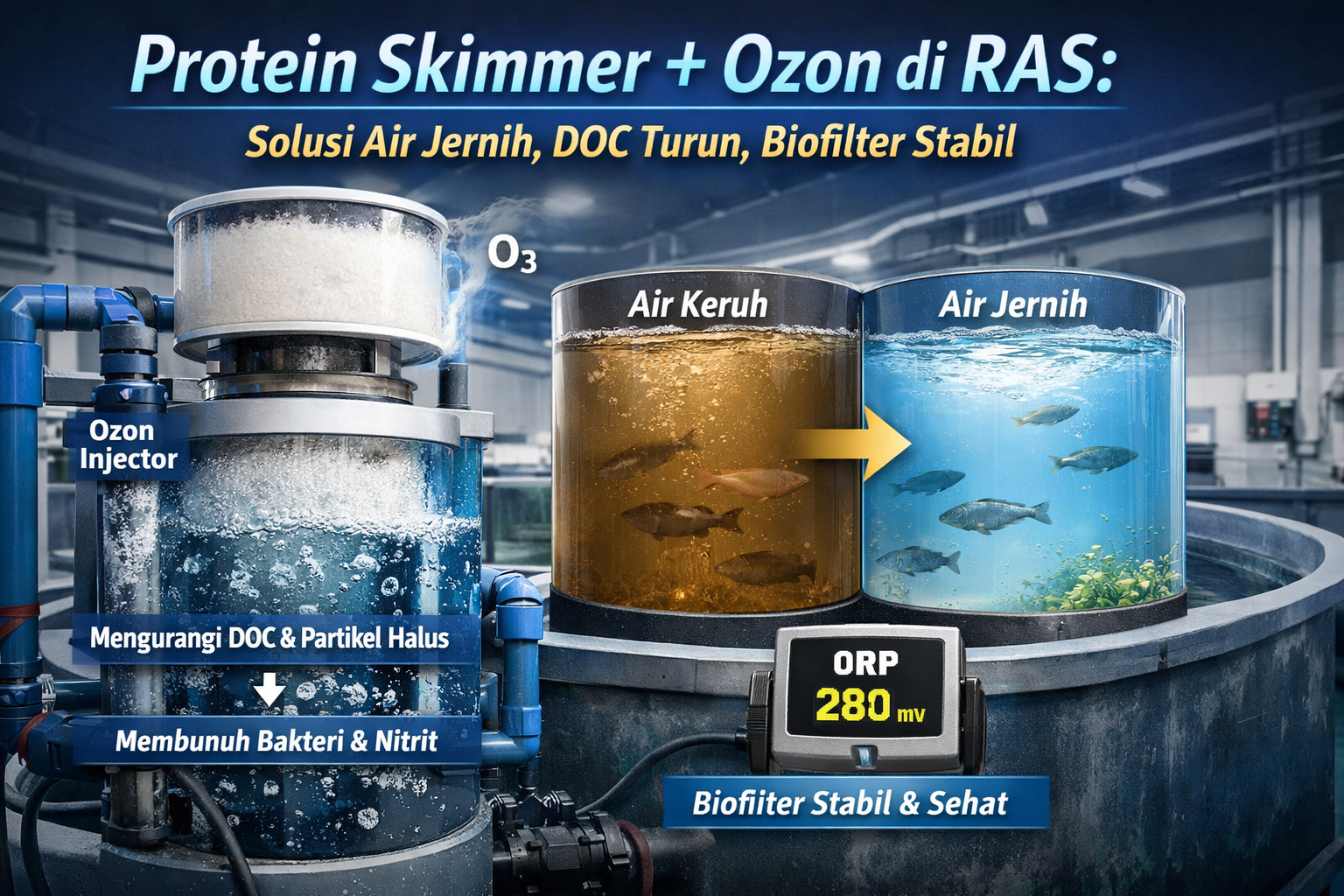
When ozone is introduced directly into the skimmer loop (often via a Venturi), outcomes change dramatically. In a full‑scale salmon RAS, two skimmer designs were tested at 0, 7 and 14 g O₃/kg feed (grams of ozone per kilogram of feed). At 14 g/kg, one‑pass particle count removal was ~52%, versus ~2.6% without ozone (researchgate.net); fine‑particle surface area removal jumped to ~42% from ~3.4% (researchgate.net). Turbidity fell by ~13.7% under high ozone, versus ~1.2% without ozone (researchgate.net), and DOC was oxidized so it became biofilter‑cleavable (dpi.nsw.gov.au). Across trials, protein skimming is most effective when paired with ozone (academic.oup.com) (cordis.europa.eu).
Bacterial loads also drop fast: the ozone‑skimmer step cut heterotrophic counts by ~60% in one pass at 14 g/kg versus ~4% without ozone (researchgate.net). Doses that raise total residual oxidants (TRO) to ~0.06–0.1 mg/L already deliver substantial disinfection without harming fish (oceanrep.geomar.de) (dpi.nsw.gov.au); a safe threshold of ~0.06 mg/L O₃ byproduct oxidants has been identified for shrimp and turbot (oceanrep.geomar.de). In RAZONE salmon trials, ozone‑treated water showed no stress and operators noted a slightly elevated feeding response, although measured growth gains were minor (cordis.europa.eu).
Nitrification support and water clarity
Ozone injected into the skimmer or a contact reactor also oxidizes nitrite to nitrate and can, in seawater, contribute to ammonia oxidation pathways (bromide→bromamines), though full ammonia oxidation is rarely targeted because it requires high residuals (dpi.nsw.gov.au) (oceanrep.geomar.de). By clumping organics and reducing BOD, ozone lightens the load on nitrifiers, helping maintain optimum conditions alongside the DO boost from ozone decay (dpi.nsw.gov.au) (dpi.nsw.gov.au) (dpi.nsw.gov.au).
Clarity gains are visible and measurable. Continuous low‑dose ozone kept UV‑transmittance high (UVT ~94%) in one study versus ~85% untreated (researchgate.net). Field reports also note ORP in the 280–290 mV range and an apparent “clean water” look when ozone is active (aquaculturemag.com) (sciencedirect.com). Oxidizing organics also cuts off‑flavors (geosmin/MIB) and heavy‑metal carryover, as metals sorbed to organics are skimmed after oxidation (aquaculturemag.com) (cordis.europa.eu). Where micro‑flocculation steers fines into sedimentation, plants often rely on clarifiers — the same principle as a clarifier in water treatment — alongside filtration.
Biofilter stability and fish outcomes
By stripping organics before biofiltration, an ozone‑skimmer loop stabilizes the entire RAS. Lower organic carbon means lower BOD on the biofilter, preventing clogging and sustaining nitrifiers; guidance explicitly notes that reducing organic loading with ozone improves biofiltration efficiency and nitrification (dpi.nsw.gov.au). In practice, operators can sustain higher feed rates or stocking densities with ozonation than without.
Pathogen risk drops as well. Ozone inactivates bacteria, viruses and parasites; ozonated systems report fewer Aeromonas/Vibrio events and less dependence on antibiotics (oxidationtech.com) (dpi.nsw.gov.au). Facilities manage safety with ORP probes that regulate ozone to avoid overdosing; safe byproduct levels (~0.06 mg/L) and ORP ceilings (typically under 310 mV) protect microbes and fish (oceanrep.geomar.de) (dpi.nsw.gov.au). Overall fish performance often improves modestly: a Swiss RAS trial found trout grew faster with ozonation than in a control, likely due to cleaner water and higher DO; at minimum, farms report no stress behaviors at design densities under ozone‑skimmer regimes and good feed conversion and survival, though gains vary by system (aquaculturemag.com) (aquaculturemag.com) (cordis.europa.eu).
Design, dosing and control parameters
A common design rule for organics control is ~10–15 g O₃ per kg feed per day; 10–15 g/kg‑feed has been recommended to degrade DOC and nitrite in typical RAS effluent, while 0–7 g/kg yields smaller bacterial effects (researchgate.net) (cordis.europa.eu) (dpi.nsw.gov.au). Generators are run in pulses after feeding or continuously if feeding is 24/7, with online ozone meters and ORP sensors targeting ~0.1–0.2 mg/L residual ozone in fresh/brackish water or ~0.05–0.1 mg/L in seawater (to account for bromide demand) (dpi.nsw.gov.au) (oceanrep.geomar.de). These instruments are standard water‑treatment ancillaries in many plants — a category reflected in water‑treatment ancillaries.
Skimmer design details matter: 1–5 minutes of ozone contact time followed by degassing; stainless‑steel Venturi injectors for ozone transfer (PVC corrodes); linear‑flow skimmer chambers for bubble‑organic contact; and empirically, raising skimmer head height increases foam volume, though Venturi plus ozone typically yields the highest solids removal per volume treated (academic.oup.com).
Measured benefits, energy and compliance
Across systems, ozonation has delivered a 20–50% reduction in turbidity, >90% removal of taste/tannin color compounds, and steady ORP above 280 mV (researchgate.net) (aquaculturemag.com). Weekly heterotrophic plate counts have fallen by ~1 log (90%) after implementing ozonation, and nitrite spikes that persisted in controls fell to near zero in treated systems. Energy trade‑offs are moderate: ozonation adds ~5–10% to power draw but often enables lower water exchanges, which can cut heating/cooling needs (oxidationtech.com) (cordis.europa.eu).
Regulators generally do not restrict ozone if it is fully reacted. In Indonesia, no specific RAS ozone rules exist, but general water reuse standards (KKP/Ministry of Environment norms) would treat ozone as an on‑site treatment chemistry; as best practice, any off‑gas or effluent ozone is quenched — commonly by carbon filtration or venting — before discharge (oceanrep.geomar.de). In seawater ozonation, operators monitor byproducts such as bromates; activated carbon can trap these if needed — the same medium used in activated carbon filters (oceanrep.geomar.de).
What the numbers say
In a marine salmon RAS, foaming plus 14 g O₃/kg‑feed achieved ~60% one‑pass bacteria kill and ~50% microparticle removal compared to ~4% and ~3% without ozone (researchgate.net) (researchgate.net), with effective single‑pass turbidity and UV‑transmittance rises of ≈5–15% (researchgate.net). For pathogen inactivation purposes, guidance suggests aiming for ~0.2–0.4 mg/L dissolved ozone for 1–5 minutes (dpi.nsw.gov.au). Case studies (RAZONE trials) confirm ozonated systems meet design production targets without fish losses, whereas controls struggled with water quality (cordis.europa.eu) (aquaculturemag.com).
Deep clarification, in short, sits “beyond the drum.” The combination of ozone‑enhanced protein skimming with downstream filtration and sedimentation (including units like a clarifier) provides quantitative reductions in DOC, microparticles, turbidity and bacteria that translate into steadier biofilters and higher feasible stocking densities (researchgate.net) (researchgate.net). For facilities implementing these steps, standard pretreatment and polishing remain relevant — including media like sand/silica — but the control layer (ORP, ozone meters and related ancillaries) and carbon safeguards (activated carbon) are what let ozone do its work efficiently and safely.
Sources include authoritative aquaculture water‑quality reviews and trials: multiple DPI NSW advisories on ozone in RAS (dpi.nsw.gov.au) (dpi.nsw.gov.au) (dpi.nsw.gov.au) (dpi.nsw.gov.au) (dpi.nsw.gov.au) (dpi.nsw.gov.au); marine system studies and safety thresholds (oceanrep.geomar.de); commercial RAS skimmer performance trials (researchgate.net) (researchgate.net) (researchgate.net) (researchgate.net); filtration capture limits (academic.oup.com); system‑level outcomes and ORP data (sciencedirect.com) (aquaculturemag.com); and RAZONE project reporting on production stability and off‑flavor reductions (cordis.europa.eu) (cordis.europa.eu).