

Industry: Nickel_Mining | Process: Leaching
Nickel’s battery moment is forcing a reckoning in materials engineering. High‑pressure acid leach (HPAL—high‑pressure acid leaching) dissolves nickel and cobalt from laterite ore using concentrated sulfuric acid at around 250 °C under multi‑megapascal pressure—a combination that chews through ordinary equipment. In an HPAL autoclave, concentrated H₂SO₄ is injected at ~250 °C to dissolve Ni/Co from ore (nickelinstitute.org) (www.researchgate.net).
Analysts describe HPAL as “handling hot corrosive slurries” with high acid and abrasion—technology that “requires exotic materials” like titanium, tantalum, ceramic, and rubber linings, and “very large processing facilities” to manage it (www.spglobal.com) (nickelinstitute.org). With electric vehicles, Ni use in batteries is predicted to grow from 6% (2020) to ~35% of global nickel demand by 2030 (www.spglobal.com), driving a wave of new Indonesian laterite leaching plants where lessons learned are helping “facilities work well from day one” (nickelinstitute.org).
Designers layer defenses—high‑nickel alloys, titanium cladding, and rubber or brick linings—and back them with a strict inspection and maintenance program. Even the acid injection step depends on accurate chemical dosing in hostile conditions (dosing pump).
HPAL acid and slurry conditions
Equipment sees 20–50%+ sulfuric acid, steam/acid vapors, oxidizing ions, and solids. In autoclaves, Ti‑clad vessels see 96–99% acid at 250 °C, while downstream tanks see ~10–30% acid at ambient or moderate temperature. Slurries contain abrasive particles and ore‑derived oxidizing ions (Fe³⁺, Cu²⁺, Cr³⁺) that increase corrosion of most alloys (www.researchgate.net) (www.spglobal.com). Table salt‑chloride issues are lower in HPAL (HCl isn’t used), but iron/oxygen from ore can attack nickel alloys, and velocity stresses can break passive films.
The upshot: materials selection must account for general corrosion, localized corrosion, and erosion in high‑temperature acid and high‑velocity slurry service (nickelinstitute.org) (www.spglobal.com).
Austenitic and duplex stainless limits
Common austenitics (304, 316, 317) have modest corrosion allowance and low Mo/Cu; they typically withstand only dilute, low‑temperature acids. In concentrated H₂SO₄, 316L performs poorly. A 316L coupon in 30% H₂SO₄ at room temperature developed a black Cr‑oxide and is “not recommended” for long‑term use, especially with any flow (hghouston.com). Data indicate 316L in <85% H₂SO₄ (RT) still corrodes at rates >5 mpy (>0.13 mm/yr; mpy = mils per year) (www.rolledalloys.com). Bulk sulfuric acid can form protective films at very high concentrations; ordinary SS is only suitable at low acid strength or in specific storage conditions, e.g., dilute, non‑agitated or above ~85% acid for storage (www.rolledalloys.com).
Special grades extend the envelope. 904L (UNS N08904; ≈25% Ni, 4% Mo, 1–2% Cu) offers good resistance up to ~70% H₂SO₄ at moderate temperature (www.rolledalloys.com). Alloys 20/31 (UNS N08020/UNS N08031) blend Ni‑Fe‑Cr with Cu and Mo; Alloy 20 (~32% Ni, 20% Cr, 3% Mo, 3% Cu) famously holds a corrosion rate <5 mpy across 0–70% H₂SO₄ up to ~57 °C (135 °F) (www.rolledalloys.com) (www.rolledalloys.com).
Duplex steels (2205, 2507, Zeron100) outperform 316L in weak acid; DSS 2205 tolerates low‑concentration H₂SO₄ at ambient better than 316L, but “small increases in temperature or acid concentration” can spike corrosion (www.rolledalloys.com). Lean duplex is not used beyond trace acid; superduplex (e.g., Zeron100 with ~35Ni‑25Cr‑4Mo) can extend use to ~70% acid at 60 °C and >90% at lower temperature (www.rolledalloys.com).
Key point: even high‑grade SS can be attacked if conditions worsen. For severe service, engineers jump to nickel‑based corrosion‑resistant alloys (CRAs; corrosion‑resistant alloys).
Nickel alloys and titanium duty
Hastelloy C‑276 (UNS N10276; Ni‑57, Cr‑16, Mo‑16 plus W) is an all‑purpose workhorse. In sulfuric acid, it shows extremely low corrosion: ~0.03 mm/year in 10% H₂SO₄ at ~66 °C, and ~0.05 mm/y in 90% H₂SO₄ at ~66 °C (www.hayneswireco.com) (www.hayneswireco.com). In practice, such data are reagent‑acid tests; actual HPAL circuits usually contain ore‑derived oxidants which further stabilize many alloys.
Inconel 625 (UNS N06625; Ni‑58, Cr‑21, Mo‑9, Nb‑3) adds high strength for high‑velocity or moderately high‑temperature lines. Incoloy 825 (UNS N08825; Ni‑41, Fe‑33, Cr‑21 plus Mo, Ti, Cu) is cited for H₂SO₄; it “performs better than Alloy 20 in 70% acid at elevated temperature” but “exhibits a much higher rate of attack at 80–95% acid” (www.rolledalloys.com).
Monel (400/500; Ni‑Cu) excels in reducing, de‑oxygenated acids but in oxidizing sulfuric—above ~70% H₂SO₄, or aerated solutions—it quickly corrodes (www.rolledalloys.com), so it’s generally limited to moderate H₂SO₄ (<50%) or short‑term use.
Titanium is the HPAL workhorse for autoclaves and piping, typically as explosion‑bonded Ti‑clad carbon steel: thick carbon steel for strength with a thin inner layer of grade 1/11/17 titanium. Large autoclaves (e.g., 4–6 m diameter) are routinely fabricated clad, not solid Ti (www.researchgate.net). Bench tests show Ti would corrode rapidly in pure hot H₂SO₄, but in real HPAL the ore’s ferric/cupric ions “passivate” Ti, driving it into a passive state (www.researchgate.net) (www.researchgate.net). Titanium or tantalum may also line exchangers, acid headers, or vent headers.
Rubber linings and brickwork
Downstream of the hottest sections, mild steel vessels are often rubber‑ or acid‑brick‑lined to create a resilient barrier. Rubber linings (e.g., neoprene, butyl, Ebonol C) and acid bricks are used extensively after high‑temperature sections (www.spglobal.com). Recent guidance notes modern HPAL facilities employing “titanium‑lined autoclaves and other rubber or brick‑lined vessels” to manage severe corrosion (nickelinstitute.org). Limitation: rubber linings are typically limited to <~80 °C and can degrade if scratched or if acid penetrates.
FRP, plastics, and ceramics
For ambient or moderately warm acid, fiberglass‑reinforced plastics (FRP; vinyl ester or novolac resins with glass fiber) have become common. A South African acid plant replaced steel/bricks with FRP in low‑acid sections and reported “wider tolerance to process excursions, easier repairs, [and] better availability” than exotic alloys (www.scielo.org.za). Vinyl‑ester FRP vessels can handle 0–50% H₂SO₄ at ≤60 °C and often outperform coated steel for dilute acid; FRP piping/tanks should be designed per ASME RTP‑1 and inspected for resin degradation. In ancillary acid environments, composite housings that are chemical‑resistant can also be used (composite housings).
Plastics like HDPE are widely used for bulk sulfuric acid storage in Indonesia; HDPE is stable up to ~50–60% concentration at ambient temperature and is inexpensive and easily fabricated (www.flootank.com). Some facilities use polypropylene or PVC‑lined steel for lower‑temperature acid streams. Plastics cannot handle high heat or concentrated oleum, so use is confined to dilute/ambient scenarios.
In small devices and special cases, glass or ceramic linings are used. For example, tantalum‑clad heat exchangers or ceramic (alumina lining) may be chosen for equipment handling >70% H₂SO₄ at ~100 °C—very expensive, and used only where needed.
Design allowances and welding
Engineers specify corrosion allowances (extra thickness) or sacrificial liners. For carbon steel storage tanks, API‑650 practice might add ~2–5 mm of thickness for acid. Highly alloyed vessels often need no allowance but require more frequent inspection. Welding should use compatible filler (e.g., Inconel welds on Hastelloy). Flanges, valves, and fasteners add risk; Ni‑alloy bolts or special coatings are common.
Inspection and maintenance program
Rigorous inspection is critical. From the start, keep detailed records for each vessel—material spec, original thickness, corrosion allowance, acid concentrations/temperatures handled, and all repairs or incidents (www.sulphuric-acid.com). Routine visual checks should be daily if possible or at least weekly, scanning for leaks, spray corrosion, bulging, undermined supports, rust stains, or crystallized salts; check foundations and insulation. The DKL Engineering guide for sulfuric acid tanks recommends “once a day if possible, minimum once a week” and to look for spilled acid, shell/roof damage, leaks at joints, and white sulfate deposits at the base (www.sulphuric-acid.com) (www.sulphuric-acid.com).
In‑service ultrasonic thickness (UT) scans should be done periodically (e.g., yearly or every shutdown), ideally while equipment remains in service, with acid inside if possible. Prioritize shell vertical seams, under nozzles (±300 mm), around welds and stiffeners—one program scans every ~300 mm next to top/bottom nozzles, every 90° around the shell, and across horizontal/vertical welds (www.sulphuric-acid.com) (www.sulphuric-acid.com). Feed the data to a corrosion engineer to calculate remaining corrosion allowance and estimate tank life (www.sulphuric-acid.com). Use dye‑penetrant or eddy‑current where pitting or cracks are suspected.
Maintenance should follow inspection findings: reinforce thin spots, reroute service, and plan lining replacements. Rubber lining or FRP layers can be checked visually, by spark‑test, or ultrasonically and replaced on schedule. Relief devices, pumps, and mixers in acid service need regular attention; replace seals at first sign of weeping and use lubricants compatible with acid (or sealed with boot covers).
Structured programs—aligned to NACE RP‑0391 and API 653 for tanks—let operators extend runs between shutdowns. A sulfuric acid plant case describes condition monitoring of FRP equipment that enabled “longer operating periods between shutdowns” and extended plant life (www.scielo.org.za). The alternative is costly: acid leaks trigger safety events and downtime. Vale’s Goro HPAL expansion overran costs by 3× due partly to technical difficulties (www.spglobal.com). New Indonesian HPAL plants are explicitly “using the experience gained” to operate smoothly from day one (nickelinstitute.org).
Cost and reliability trade‑offs
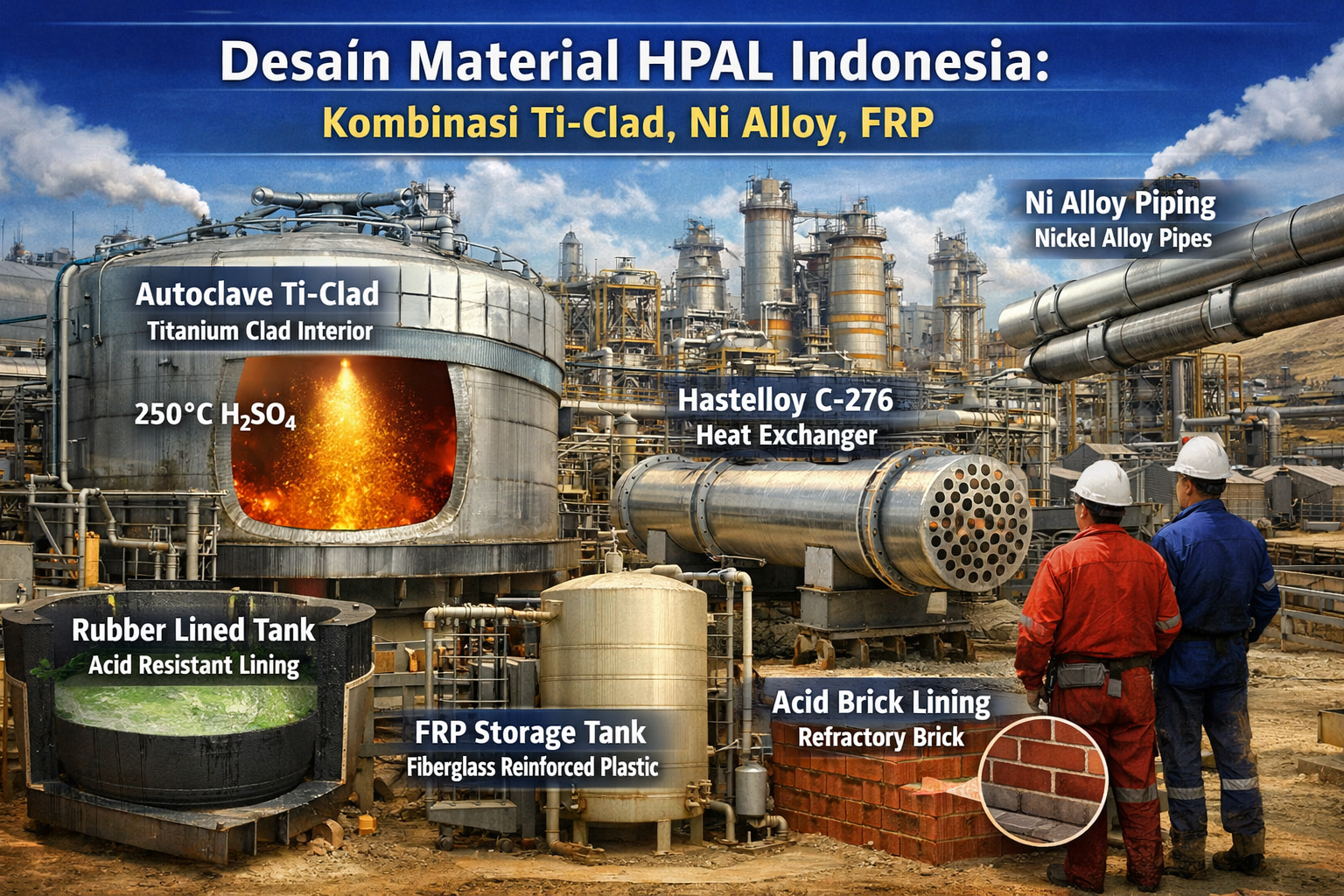
Layering protection is standard: Ti‑clad steel autoclaves, Hastelloy C‑276 heat exchangers, 316L/904L piping in warm acid, rubber‑lined mixing tanks, and FRP in dilute sections. This layered strategy—titanium + nickel‑alloys + rubber + brick—is specifically recommended for HPAL (nickelinstitute.org) (www.spglobal.com).
Trade‑offs are blunt: high‑Ni alloys can cost 5–20× carbon steel but can cut corrosion from millimeters to fractions of a millimeter per year, per Haynes and Rolled Alloys data (e.g., C‑276 at ~0.03–0.05 mm/y in test acids) (www.hayneswireco.com) (www.rolledalloys.com). The reliability dividend only pays with a committed integrity program—daily visuals, periodic UT scans, and disciplined data tracking (www.sulphuric-acid.com) (www.sulphuric-acid.com).
Stainless ancillaries in context
Where mild acid exposure and ambient temperatures apply, 316L appears in utility components—even as its limits in concentrated H₂SO₄ are documented. Note the contrast when selecting any 316L stainless steel ancillary (316L stainless steel): in HPAL acid circuits, use is confined to dilute conditions or protected storage windows, as above (hghouston.com) (www.rolledalloys.com).
Sources: Nickel Institute guidance (nickelinstitute.org) (nickelinstitute.org), corrosion data from Haynes International (www.hayneswireco.com) and Rolled Alloys (www.rolledalloys.com) (www.rolledalloys.com) (www.rolledalloys.com) (www.rolledalloys.com) (www.rolledalloys.com), equipment manuals and inspection guides (www.sulphuric-acid.com) (www.sulphuric-acid.com) (www.sulphuric-acid.com) (www.sulphuric-acid.com) (www.sulphuric-acid.com), and project/market commentary (www.spglobal.com) (www.spglobal.com) (www.spglobal.com). For plastics in acid storage, see Indonesian practice (www.flootank.com).