
Nickel operations are weighing low‑cost geotextile bags against mechanical belt filter presses to cut sludge volumes and hauling bills — with polymer chemistry doing the heavy lifting. Case data show big differences in energy, throughput, and time to dryness, but both hinge on dialing in flocculants.
For mine water treatment plants, the cheapest liter of water is the one squeezed out of sludge on site. In nickel mining, that choice increasingly comes down to passive geotextile dewatering bags (“geotubes”) versus continuous belt filter presses — and how much polymer it takes to make either sing (bishopwater.ca).
Both routes can capture solids and shrink volumes dramatically. But they diverge on speed, power draw, and how long operators must wait for final dryness — with the geotube option often trading time and lay‑down area for lower capital and energy (www.solmax.com).
Geotextile tube dewatering performance
Geotextile bags are passive fabric containers; diluted tailings or sludge is pumped in, water drains through the porous fabric, and a dewatered “cake” consolidates inside (a simple setup that needs only a pump, low power, and modest operator skill) (bishopwater.ca). Capital cost is low (fabric, pumps, hoses) and the system is modular for remote sites or when impoundments are full (bishopwater.ca) (www.solmax.com).
In practice, geotubes typically cut moisture by 50–70% — for example, slurries reduced from ~80% to ~24–40% water (www.westwoodwater.com). Over time, “dry” cake solids can reach on the order of 30–55% (www.tencategeo.asia). One Kalimantan nickel/coal mine pumped 160,000 m³ of slurry into six 100 m×36.6 m geotubes, yielding ≈20,000 m³ of dry cake — about an 87.5% volume reduction (www.solmax.com). Consolidation takes days–weeks (often ~4–8 weeks for ~50% solids) and needs lay‑down area, but the final volume is much smaller than in traditional ponds (www.tencategeo.asia) (www.solmax.com).
Conditioning is essential: without polymer, fines clog the fabric and drainage slows. Adding polyacrylamide flocculant (often cationic PAM) at ~1–5 mg per g of solids (equivalent to g/kg dosing) accelerates settling and improves dryness (www.mdpi.com) (www.mdpi.com). In one study, ≈2 mg PAM per g total solids (≈2 g/kg) inside a geotube was needed to keep effluent turbidity within discharge limits (www.mdpi.com). With optimized dosing, polymers can raise cake solids by 10–20 percentage points (e.g., from ~30% to ~40–50%) by agglomerating fines (www.mdpi.com) (www.tencategeo.asia). The polymer also retains >90% of suspended solids, trapping metals and nutrients in the cake (www.mdpi.com). Because the cake stays contained, odors and spills are minimal, and the recovered water can often be recycled on‑site. Plants typically source such flocculants as part of a broader chemical program.
Belt filter press operating envelope
Belt filter presses (BFPs) are continuous mechanical dewatering units with gravity‑drainage and compression zones; sludge is fed onto a moving porous belt, then sandwiched and squeezed through rollers to expel water (www.climate-policy-watcher.org) (www.climate-policy-watcher.org). This mature, widely used setup is known for reliability. Case metrics show solids capture >95% (www.climate-policy-watcher.org) and final cake solids around 18–30% (i.e., 70–82% moisture) (www.climate-policy-watcher.org). Typical municipal feeds (4–12% solids) yield cakes in the mid‑20% range (www.climate-policy-watcher.org), and higher feed solids or multi‑stage presses can push toward 30% solids.
Polymers are critical here too: raw sludge is mixed with flocculant before the gravity zone. Doses run ~1–10 g per kg of dry solids (0.1–1.0% by weight) (www.climate-policy-watcher.org). Proper flocculation yields dense, fast‑draining flocs and >95% solids capture (www.climate-policy-watcher.org). Insufficient polymer produces thin cakes (<10% solids), while optimal jar‑test‑guided dosing delivers ~18–27% solids and clear filtrate (www.climate-policy-watcher.org) (bishopwater.ca). In practice, polymer type and chemistry are tailored to sludge (e.g., cationic PAM for anionic clays), sourced among water and wastewater chemicals.
Throughput is a BFP strength. Typical belt widths are 1–3 m, with feed rates about 80–380 L/min per meter of belt (www.climate-policy-watcher.org). A 2 m press may process ≈600–1,000 L/min with adequate feed solids, and might be sized for ~100–200 m³/d of thickened sludge. The trade‑off: higher equipment CAPEX (hundreds of thousands USD), significant electricity consumption (motors and wash pumps on the order of kW), and active supervision to adjust belt speed, tension, and polymer feed; operators also manage cake discharge and belt washing (bishopwater.ca).
Polymers and floc formation mechanisms
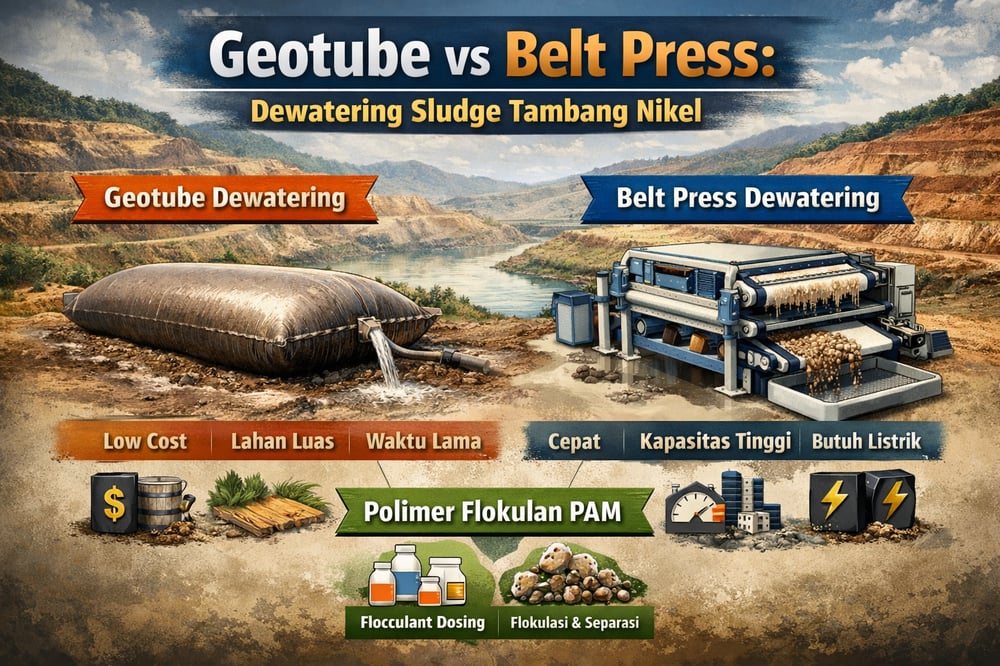
Across both systems, polymeric flocculants — high‑molecular‑weight polyacrylamides (often cationic for mine sludge) — adsorb onto clay/metal oxides and “bridge” particles into larger, faster‑draining flocs (www.mdpi.com). In belt presses, typical doses are ~1–10 g/kg solids (www.climate-policy-watcher.org); for geotubes, similar or slightly lower doses on the order of 0.1–0.5% by weight are used, optimized via jar tests (mg polymer per g of total solids is reported as mgPol/gTS) (www.mdpi.com). In one case, ~2 g/kg dosing inside a geotube reduced effluent turbidity to acceptable limits (www.mdpi.com) and produced cakes 25% solids or higher. In belt presses, optimized polymer feeds often double cake solids versus unconditioned sludge. Overall, polymers can trim the final wet volume by ~20–50% relative to unflocculated slurry, cutting hauling and disposal in proportion.
On terminology: “gTS” denotes grams per gram of total solids (used here as mg polymer per gram total solids), and “PAM” refers to polyacrylamide, a common flocculant. These flocculants are the lever that shifts capture efficiency and dryness.
Comparative performance summary
- Dewatering efficiency: Belt presses reliably produce ~20–30% solids cakes (www.climate-policy-watcher.org). Geotextile tubes can achieve drier solids (~30–50% if given time) (www.tencategeo.asia) (www.mdpi.com), yielding smaller final volume.
- Throughput & scale: Belt presses handle continuous flow (hundreds of L/min per belt meter (www.climate-policy-watcher.org)) but are limited by size/number of presses. Geotextile systems scale by adding bags: a single large tube can handle hundreds of m³/h (e.g., 550 m³/h in a Kalimantan case (www.solmax.com)), and aggregate flow can reach thousands of L/min across several units (bishopwater.ca).
- Capital & energy: Geotextile setups have low CAPEX (fabric, pump, simple mixers) and minimal energy (only pumps) (bishopwater.ca). Belt presses cost much more and need constant power for belts and backflushing.
- Operation & labor: Geobags are easy to operate; after setup they run with little oversight (polymer/pump auto‑feed) (bishopwater.ca). BFPs require trained operators for tuning and maintenance (belt alignment, wash, etc.).
- Dewatered sludge handling: Geotube cakes stay contained and can be left to dry on site, reducing handling. Belt press cakes emerge moist and must be conveyed to storage or further drying, with spillage and exposure risks. Geotubes also retain ~95% of contaminants in the cake (bishopwater.ca).
Bottom line for mine water plants
Geotextile dewatering bags offer a low‑cost, low‑energy path for large or remote nickel mine sludge volumes, achieving high solids capture and up to ~50%+ cake solids with polymer — albeit over longer timeframes (www.tencategeo.asia). Belt filter presses provide faster, continuous dewatering to ~20–30% solids, fitting centralized plants with skilled operators and available power (www.climate-policy-watcher.org). In both cases, proper polymer conditioning — on the order of a few grams per kilogram dry solids — is the critical lever to maximize efficiency and minimize final sludge volume (www.mdpi.com) (www.climate-policy-watcher.org).
References: Authoritative sources and case studies provide these figures and comparisons (www.westwoodwater.com) (www.climate-policy-watcher.org) (www.climate-policy-watcher.org) (www.mdpi.com) (www.mdpi.com) (www.mdpi.com) (bishopwater.ca) (www.solmax.com).
