

Industry: Landfill | Process: Leachate_Pre
Landfill leachate—the high‑strength wastewater generated when rain, runoff or intrinsic waste moisture percolate through municipal solid waste—packs extreme loads of organics, nutrients, salts and metals. Untreated, it can contaminate soil and groundwater (ResearchGate) (EPA NEPIS).
In warm, humid Indonesia, production is essentially continuous—even in “dry” seasons—because waste moisture and humidity stay high (ResearchGate). That is why Indonesian regulations (MOEF PermenP 59/2016) require collection and treatment so discharge meets strict limits (ResearchGate) (ResearchGate). In practice, many raw leachates far exceed those limits (ResearchGate) (MDPI).
Effluent limits and compliance metrics
Indonesian discharge limits (PermenP 59/2016) apply at the point of discharge to receiving water (ResearchGate) (ResearchGate):
- pH: 6.0–9.0
- BOD5 (biochemical oxygen demand, 5‑day test): ≤150 mg/L
- COD (chemical oxygen demand): ≤300 mg/L
- TSS (total suspended solids): ≤100 mg/L
- Total N (TKN + nitrate + nitrite): ≤60 mg/L
- Hg: ≤0.005 mg/L; Cd: ≤0.1 mg/L
Regulatory note: the limits above apply at discharge. Leachate must be treated—usually biologically—because raw concentrations are commonly many times higher.
Characterization parameters and why they matter
Design lives or dies on the data. A robust program captures:
- Physical: pH, temperature, electrical conductivity (EC), turbidity. As leachate ages, pH moves to neutral/alkaline, and salts drive very high EC/TDS; TSS can exceed 100 mg/L (ResearchGate).
- Organic matter: BOD5, COD, total organic carbon (TOC). COD can hit a few hundred up to 70,000 mg/L (ScienceDirect); young leachate BOD5 commonly runs 4,000–13,000 mg/L, falling to <1,000–2,000 mg/L in older leachate (ResearchGate). The BOD5/COD ratio gauges biodegradability: ~0.4–0.7 when young; <0.1 when mature (ResearchGate). Volatile fatty acids (VFAs—acetic, propionic, etc.) can be ~50% of organic carbon in young leachate and are tracked via GC or titration (EPA NEPIS) (EPA NEPIS).
- Nutrients: Ammonia (NH4‑N) dominates, often hundreds to >1,000 mg/L in mature leachate (ScienceDirect) (ResearchGate). Measure TKN (total Kjeldahl nitrogen) and nitrate/nitrite as needed; nitrate is usually low in young, anaerobic leachate but can appear with aeration or storage via nitrification (MDPI). Phosphate is often in the tens of mg/L and is tracked for nutrient balance.
- Inorganics: Major ions (Cl−, SO42−, Na+, K+, Ca2+, Mg2+, HCO3−). Chloride typically ranges 100–5,000 mg/L (ScienceDirect) and 3,000–5,000 mg/L has been reported at Asian sites (MDPI). Sulfate spans 10 to >8,000 mg/L (ScienceDirect). Alkalinity (bicarbonate) rises with age, often 600–7,500 mg/L as HCO3− (ScienceDirect).
- Metals and trace organics: Heavy metals (Fe, Zn, Mn, Pb, Ni, Cu, Cr, As, Cd, Hg) vary from μg/L to tens of mg/L; Fe and Zn can be especially high in young leachate (EPA NEPIS). Use ICP‑MS/OES (inductively coupled plasma mass/optical emission spectrometry) after filtration/digestion for regulated metals plus Fe, Zn. Check cyanide, phenols, VOCs (volatile organic compounds) if industrial inputs are suspected; endocrine disruptors/PPCPs are site‑specific and need specialized labs.
- Microbial indicators: E. coli/coliforms are less determinative for process selection; trace organic micro‑pollutants can be assessed case‑by‑case.
Sampling protocols and analytical methods
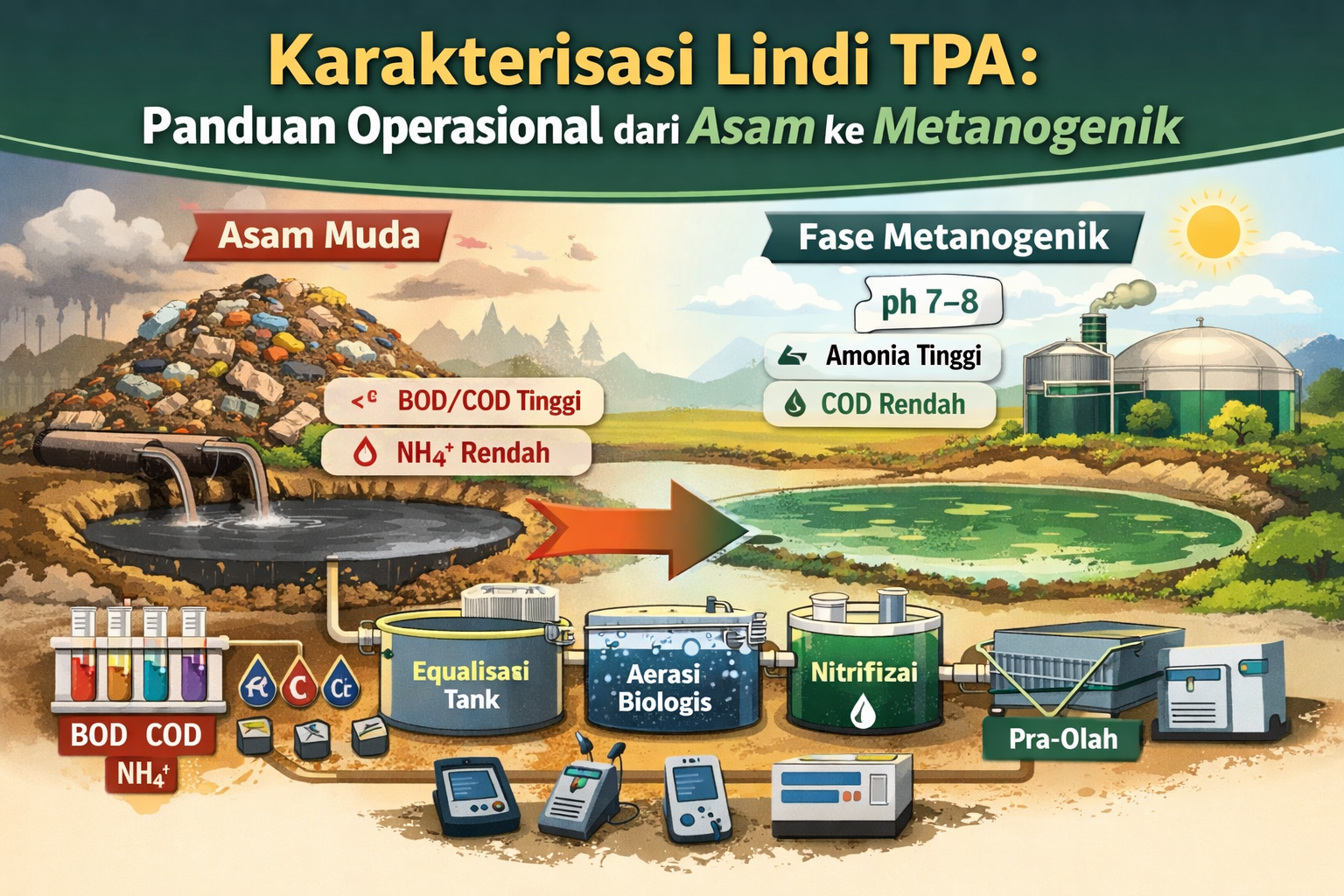
Sample from collection sumps or ponds after thorough mixing; analyze fast—BOD and hydraulic retention time (HRT) are sensitive. Prepare field aliquots (e.g., 0.45 μm filtration for metals; acidify nutrients) per standard methods; measure pH, EC, DO and temperature in situ. Monthly monitoring is typical per Indonesian regulation (ResearchGate), but weekly or even daily checks during startup capture variability.
Follow APHA/ISO methods: pH meter; conductometer; gravimetric TSS/TDS; BOD5 (5‑day test); COD (dichromate); TOC analyzer; Kjeldahl digestion; ion chromatography or titration for NO3−, SO42−, Cl−; spectrophotometric nutrients; atomic absorption or ICP for metals; GC‑MS (gas chromatography–mass spectrometry) for VOCs/phenols if needed.
Chemistry shifts across landfill phases
These are well‑recognized decomposition phases with signature chemistries (EPA NEPIS) (ResearchGate):
- Initial phase (~0–0.5 years): Infiltration water dominates; organics low if micro‑conditions are aerobic; pH ~6–7. Data in practice start in the acidogenic phase.
- Acidogenic (~0.5–3 years): Hydrolysis/fermentation produce large VFAs; pH often <6 (down to ~5) (ResearchGate). “Young” leachate is very high in organics: BOD5 4,000–13,000 mg/L; COD 30,000–60,000 mg/L; BOD/COD 0.4–0.7; VFAs nearly half of TOC (ResearchGate) (EPA NEPIS) (EPA NEPIS). Ammonia often <~400 mg/L NH3‑N (ResearchGate). Metals are relatively soluble; Fe and Zn can spike (EPA NEPIS). Example: pH ~5–6.5; BOD5 in the thousands; COD in the tens of thousands; NH4‑N <400 mg/L (ResearchGate).
- Transition (~2–5 years): Methanogens emerge and consume VFAs; pH rebounds to 6.5–7.5; BOD and VFAs drop; ammonia climbs to a few hundred mg/L; BOD/COD falls. Warmer tropical sites often move through this phase faster.
- Methanogenic (>5–10 years): pH ~7–8; bicarbonate and ammonia buffer alkalinity. COD typically hundreds to a few thousand mg/L (<4,000 mg/L often observed) and BOD5 a few hundred mg/L or less; ammonia‑N often >400–1,000 mg/L; BOD/COD <0.1 (refractory humics dominate) (ResearchGate). Dissolved metals decline as pH rises (precipitation/adsorption; decreasing with age) (EPA NEPIS). Example: mature Indonesian sites report COD <1,000 mg/L (after dilution/settling), BOD5 <100 mg/L, NH4‑N >500 mg/L, pH ~7–8 (ResearchGate) (ResearchGate).
- Long‑term (post‑closure): Flows diminish but risk persists for decades; Indonesian sites aged ~10–20 years still report COD/BOD in the hundreds to thousands mg/L, above the 300/150 mg/L limits (ResearchGate).
Climate influence on leachate quality
Warm, humid Indonesia accelerates decomposition; the acid phase can be short (months to a couple of years) and methane onset earlier. Heavy rainfall dilutes concentrations but increases volume; in drier stretches, percolation drops and contaminants can concentrate. Seasonal monitoring often shows lower conductance and COD during rains (MDPI).
Concentration ranges for design calculations
Global reviews and Indonesian case studies show extreme variability:
- Global ranges: COD 100–70,900 mg/L; pH 5.8–8.5 (ScienceDirect).
- Young leachate (1–5 yr): pH ~4.5–6.5 (acidic) (ResearchGate); BOD5 4,000–13,000 mg/L; COD 30,000–60,000 mg/L; BOD/COD 0.4–0.7 (ResearchGate).
- Mature leachate (>10 yr): pH ~7.0–8.5 (neutral to alkaline) (ResearchGate) (ResearchGate); BOD5 <100–500 mg/L; COD 800–4,000 mg/L; BOD/COD <0.1 (ResearchGate).
- Indonesian field data: pH 7.3–8.5 at several sites (ResearchGate); BOD5 88–1,600 mg/L (e.g., 1,600 mg/L at Semarang) (ResearchGate); COD 299–6,518 mg/L (e.g., 6,518 mg/L at Banjarmasin) (ResearchGate); implied BOD/COD 0.2–0.4; chloride often 3,000–5,000 mg/L observed (MDPI); conductivity 20–40 mS/cm on dry samples (MDPI).
- Ammonia: young <100–400 mg/L NH4‑N; mature >400–1,000+ mg/L NH4‑N (ResearchGate).
- Major ions: chloride 100–5,000 mg/L; sulfate 10–8,000+ mg/L; bicarbonate typically 600–7,500 mg/L (ScienceDirect).
- Conductivity: often 10–30 mS/cm (very high) when young; 3–10 mS/cm when mature; Indonesian dry samples 20–40 mS/cm (MDPI).
- TSS: 100–1,000 mg/L (variable) when young; 50–300 mg/L when mature.
- Metals (dissolved): up to tens of mg/L for Fe, Zn in young leachate; decrease with age (EPA NEPIS) (EPA NEPIS).
Design implications for pre‑treatment and storage
High BOD/COD in young leachate is driven by degradable VFAs and organic nitrogen, which strongly favors biological treatment—activated sludge, anaerobic ponds, or fluidized‑bed bioreactors—sized for several g/L‑day COD loads (EPA NEPIS) (EPA NEPIS). Where activated sludge is selected, designers often pair it with equalization and solids handling; packaged options like an activated sludge system can anchor that biological stage.
As landfills mature, ammonia becomes the dominant pollutant. Treatment trains must include nitrification (biological) or air stripping; at >500 mg/L NH4‑N, aeration basins or chemical routes must be scaled accordingly. In Indonesia, discharge limits for NH4 may be <50 mg/L, pushing many mature leachates to multi‑stage treatment.
pH adjustment frequently precedes biology in acidic, young leachate: lime or soda ash additions bring pH toward 7–8. Metered delivery via a dosing pump is a common way to control neutralization setpoints. In mature leachate, pH is often already ~7–8, adjusted as needed for nitrification.
Particulates and metals: preliminary solids removal (settling or filtration) is advised when TSS/metals run high. Studies found most toxic metals were particle‑bound, so sedimentation could remove ~70% of metals (MDPI) (EPA NEPIS). Compact sedimentation with a lamella settler can slot ahead of the biological or polishing steps; some sites also front‑end with physical separation to intercept debris.
Equalization and storage matter because flows and loads swing with rainfall and operations. An equalization tank sized from characterization data (flow, COD, NH4 load) for at least several days’ capacity smooths peaks. Indonesian datasets show “mature” leachate is often 10–20× too strong for raw discharge, reinforcing the need for retention (ResearchGate).
Monitoring during operation should include online pH, EC, NH4‑N and ORP (oxidation‑reduction potential) to track process health, with periodic lab checks of BOD/COD, metals and other parameters to confirm effluent quality and detect any input changes.
What operators should take away
Young, acidogenic leachates are marked by very high COD/BOD and low pH; mature, methanogenic leachates carry lower organics but high ammonia and neutral‑to‑alkaline pH (ResearchGate) (ResearchGate). The data trends are consistent across global and Indonesian studies—e.g., BOD5 drops from thousands to hundreds of mg/L while NH4‑N rises from <400 to >500 mg/L (ResearchGate) (ResearchGate).
Pre‑treatment and storage design should reflect those extremes—chemical neutralization and anaerobic/biological treatment for “young” leachate; nitrification/stripping for “older” ammonia loads; solids removal where metals are particle‑bound. Routine profiling (bi‑weekly or monthly) and updating load calculations keeps plants aligned with Indonesian standards and site permits (ResearchGate) (EPA NEPIS).
References: Regulations and limits from Indonesia’s MOEF PermenP 59/2016 (ResearchGate) (ResearchGate); Indonesian site strengths and variability (ResearchGate); global ranges and temporal evolution (EPA NEPIS) (EPA NEPIS). The sources linked inline include the precise values underpinning engineering decisions.