

Industry: Coal_Mining | Process: Coal_Washing_&_Preparation_(Prep_Plant)
Wear is the plant killer in coal preparation. Fast, abrasive slurries and sharp mineral inclusions batter pipes, cyclones, pumps and chutes — unless materials and operating discipline change. The result when they do: multi‑fold life extensions, fewer shutdowns, and a measurable cut in maintenance spend.
Across prep circuits, the focus has narrowed to two levers: hard, wear‑resistant upgrades (ceramic linings, high‑chrome pump internals) and running pumps where they want to run — near their Best Efficiency Point, or BEP (the point on a pump curve where internal recirculation is minimized and efficiency peaks).
Abrasive slurry wear conditions
Coal is relatively soft, but it carries hard mineral inclusions like silica and moves as a fast slurry — flow can reach roughly 25–30 m/s — which makes for severe abrasion and erosion in coal prep plant equipment (ResearchGate) (Abrasion Resistant Pipe). Pulverized coal pipelines in power plants, for example, see scouring velocities up to 30 m/s; ordinary steel (approximately HRC60 on the Rockwell C hardness scale) wears out in 1–2 years, whereas ceramic liners (hardness HRA≥85 on the Rockwell A scale) show only about 0.2 mm wear in 5 years — roughly a 3× life improvement (Abrasion Resistant Pipe). Dense‑media circuits (heavy‑media slurry) magnify the problem: heavy‑media slurry pumps and cyclone feeds are “among the highest wear applications” in a coal prep plant (Coal Age).
Ceramic linings and tiles
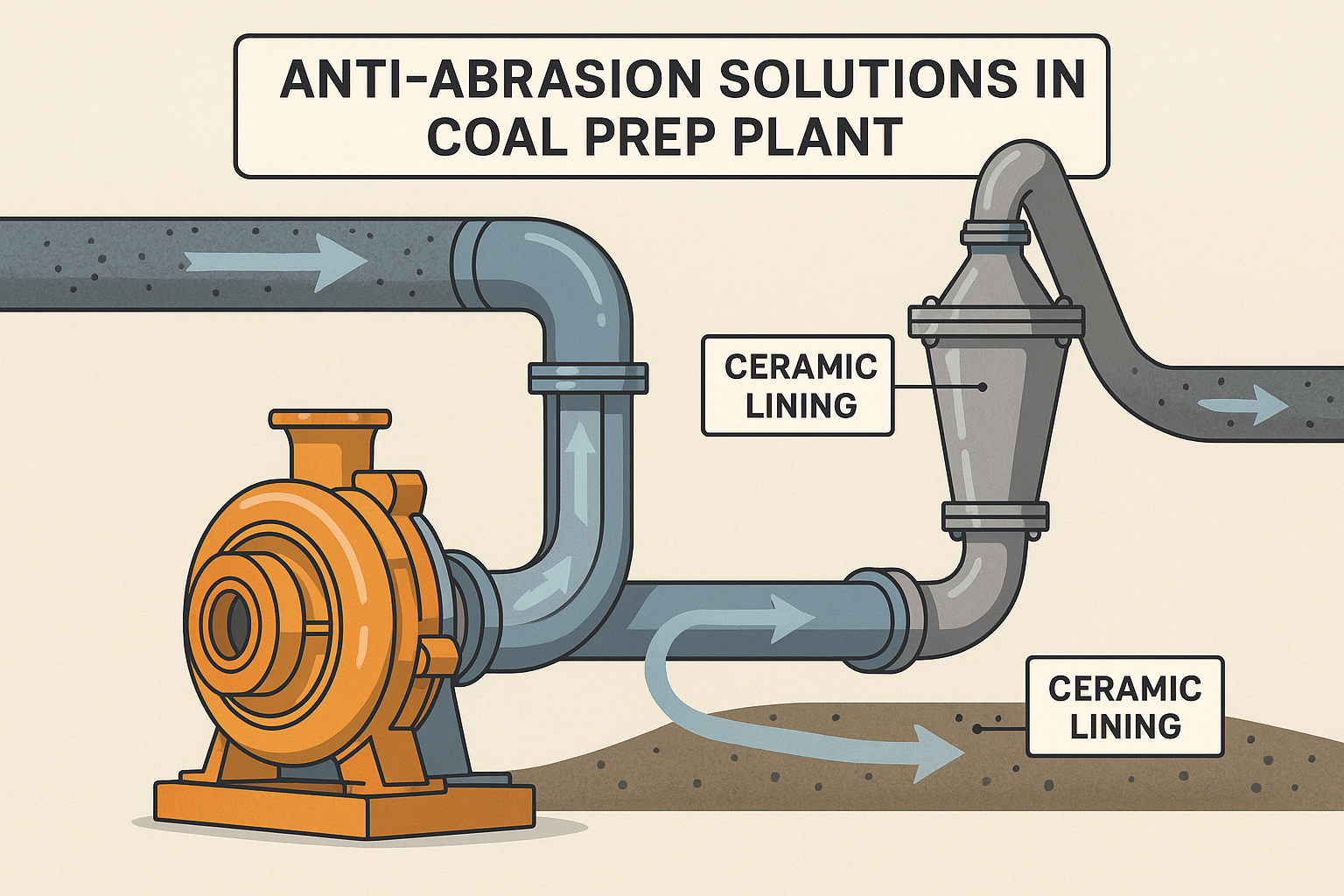
Industry practice is to armor high‑velocity, high‑impact surfaces with ceramics — typically high‑alumina or silicon carbide tiles — in pipes, elbows, cyclones, hoppers and dewatering units. Ceramics’ hardness and chemical inertness mean negligible particle embedment (Abrasion Resistant Pipe) (ResearchGate), delivering multi‑fold life gains in practice. Replacing a steel slurry line or chute with alumina‑ceramic modules has extended service life by 5–6× in mining trials (Australian Mining Review). HMA Wear Solutions reports ceramic pipe upgrades that took a standard 1‑year HDPE steel line to an additional 8–10 years of life (Australian Mining Review).
Image data from a mine shows dewatering cyclones lasting 3 months versus 24 months with a ceramic upgrade — an 8× life extension (Australian Mining Review). Kingfisher Industrial reports cyclones clad with 25–6 mm alumina tiles that delivered a guaranteed 3‑year life — a 300% improvement over the original 9‑month cast‑iron units — at lower purchase cost because no machining was required (Australian Mining Review) (Australian Mining Review). Summed up, ceramic linings typically cut wear rates by about 5–6× versus unlined steel (Australian Mining Review) (Australian Mining Review), translating to fewer replacements and higher uptime.
Two additional benefits: multi‑year maintenance relief and thinner constructions. One hard‑ceramic pipeline used only a 3 mm steel shell with an 8–10 mm ceramic lining while maintaining pressure rating and achieving 5–6× slower wear than a solid steel pipe (Australian Mining Review). Case studies cite life increases of 5× or more; planned maintenance intervals can stretch out by a decade with ceramic technology (Australian Mining Review) (Australian Mining Review). One supplier’s designer ceramic pipe sleeves “can save eight to ten years of maintenance” relative to steel piping (Australian Mining Review).
High‑chrome alloys and coatings
Centrifugal slurry pumps in coal plants commonly rely on high‑chromium cast irons (Cr ≥27%) for wet‑end parts. These high‑Cr alloys deliver ~650 HB (Brinell hardness; roughly 60 HRC on the Rockwell C scale) and solid corrosion resistance; Schurco Slurry lists 27–28%‑Cr parts (≥650 HB) as standard for severe slurries (Mining Weekly). Tungsten‑carbide cermet coatings further harden critical wear surfaces: HVOF (high‑velocity oxy‑fuel)‑sprayed WC–Co/Cr coatings can reach >1200 HV (Vickers hardness) and pass >400 h salt‑spray corrosion tests, markedly outperforming non‑coated steel; these coatings can be reapplied during refurb, restoring pump internals (Pump Industry).
Material selection remains duty‑specific. Rubber or polyurethane liners suit very fine, low‑abrasion slurries, but coal prep slurries are often coarse and fast. Vendors advise against rubber liners when solids are large/sharp, temperatures are high or impeller speeds are high; high‑chrome metal parts are recommended in those cases (Atlantic Pumps). In one comparison, “large coarse/sharp particles” and “high speeds or high heads” list rubber as “not appropriate” and high‑chrome as “recommended”; rubber may be acceptable for clean or fine slurries where impact is low (Atlantic Pumps).
Pump duty and BEP operation
Proper pump selection starts with real duty — flow, head, particle size and density. Manufacturers and best‑practice guides (e.g., the Hydraulics Institute) classify slurry duties (Service Classes 1–4) and map them to pump selections; duty points should be checked against pump curves, and resized or speed‑adjusted as process loads change (Metso).
Nuances of operation drive wear. Running near BEP (Best Efficiency Point) minimizes internal recirculation and impeller tip speeds, reducing wear. As Metso puts it: “pumps like to work at their most efficient point because this reduces the amount of wear seen, ultimately extending the service life” (Metso). Trimming far below BEP triggers internal recirculation and severe abrasion; pushing above BEP can generate turbulent inflow and impeller eye erosion (Metso). Small shifts in head or flow — higher tonnage, different feed, longer pipe runs — can “quickly turn a maintenance headache” by accelerating wear; monitoring and using VFDs (variable‑frequency drives) or changing pump size keeps operation in the preferred range (Metso).
Other operational controls: maintain adequate NPSH (net positive suction head) to avoid cavitation, keep suction lines free of settled solids, and avoid extended low‑flow or dry conditions. On commissioning or after rebuild, record baseline vibration and performance; many plants now add bolt‑on vibration/temperature monitors at grease‑lubrication points (e.g., threaded vibration probes at bearing housings) for real‑time health, with flow and pressure instruments to spot duty drift (Coal Age).
Preventive maintenance intervals
Even with optimized materials and duty, preventive maintenance (PM) is non‑negotiable. For coal prep slurry pumps, open and inspect roughly every 1,000 operating hours: remove the inlet/outlet spool pieces, use a flashlight to find high‑wear zones, and gauge liners or abraded areas (Coal Age). Reset impeller clearance on the suction side; “closing the impeller clearance…is important to reduce recirculation, increase efficiency and extend the wear life” (Coal Age). Inspect packing or mechanical seals and replace on evidence of leakage.
Bearings typically use heavy grease; follow OEM lubricant/frequency guidance. Auto‑lube cups help but must be checked or they can run dry unnoticed (Coal Age). Beyond pumps, vibrating screens may require oil changes every ~800 hours and routine suspension spring checks (Coal Age) (Coal Age). APAC experience underscores that visual inspections and planned maintenance extend prep‑plant equipment life (Coal Age).
Planning matters: have lifting gear and spares ready; many mines keep a pool of rebuilt pumps to swap in a ready spare and overhaul the worn unit offline. For heavy pumps, in‑situ repairs using a pre‑built rotating assembly can further reduce downtime.
Measured outcomes and availability
Where these measures are applied, results are quantifiable. Composite ceramic piping has cut wear rates by ~5–6× relative to steel — a line swapped yearly can push toward a near‑decade life (Australian Mining Review) (Australian Mining Review). Cyclones and chutes lined with alumina routinely last years instead of months (Australian Mining Review). Pumps run at optimal BEP use ~10–20% less power on average (industry practice), and suffer fewer failures (Atlantic Pumps). One study notes even “lower grade ceramics run well in straight pipes” and can add 8–10 years before replacement (Australian Mining Review). For mine operators, that looks like >90–95% uptime and lower life‑cycle cost.
Citations and practice guidance
Technical reviews and case studies quantify the abrasion environment and the impact of ceramic and high‑chrome solutions: extreme slurry conditions (25–30 m/s, silica inclusions) (ResearchGate), and 5–10× life extensions from ceramic and high‑chrome implementations (Australian Mining Review) (Australian Mining Review). Manufacturer guidelines consolidate best practice on BEP‑aligned operation, 1000‑h pump inspections, and duty‑matched materials and sizing (Coal Age) (Metso) (Atlantic Pumps).
Bottom line: a maintenance strategy centered on ceramic linings and high‑alloy pump parts — paired with duty‑matched pump selection, BEP‑centric operation, and disciplined PM — extends component life by several‑fold (often 3×–10×), reduces unplanned shutdowns, and delivers a clear return on investment (Abrasion Resistant Pipe) (Australian Mining Review) (Metso) (Coal Age).