

Industry: Aquaculture | Process: Disinfection_&_Water_Quality_Management
Aquaculture now supplies over half of the world’s seafood (www.fao.org). But disease outbreaks — estimated at ∼$6 billion per year globally (www.was.org) — and water quality risks make disinfection a defining operational choice.
Contaminated water is a primary vector for bacteria, viruses, fungi, and parasites. The right approach depends on system type (recirculating aquaculture systems, or RAS; flow‑through; ponds), target pathogens, and cost/safety trade‑offs. Below, a comprehensive guide to ultraviolet (UV) irradiation, ozonation, chlorination with dechlorination, and “specialty” oxidizers like peracetic acid (PAA) and stabilized chlorine dioxide (ClO₂) — with quantitative efficacy, operational costs, and safety considerations, and a decision framework for farm managers.
Ultraviolet sterilization: dose and clarity
UV-C (germicidal ultraviolet at ~254 nm) inactivates microbes by damaging DNA/RNA. In practice, water passes a lamp inside a reactor, receiving a controlled dose (millijoules per square centimeter, mJ/cm²). UV leaves no chemical residual, but performance depends on clarity: turbidity should be <1 NTU, often after sand filters or cartridge pre‑filters.
In trials, UV is strongly effective against bacteria and many viruses. Hansen (1999) reported 99.9% (3‑log) kill of infectious salmon anemia virus (ISAV) at ~33 J/m², and of viral haemorrhagic septicaemia virus (VHSV) at ~7.9 J/m²; infectious pancreatic necrosis virus (IPNV) required ~1188 J/m² (pubmed.ncbi.nlm.nih.gov). Bacteria (e.g., Vibrio) typically need only a few mJ/cm² for a 3‑log reduction. Protozoan cysts and eggs are among the most UV‑resistant (often requiring hundreds of J/m²). Well‑designed UV systems target 30–60 mJ/cm² to achieve multi‑log reductions in clear water.
Operationally, “UV must follow filtration”: even small particulates or color attenuate dose. Facilities often run a sand filter before UV; many apply a polishing step with a sand‑silica filter and then a cartridge filter to secure <1 NTU. Lamp intensity decays over time (~10–15% per 1,000 hr), so annual lamp and quartz sleeve replacement is typical. Electric draw is modest — roughly 0.05–0.2 kWh per m³ treated; for example, a 1 kW UV can “treat” ≈100–200 m³/hr of clear water, depending on design. Capital costs scale with flow; operating cost is mostly power plus periodic lamp/ballast replacement. Vendors note that once sized, incremental lamp additions treat large volumes at low marginal cost.
Advantages include no disinfectant residual or byproducts (no THMs), and preservation of nitrifying/denitrifying bacteria in RAS biofilters. Worker safety requires shielding from UV‑C; closed housings and interlocks mitigate this. There is mercury disposal for lamps, although UV‑LEDs (260–280 nm) are emerging with similar germicidal efficacy and no mercury (pubmed.ncbi.nlm.nih.gov; pubmed.ncbi.nlm.nih.gov). Limitations: water quality is the primary constraint; suspended solids (plankton, silt, biofilm fragments) can shield pathogens, and UV provides no residual. Some organisms (notably protozoan cysts) remain highly UV‑resistant. Multi‑barrier schemes (filtration, then UV or UV+ozone) are common (www.fishhealth.ie). For reactor hardware, farms typically specify a dedicated ultraviolet disinfection unit sized to flow and target dose.
Ozonation systems: CT and ORP control
Ozone (O₃) is a very strong oxidizer (oxidation potential ~2.07 V). It’s generated on‑site by corona discharge (from dried air or oxygen) and injected via Venturi/diffuser. In water, ozone rapidly decomposes to O₂ and hydroxyl radicals (•OH), enhancing oxidation of organics; it leaves no long‑lived residual.
Efficacy is broad. In seawater in vitro, 0.063–0.064 mg/L total residual oxidant (TRO; ozone plus breakdown products) for 1 minute produced ~99% kill of Pasteurella piscicida and Vibrio anguillarum; the 99% (2‑log) inactivation CT (concentration×time) was ~0.056–0.081 mg·min/L. In mixed coastal seawater, 99.9% kill needed CT ≈0.621 mg·min/L (pmc.ncbi.nlm.nih.gov; pmc.ncbi.nlm.nih.gov; pmc.ncbi.nlm.nih.gov). In practice, dosing above ~0.5–1.0 mg/L with several minutes contact is often sufficient to sterilize typical aquaculture water (pmc.ncbi.nlm.nih.gov).
Beyond disinfection, ozone reduces turbidity, color, and odors. In a shrimp RAS study, ozone targeted to ~350 mV ORP (oxidation‑reduction potential) “stabilized the microbial composition,” prevented nitrite spikes, and accelerated nitrate conversion; UV alone did not (pubmed.ncbi.nlm.nih.gov).
Operationally, ozone systems are more complex: feed gas drying, high‑voltage generation, precise injection, and safe off‑gas handling (OSHA TLV ~0.1 ppm; workers should be shielded from ozone gas, e.g., >0.05 ppm). Design often targets a residual ORP (e.g., 400–700 mV) or specified CT; colder water improves solubility. Because ozone decomposes quickly, contact tanks or long diffusers ensure exposure.
Costs: generators have significant capex and higher energy use than UV. As a rough marker, a 10 g/hr generator might consume ~1–3 kW. In RAS, ozone can be continuous or timed; operating cost is on the order of ~$0.10–0.30 per m³ treated (electricity and maintenance). There’s no recurring chemical feed, but electrodes and parts require periodic replacement; optimizing contact and minimizing off‑gassing improves cost‑effectiveness (pubmed.ncbi.nlm.nih.gov).
Safety: ozone is highly toxic to fish at low residuals (96‑h LC₅₀ ~0.06–0.20 mg/L ozone or TRO for sensitive species like striped bass; www.e-fas.org). Applied ozone must be fully consumed or off‑gassed before water returns to tanks. Overdosage can damage gills (see Zhang et al., 2018). With bromide‑containing waters (seawater), ozone can form bromate (BrO₃⁻). High doses can also harm nitrifiers if not managed.
Chlorination and dechlorination: usage and residues
Chlorination — typically calcium hypochlorite (Ca(ClO)₂, “HTH”), sodium hypochlorite (bleach), or chloramine‑T — provides a “free chlorine” residual (mainly hypochlorous acid, HOCl) that kills via oxidation. In aquaculture it’s most often a one‑time treatment on empty systems: sterilizing ponds, new tanks, or intake water before stocking. Post‑harvest pond sterilization is common (www.globalseafood.org; www.fishhealth.ie).
Efficacy is high: HOCl is ~100× more potent than OCl⁻ ion (www.globalseafood.org). Farms typically aim for ~1–3 mg/L free chlorine (www.globalseafood.org). Claude Boyd (2008) notes that at pH 7–8, achieving 1 mg/L free chlorine requires ~1.5–3 mg/L HTH (www.globalseafood.org). Irish aquaculture guidelines recommend 100 ppm hypochlorite (0.01%) for 10 minutes to disinfect nets and tanks; 1000 ppm (0.1%) for nets can be used for hours of soak (www.fishhealth.ie; www.fishhealth.ie). Chlorinated lime (quicklime, CaO) on emptied earthen ponds — slaked with water to paste — raises pH and provides sustained disinfection (e.g., 0.5 kg/m² for 4 weeks; www.fishhealth.ie).
Chemical costs are low: Ca(ClO)₂ might be $0.3–0.5 per kg, and 1–5 kg can sanitize a cubic meter (depending on demand). Dechlorination adds a small cost; sodium thiosulfate is inexpensive and is commonly applied at 1–2 mg/L to neutralize ~1 mg/L HOCl. Where neutralization is specified, farms lean on a labeled dechlorination agent for predictable residual removal.
Safety: chlorine is toxic to fish and workers (“chlorine compounds can be toxic to culture species, but they also can be toxic to workers”; www.globalseafood.org). Sunlight degrades free chlorine (half‑life hours); outdoors, residuals last only a short time (www.globalseafood.org). Reactions with organics, ammonia, and nitrite increase demand — and can form chloramines and trihalomethanes (THMs), making discharge of chlorinated effluent regulated in many countries. In hatcheries or RAS, chlorine is used on empty systems or neutralized fully before reuse. For bulk chemical handling, many operators source disinfectants as regulated biocides with clear application labels.
Specialty oxidizers: peracetic acid and stabilized ClO₂
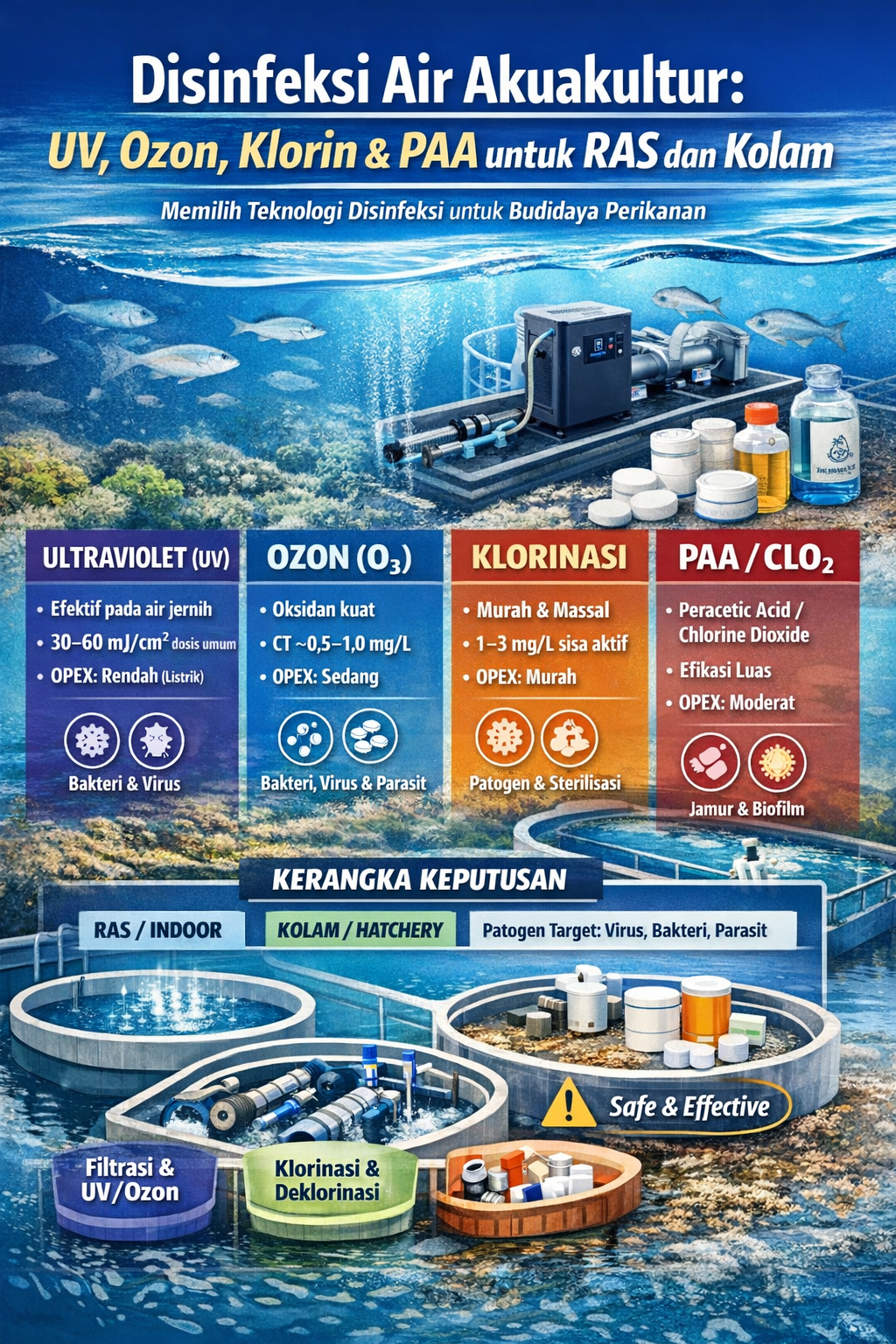
Peracetic acid (PAA) is a mixture of acetic acid and hydrogen peroxide (often 15–30% acetic, remainder H₂O₂). It’s a strong oxidizer/disinfectant that breaks down to acetic acid, water, and oxygen. PAA is effective against bacteria, viruses, fungi, and many parasites, often faster than chlorine or H₂O₂ alone, and leaves no toxic residue (www.rastechmagazine.com).
Good et al. (2022) call PAA “an efficacious alternative to common disinfectants” in aquaculture (onlinelibrary.wiley.com). In a salmon parr RAS, adding 0.2–1.0 mg/L PAA daily after vaccination significantly reduced saprolegnia infections and did not impair biofilter nitrification (www.rastechmagazine.com). Other RAS trials reported continuous 0.1 mg/L had negligible effect, while 10 mg/L caused water chemistry disruptions; continuous 1 mg/L raised ammonia — pointing to a careful balance (low–moderate PAA tolerated; high doses can depress nitrifiers) (pubmed.ncbi.nlm.nih.gov).
Applications: in RAS, PAA is often low‑level continuous or pulsed for biosecurity (Europe has accepted in‑tank use; in the US it was initially approved only for equipment/tank disinfection, with approvals evolving; www.rastechmagazine.com). In hatcheries and smaller tanks, PAA is used for emergency disinfection; for example, Proxitane Kickstart (a PAA/H₂O₂ blend) at ~0.4% v/v (4 mL/L) for 5 minutes on eggs or work surfaces is effective against salmonid viruses (www.fishhealth.ie). In ponds, PAA can disinfect surfaces and biofilms without long‑term residue. Safety: PAA is corrosive and pungent; label PPE and ventilation are required (OSHA exposure limits ~0.5 ppm vapor). It decomposes fully, so no post‑neutralization is required at recommended doses.
Chlorine dioxide (ClO₂) is generated from precursors (e.g., sodium chlorite plus an activator). It’s a rapid oxidizer that does not chlorinate organics (fewer THMs), decomposing to chloride, chlorite, and chlorate. In food processing, ~200–400 ppm achieves complete inactivation of Listeria in seconds; aquaculture uses far lower concentrations (www.selectivemicro.com). Irish guidelines recommend 1–1.5 ppm ClO₂ for disinfecting processing plant water (www.fishhealth.ie). Lower doses (0.1–0.5 ppm) can prevent biofilm formation and pathogen regrowth in RAS sumps and stand pipes (svsaqua.com). Hatcheries often use stabilized ClO₂ at 0.2–0.5 mg/L to rinse eggs and equipment; emergency dips or pond exposures may run a few mg/L for brief periods. Safety: ClO₂ gas at high ppm is harmful; at disinfection levels in water it’s fish‑safe when drained or broken down afterward. Chlorite residuals are regulated; ClO₂ does not form THMs. Excess gas should be vented.
Emergency and equipment disinfection protocols
Best practice starts with cleaning: removing organics and biofilm before disinfectant application (www.fishhealth.ie). Common doses include hypochlorite at 100–1000 ppm (0.01–0.1%) for ≥10 minutes; iodophor at ~100 ppm for 10 minutes (effective vs. fish viruses); Virkon Aquatic® (a PAA/surfactant mix) at ~1% for 10 minutes (effective vs. BKD, ISA, IPN); and peracid blends such as Proxitane 0.4% for 5 minutes (effective vs. IHNV/ISAV) (www.fishhealth.ie; www.fishhealth.ie; www.fishhealth.ie). Rinse equipment well before reuse.
Tanks and floors: empty rearing tanks can be treated with chlorine gas or HTH (5–10 mg/L free chlorine for 30 minutes), followed by neutralization. In earthen ponds dried out, slaked lime (CaO) can be applied as noted above (www.fishhealth.ie). Formalin was historically used in hatcheries but is banned/discouraged in many places; PAA or Virkon is now preferred for tank sterilization in those jurisdictions.
Water flush: during outbreaks, systems may be emptied and recirculated with a blanket PAA dose (e.g., 5–10 mg/L) for a short period, then drained and refilled (pubmed.ncbi.nlm.nih.gov). Zhang et al. 2024 recommend against continuous 1 mg/L PAA use, but short shock treatments can be valuable (pubmed.ncbi.nlm.nih.gov). Stabilized ClO₂ can likewise be dosed to a few mg/L in static water for a brief disinfection flush. Eggs and broodstock: iodophor (100–200 ppm) is widely used for egg surface disinfection; 10–50 ppm ClO₂ has been used for eggs in some hatcheries.
Comparative efficacy, cost, and safety
Efficacy: all methods can achieve high kill if properly applied. UV in clear water reduces most bacteria/viruses by ≥3 log at moderate doses (pubmed.ncbi.nlm.nih.gov), but is poor on oocytes/cysts. Ozone achieves similar or better performance (e.g., 99% kill of major fish pathogens at ~0.06 mg/L in 1 minute; 99.9% at CT ~0.6 mg·min/L in natural seawater; pmc.ncbi.nlm.nih.gov; pmc.ncbi.nlm.nih.gov). Chlorine at 1–3 mg/L is broadly biocidal. PAA at low mg/L is very effective and worked on fungi at 0.2–1 mg/L in RAS (www.rastechmagazine.com). ClO₂ at 1–2 ppm readily kills most waterborne pathogens (aquaculture‑specific live‑system data are fewer, but it’s at least as strong as chlorine per ppm).
Target pathogens: viruses (IHNV, VHSV, WSSV, etc.) are very susceptible to ozone and PAA; UV also works for most in clear water (birnaviruses like IPNV are UV‑resistant; pubmed.ncbi.nlm.nih.gov). Bacteria (Vibrio, Aeromonas) are killed by all methods at moderate doses. Parasites/cysts: ozone and high‑energy UV are most effective; chlorine/PAA kill free‑swimming stages but not hardy eggs/cysts. Fungal (Saprolegnia): PAA excels at low mg/L.
Ongoing costs: UV has the lowest operating cost (electricity and bulbs, zero chemical purchase). Ozone costs are moderate (power and maintenance); no chemical feed. Chlorine has very low per‑use chemical cost but requires purchase/handling and neutralization. PAA and ClO₂ are relatively costly per kg yet often effective at low mg/L.
Safety and byproducts: UV has no chemical byproducts. Ozone leaves no long‑lived residue but must be fully consumed/vented. Chlorine can form chloramines and THMs, with ecological and regulatory implications. PAA decomposes to acetate and O₂; it can transiently oxidize nitrite to nitrate and raise pH. ClO₂ leaves chlorite/chlorate (regulated), but does not form THMs. Of the four, UV and PAA are often considered safest for continuous use in RAS (no cumulative toxins).
Trends and statistics: adoption of UV and ozone is growing in modern RAS; one survey reported ozone preferred to UV for microbial control and water quality (pubmed.ncbi.nlm.nih.gov). Ponds/hatcheries still predominantly use chlorine/hypochlorite for bulk disinfection (www.globalseafood.org; www.rastechmagazine.com). Usage of PAA is rising in Europe; a 2020 survey reported PAA as the most common surface disinfectant in Norwegian RAS, while North American RAS still rely on bleach and quaternary ammonium — reflecting regulatory approvals (EU allows in‑tank PAA; the US initially allowed PAA only for empty‑system dips; www.rastechmagazine.com; www.rastechmagazine.com). Stabilized ClO₂ is an emerging option for hatcheries and processing with a food‑safety focus.
Safety notes: all chemical disinfectants require PPE (gloves, eye protection, respirators) and ventilation, especially chlorine, ozone, and PAA. SOPs and emergency protocols (eyewash, neutralizing materials) are essential.
Decision framework by system and pathogen
System type — RAS/indoor tanks: closed loops disfavor long‑lived chemical residues. Preferred options are UV and/or ozone in the main loop to disinfect without persistent poisons. Many RAS farms place UV on intake or run a modest ozone injection to maintain microbial balance (pubmed.ncbi.nlm.nih.gov). Typical practice is a small continuous ozone dose (target ~0.02–0.05 mg/L residual) or periodic UV pass; continuous dosing of PAA or chlorine in fish‑holding water is not recommended because of nitrification impacts. PAA or ozone pulses (e.g., 1 mg/L PAA daily, or high‑ORP ozone for 30 minutes) may be used prophylactically, noting that even 1 mg/L PAA raised ammonia in trials (pubmed.ncbi.nlm.nih.gov). During disease outbreaks, empty and disinfect tanks (e.g., scrub and apply 0.5–2% PAA to surfaces, rinse thoroughly); soak nets/hoses in bleach (1000 ppm) or PAA (0.5–1%) for minutes and dry (www.fishhealth.ie; www.fishhealth.ie). For UV clarity in loops, farms often secure a pre‑UV train with a sand filter followed by a cartridge filter.
System type — flow‑through and ponds: large volumes make continuous ozone/UV less practical. Common strategy: treat input water before it enters ponds/tanks (e.g., UV or ozone on pump intake). For pond sterilization, empty and disinfect the benthos: quicklime (CaO) at 0.5 kg/m² for 1–4 weeks is traditional (www.fishhealth.ie). Before refilling, source water can be chlorinated (or run through a contact tank) with dechlorination (e.g., sodium thiosulfate or aeration) before fish return. One‑time high doses of PAA (several mg/L) or ozone can sanitize smaller ponds/tanks; stabilized ClO₂ pulses (1–2 ppm) are also used. Pond farmers often rely on chlorine dips (Ca(ClO)₂ or TCCA) at 1–3 mg/L, then aerate/neutralize. Indonesian shrimp farms historically use TCCA at ∼1 g/m³ (active ClO₂) pre‑stocking, then aerate to decompose chlorine; one report estimates sterilization cost is 5–10% of production cost (fistx.co.id; fistx.co.id).
Pathogen target: viruses (IHNV, VHSV, WSSV, etc.) — prioritize ozone or PAA; UV is effective in clear water (pubmed.ncbi.nlm.nih.gov). Bacteria (Vibrio, Aeromonas) — all methods work at moderate doses. Parasites (ich, flukes) — focus on contact methods: high‑UV/ozone for free‑swimming stages; chlorine largely ineffective against cysts. Fungi (Saprolegnia) — PAA was effective at 0.2–1 mg/L in RAS (www.rastechmagazine.com). Safety/regulatory constraints: where chlorine discharge is regulated, prefer UV/ozone or ensure full neutralization. In RAS, avoid chemicals that disrupt nitrification. If dosing complexity is a constraint, a packaged UV unit is often the simplest primary barrier.
Examples: shrimp RAS typically combine mechanical filtration + UV and a low‑level ozone feed (to maintain ORP). Freshwater trout RAS often run UV on inlet and may pulse PAA at 0.2–0.5 mg/L daily during stress periods (www.rastechmagazine.com). Hatchery fry tanks use UV or chlorine dioxide on incoming water and spray walls/egg trays with Virkon or iodine between lots. Outdoor ponds lime the bottom after draining and sterilize refill water with chlorination, then dechlorinate.
Ultimately, managers should weigh water volume/turnover (m³/day), existing equipment, species tolerance, pathogen pressure, and budget. Small indoor shrimp farms (≤100 m³) may justify a single ozone generator and reactor (capex in tens of thousands USD) and run low‑dose ozone continuously; large extensive ponds lean on batch chemical dosing and biosecurity. Outcomes should be monitored (e.g., heterotrophic bacteria counts or biodiversity assays) to confirm the intended log‑kill is achieved.
Key data points and sources
Global context: aquaculture exceeds capture in output (www.fao.org); diseases cost ~$6B/yr (www.was.org). UV: 99.9% virus kill at ~8–33 J/m² (VHSV, ISAV), IPNV needs ~1188 J/m² (pubmed.ncbi.nlm.nih.gov). Ozone: ~0.06 mg/L for 1 minute gives 99% kill; CT ≥0.6 mg·min/L gives ~99.9% in natural seawater (pmc.ncbi.nlm.nih.gov; pmc.ncbi.nlm.nih.gov). Shrimp RAS trial: ozone at ORP ~350 mV stabilized systems better than UV (pubmed.ncbi.nlm.nih.gov). PAA: 0.2–1.0 mg/L reduced fungal disease without hurting nitrification; continuous 1 mg/L raised ammonia (www.rastechmagazine.com; pubmed.ncbi.nlm.nih.gov). Chlorination of ponds/tanks at 1–3 mg/L is effective but toxic to fish and workers (www.globalseafood.org; www.globalseafood.org). Combinations — UV+ozone on effluent (www.fishhealth.ie) or chlorine followed by thiosulfate neutralization — are common. These data allow log‑kill targets to be matched with UV dose, ozone CT, or chlorine ppm for farm‑specific conditions.